In my
first Note on China in this pre-seminar series, July 13, I urged clients to take a look at the thesis of China scholar Weiwei Zhang
[1], that China's rise in the past 25 years or so was "the greatest economic and social revolution in human history," that it lifted over 400 million people out of poverty, and that (having done so in the midst of much global turbulence and competition) the rise is resilient and unlikely to fall apart easily.
Let me emphasize that I do NOT necessarily buy into Zhang's entire argument, especially his assertion that "the rise is resilient and unlikely to fall apart easily." There's no way to know this for sure, and our job as commercial strategists in American Agriculture is to test all such arguments against what we know and what our lifetime savvy suggests.
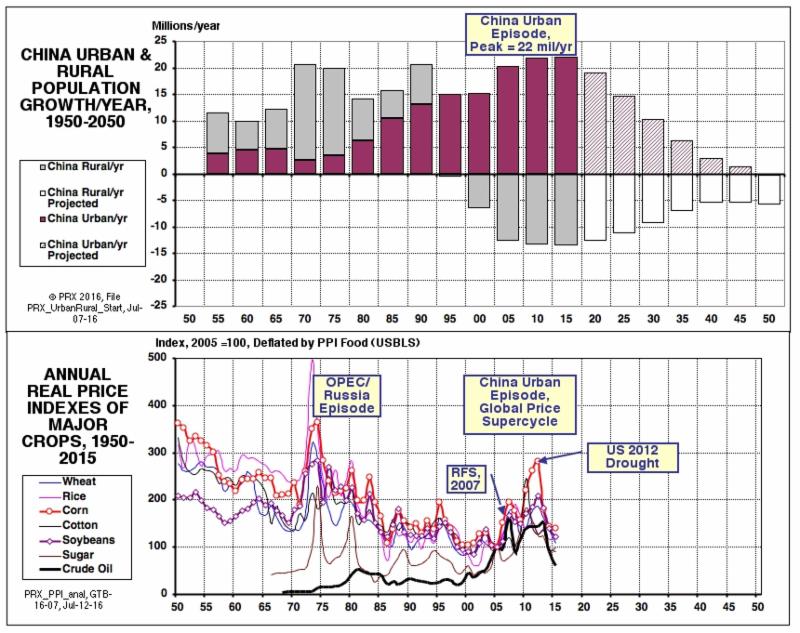
But one thing I can say is this, as demonstrated by the top chart below: Growing cities at the peak rate of 15-20 million people per year for a decade or more is impressive. In fact, it's almost beyond comprehension--a special EPISODE in world grain trade!
The correlation shown in the bottom chart is unmistakable: Beginning in 2002 or 2003, China's demand for raw materials commanded the price of all global commodities. As China's share of world crude oil trade, for instance, headed up toward 10 percent, the price rose to $100 per barrel--and stayed there for several years. These very high oil and gasoline prices made processing corn ethanol profitable, and a dry mill boom commenced by 2004, well before the 2005 Energy Act and way before the 15 billion gallon RFS "mandate" in the 2007 Energy Act, codified by EPA in 2009.
Our PRX Report in December 2014, "Corn-Soybean Wealth Build of 2007-2013," took the view that the $200 billion income boom for US farmers had its initial cause in the Rise of China, of which the ethanol boom was a (grateful) consequence. This chicken and egg question plagues us yet today, however, especially among cornbelt farmers--who often see the corn RFS as the primary driver. I constantly harangue that they are corn AND soybean farmers, that China's soybean imports of beyond 80 mmt/year are the equivalent of more than 8 billion bushels of corn, in acreage terms, and that the continuation of this oilseed import demand is crucial, if not even moreso than the RFS itself.
I also asked the question in PRX Note on China (#1) whether Professor Zhang "knows and appreciates that China is now 75% dependent on foreign imports of soybeans and palm oil for its basic food needs?" How does this extreme dependency on the rest of the world-especially on the Americas and the Black Sea--play into China's aggressive stance in the South China Sea, and China's mercurial policy behavior in stopping (and re-re-starting) GMO grain and oilseed imports?
The question I plan to raise at the PRX August Seminar is this: How can what the world's most massive "Civilization State," as Zhang calls China, get away with bullying its key food suppliers instead of fairly cooperating with them?
Early bird registration is here. View the agenda here.
More dimensions of this issue to come next week in this series on one-page notes!
[1] The China Wave: Rise of a Civilizational State, by Weiwei Zhang, 2012. Available in Kindle.