Double Trouble. As I listen to the risk management debate on new crop corn and soybeans, facing "heat dome" next week, the core issue seems to be--especially for beans--not only how long the heat dome will persist, but (perhaps equally!) how reliable is the forecast for soybean export shipments to China in the rest of 15-16 and for China demand in 16-17? (And what might happen to both bean price and demand in the event of extended hot-dry conditions inot August?)
We know that the Jul-12 USDA WASDE shows China's soybean exports at 83 mmt for 2015-16, but the US share of these tons seems to be falling behind. We know that USDA sees the total demand increasing by 4 mmt (!) to 87 mmt in 2016-17. But we also heard in a telephone briefing to the PRX Roundtable two months ago by USDA Senior Economist Fred Gale that the 4 mmt increase in 2016-17 by the WAOB was a "best guess!"
So I have spent the summer working on how to forecast China's soybean (and feedgrain) demand, long-term, for the purpose of our PRX ten-year Blue Sky Model.
Start Here with a Useful and Readable Book on Subject: The China Wave: Rise of a Civilizational State, by Weiwei Zhang[1], 2012 (World Scientific Publishing). The Kindle edition is $12.99, what do you have to lose? At least read the full Introduction and "examine" the rest. (There's a newer 2016 book in Zhang's trilogy on the new China Model, but save this for later--it will help when we get around to China's provocative actions in the South China Sea.)
I'm going to quote directly a few paragraphs of the Introduction of The China Wave:
"China, or the rise of China, remains controversial in the West for all kinds of reasons. Indeed, over the past 30 or so years, the Chinese state has often been portrayed in the Western media as a dichotomy of a repressive regime clinging to power and a society led by pro-democracy dissidents bordering on rebellion; and some Europeans, for instance, in Oslo, still view China as an enlarged East Germany or Belarus awaiting a color revolution.
This perception has led many China-watchers in the West to confidently crystal-ball a pessimistic future for China: the regime would collapse after the Tiananmen event in 1989; China would follow in the footsteps of the Soviet Union in its disintegration; chaos would engulf China after Deng Xiaoping's death; the prosperity of Hong Kong would fade with its return to China; the explosion of SARS would be China's Chernobyl; China would fall apart after its WTO entry; and chaos would ensue following the 2008 global financial tsunami. Yet all these forecasts turned out to be wrong: it is not China that has collapsed, but all the forecasts about China's collapse that have "collapsed".
This unimpressive track record of crystal-balling China's future reminds us of the need to look at this huge and complex country in a more objective way, and perhaps with an approach adopted by the great German philosopher G. W. Leibniz (1646-1716) to focus on how the Chinese developed what he called a "natural religion" or the secular application of ethics and political philosophy to social, economic and political governance.
If we are freed from ideological hangups, we may come to see that what has happened over the past three decades in China is arguably the greatest economic and social revolution in human history: over 400 million people have been lifted out of poverty, with all the implications of this success for China and the rest of the world.
[A new]China model has taken shape in the midst of global turbulence and competition. It is therefore resilient and competitive and unlikely to fall apart easily. With further improvements, the model's future is promising. From a long-term historical perspective, China's rise, at least to this author, is not that of an ordinary country, but the rise of a civilizational state.
Again, this rise is unprecedented in human history. China is now the only country in the world which has amalgamated the world's longest continuous civilization with a huge modern state.
A civilizational state has exceedingly strong historical and cultural traditions. It does not easily imitate or follow other models, be they Western or otherwise. It has its own intrinsic logic of evolution and development. It is bound to encounter all kinds of challenges in the future, but its rise is seemingly unstoppable and irreversible.
The civilizational state has a strong capability to draw on the strengths of other nations while maintaining its own identity. As an endogenous civilization capable of generating its own standards and values, it makes unique contributions to the world civilizations. A civilizational state can exist and evolve independently of the endorsement or acknowledgment from others.
The world is thus witnessing a wave of change from a vertical world order, in which the est is above the rest in both wealth and ideas, to a more horizontal order, in which the rest, notably China, will be on a par with the West in both wealth and ideas. This is an unprecedented shift of economic and political gravity in human history, which will change the world forever."
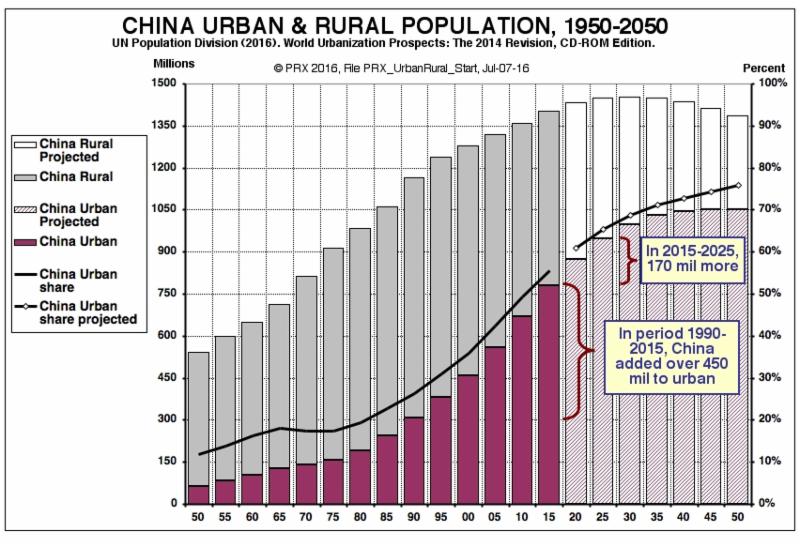
Okay, the whole idea of Zhang's is a big one, but one I think we should take seriously. Check the UN demographic chart below. It's not the overall population growth that matters--to our narrow concern with soybean and feedgrain imports--it's the dramatic growth in URBAN population, the people that eat meat requiring soymeal and cooked in vegetable oil in woks! Question: Does Zhang know and appreciate that China is now 75% import dependent on foreign imports of soybeans and palm oil for its basic food needs?
I have a big stack of slides to go through at our seminar August 18, and I'll preview some of these in the next week or so of emails.
Early bird registration is here. View the agenda here.