|
"Assurances" From The EPA Are Not Enough
Federal delegation must act to rein in potentially devastating federal action
Since the early days of the Obama Administration, there has been a constant cloud hanging over the energy industry. For the first six months of 2009, the biggest threat was Cap and Trade - in July of 2009, the U.S. House passed that horrible legislation.
The U.S. Senate never took up the bill because the Democratic leadership decided to ram through the ObamaCare healthcare bill instead.
Since that time, North Dakota officials have been dealing with a constant drumbeat of threats by the EPA to regulate pretty much everything that makes North Dakota's economy move.
Back in February of 2011, Governor Jack Dalrymple issued a joint news release about the various ways the EPA was looking at regulating air quality - up to and including basic "dust."
Governor Jack Dalrymple told Environmental Protection Agency officials today that their proposal to further restrict regional haze is overreaching and would have devastating consequences in rural America, where normally occurring dust is a fact of life in agriculture production.
Dalrymple, U.S. Sen. John Hoeven, U.S. Sen. Kent Conrad and a representative for U.S. Rep. Rick Berg met jointly with EPA Deputy Administrator Bob Perciasepe and Janet McCabe, Deputy Assistant Administrator of the EPA's air quality division, to share North Dakota's concerns about EPA proposals to further regulate industry emissions and dust.
"The EPA seems determined to force a blanket emissions policy that will unnecessarily impede new development and cost us jobs," Dalrymple said.
Over the summer and fall, the "regional haze" threat from the EPA kept North Dakota
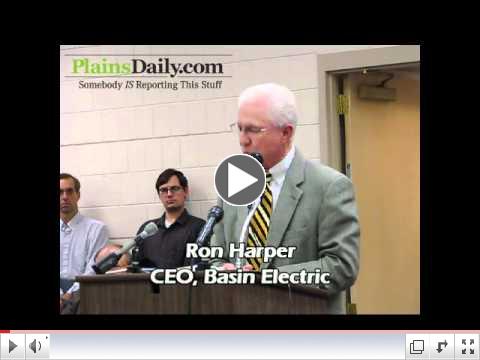 | | Governor Jack Dalrymple, Attorney General Wayne Stenehjem, Public Service Commissioner Kevin Cramer, Former Governor and U.S. Secretary of Agriculture Ed Schafer, Basin Electric CEO Ron Harper, and Mac McLennan of Minnkota testify at EPA hearing |
political and energy industry leaders busy. (See video here.)
Congressman Rick Berg has even had to introduce a bill in Congress to address the issue of regional haze because it has become clear that without Congress taking action to control the EPA, they are going to run wild.
Yesterday, we told you about the story over the weekend that cited Lynn Helms as "predicting" the EPA could shut down the practice of "fracking" as soon as January. About the same time as our email went out citing the original news story, Lynn Helms sent out a press release stating quote: "I made no such prediction and have no reasonable basis to make one."
While Lynn Helms backed down from the prediction that "fracking" would be shut down in January, he did not explicitly back down from the rest of the story. We know this because the Tribune story was not the first time he sounded the warning on-the-record with the media.
On November 11th, the Minot Daily News reported:
The U.S. Environmental Protection Agency is developing Underground Injection Control Class II permitting guidance for hydraulic fracturing activities that use diesel fuels in fracturing fluids.
"In our opinion, this is an underhanded attempt to pick the lock on the back door and get regulatory oversight over fracturing. As I have said earlier, this could easily stop 95 percent of North Dakota drilling for 18 to 24 months and slow it to ha
lf or less of current levels after that," said Lynn Helms, Bismarck, director of the N.D. Department of Mineral Resources.
The EPA is studying any potential impact of fracking on groundwater and drinking water and Helms has said also would impact drilling in the state. That study was announced earlier this year.
Furthermore, the fact that Governor Jack Dalrymple included a $1 million appropriation "just in case" North Dakota has to sue the EPA over this very issue means that it is not just a case of fear-mongering, but that actual policy preparations must be made to deal with the EPA.
From KFYR-TV on November 7th:
It`s no secret that North Dakota`s booming oil production has brought in thousands of jobs to the state. But those same workers could soon be leaving. The Environmental Protection Agency is looking into regulating the state`s hydraulic fracturing. If they do, the state`s rising oil production would start to spiral downward.
Gov. Jack Dalrymple introduced a disaster bill during the first day of the special session. Buried in the bill is a section that would allocate a mi
llion dollars for the state to sue the EPA if it decides to regulate the state`s hydraulic fracturing. Half of it would come from taxpayers and the other half would come from the Bank of North Dakota.
This appropriation was approved by the legislature. Clearly, there was enough evidence for Governor Dalrymple and the legislature to think the EPA is a threat to oil production in North Dakota if they are looking to back a lawsuit to stop it from happening.
The  North Dakota Republican Party even featured Lynn Helms as a speaker at its last lunch meeting in Bismarck. (I happened to be in attendance, Helms went over these threats in a very straight forward way.) North Dakota Republican Party even featured Lynn Helms as a speaker at its last lunch meeting in Bismarck. (I happened to be in attendance, Helms went over these threats in a very straight forward way.)
Late last night, a new shoe in this story dropped.
Senator John Hoeven today said the Environmental Protection Agency has clarified that it is not planning a moratorium on hydraulic fracturing, or fracking, in North Dakota. The agency will, however, provide guidelines that state regulators can use to draft rules governing the use of diesel fuel in fracking under the Safe Drin  | | Hoeven Says EPA Won't Ban Fracking |
king Water Act.
In a conference call arranged by Senator Hoeven, EPA officials Cynthia Dougherty, Director of the Office of Ground Water and Drinking Water, and Ann Codrington, Director of the Drinking Water Protection Division, said the agency will provide a process for the state of North Dakota to provide input on the diesel fracking guidelines before they're finalized. The state will continue as the primary regulator, they said. Hoeven stressed the need to make the rules realistic and workable, and to ensure that there is a process for their implementation so there is no gap in the state's ability to oversee hydraulic fracturing. Another Bismarck Tribune article late last night reported on what the EPA is now claiming: The Environmental Protection Agency said fears a moratorium will be placed on hydraulic fracturing are unfounded. The agency is in the process of conducting a congressionally-ordered study of hydraulic fracturing, also known as "fracking." Hydraulic fracturing is used to retrieve natural gas and oil and is widely used in North Dakota's oil fields. Pressurized fluids, which can include small amounts of diesel, are forced into fractures to extract the wanted substances.
From the study, the EPA plans to issue guidelines for states such as North Dakota to issue permits for use of hydraulic fracturing involving diesel. The EPA has authority under the federal Safe Drinking Water Act to make sure hydraulic fracturing operations do not pollute drinking waters when diesel fuels are used in the processes, the agency said.
"The guidance document is not intended to be a regulatory document and would not itself require any state to change its regulations," Jim Martin, administrator of the EPA Office of Water, said in a statement to the Tribune. "In fact, it is based on existing best practices in use by the industry today."
The EPA says there is nothing to worry about. They say "the guidance document is not intended to be a regulatory document and would not itself require any state to change its regulations."
The guidance document may not be a regulatory document itself, but this certainly does not rule out the potential for the guidance document leading to an eventual regulatory document at some point down the line.
According to Senator Hoeven, there is no need to worry about this issue that the EPA says everything will be OK.
One has to wonder if that applies to Congressman Rick Berg's legislation regarding
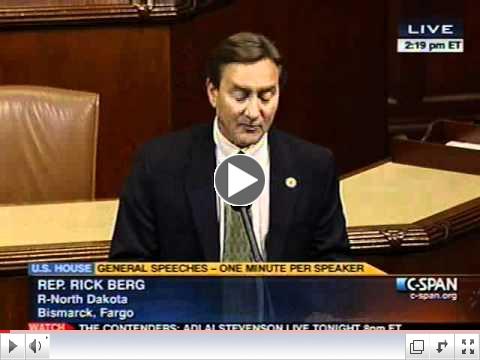 | | Berg Introduces Regional Haze Bill To Rein In The EPA |
"regional haze" as well?
After all, Senator Conrad says the EPA doesn't plan to do anything on that issue either.
At the end of the day:
- Governor Dalrymple and the legislature are right to worry about the EPA, and set-aside the $1 million just in case the state has to sue the EPA.
- State leaders have been right over the last two years to oppose the over-reach of the EPA.
- Congressman Berg is right to propose legislation to rein in the EPA on regional haze, and should immediately propose the same legislation to rein in the EPA on the fracking issue.
- North Dakota's policymakers should plan for the worst when it comes to federal regulations.
- Lastly, Lynn Helms was right to sound the alarm on all of this, if for no other reason than people now understand just how big of an issue this is to North Dakota.
Until Congress proactively eliminates this threat, the threat will remain regardless of what some EPA bureaucrats, Senator Hoeven, or Senator Conrad say.
| 



