|
Congrats to the 43% who answered correctly. And 57% improved their writing skill.
Correct answer: Water comprises hydrogen and oxygen.
|
|
|
|
|
THE BUSINESS CORNER
Boom, Gloom and the New Normal - Part 6
(Access Archives for Part 1, Part 2, Part 3, Part 4, Part 5)
By Paul Hodges, International eChem

Rising risks over future growth in China and India
Most chemical companies now believe it is inevitable that China and India will reach developed economy status. Many even hope that their strong growth could mean "the end of economic cycles".
But as we discuss in chapter 6 of 'Boom, Gloom and the New Normal', the new International eChem/ICIS eBook, there are three major risks to this rosy scenario:
China's demographic timebomb. Its one-child policy was introduced in 1978, to counter fears of over-population and famine. By China's own accounting, about 400m births were prevented between 1979 and 2010.
This has reduced today's 25-to-35-year-old age group by 75%. As demographer Kenneth Gronbach notes, "the 30-somethings will have to do the majority of China's production, consumption and taxpaying, and when you have a 75% reduction in the group that is chiefly responsible for those activities, you've got a real problem".
Lower incomes. China and India's "middle class" have incomes that are only a tenth of those in developed markets, as we discussed in Chapter 4. This has major implications for the nature of consumption in China and India - and for the type of products that companies will need to make to prosper.
The transition is not guaranteed. It takes 50 consecutive years of 7% annual growth for a country to boost per capita income from $500 to $20,000, says Nobel Prize-winning economist Michael Spence. China's per capita GDP was only $4382 at end-2010, and India's $1371, according to the International Monetary Fund. So both countries still have a long way to go.
Recent growth in China and India has also come at a price: Poor air quality, chronic water shortages and deforestation. Equally, China needs to rebalance its economy away from its over-reliance on exports.
India must improve its atrocious infrastructure, and reform the harmful government subsidies that are holding back the agricultural sector. It is also often forgotten that India is home to a third of the world's poor people, with 37% of its population (410 million) classified as poor by the World Bank. Its overall literacy rate is only 61% - and just 48% for women.
The new chapter therefore argues that China and India will require quite different products and services from those sold in the West. It also warns that their growth should not be taken for granted. Companies need to develop robust scenarios to manage the uncertainty this will create.
Go to www.icis.com/NewNormalEbook to download Chapter 6.
Chemicals and the Economy blogger. Register & chat with Paul on ACS Webinars Dec. 15, 2011 on Chemistry and the Economy 2011 Year-End Review and 2012 Outlook.
Email us chemical business topics you would like us to cover in future issues.
Back to Top Page
|
|
CONSULTING TIP OF THE MONTH
Keeping Financial Records
William Golton, Ph.D., Chemical Consultants Network
It should go without saying that as small businessmen and women, independent consultants need to keep good financial records. Items to record include:
* Billable time by client, with details for your invoices
* Billable expenses by client, with details for your invoices
*Tax deductible expenses sortable by tax category
* Invoices sent to clients
* Accounts Receivable
* Client payments, including deposits or retainers
The question is, how best to do this. In a discussion in the Chemical Consultants Network (CCN) LinkedIn group, some of the options mentioned were:
* Pen and paper for bookkeeping
* Spreadsheets for bookkeeping
* Template for invoices
* Specialized software for bookkeeping and invoices
* Hire a bookkeeper
* Combinations of the above
Pen and paper may be adequate if you don't do much consulting. Just keep the records in a bound journal and use ink, just as you should for lab records. Although remote, an IRS audit is a possibility.
For a busy practice, several spreadsheets may be needed in order to track all of your activities, expenses and income, as mentioned above. And they need to be sortable by date, client and (for expenses) by tax category.
There is a lot of commercially available software, and even some freeware for small business accounting. However, based on the LinkedIn discussion and a round table discussion on the subject at a recent CCN program (view the slides), Intuit's QuickBooks appears to be the most popular application among chemical consultants who use accounting software. The same set of slides lists links to accounting software and reviews. Also there is a slide that shows examples of various tax-deductible expenses.
Although there is a significant learning curve with some software, once mastered, it enables consultants to handle all of the accounting chores in one place. For example, some accounting software can send e-mail invoices directly to clients.
Because the software can be complicated, some consultants choose to hire a bookkeeper to handle it. If you need the time for clients, the bookkeeper's hourly rate is probably much less than yours. But you still need to give accurate records to the bookkeeper, or you know the old saying: garbage in, garbage out!
Thanks to Dr John Newport and Dr. Ron Bihovsky for contributing to the round table discussion and their slides. Next month's Tip will discuss a critical credential, the PE license for chemical engineers.
 A frequent contributor to The Distillate, Dr. Golton has written and lectured extensively on the subject of consulting. He recently retired as Vice President of The CECON Group, Inc. Prior to becoming a consultant, he held various positions at DuPont. A frequent contributor to The Distillate, Dr. Golton has written and lectured extensively on the subject of consulting. He recently retired as Vice President of The CECON Group, Inc. Prior to becoming a consultant, he held various positions at DuPont.
This monthly tip is brought to you in collaboration with the Chemical Consultants Network. Have a comment? Go to Chemical Consultants Network LinkedIn page.
Back to Top Page
|
|
THE WRITING CLINIC - The Doctor is IN
Experiment with Punctuation
By Kristin Sainani, PhD., Stanford University.

(Take this QUIZ to test your writing knowledge).
Professional writers use colons, dashes, parentheses, and semicolons to help vary sentence structure, add emphasis, or improve flow (some of my favorite examples appear below). But these versatile punctuation marks are underappreciated and underused in scientific writing. Try them in your next piece:
- Use the colon to introduce a list, quote, explanation, or amplification.
Examples:
"The hydrogen bonds are made as follows: purine position 1 to pyrimidine position 1; purine position 6 to pyrimidine position 6."
"The woman suffers from lack of experience and a chronic Democratic disease: compound sentences."
- Use the dash to add emphasis or to insert a definition or description almost anywhere in the sentence. Just don't overuse it, or it loses its impact.
Examples:
"The drugs triggered overweight mice to shed significant amounts of fat--up to half their body weight."
"Baseball is the only game that's played every day, which is why its season often seems endless, right up to the inning and the out--the little toss over to first base--when, wow, it ends." (Red Sox fans will appreciate that image!)
- Use parentheses to insert non-essential, but compelling, details. See my example above.
- Use a semicolon to link the ideas in two related sentences.
Examples:
"It was the best of times; it was the worst of times."
"Kennedy knew something about the world; he also cared about it."
For more details on usage, see Strunk and White's classic, The Elements of Style. Examples from: Watson & Crick, Joe Klein, Roger Angell, Dickens, Louis Menand.
 Kristin Sainani is a clinical assistant professor at Stanford, where she teaches statistics and manuscript writing. She is also a freelance health and science writer. Kristin Sainani is a clinical assistant professor at Stanford, where she teaches statistics and manuscript writing. She is also a freelance health and science writer.
Want more tips? View Kristin's recorded presentation and register for Kristin's upcoming ACS Webinars presentation.
Have writing questions for Kristin? Email us your questions or tips you would like Kristin to cover in future issues.
Back to Top Page
|
|
FROM THE LAB CORNER
A Good Lab - A Good Company
By Chemjobber

What should you be looking for in your next position? Well (unless you're a charity), pay has its benefits. Certainly geography plays its role, and the science that you'll do is going to be pretty important. I don't doubt that you'll also be looking for "a good fit." What that fit might be, of course, is up to the individual.
I recently learned a Yiddish word that sums up the feel of many a good lab and many a good company: haimish. According to contemporary definitions, it connotates warmth and friendliness. Haimish labs may not have the finest equipment or the poshest surroundings, but they're probably more conducive to problem solving sessions where humor and incisive debate can go hand-in-hand. They're a place where people can sit and talk for a while about the scientific problems they're having and learn from each other. While it may not be a 100% efficient environment, chances are that plenty of productive science is being done. (Signs of a haimish lab are not necessarily universal, but typically can include home-baked goods and lots of laughter.)
Here's hoping that you're in a haimish work environment, or if not, that you find one. Good luck and good hunting.
 Chemjobber is a working chemist in industry and a blogger on employment in chemistry. Chemjobber is a working chemist in industry and a blogger on employment in chemistry.
Have lab/career questions? Email us your questions that you would like The Distillate to cover in future issues.
Back to Top Page
|
ACS Webinars™ CLICK * WATCH * LEARN * DISCUSSLearn more and register at www.acswebinars.org - Business and Innovation
- Dec. 15, 2011 - Chemistry and the Economy 2011 Year-End Review and 2012 Outlook.
ACS Webinars™ connects you with subject matter experts and global thought leaders in chemical sciences, management, and business on relevant professional issues. More information and registration... Have ideas? Email us your suggestions for future ACS Webinars ™ topics. Please include 'Webinar Topic Suggestion' in the subject line. Back to Top Page
|
Upcoming conferences that may be of interest to you:
Back to Top Page |
Can't attend the live ACS Webinars? To access recordings of past ACS Webinars, please visit our On-Demand content library or YouTube. Want your events included in The Distillate and/or ACS Webinars webpage? Please email us your event info with the subject title EVENTS. Back to Top Page
|
|
Learn Chemistry - By Torturing a Gummy Bear?
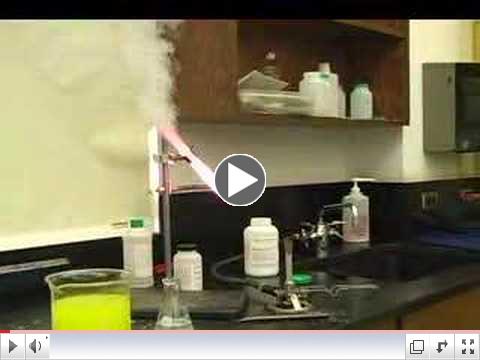 | | Potassium Chlorate and Gummy Bear |
Ever wonder what happens when a gummy bear (sugar) is added into molten potassium chlorate? Well, we get one tortured bear and a cool lesson in redox reaction.
Have chemistry vids or images we should feature? Write to us at distillate@acs.org.
Back to Top Page
|
 Win an ACS 'Proud to be a Chemist' lapel pin. Win an ACS 'Proud to be a Chemist' lapel pin.
"If your experiment needs statistics, then you ought to have done a better experiment" by ???
Send us your correct answer to win the lapel pin. Three winners will be selected for this popular pin. This month's quote was submitted by Yolanda Sanchez from Guadalajara, México.
Email us (distillate@acs.org) your answer by November 15, 2011 to be entered into the drawing. Please use QUOTE for the subject line. The answer to the quote and the winners will be posted in next month's edition.
Congratulations to Joe Iannone of Delaware, Natasha Sihota of Canada, and Robyn Sevier of Georgia. Winners were randomly selected from all the correct entries received (Answer: Who is Neils Bohr). Thank you to all who entered the contest.
Have a favorite quote? Please email us (distillate@acs.org) and if we use your submission, we will send you a prize.
Back to Top Page
|
Reach >100,000 scientific professionals. If you would like to submit an article, news item, or upcoming event for next month's newsletter, email us by 5:00 pm Eastern Time on the third Friday of the month to distillate@acs.org. Inclusion is subject to space and editorial discretion.
|
|
|
|
|


 A
A