|
APRIL GAZETTE | Our 94th year!
April, 2016 - Vol 63, Issue 7
|
|
|
| Board of Governors |
President
President-Elect
Honeywell Building Solutions
Vice President
Treasurer
Antonio Figueiredo
Secretary
Past President
Dynergy
|
|
|
|
President's Message
| |
Hello and welcome to the April issue of the Gazette!
ASHRAE is a grassroots organization run by volunteer members for the benefit of the membership and society in general. Participation in your local Chapter offers continuing personal and professional growth opportunity and enjoyable interaction with your peers and colleagues outside of your everyday work environment.
ASHRAE Toronto Chapter provides an excellent way to maintain your existing relationships, build new connections and keep current on local issues, events and developments. Face to face contact has never been more important than in this day and age of texting and social media.
I encourage you to keep up personal connections with others in your industry through active participation in ASHRAE Toronto Chapter activities and events.
Alan J. Porter, P. Eng
President - ASHRAE Toronto Chapter
|
CTTC Schedule
|
ASHRAE Toronto Meetings 2015/2016: Please click here to see ASHRAE Toronto's 2015/2016 Program Schedule. Please note that the schedule can change. Members will be prompted via email to register for upcoming events at TorontoASHRAE.com.
|
ASHRAE Webcast Registration
|
Free registration is open for the 2016 ASHRAE Webcast: "Making Net Zero Net Positive: Solving the Efficiency & Cost Paradox." Visit www.ashrae.org/webcast.
Webcast is 1pm - 4pm EDT on April 21st 2016 & offered by ASHRAE's CTTC Committee.
Webcast presenters are:
- 2015-16 ASHRAE President David Underwood, P.Eng., CPMP, Oakville, Ontario, Canada
- Marc Brune, P.E., senior associate and mechanical engineer, PAE, Portland, Ore.
- Philip Macey, AIA, national director of collaborative delivery, JE Dunn Construction, Denver, Colo.
- Paul Torcellini, Ph.D., P.E., principal engineer for commercial building research, National Renewable Energy Laboratory, Golden, Colo.
The Webcast has been approved for three HSW Learning Units (LU/HSW) by the American Institute of Architects (AIA) and three Continuing Education Hours (CEs) by GBCI. The state of New York also recognizes AIA course approval.
Not able to view the live webcast? Register to take advantage of the free online on demand webcast, which allows viewers unlimited access to the webcast online until May 6, 2016.
|
|
|
|
Notice of Meeting
|
April 2016 Joint Dinner Meeting
Monday April 11th, 2016
Registration & Reception: 5:00 PM- 6:00 PM
Dinner Meeting: 6:00 PM- 8:30 PM
Holiday Inn Oakville
590 Argus Rd
Oakville, ON
L6J 3J3
ASHRAE Hamilton Chapter and Toronto Chapter present the following dinner meeting presentation:
HVAC Renovation in Existing Buildings
Renovation of existing buildings, especially the HVAC systems can have a significant impact on their operational cost and competitiveness. It can also lead to a new concept of designing HVAC systems, which presents great opportunity for energy savings, and leading to a sustainable future. The procedure normally initiated by computer simulation, followed with optimal operation strategies development and full-scale experimental validation.
The presentation highlights the findings obtained and lessons learned from the 200 HVAC systems renovation projects led by Dr. Yang. The procedure includes computer simulation using eQuest in establishing optimal operation strategies for systems with multiple chillers, the VWV and the VAV systems. Also, it will be demonstrated how thermal energy storage air-conditioning systems can be retro-fitted, without replacing its existing chillers, while reviving its cooling capacity simultaneously. Also, procedures in upgrading system performances by implementing the Testing, Adjusting, Balancing and Commissioning (TAB/Cx) procedures recommended by the ASHRAE, with a slight modification and simplification, will be demonstrated.
ASHRAE Distinguisghed Lecturer
Jerry K.H. Yang, PhD
Professor, Sun Yat-Sen University
Kuan Hsiung Yang is a professor of Sun Yat-Sen University and a technical consultant of China Engineering Consultants, Incorporated, and Chunghwa Telecom, on Building Energy Conservation and HVAC System Designs. He received his degree in Mechanical Engineering from Lamar University in 1985. He is a member of Technical Committee of Building Science, HVAC systems and Fire-protection Engineering for the Ministry of the Interior, Taiwan. In the field of HVAC and fire protection, he served as a professor in Mechanical Engineering, both on undergraduate and graduate levels at the National Sun Yat-Sen University in Taiwan for 25 years, and a visiting professor at the Sun Yat-Sen University at Guangzhou, China, serving as Master and Doctoral students thesis advisor concentrating on HVAC and fire protection system designs, simulation and full-scale experimental investigation. Dr. Yang is a Fellow in the American Society of Heating, Refrigerating and Air-Conditioning Engineers (ASHRAE). He is a recipient of Outstanding Contribution on Building Energy Research Awards, Ministry of the Interior, Taiwan, in 1991, Best Research Award on Building Thermal Energy Storage HVAC Systems, Taiwan Power Company in 1992, Top 10 Engineering Professors Award in Taiwan in 1993, Best Research Award on Centrifugal Chillers under Cycling Operation Modes, National Electrical Power Association in 1994. Ozone Protection and Chiller CFC Refrigerant Conversion Technology Award in 1995, Tunnel Ventilation Award, China Road Congress in 1996, IBC Award on HVAC Engineering Research in 1997, Inclusion in Mcquis Who's Who in the World 2000, Teaching Excellence Awards in NSYSU, College of Engineering, in 2006 and 2008. Outstanding Contribution Award in HVAC Engineering in Taiwan, 2010. He is also the leader in the National program on HVAC System Retrofits (2003-2007 Green HVAC) and the Building Energy Efficiency Upgrade (2007-2011 BeeUp), completing 200 buildings energy systems retrofitting and commissioning with a total budget of 30 million USD and realizing energy savings of 22.5% each year. He is also the author of two (2) books, and published over 200 technical papers in the U.S. and other parts of the world addressing topics on HVAC systems, tunnel ventilation, smoke management and egress analysis, using 3D CFD as a tool followed by full-scale experiments.
Need Assistance? Feel free to contact the following members for further details:
Brendan McDermott ASHRAE Toronto Chapter Technology Transfer Committee Chair
Frank Mesicek
ASHRAE Hamilton Chapter Technology Transfer Committee Chair
|
Gazette Sponsors
|
ASHRAE Toronto Chapter thanks the following
companies for their support of the Gazette
|
|
March Commissioning Seminar Summary
|
March Commissioning Seminar Summary
The 2016 Commissioning Services Seminar took place on Monday, March 7th, 2016 at Parkview Manor in Toronto's east end. The event was a combined effort between three organizations, the Toronto Chapter of the American Society of Heating, Refrigerating and Air-Conditioning Engineers (ASHRAE), the Building Commissioning Association (BCxA) and the Building Owners and Managers Association (BOMA). The topic of the seminar was "Making the Connection Between Energy and Greenhouse Gasses".
The first presenter, Craig Golding is a member of the Ontario Ministry of the Environment and Climate Change. His presentation revolved around the future of codes, standards and emission reporting requirements, which would be enacted by the provincial government. He discussed, the new cap and trade bill called the Climate Change Mitigation and Low-Carbon Economy Act (Bill 172), which was introduced on February 24th. This new bill would lower the reporting threshold, introduce reporting only emissions (emissions that have to be quantified and reported, but not verified) only for certain activities), introduce new verification opinion options and add new sources that are required to report. Paul Leitch from the University of Toronto was the second presenter. His presentation, entitled "Justifying Emissions with Energy Efficient CHP Plants", compared the efficiencies and emissions produced by a conventional plant to a combined heat and power (CHP) plant. In his review, he concluded that the combined heat and power (CHP) plant would provide greater efficiency, but also create more greenhouse gas emissions than a conventional plant. Christopher Piche from the Integral Group was the third presenter and his presentation was entitled "Benchmarking and Optimization Opportunities through Existing Building Commissioning". His presentation provided insight into the overview of techniques applied during the existing building commissioning process, which support building reporting and benchmarking. Fiona Oliver-Glasford and Mark Cammisuli from the Enbridge Gas Distribution were the fourth and fifth presenters. Fiona discussed the free allowances, early reduction credits, which will be available from the Ontario provincial government. Mark's presentation described the current funds and incentives programs available from Enbridge for new construction, retrofits and operational. Philippe Bernier from Triovest Realty Advisors Inc. was the sixth presenter. Philippe's presentation was entitled "A Manager and Owner's Approach to Reducing Portfolio Greenhouse Gas Emissions". Philippe discussed the reasons why managers and owners are managing greenhouse gas emissions as well as what owners and managers measure and how they are pursuing portfolio greenhouse gas emissions. Eric Chisholm from WSP was the final presenter. His presentation was entitled "Savings Persistence". Eric described the ongoing commissioning process and recommended that engineers engage more with operations staff to ensure that feedback is received and used to improve the overall building process.
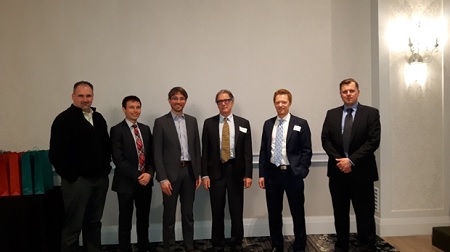
From Left to Right: Christopher Piche, Eric Chisholm, Philippe Bernier, Paul Leitch, Mark Cammisuli and Craig Golding. Absent: Fiona Oliver-Glasford
|
|
March Dinner Meeting Summary
|
March Dinner Meeting Summary
Solar Thermal Cooling
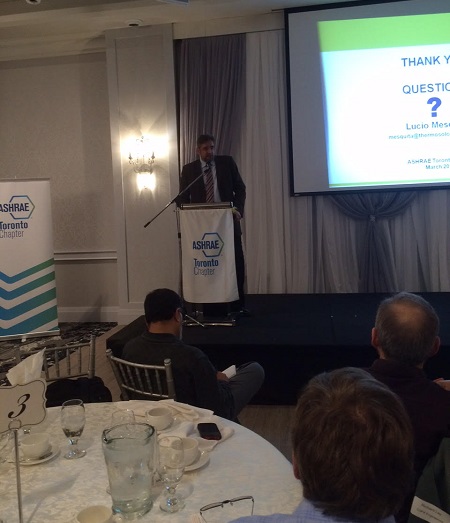
The presentation at this month was delivered by Lucio Mesquita, Ph.D., who currently works for Thermosol Consulting. Dr. Lucio Mesquita has worked for governments, trade associations and private companies on topics such as solar thermal market analysis and policy, technology evaluation and development, and training. As a mechanical engineer, he has worked on the design and commissioning of more than 180 commercial solar thermal projects in several countries. Dr. Mesquita is also an expert in solar cooling, having written his PhD thesis on the topic at Queen's University.
At this month's presentation, Mr. Mesquita delivered a presentation on the topic of Solar Thermal Cooling. Mr. Mesquita's work is especially important when one considers the number of homes which have central air conditioning. Approximately 87% of housing units have AC. That number has increased dramatically in the past four decades from 23% in 1978 to 61% in 2009 of housing units that have central air conditioning. The energy consumed by space heating, cooling and water heating combined, in Canada, is more than that of passenger vehicles and light trucks combined.
Ideally, using solar power to deliver both space heating and cooling would provide the largest benefit to green energy production. However, the amount of solar energy that can be produced in the winter is limited greatly by the reduced amount of sunlight received in Canada during these months. So, using solar power to develop cooling methods is a more viable option.
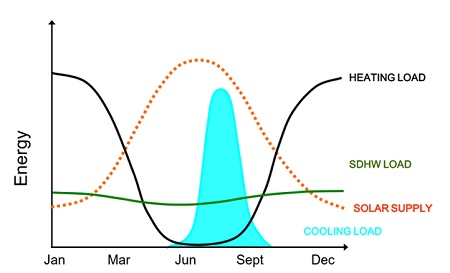
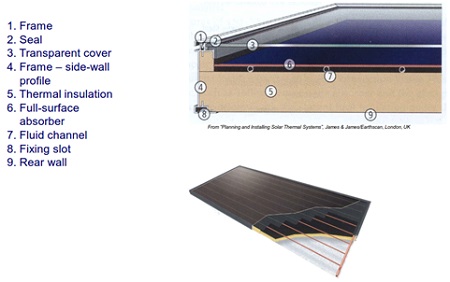
There are several ways that solar power can alleviate a building's reliance on conventional energy production. The first, and most obvious way is through the use of photovoltaic cells to produce electricity and power the cooling process. This process relies on the use of the typical glazed flat-plate collectors we are all familiar with.
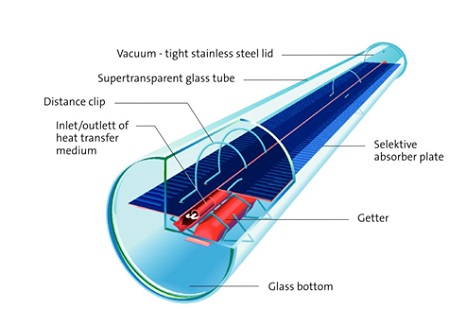
A second type of solar panel which can be used is the evacuated tube solar collectors. These panels consist of several cylindrical tubes that contain a vacuum, allowing for better transfer of heat and an increased energy efficiency ratio. They allow for a higher level of heat transfer, meaning more potential to use the actual heat collected instead of simply transferring it to electricity. However, these panels take up more space than the conventional glazed flat plate collectors since there must be space between each tube. It can sometimes be more efficient to use solar plate collectors based on space constraints.
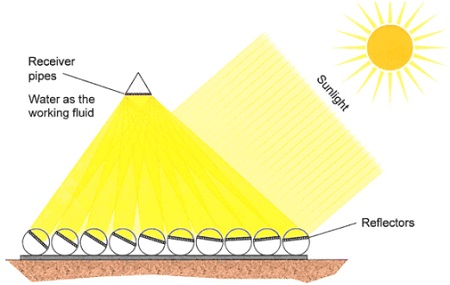
For both panel types, there are ways to make the panels even more efficient in their solar collection capacity. Using transparent insulation can allow for more heat transfer into the cell. Another method is to reflect the light in order to concentrate it and direct it at the cells. One can even set up the system to track with the sun's movement, allowing for maximum exposure throughout the day. Obviously, these methods mean a more expensive apparatus, but pending the situation, these methods may be beneficial in the long-term.
Lucio summarized by saying that the selection of the proper solar collector is situation dependent. Factors such as the end-use temperature and the surrounding ambient temperature can determine how much heat you need to generate from your panels. The climactic conditions can also affect the choice of the panel, depending on the abundance of sunlight and typical cloud cover. Locational issues such as space requirements, complex racking/mounting systems can also limit your choice. Be sure to simulate the typical conditions and review the various options to select the right solar collection system for your project.
But how can the heat from these solar panels be used to cool a building? The idea of using solar heat to provide space cooling seems like a counterintuitive process upon hearing the initial concept, but Lucio explained how it is possible.
Adsorption and absorption chillers require an input heat source to drive the absorption cycle. While this is usually done through the use of natural gas, if the temperature is high enough, the heat collected from solar panels can be used to drive the cycle. The importance of raising the heat temperature becomes paramount in this case. Natural gas can obtain very high temperatures which can be used in coordination with a relatively small absorption chiller. Using the methods described above (using evacuated tube panels, reflecting the sunlight to concentrate the heat and tracking the sun's movement) can make the heat that is generated from these panels a high enough temperature to be used in an absorption or adsorption chiller. However, since to the heating capacity of the solar panels is limited by the amount of sunlight available, a larger cooling tower is typically needed to compensate for the lower temperature difference between the hot and cold water. Of the systems using solar thermal cooling, approximately 92% rely on absorption chillers, while only 8% is done with adsorption chillers.
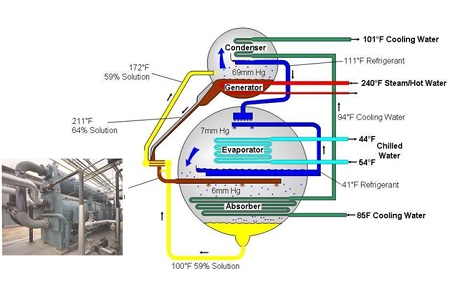
So how do we know when it is a good time to consider installing a solar thermal cooling system? For smaller systems, (i.e., less than 100 tons of cooling) a thermal solar cooling system may not be the best option. In these cases, it may be better to use a typical photovoltaic system and use the energy to power the cooling system. The cost for smaller applications is lower; however, storage of the energy created can be an issue.
Thermal solar cooling systems are more complex and a higher cost to build. But their storage method is usually less complex since you are storing hot water instead of energy. However, the problems of having sufficient heat and sunlight create a limit on this system's capabilities. It is usually best for these systems to be used in combination with natural gas to allow for year-round use. Dr. Mesquita closed his presentation by stating that, as this technology is still developing and becoming more reliable, there are opportunities for further improvement, including creating better collector technology to raise the thermal efficiency of the panels and, as a result, increase the temperature the panels can produce. This can lead to energy cost savings and using smaller cooling towers.
Written by,
Michael Peterson, B.Eng.
Project Associate
WSP Canada Inc.
|
|
March Seminar & Dinner Meeting Pictures
|
March Dinner Meeting Pictures
|
|
CPMX Keynote HRAI/ASHRAE Speaker
|
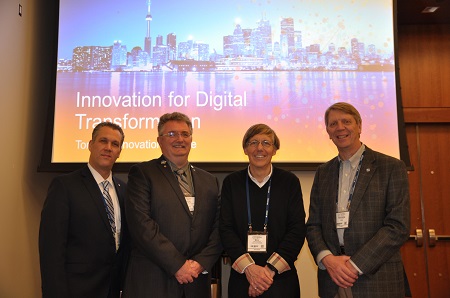
For the CPMX Show March 16th to 18th 2016, HRAI extended a request to ASHRAE for a keynote speaker. David Benedetti (former Toronto Chapter President) reached out to Bill MacGowan of Cisco, Bill graciously accepted to present as a keynote speaker. The presentation was a success and great kick off to the show.
From left to right: David Benedetti (Delta Controls; ASHRAE Region II Executive Treasurer; ASHRAE Toronto Past President); Doug Cochrane (P.Eng., LEED AP; Carrier Enterprise Canada; ASHRAE Region II - DRC; ASHRAE Toronto Past President); William R MacGowan (P. Eng., CEM; Direct Smart Building Digitization, Cisco Systems Canada; ASHRAE Toronto Chapter Member); and Warren Heeley (HRAI President)
|
|
Viewpoint
|
This year, my wife and I were fortunate enough to take a lovely vacation together (sans children!) to Mexico, and as I sit here on the beach, my mind can't help but drift back home and contemplate the differences between the two countries. It is not so much the differences, but the similarities that tell much of the HVAC story.
Even in such a radically different climate from Southern Ontario, I can feel the presence of ASHRAE all around me. As many of you will know, it is prescribed that the optimal indoor humidity levels to minimize bacterial and fungal growths is between 30-50%, and upon pressing the staff for information, I found that the room system will seek to maintain 40%. In keeping with the mandate of using the elements of your natural surroundings to influence your energy use, the vast majority of buildings are equipped with solar PV panels to offset some of the strain on the, often coal reliant, electrical grid in Mexico. Further, following the lead of many contemporaries in Europe, the US and Canada, a full retrofit was completed to install ductless split A/C units throughout the hotel, in all the rooms, to take advantage of better zoning capability and vastly improved fan efficiencies. Again, on pressing the staff for information, this has yielded energy savings of over 30% over the last two years.
As David Underwood stressed in his presidential address, the 'A' and 'E' of ASHRAE are steadily becoming less exclusive. We are not just American, and we are not just Engineers. Manufacturers, vendors, engineers and contractors, from the white snows of Canada to the white sand beaches of Mexico, we are all connected through the power of ASHRAE. So with that in mind, from me to all of you, I would like to say, adiós and hasta luego mes amigos!
Toronto Chapter CTTC Committee Chair 2015-2016
|
|
Young Engineers in ASHRAE
|
ASHRAE is having its next YEA Leadership weekend this Fall - likely at the headquarters in Atlanta. The Toronto Chapter is looking for candidates to sponsor for this event. If you are interested in attending, please reach out to me. More details can be found on the ASHRAE website. www.ashrae.org/YLW.
Toronto Chapter YEA Committee Chair 2015-2016
|
|
Student Activities
|
The career fair was a great success, I would like to thank Ryerson university and the ASHRAE Ryerson branch for hosting such a spectacular event. I would also like to thank everyone involved in planning and making this event a success.
As the year approaches the end, I wish all the students good luck with exams.
Toronto Chapter SA Committee Chair 2015-2016
|
|
Grassroots Government Affairs
|
The Toronto Chapter GGAC has been focused on trying to establish bEQ as an alternative to Energy Star Portfolio Manager (ESPM). Our initial direction since the GGAC was established has been on the City of Toronto. In a recent publication, the Province of Ontario made it clear ESPM is the preferred benchmarking tool. The following reasons form part of Ontario's decision:
- NRCan has been working with the U.S. EPA and DOE since 2013 to "Canadianize" ESPM.
- NRCan translated ESPM into French.
- Metric is available.
- Includes Canadian climate data.
- National in scope.
- 40% of Canadian buildings have already entered data.
- ESPM is the only international standardized energy benchmarking platform endorsed by both the Canadian and U.S. governments. Companies operating in both countries have a standard means of assessing properties.
- ESPM is free.
Currently a public commentary opportunity is open prior to ESPM becoming legislated. Since the approach is now to the Province of Ontario and not the City of Toronto, we have to bring ASHRAE International into the picture. The ASHRAE Toronto Chapter cannot act for ASHRAE nor can it act on behalf of other chapters.
This is where we stand at the present time. There will be more on this in the next edition.
Toronto Chapter GGAC Committee Chair 2015-2016
|
|
PAOE
| |
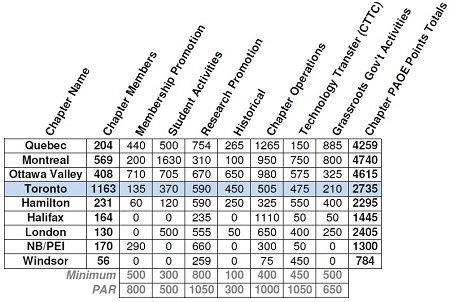
PAOE or Presidents Award Of Excellence, provides the chapters in Region II with a means of measuring success across a wide range of chapter operations. It is meant as a tool to guide the Board of Directors and Committee Chairs towards their goals. Below is a summary of PAOE Points for all of the Chapters in Region II so far this year.
Toronto Chapter President-Elect 2015-2016
|
|
Social Media
|
We have grown our base of followers since we started our incursion in social media. We have been in Twitter and Facebook since 2011 and in 2013 launched our official LinkedIn page.
Do you want to know about what is happening with our chapter? Join the conversation!
|
|
Society News
|
ASHRAE Certificates
ASHRAE offers the following certificates for professionals:
Certificate programs are developed by subject matter experts and benchmark with the ANSI/ISO accreditation standards for personnel certification programs to help ensure quality. Benefits to participants include greater competence in job knowledge, skills and abilities; credential recognized and valued by employers; and competitive edge amongst peers and potential clients.
|
|
|
HVAC Design Essentials Training Halifax 2016
|
 | HVAC Design: Level 1 - Essentials
ASHRAE's HVAC Design: Level I - Essentials training provides intensive, practical training ideal for recent technology or engineering school graduates, engineers new to the HVAC field, those who need a refresher in new technologies, and facility managers, sales representatives and others who need to gain an understanding of HVAC systems.
In three days, gain practical skills and knowledge in designing, installing and maintaining HVAC systems that can be put to immediate use. The training provides real-world examples of HVAC systems, including calculations of heating and cooling loads, ventilation and diffuser selection using the renovated ASHRAE Headquarters building as a living lab. Engineered drawings of the ASHRAE Headquarters renovations will be incorporated to expose attendees to plan reading and a graphical understanding of system design.
~~~~~~~~~~~~~~~~~~~~~
Training Topics:
- Fundamentals
- Heating/Cooling Load Calculation
- System Selections
- HVAC System and Components
- Cooling System
- Basic Design of Hydronic Systems
- Basic Design of Air Systems
- Control/BAS
- Sustainable Design
- Project Management and Other Soft Skills
- Introduction to Technical Sales
| 
|
Your Instructor

Joel Primeau, P.Eng.
Member ASHRAE, HBDP, LEED® AP
|
|
|
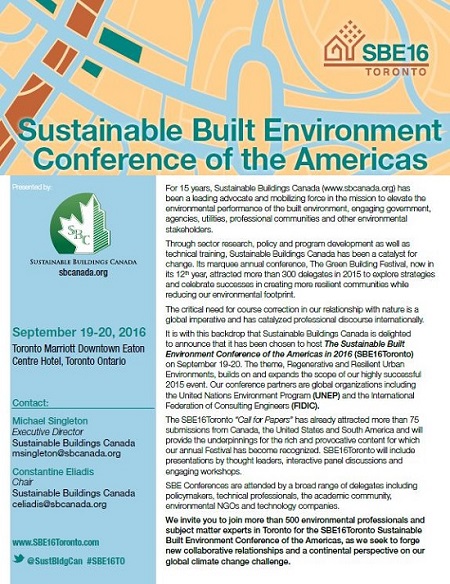
Sustainable Built Environment Conference of the Americas 2016
| |
|
|
|
|
|