|
DECEMBER GAZETTE | Our 94th year!
December, 2015 - Vol 63, Issue 3
|
|
|
| Board of Governors |
President
President-Elect
Honeywell Building Solutions
Vice President
Treasurer
Antonio Figueiredo
Secretary
Past President
Dynergy
|
|
|
|
President's Message
| |
Season's Greetings!
It's that time of year again to reflect on the past and look forward to the upcoming year.
Toronto Chapter organized two successful dinner meetings, a two day Retro Commissioning Seminar (first time in Canada) and the ASHRAE/SMACNA trade-show through the September-November period.
Decemberfest is next on the event agenda for December 7th . Decemberfest is Toronto Chapter's only non-technical dinner get together of the year and as always will be an enjoyable social event.
The program for the new year includes a career fair, five more monthly dinner meetings and a golf tournament in the spring. Refer to the events link on www.torontoashrae.com for details and registration links as the activities are posted.
I look forward to seeing many of you at Decemberfest and sincerely wish you all a happy holiday season and a great new year!
Alan J. Porter, P. Eng
President - ASHRAE Toronto Chapter
|
CTTC Schedule
|
ASHRAE Toronto Meetings 2015/2016: Please click here to see ASHRAE Toronto's 2015/2016 Program Schedule. Please note that the schedule can change. Members will be prompted via email to register for upcoming events at TorontoASHRAE.com.
|
|
|
|
Notice of Meeting
|
Please join us for a celebration of the season!
Bring your significant other as we raise a glass to the coming New Year. Put all your winter worries on hold and spend some quality time at the Second City!
Monday December 7th, 2015
Cocktails / Dinner: 5:30 PM - 7:30 PM
Wayne Gretzky's Restaurant 99 Blue Jays Way - Toronto, Ontario. M5V 9G9
Theatre: 7:30 PM- 9:30 PM
The Second City Theatre*
51 Mercer Street -Toronto, Ontario. M5V 9G9
* same building - entrance from Gretzy's into the Theatre.
Pre-registration is Required. No Walk-ins Allowed.

Come celebrate as the ASHRAE Toronto Chapter hosts our 2015 Decemberfest.We will have dinner at Wayne Gretzy's Restaurant and enjoy the sketch comedy Holidazed and Confused at the Second City Theatre after.
Inviteyour family, friends, or colleagues to join you for the holidays like you've never seen them before! The Second City cuts through all the tinsel to the hilarious un-frosted truths about the holiday season. In The Second City Unwrapped, Toronto's renown comedy troupe presents fresh and festive collection of satirical sketches, songs, and improvisations. inspired by the season of merriment, mirth, and last-minute shopping. No matter what holiday you celebrate (and even you soulless atheists!) you'll enjoy a high-spirited, warm-hearted blizzard of fun.
We ask that you pre-register for the dinner at your earliest convenience online at www.torontoashrae.com, select "Meeting Registration and Calendar" from the left tab and then "Register" button for the ASHRAE Toronto - Decemberfest 2015 You may also still register through the ASHRAE chapter office (support@torontoashrae.com). Please indicate at time of registration if you have any specific meal requirements.
Need Assistance? Feel free to contact the following members for further details:
Brendan McDermott ASHRAE Toronto Chapter Technology Transfer Committee Chair
|
Gazette Sponsors
|
ASHRAE Toronto Chapter thanks the following
companies for their support of the Gazette
|
|
November Meeting Summary
|
November 2015 Dinner Meeting Summary
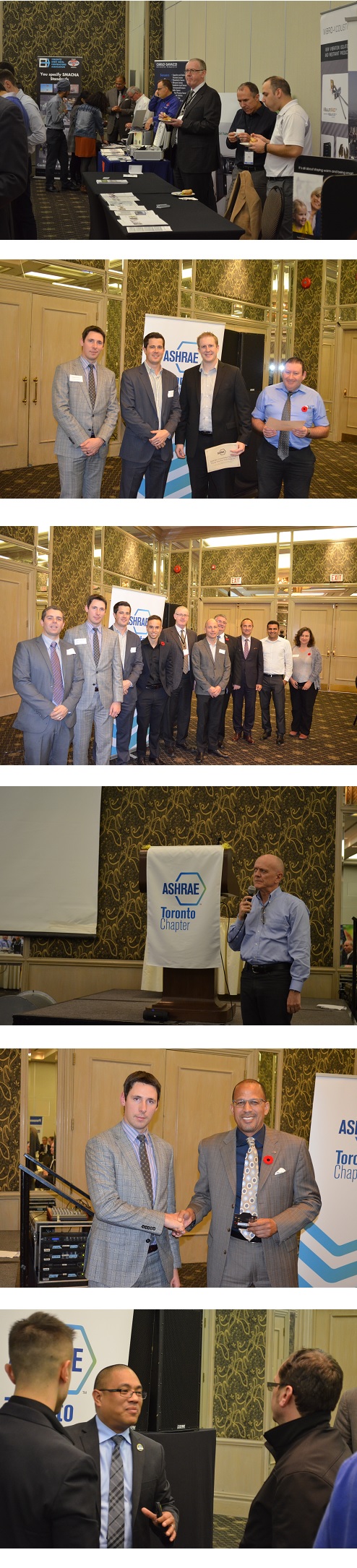
The November meeting consisted of a joint trade show/dinner meeting between TSMCA and ASHRAE which provided attendees with the opportunity to learn about some emerging HVAC technologies as well as several sheet metal product lines on display by local suppliers.
SMACNA Seismic Restraint Manual - Eli P. Howard
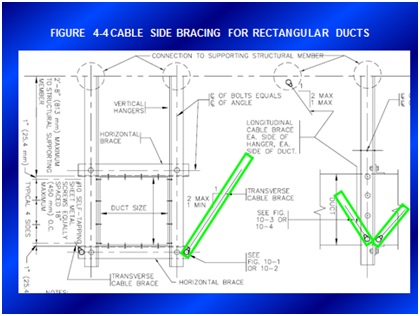
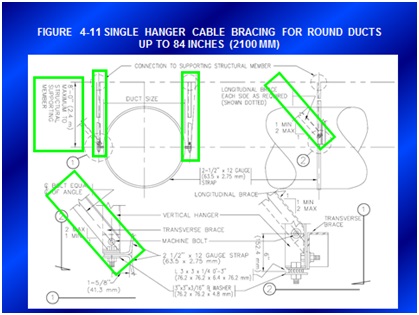
There were two presentations this month, the first of which was delivered by Eli Howard, the Executive Director for Sheet Metal & Air Conditioners National Association (SMACNA) Technical Services. Mr. Howard has the overall responsibilities of the more than 30 SMACNA Technical and ANSI Standards related to the HVAC and sheet metal industry. He is also a member of several ASHRAE Technical Committees. Prior to joining SMACNA, he was Manager of Technical Program Development for NEMI, providing technical assistance to contractors in energy engineering and IAQ technologies. His experience also includes work with Marriott International as a Mechanical Engineer for design/construction of hotels in the United States, Hong Kong and Poland. Mr. Howard's presentation focused on the use of seismic restraint systems on HVAC systems and the development of SMACNA's standardized code for the use of seismic bracing. The presentation began with a brief history of the development code dating back to 1976 when the Guidelines for Seismic Restraint of Mechanical Systems was first developed by the Sheet Metal Industry Fund of Los Angeles. The code continued to develop through the years to include larger ducts, incorporate OSHPD requirements for seismic bracing. The first edition of the Seismic Restraint Manual developed by SMACNA was release in 1991, while a second edition was released in 2009. Mr. Howard went on to discuss some specifics regarding the current version of the manual. This included several details, such as the way regions of the world are classified by different Seismic Hazard Levels based on their location and likelihood of experiencing seismic activity. This is then factored into the calculation of the required seismic bracing for the HVAC equipment in that area. He also addressed some general requirements when designing seismic bracing, including:
- The importance of choosing either solid bracing or cable bracing to support a mechanical system component. The two must be not combined along the same run of piping or ducting in order to meet the requirements set out by the code.
- All runs of piping or ducting must have a minimum of two transverse braces and one longitudinal brace.
- Bracing for in-line equipment is not factored into the design of seismic restraint and must be considered separately.
- Wall penetrations may replace transverse bracing, however solid blocking is required.
- From here, Mr. Howard presented some of the typical drawings and details depicted in the SMACNA code to help give visual examples of the ways in which seismic bracing can be applied.
Eli finished his presentation by taking the audience through an example calculation for determining the appropriate bracing for a specific run of piping, and showed the detailed steps and calculations required for an accurate and sufficient design of seismic bracing.
Energy Efficient Embedded Tube Radiant Cooling Systems - Devin A. Abellon
The second presentation of the evening was delivered by Devin A. Abellon, a registered professional engineer with over 17 years of experience in the HVAC field designing systems for commercial, institutional, industrial, health care, and municipal projects. Mr. Abellon was Vice President and managing principal of LSW Engineers California, Incorporated in San Diego until 2009, when he accepted a position as Business Development Manager for Uponor North America. He now works closely with engineers throughout the country, supporting projects that integrate radiant heating and cooling strategies to maximize energy efficiency. He is an active member of ASHRAE on the local chapter, regional, and society level and is currently the Programs Subcommittee Chair for ASHRAE TC6.5 - Radiant and Convective Space Heating and Cooling, as well as a Regional Vice Chair in Region X. Devin delivered a presentation on the use of Energy Efficient Embedded Tube Radiant Cooling Systems, starting with the fundamentals of radiant heat. Mr. Abellon explained that emitting heat through a floor through a radiant heating system is an idea which has been around long before the technology we are surrounded by today was used to heat and cool our buildings. Dating back to Roman times, radiant cooling was used through a hypocaust system. The development of human technology however, allows us to heat and cool much larger spaces more efficiently while expending less energy.
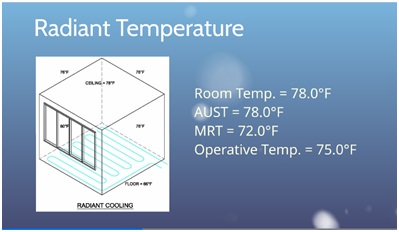
In order to see the ways in which radiant slab cooling can improve a building's climate, Mr. Abellon suggests that we consider the idea of Human Comfort as defined by ASHRAE Standard 55. Out of the six factors contributing to Human Comfort (air temperature, air movement, relative humidity, radiant temperature, clothing and metabolism), radiant temperature is the factor of Human Comfort which radiant slab heating is able to have the greatest effect upon. There are three main factors which contribute to the Radiant temperature: The average uncontrolled surface temperature (area-weighted average of the surface temperatures of an uncontrolled surface such as a roof), the mean radiant temperature (area weighted average of the AUST and the surface temperature of the controlled surface) and the operative temperature (the average of the mean radiant temperature and the air temperature). Essentially, the idea behind the radiant slab cooling is that while the radiant slab (the controlled surface) might be colder than the ideal temperature for the room, the mixing of the air near the slab with the air near the ceiling (uncontrolled surface) will allow for a desirable temperature to be achieved at the occupied area in the middle of the room between the two surfaces.
Another interesting use of radiant slab heating is the ability to absorb solar gains. This can be seen most prominently in a large, open area with a lot of windows and sunlight, such as a lobby or atrium. The slab has the ability to absorb a portion of the incident radiation, thus helping to maintain the desired operative temperature. Radiant slab cooling also provides the ability for greater architectural freedom and reduced drafts and noise due to fans and blowers.
Radiant slab cooling has the potential to save between 17-42% of energy costs over the baseline VAV system, depending on the climate. Devin then went on to discuss more details about the radiant slab system.
- The typical parameters consist of 5/8" PEX piping laid out in the slab at spacing of 6" to 9" center to center.
- The typical tube length is between 350'-500' per loop.
- The operating water temperatures are between 55°F to 50°F.
- The surface temperature of the slab is a minimum of 66°F.
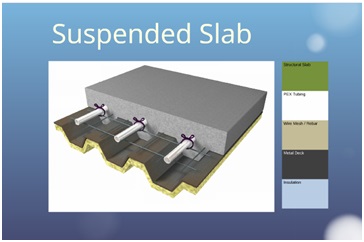
He also spoke about the different ways in which a radiant slab system can be installed including inside of a poured concrete slab or as part of a concrete topping installed on an existing floor. Depending on whether you wish to use your system as a radiant floor slab or radiant ceiling slab, you can install insulation to help suit your needs.
From here, the presentation turned towards the use of a system once it has been installed. Similar to a VAV system, a radiant slab system can be split into zones with different manifolds located throughout the building, managed by different control points.
One issue that was mentioned during the presentation was that the radiant slab can take some time to achieve the desired temperature. It is not as instantaneous as a typical air blown system. However, once the slab has met its desired conditions, the high thermal mass provides "inertia" against thermal changes. It will take either a long period of time, or a large external load to cause the temperature of a space to change significantly. A management strategy that is adopted in some cases where radiant slab cooling has been installed is to address the base heating/cooling load through the radiant slab system and use a small supplementary air blown system to meet minor changes in the desired room temperature.
Another concern which many individuals have with the use of radiant slab cooling is the possibility of condensation. While condensation will occur if the surface temperature drops below the dew point, the system can be continuously monitored and set to maintain a supply water temperature above the dew point at all times.
Mr. Abellon closed with a few comments on the cost of the radiant slab system. It can be difficult to determine an average cost for installation of this system since there are so many factors to account for. However, based on the 2014 cost data acquired, it is estimated that the average cost of materials and labour (excluding the chilled water source) is in the range of $5-$6/ft2.
The appeal of this system is clearly present from Mr. Abellon's presentation. The ability to use radiant cooling can dramatically reduce a building's overall energy consumption, creating the ability for improved architectural freedom and superior Human Comfort. With the ability to absorb 12-14 BTUH/SF (25-32 BTUH/SF if direct solar gains are present), it is easy to see how this system can create improved efficiency. This can be especially beneficial in achieving LEED certification. Since Energy & Atmosphere accounts for a total of 33 points (approximately double that of any other category) saving energy and improving climate management can help to improve a building's LEED status. However, it is important to remember that each building is different and that several things must be taken into consideration, including controlling the indoor relative humidity, designing proper controls and the installation method.
Dinner summarized by Michael Peterson, B.Eng
|
Viewpoint
|
I'm sure we have all had the following conversation with our friends or family:
"Hey Peter what are you doing on Monday night?"
"I'm going to an ASHRAE meeting"
"Ashtray? Nobody smokes anymore"
"No ASHRAE......."
And then where does the conversation go from there? How do you describe ASHRAE to someone who has never heard of it before? Could you describe ASHRAE to someone in one word? (Does amazing, important or valuable work?). No, I can't describe ASHRAE in one word. "Industry Association" is the best I can do. After that people often ask "Okay what does ASHRAE do?" and that is when the conversation gets very interesting. I see two very important items that describe what ASHRAE does: 1) The 4 handbooks. 2) Our monthly chapter dinner meetings.
The ASHRAE handbooks make us all better at our jobs. They are the "design bibles" that provide the generally agreed upon fundamentals. The handbooks are the product of decades of knowledge and the research that our chapter funds. Buildings would be less healthy, less energy efficient and we would all be worse at our jobs without the handbooks. Would you generally agree that the better you are something, the more money you will be paid for it? The ASHRAE handbooks help us do that. The standards and handbooks force us to use what we have learned in the past and further design innovation. But how can learn more from our peers and not just the manuals?
Two years ago I was the head of the CTTC (Chapter Technology Transfer Committee) or as I like to say "the person responsible for organizing our monthly meetings". It was a challenging commitment. During a Chapter Regional Conference (CRC) with fellow "monthly meeting organizers" from other chapters, an ASHRAE Society member from the U.S. said to us "You are ASHRAE". It was a scary statement, I certainly didn't feel ready for the responsibility that carries. But at the chapter level, we are nothing without our monthly dinner meetings. The Toronto Chapter raises more than $30,000 a year for ASHRAE research through donations, 50/50 tickets and other means. (See the previous paragraph for why that is important). The monthly dinner meetings allow us to raise money for research, network, exchange information and "learn what the other guys are doing". The monthly meetings are what the Toronto ASHRAE Chapter is. This is why Brendan McDermott has the most important role at our chapter and is doing a great job. Be sure to tell Brendan you appreciate what he is doing for us.
ASHRAE is more than just the 2 items I have described, but they are the indispensable blocks in the foundation of our organization. So tell your friends and family that they're right, nobody smokes anymore and you are going out on Monday night to increase the value of your profession and learn what the other guys are doing.
Toronto Chapter Vice President 2015-2016
|
|
Research Promotion Committee
|
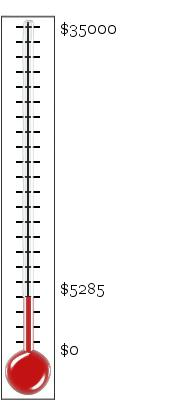
At the November dinner meeting we recognized our past donors and handed out ASHRAE Research recognition coins. Please contact me to get your coin if you did not pick it up or if you were not able to make the November dinner meeting. With the end of the year approaching its a good time to think about your corporate and personal contributions to ASHRAE Research Canada. If your company budgets ahead of time for donations, please keep ASHRAE Research Canada in mind for 2016. We are already sitting at 15% of our goal for the year! Thank you to all that have contributed so far. Looking forward to seeing everyone at Decemberfest for some great food and comedy.
Sincerely,
Toronto Chapter Past-President 2015-2016
Toronto Chapter RP Committee Chair 2015-2016
glenn@kilmerenv.com
|
|
Grassroots and Government Affairs Committee
| |
We will be having our first meeting at Noon on November 27th. I'm proposing two topics for discussion:
- Following up on the successful bEQ course and evaluation at a Toronto Public Library building, how do we advance bEQ with the City of Toronto when RETScreen and Energy Star are being favoured?
- Can we use the contacts we developed with the City Of Toronto to engage them in a discussion on implementing an enhanced building code inspection programme for EE?
We will of course entertain any other topics, but for a start we have two ambitious prospects that promise to make the 2015/2016 session of GGAC quite exciting. More to come as we travel along these roads.
Toronto Chapter GGAC Chair 2015-2016
416-606-1512
|
|
PAOE
| |
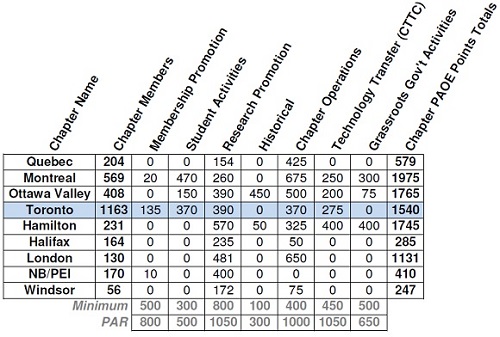
PAOE or Presidents Award Of Excellence, provides the chapters in Region II with a means of measuring success across a wide range of chapter operations. It is meant as a tool to guide the Board of Directors and Committee Chairs towards their goals. Below is a summary of PAOE Points for all of the Chapters in Region II so far this year.
Toronto Chapter President-Elect 2015-2016
|
|
Young Engineers in ASHRAE
|
Young Engineers In ASHRAE
We had our annual pub nigh earlier this month. It was great to see so many of you join us for some drinks and general talk about the HVAC industry!
ASHRAE is having its next YEA Leadership weekend this Spring - February 19-21, in Austin Texas. The Toronto Chapter is looking for candidates to sponsor for this event. If you are interested in attending, please reach out to me. More details can be found on the ASHRAE website. www.ashrae.org/YLW
Michael GeninToronto Chapter YEA Chair 2015-2016
|
| Student Activities |
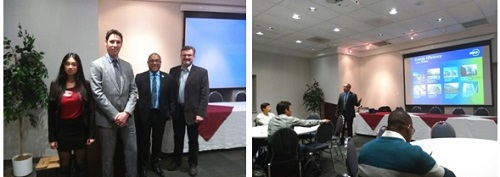
A big shout out to Seneca College and ASHRAE at Seneca for doing a great job at organizing the Seminar and for being great hosts to Devin Abellon!
Few pictures from the seminar:
Have you heard?? ASHRAE Design competition information is already out! Interested in participating in a competition that is recognized all across the board? Send me an email and let's get started!
May this holiday season sparkle and shine, may all of your wishes and dreams come true, and may you feel this happiness all year round. Wishing everyone a very merry Christmas, happy new year and happy holidays!
Toronto Chapter Student Activities Chair 2015-2016
|
|
Social Media
|
We have grown our base of followers since we started our incursion in social media. We have been in Twitter and Facebook since 2011 and in 2013 launched our official LinkedIn page.
Do you want to know about what is happening with our chapter? Join the conversation!
|
|
Society News
|
ASHRAE Extends Paper Deadline and Announces Call for Presenters for IAQ 2016 Conference
ATLANTA - A call for papers for the IAQ 2016 Conference, "Defining Indoor Air Quality: Policy, Standards and Best Practices," co-organized by ASHRAE and AIVC, has been extended until Dec. 14, 2015.
The conference will take place Sept. 12-14, 2016, in Alexandria, Va., at the Crowne Plaza Old Town Alexandria. To submit an abstract or for more information, visit www.ashrae.org/IAQ2016.
The conference is the 18th in the ASHRAE IAQ series since its inception in 1986 and the 37th AIVC conference. The program will focus on current and emerging definitions of indoor air quality and how they are - or could be - implemented in government policies and in standards for the design and operation of buildings and other indoor environments used worldwide. IAQ 2016 will also highlight best practice solutions that go beyond existing minimum requirements.
Authors are invited to submit papers on the following topics and others appropriate to the Conference theme:
- Definitions and metrics
- Perception vs. performance
- Monetization of IAQ
- DALY (disability adjusted life years) and related approaches
- Task performance/productivity
- Integrated IEQ metrics
- Regulatory vs. voluntary compliance for achieving IAQ
- IAQ certification programs
- Low energy/high performance buildings and IAQ
- IAQ in sustainable building programs
- Interactions: IEQ, climate change, energy efficiency
- Monitoring
- Sensors and big data
- Post occupancy evaluations
- Best practices
- Case studies with data
- Design, construction, operation
- Commissioning
- Ventilation and infiltration
- IAQ, energy and moisture impacts
- Mechanical and natural ventilation performance
- IEQ and natural ventilation
- IAQ and building/ductwork airtightness
- Residential IAQ standards and policies
- IAQ in Developing Economies
- IAQ in mobile environments: aircraft, trains, ships, motor vehicles
Abstracts are due Dec. 14, 2015. Upon acceptance, papers are due March 28, 2016.
Call for Presentations
Abstracts are invited for presentations and sessions that address the conference theme.
Session proposals must include a 400 word overall abstract and titles and speaker information for presentations. Session format is flexible and may be panel discussion with short framing presentations or a group of longer format presentations. Target session length is 60 or 90 minutes.
Individual presentation proposals require a 400 word abstract and a 100-word "promotion" abstract. Accepted individual presentations will be organized into sessions by the Steering Committee.
Full length conference papers are not required for accepted presentations and sessions, but presenters must agree to recording of their presentation with slides and voiceover.
Presentation and abstracts are due March 7, 2016, and notifications of acceptance will be sent on March 28.
The conference program will include internationally acclaimed keynote speakers, original peer reviewed papers and the latest in indoor environmental quality control, plus invited speakers, workshops and panel discussions. A call for presenters will be announced after the call for papers closes. Invited speakers and keynote speakers will be announced.
The Indoor Air Quality Association and the Indoor Environmental Quality Global Alliance are partnering organizations.
ASHRAE, founded in 1894, is a global society advancing human well-being through sustainable technology for the built environment. The Society and its more than 50,000 members worldwide focus on building systems, energy efficiency, indoor air quality, refrigeration and sustainability. Through research, standards writing, publishing, certification and continuing education, ASHRAE shapes tomorrow's built environment today. More information can be found at www.ashrae.org/news.
AIVC (Air infiltration and Ventilation Centre) is the IEA information center on energy efficient ventilation. In recognition of the significant impact of ventilation on energy use, combined with concerns over indoor air quality, the International Energy Agency (IEA) inaugurated the AIVC in 1979. The AIVC offers industry and research organizations technical support aimed at optimizing ventilation technology. The AIVC offers a range of services and facilities, including comprehensive database on literature standards, and ventilation data. For more information, visit www.aivc.org.
|
|
|
|
|
|
|