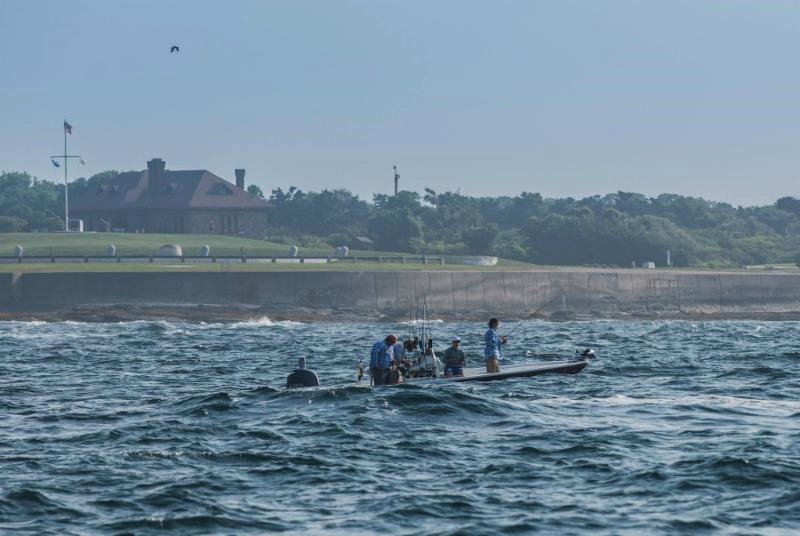
Newsletter- September 8, 2016
|
|
|
|
Greetings!
The False Albacore, Bonito, Striped Bass and Bluefish fall migration is in count down mode. It's clear, this is the very best time to fish the Ocean State and nearby Massachusetts and Connecticut waters. Don't get me wrong I love the spring bite, but it's pretty much restricted to striped bass. Come September, we have a lot more fish pushing through our waters as they begin to prepare to head south along our coast to their winter-over waters, and typically while they are here, they are hungry. The days of carefully constructing a fishing outing around the tides are largely over until next spring. It's not that tide stage is unimportant, it's just less a factor in these fall months. We routinely have surface blitzes of mixed schools of fish occurring throughout the day, irrespective of tide.
Tropical storm Hermine just blew through Rhode Island giving us moderately high winds but delivering no real damage. It's not clear what affect the storm will have on our fishing, clearly the surf is still very high and the water is loaded with weed, sand and air. It will take a few days for things to settle down. Our hope, of course, is that the after-affects will clear quickly and the bait will once again ball-up and fish will be munchin'. I still have some very good dates available for September and early October charters, so if you are game for about the most fun you can have fishing our nearshore waters with the fly rod and light tackle, pick up the phone or drop me an email and let's get you scheduled. The next thing you will hear as you're picking out your new snow shovel, is that this year's fall run was epic, and you then realize you missed out.
I hope you find this newsletter of interest.
Thanks, Jim Barr
Capt. Jim Barr
|
|
 Pro Staff 

Pro Staff Team Pro Program
|
 | | Pro Staff |
|
|
|
| Capital Improvements to "The Kit" | |
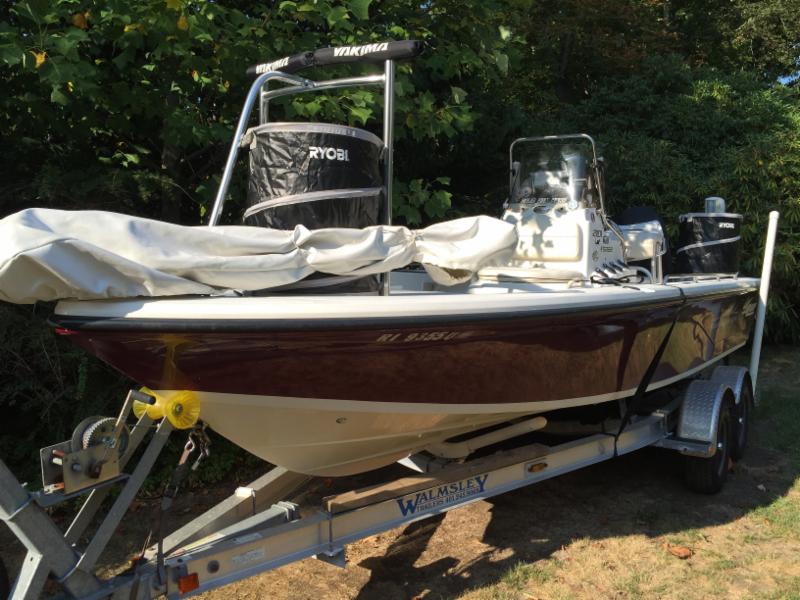
During August I had the opportunity to perform a few upgrades to my boat and trailer. As you know, I fish a 22' Mako Inshore Bay Boat. It's a spectacular boat for fishing our skinniest of waters (like the spring-time cinder worm hatch in our salt ponds and sand eel flats fishing in Little Narragansett Bay). The foredeck is raised and offers a wide-open platform helpful for sighting fish and accurately casting to them. As my season progresses I begin fishing in Newport's near-shore waters. Casting from the foredeck can be a bit of a challenge in windy and bumpy sea conditions so I collaborated with a marine hardware fabricator in nearby Fall River, Massachusetts (Titone Custom Metal Works) and together we designed a removable casting brace. They completed the fabrication/installation in record time and I have been able to run quite a few of my August and early September charters with this new addition. Anglers can now remain on the foredeck in the roughest of conditions and feel secure as I angle up on feeding fish and structure. I wanted the brace to be portable so when we are fishing the flat waters of Ninigret Pond next May and early June, I can easily remove it.
I have added foam padding (left over Yakima roof rack pads) to the cross bar that provides cushioning for the angler.
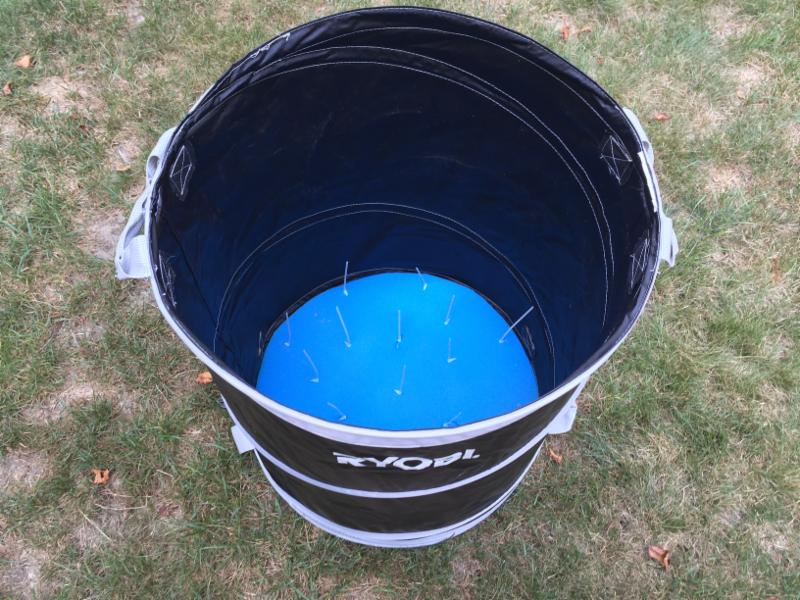
I also fabricated (more like "MacGyvered") two fly casting stripping baskets that can be used on the bow and stern casting decks to help the angler manage fly lines in the process of casting and playing fish. These baskets started out as collapsible leaf bags from Home Depot, but with some ingenuity they morphed into something much more. (More about this later in the newsletter.)
Additionally, I had the stock hydraulic brakes on my aluminum trailer replaced and upgraded with heavy-duty stainless steel components for corrosion free performance and better stopping power for when I trailer longer distances.
Also added to inventory were ten new Outbound Short fly lines from RIO Products in a variety of line weights in floating, intermediate sink and fast sinking tip.
These lines are available at The Bear's Den Fly Fishing Company in Taunton, MA. http://www.bearsden.com/ 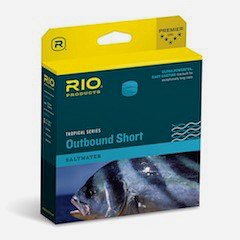
Lastly I added the SAGE X fly rod in a nine weight. This is the newest Sage fly rod that received the Best Saltwater Fly Rod award at the 2016 International Tackle Dealer Show. This rod likewise can be purchased at The Bear's Den.
http://www.sageflyfish.com/x
 The following reviews will help you better understand the performance points of this new fly rod. The following reviews will help you better understand the performance points of this new fly rod.
Skinny Water Charters is proud to be in the Far Bank Pro Program (Sage flyrods, RIO Products fly lines, and Redington rods, reels and apparel). As such I carry on my boat nearly a full inventory of Sage saltwater and allwater rods, that includes the Xi3, One, Salt, Bass II, Method and now the X models. All my fly lines are current models of those offered by RIO Products. Nothing but the best for my clients.
|
|
|
|
|
False Albacore and Bonito- Shore locations 'n Fly Patterns
|
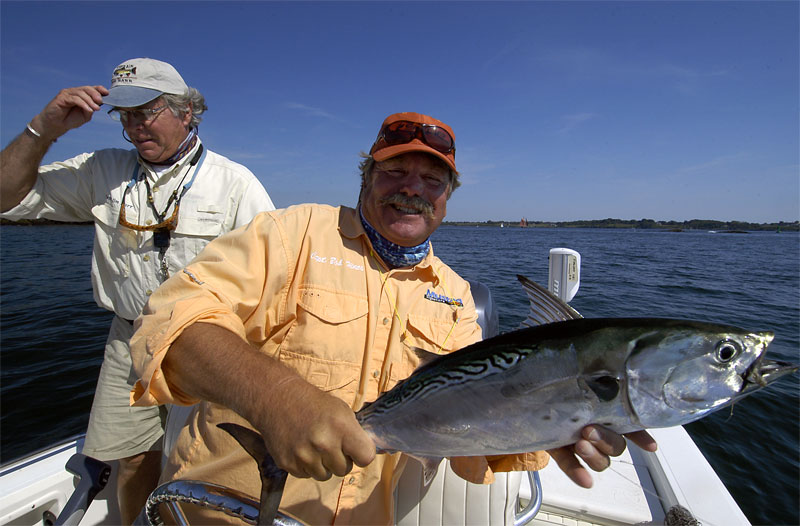 In the July newsletter I included a short article that attempted to take some of the mystery out of fishing for False Albacore and Atlantic Bonito. As I noted then, too much has been written and talked about in terms of the difficulty of hooking and landing these fish. That's actually the easy part, the harder part is finding them and getting into position to make a good cast. Boat anglers clearly have the advantage, but shore anglers, if persistent, can locate and land these speedsters. Ask anyone who has caught these fish on a fly rod or light tackle and they can't say enough about the experience. In Rhode Island there are a number of very good shore access points to intercept these fish. In the July newsletter I included a short article that attempted to take some of the mystery out of fishing for False Albacore and Atlantic Bonito. As I noted then, too much has been written and talked about in terms of the difficulty of hooking and landing these fish. That's actually the easy part, the harder part is finding them and getting into position to make a good cast. Boat anglers clearly have the advantage, but shore anglers, if persistent, can locate and land these speedsters. Ask anyone who has caught these fish on a fly rod or light tackle and they can't say enough about the experience. In Rhode Island there are a number of very good shore access points to intercept these fish.
The following list of Rhode Island shore locations come from presentations I have given at Bass Pro Shops, and the Rhode Island Saltwater Anglers- New England Fishing Show in Providence.
(From east to west)
- Sachuest Point National Wildlife Refuge- Middletown
- Brenton Point State Park- Newport
- the ledges at Castle Hill in Newport- park in the hotel parking lot and sneak down to the cliffs, or alternatively, park in the lot by the Coast Guard facility at the marina.
- Pt. Judith Lighthouse- below the parking lot on the bluff. Fish the beach facing east and at the point itself.
- Pt. Judith, Narragansett- East Wall jetty- park at the Camp Cronin Fishing area off Ocean Rd.
- South Kingstown- West Wall jetty- park on the road going into Jerusalem village at the end of Succotash Rd, (East Matunuck Beach Rd).
- Quonochontaug Breachway jetty- East Beach Rd., off of Rt 1 in Charlestown
- Charlestown Breachway jetty- (Charlestown Breachway Campground) Charlestown Beach Rd, off of Matunuck School House Rd, off of Rt 1A, off of Rt 1 in Charlestown
- Weekapaug Point- end of Noyes Neck Rd. in Westerly
- Weekapaug breachway jetty- Atlantic Ave., Westerly
- Napatree Beach- parking lot in Watch Hill
- East Beach- East Beach Access- Bluff Ave., Watch Hill
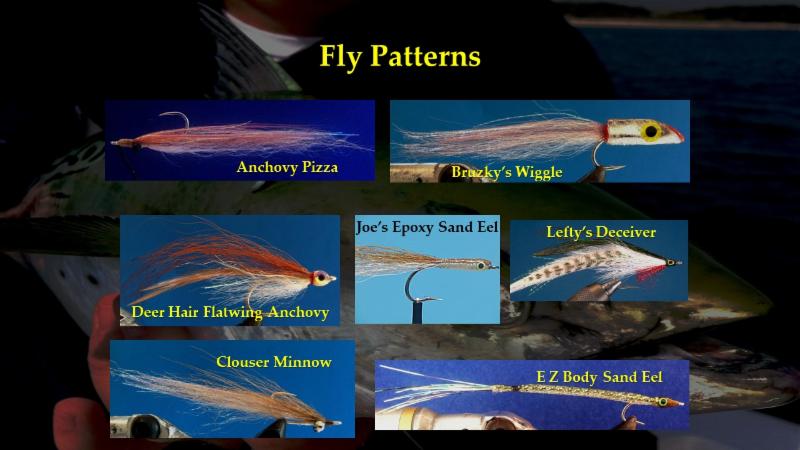
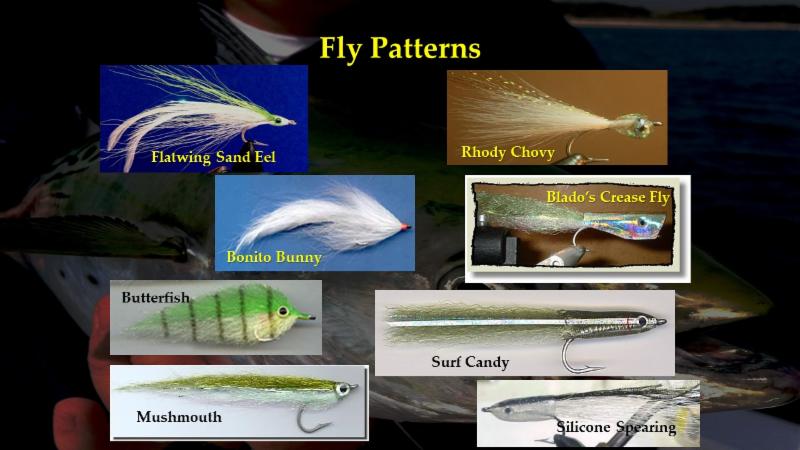
Some of my favorite patterns for these fish are depicted in the following graphics. Again, don't go crazy trying to replicate any of these, at the end of the day, if you use a fly pattern that looks like a smallish bait fish, and you get it in front of these fish, they are probably going to eat it.
|
| Casting Corner- Line hand, the "O", and Striking the Fish |
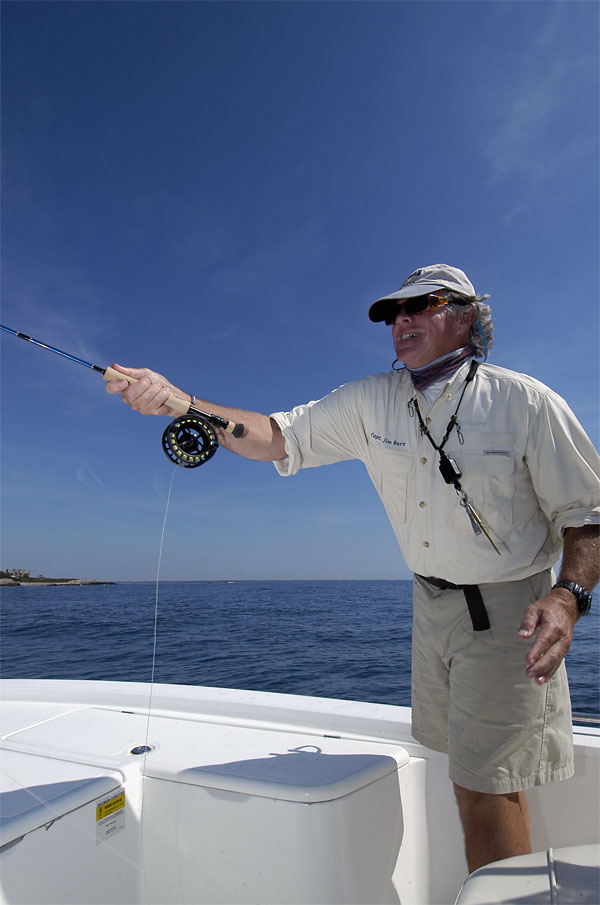 One on the most common casting errors I see plaguing fly anglers on my boat is their line hand is oftentimes positioned too high and too close to the fly rod and reel. Typically if the line hand is near the rod in the false casting and line shooting stages it means the hand, forearm and upper arm are all in a "high" position, and whenever that occurs for a sustained period of time (a day fly fishing), the arm gets fatigued as does the shoulder and the back and the angler tires more quickly. The other thing that oftentimes occurs is when the angler finally shoots line on their forward cast, the excess line on the deck or in the stripping basket rapidly shoots upwards and collides with the rod as the idle line is pulled up by the weight of the line outside the tiptop. This collision can occur anywhere from the rod butt and up to and including the first stripping guide. Two things happen when you get collision of the line (line slap) against the rod: 1. You lose distance in your cast because the line does not run smoothly through the guide set, and 2. The excess line will oftentimes wrap around the butt of the fly rod, or the reel, or the first stripping guide, or perhaps all three points. In each case there goes your opportunity to make the distance and expeditious cast to the moving fish. Missed opportunity! One on the most common casting errors I see plaguing fly anglers on my boat is their line hand is oftentimes positioned too high and too close to the fly rod and reel. Typically if the line hand is near the rod in the false casting and line shooting stages it means the hand, forearm and upper arm are all in a "high" position, and whenever that occurs for a sustained period of time (a day fly fishing), the arm gets fatigued as does the shoulder and the back and the angler tires more quickly. The other thing that oftentimes occurs is when the angler finally shoots line on their forward cast, the excess line on the deck or in the stripping basket rapidly shoots upwards and collides with the rod as the idle line is pulled up by the weight of the line outside the tiptop. This collision can occur anywhere from the rod butt and up to and including the first stripping guide. Two things happen when you get collision of the line (line slap) against the rod: 1. You lose distance in your cast because the line does not run smoothly through the guide set, and 2. The excess line will oftentimes wrap around the butt of the fly rod, or the reel, or the first stripping guide, or perhaps all three points. In each case there goes your opportunity to make the distance and expeditious cast to the moving fish. Missed opportunity!
My recommendation is to keep the line hand elevation somewhere between the angler's waist and the middle of the chest, and to keep the line hand upwards of two feet away from the rod. By doing this your arm is not in that high, stressful position and your arm movements are more relaxed as the hand and forearm are in a more ergonomically efficient and comfortable position. You will see this recommended arm position in the attached YouTube video. You will also see that I am pinching the line with my left hand between my thumb and forefinger as I make an "O" with those two fingers. As I execute my false casts preparing to shoot the line towards the target, I can either keep the line pinched (static) until I have the line speed and direction I want, or I can slip line both on the forward and back false casts in order to lengthen the amount of line I am carrying in the air.
You will also see that when I release the line in the final forward cast, I release it so that the line is enclosed inside the "O" that I have formed with my fingers. I do this for two reasons, each very important. By maintaining control of the line inside the O, I am effectively using this finger positioning as an artificial (finger/hand) stripping guide- the first one if you will that operates to align and funnel the loose/excess line into the first stripping guide on the fly rod. The other important reason for keeping the line controlled within the O, is that when my line and fly lands on the water, I can readily transfer the line to my rod hand pinching it between my right forefinger and the rod grip, while pinching the lower section of the line with my line hand as I prepare for my retrieve, or better yet for strip-striking the fish. Many anglers will simply let go of the fly line in the process of shooting the line. I have seen many of those same anglers miss strikes that happen instantaneously as the fly hits the water because they are fumbling to regain control of the line. After making the cast I strip the line between my rod hand forefinger and the grip. I pinch that line tightly as I reach up with my line hand to the grip to pull the line in for the next retrieve/strip. The fly line must always be held tightly- slack line is a killer and causes anglers to miss the strike.
While on the subject of striking the fish, many anglers new to fly fishing in the saltwater are used to striking (setting the hook) the fish using the traditional "trout set" where the rod is raised in a high position. If you employ this technique in saltwater you are going to miss a lot of fish or because the hook set is weak, the hook will not penetrate the fishes mouth and it will come unbuttoned. The proper technique is to start your retrieve with the rod tip at water level or just above with zero slack in the line. When the fish eats the fly, the angler keeps the rod position low (water level or slightly higher) and with the line hand pulls the line back with force parallel to the rod and water inducing a fast and strong connection to the fish. Generally it's a good idea to strip-strike (line strike) the fish several times in this low position, then angle the rod to either side .... then raise the rod to begin playing the fish. High trout sets are sometimes ingrained in an angler's DNA, but using this technique in saltwater can cause you to lose a lot of fish, and also potentially break the tip section of your rod by putting too much force on it.
|
| MacGyver Stripping Basket |
Like many fly anglers, my first wearable fly line stripping basket was a Tupperware dishwashing tub with two holes melted into it on either end of one of it's long sides using a heated screw driver, and finished off with a bungee cord fixed to the holes, and then stretched around my waist. Simple, super cheap (and cheap looking), but it worked. Then came a variety of iterations such as laundry baskets, then molded plastic inserts with an array of "cones" that were dropped into the tub designed to keep the line from tangling onto itself, secured by epoxy or in my case pop riveted into place. There were also designs that used heavy duty string trimmer line, clipped at 2-3" lengths and epoxied into the floor of the tub... on and on. 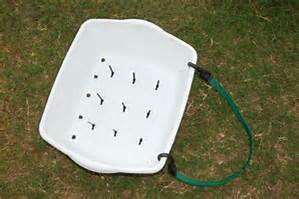
Then somewhere along the time and expense continuum, Orvis developed their version at $80 a copy, made from a sturdier plastic, with a fancy web belt, and injection molded cones together with a rod rest. They are nice, but heavy and pretty expensive.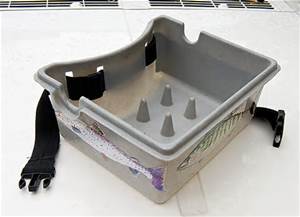 Whatever the size, construction and cost, they all worked great for helping to manage fly lines, particularly on windy days and in the surf, and if you didn't put holes in the bottom to let the water drain, they also made pretty good open-top beer coolers. Most of us however defaulted towards constructing our own MacGyvered versions. Whatever the size, construction and cost, they all worked great for helping to manage fly lines, particularly on windy days and in the surf, and if you didn't put holes in the bottom to let the water drain, they also made pretty good open-top beer coolers. Most of us however defaulted towards constructing our own MacGyvered versions. Then as fly fishing in saltwater from boats became increasingly popular, along came a variety of deck-positioned stripping baskets or line tamers, as the case may be, again- neat designs but many of them pretty expensive, some running in the vicinity of $200, like this beauty. Nice, but expensive. 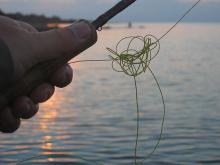 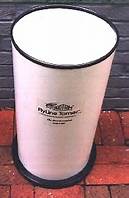
Most of my charters following the serenity, no wind and flat water conditions of the spring cinder worm hatches, are in Newport near-shore waters. For the spin fisher, wind acting on their fishing line is a non-event. Line is always in reserve on the reel so the wind is only a factor in reducing the distance of the cast or perhaps it's direction. However, wind, a bumpy boat and a wave-splashed deck acting on excess/loose fly line can be a show stopper. Fly line will always find something to hang up on, be it a cleat, the trolling motor, your feet, etc. Storing excess fly line in a stripping basket as you are casting will definitely up your catch rate because the line can run freely into the guides as the fish takes off. Also, while moving from location to location, a secured stripping basket will enable the angler to temporarily stow the rod and loose line in the basket while the helmsman makes longer runs to new fishing locations. The following video was taken in the fall of 2011 and depicts two anglers on their first false albacore fishing outing. In this video you will see one angler tight to a hot Albie but because of poor line management manages to get a loop in his fly line that hangs up in the guides nearly resulting in the angler losing the fish or worse yet, breaking his rod. Both of these anglers had excess line on the deck during the outing in danger of tangling. When a false albacore is hooked, typically they will swim away from the boat at top speed, that's 60 feet a second! A tangled fly line gets jammed in the guide-set in a heartbeat, oftentimes resulting in a lost fish, or the sections of the rod coming apart. This video is displayed not to embarrass anyone but simply to illustrate the importance of line management. The tangled line would likely not have occurred if the angler was using a stripping basket (personal or deck positioned).
 |
|
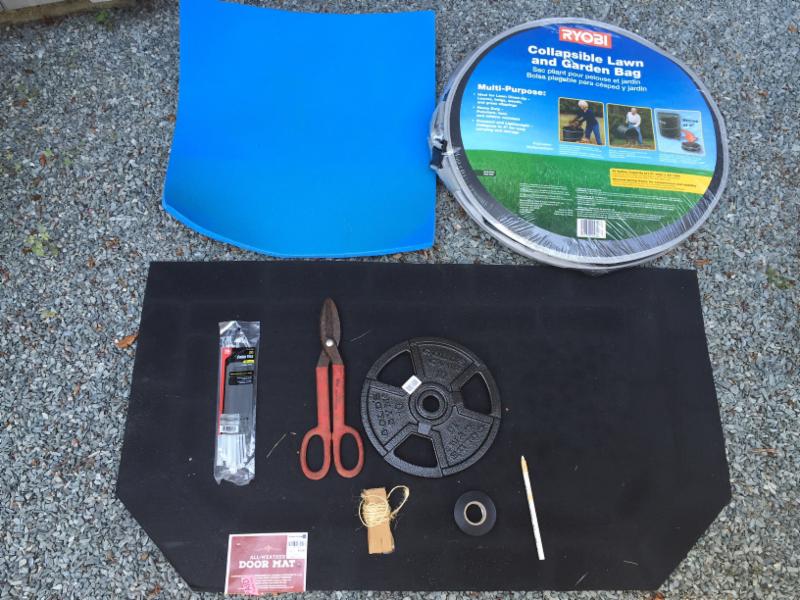
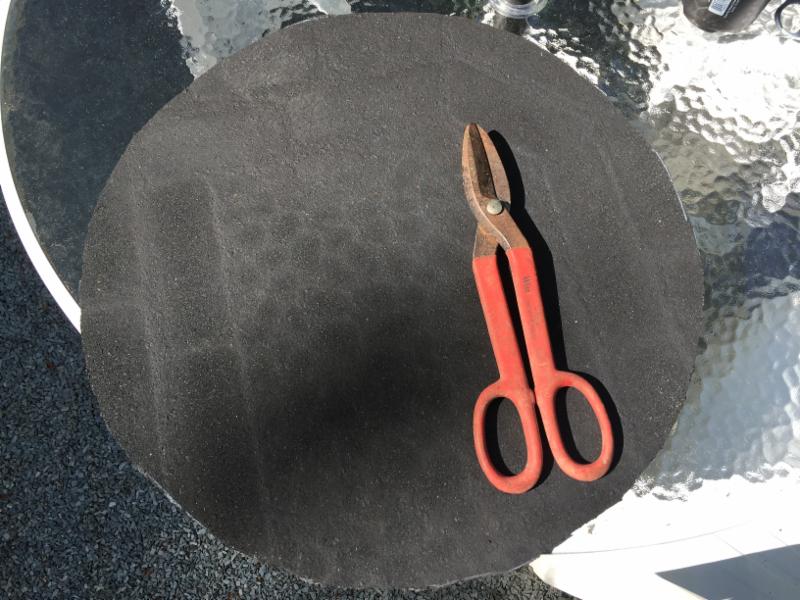
With a bit of creativity and small money I developed for my boats the "Ryobi Special" deck-positioned stripping basket. This design may be a bit different than other MacGyver's have devised, but it basically follows the same idea of using a leaf bag as a container for slack fly line. Materials for two baskets rang up just south of $80 and took about an hour and a half to design and fabricate.
Materials for two baskets:
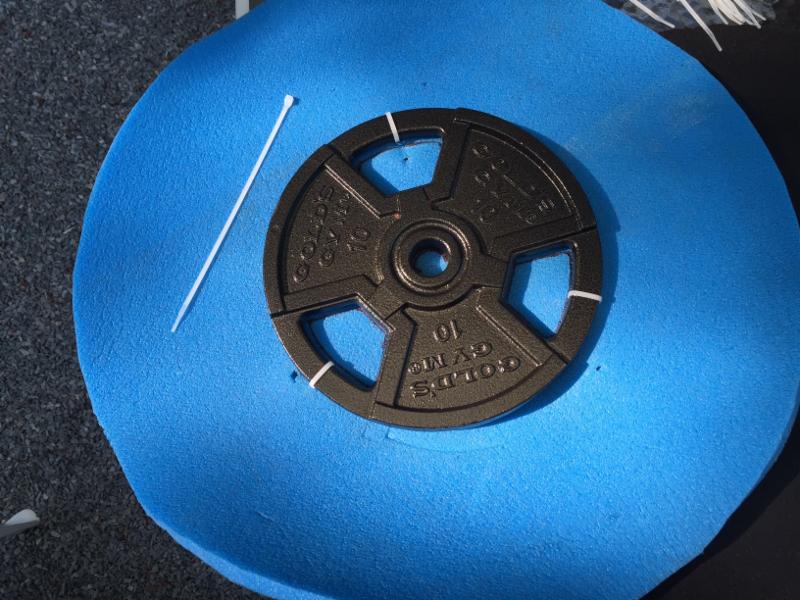
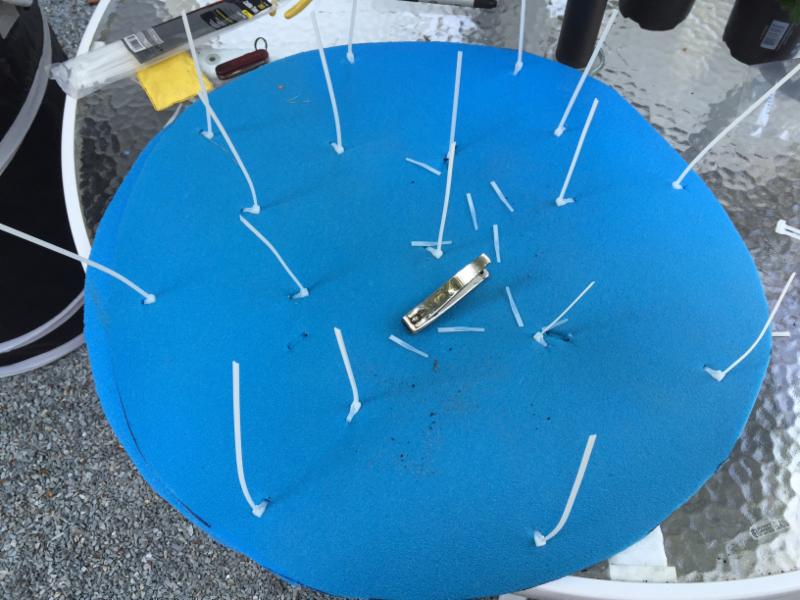
Ryobi 21" diameter collapsible leaf bags-$40 (Home Depot). 5/8" rubber doormat-$10 (Christmas Tree Shops). Ensolite ground pad- $0 (Eastern Mountain Sports, leftover from my backpacking days). 10 lb barbell weights- $10 each (Walmart). Zip ties-$6 (Home Depot). The leaf bag is spring loaded, collapsible, with buckles to hold it closed when not deployed. The combination rubber door mat and Ensolite pads provide cushioning and encapsulate the barbell weight that's used to stabilize the basket and keep it from being blow overboard. The zip ties create "fingers" that keep the fly line immobilized and free from tangling. I sprayed the barbell weights with clear polyurethane to prevent rust and corrosion from rain and salt spray.
|
|
Pulling the Fly from the Feeding Zone (aka Stripping too Fast)
| |
There is a common belief that fly anglers need to strip their fly very fast during a False Albacore and Atlantic Bonito (funny fish) feed. This is typically not necessary, in fact it can be counterproductive. Like any saltwater fish that is feeding on bait fish, the angler must determine the appropriate pace and position necessary for the fish to sight the fly pattern, be tricked into believing it's the real deal, and commit to eating it. It is true that funny fish are fast swimmers, in fact two of the fastest swimming fish in the ocean. In hot pursuit of bait or in fleeing, a false albacore can swim 60 feet a second. Remember, bay anchovies, silversides or butterfish are very small and incapable of sustained speeds anywhere near that of the funny fish "drag racer". So what's the point of stripping so fast?...frankly there is little. An exception might be when you have a school of fish moving quickly to locate and chase down schooled-up bait. We've seen what happens when in the boat we attempt to follow terns and gulls that are flying just above racing and marauding tuna. However once these tuna locate a bait ball and "circle it up" they can actually become pretty controlled, slow and methodical in their feeding habits.
Once a school of false albacore and bonito circle up on a bait ball, and you cast into that melee, you can very easily pull your fly pattern out of the feeding zone too quickly by stripping over aggressively. So, what should be your strategy?
Let's take a look at two video's that I took of a mixed school of false albacore and bonito feeding on bay anchovy, their favorite meal.
Video #1- shows a school of fish that have balled up a school of bait and are attacking it super aggressively from multiple directions. In this frantic feed, bait fish are spraying from the water as tuna's are climbing through it at high speed but in geographically tight areas. Here, I want to use a moderate retrieve with a fly pattern that is larger than the average bait being chased. I want my fly to stand out in the crowd, I clearly cannot swim my fly in the same direction of the fleeing bait as my retrieve and the direction of the bait and the tuna may be at opposing angles. I want to anticipate from which direction the fish will likely attack, get my fly into or near the bait ball, make a relatively slow strip and await the hit. Alternatively, I may want to use a fast sinking tip fly line and get my fly out of the crush, where it can readily be distinguished from the bait school and therefore become more vulnerable. Top water breaking funny fish can follow the iceberg theory, where there is actually more action out of sight (below) the top water explosions we see in this video.
Video #2- a better video to illustrate my point about retrieval speed. Here I have put this fly angler right on top of several schools of lazy feeding false albacore. These fish have bait contained in several areas, with no avenue of escape. Here the angler is stripping his fly entirely too fast. He is a very good caster, and is laying his fly pattern in the middle of the feeding fish, but his fast retrieval rate is pulling it through and out of the feeding zone. A much better strategy is to drop the fly into the action and either dead drift it, or move it slowly as if it were injured. In this instance a close replication of the size, profile and color of the bait fish is likely more important than in Video #1 due to the casual feeding behavior of these Albies.
So the takeaway here is to study how the bait is moving, assess the feeding behavior of the fish and their speed, think about the fly selection (again, exact imitations may go unnoticed), and a retrieval rate to fit your observations. The most important element is to keep the fly in the feeding zone. It's difficult to use discipline when you're "on location", the fish are on your doorstep, busting the surface and causing your heart to jump out of your chest. Howeve through observation, planning, executing a good cast and coupling it with the right retrieve, you will unlock the mystery of catching these wonderful fish.
If you have the luxury of finding feeding fish without any competing anglers nearby, have fun, keep bent rods low and try to limit the hooting and hollering to maintain your privacy as long as possible. If you fail to be cool, you will become the Pied Piper of Hamelin and have everybody and their brother suddenly crowding your water.
|
|
Use Your Sinking Line (much) more Often
|
Very few anglers know how to efficiently cast a full sinking or sinking tip fly line. They are much better at casting their floating and intermediate sinking fly lines, but the fact of the matter is the sinking line is a much more effective line to use when fly fishing deeper water. Rarely are the fish feeding on top, so in most cases using a floating line in our local waters, particularly when targeting false albacore and bonito, can be a waste of time and energy. Most anglers will default to using the intermediate sinking line, either a full intermediate line or the more popular and easier to cast, intermediate tip line (that has a floating running line behind the sinking tip). The intermediate line is not a bad choice, it's just not an effective line to use when targeting fish that are feeding in two feet or deeper water. Let's review the math.
The typical intermediate line has a sink rate of 1.5 inches per second. If we have fish two feet down, the straight calculation indicates it will take 16 seconds for that fly to reach those fish. Perhaps a bit less if the angler is fishing a weighted fly like the Clouser Minnow. Let's say the fish are at three feet, now the wait time before you should start your retrieve becomes 30 seconds. Understand these calculations do not consider the delaying effect of a long leader that takes additional time to sink, combined with wave action and wind that can inhibit the sink rate of that portion of the line at or near the top of the water column. The intermediate line is nearly as easy to cast as the floating line, but most of the time it is an inefficient line to use when targeting fish in depths beyond a foot. Show me an angler who will wait 30 seconds or a bit longer to start their retrieve when using an intermediate sinking line.
OK, let's now consider a different model- using a fast sinking line, either a full sink or sinking tip. These lines come in a variety of sink rates and what line you ultimately use may vary depending upon the make and model of your fly rod, and whether you are fishing in fresh or salt water and what species of fish you are targeting. I visited the RIO Products website and plugged in a few variables in their Fly Line Selector web tool. (http://www.rioproducts.com/learn/line-selector). 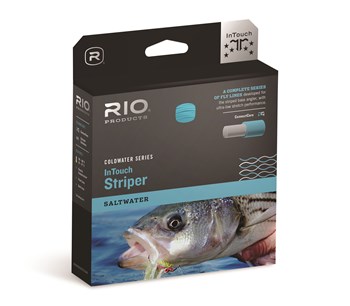
As an example, when utilizing this selection tool, I answered the software prompts accordingly (Open this tool and plug in your variables so you get my drift). I fish a single hand, Sage Method 9' 9 weight rod, in cold water, for striped bass, in saltwater, from a boat, I prefer the sink tip (a full sinking line can be a bear in aerializing and casting...too much weight), and I am an experienced fly caster. The software suggests three options, the one I choose is the InTouch Striper 30ft fast sinking tip line. (I don't want the intermediate lines given their painfully slow sink rates). The software then provides the details on the line I like, in the instant case a 350 grain (#9weight) with a head length of 34 feet and sink rate of 8.2 inches per second for the sinking tip, and 1.5 inches per second for the intermediate running line behind the head.
|
| | "Up to the gunnels"
(or so it appears) |
OK, so back to the exercise of the model where our fish are two to three feet down. At two feet, my preferred line choice will get the fly there in 3 seconds, or about 4.5 seconds for fish at three feet. I like those sink rates much more because I can spend more time fishing and less time waiting for the fly to sink to the level of the fish (generally fish are not static). The other consideration here is that a fly angler who has practiced and is reasonably proficient at casting a sinking tip line, can take one false cast and deliver the fly to the target versus taking multiple false casts (which translates into wasted time) that most casters employ when using intermediate and floating lines. This too translates to more fishing time and less time (and body strain) than when casting an intermediate line. When fish are deeper than three feet, which is often the case, the sinking and sinking tip lines become the only logical choice. Your captain should tell you how deep the fish are holding, quickly do the math for you, and advise the appropriate delay you should follow before you start your retrieve.

The considerations are several: If you have a sinking line, use it more often. If you don't you should buy another spool for your reel, backing and a new fly line... and then learn how to cast this heavier line. As a guide I can tell you from experience that most fly casters cannot cast a sinking line to save their lives! Typically they take too many false casts, end up with way too much line outside the rod tip... and it generally goes down hill from there. As an IFFF casting instructor, I can, in pretty quick order, get my clients casting a sinking tip line, maybe not the 80 foot cast they dream of, but a cast that's long enough to present the fly to deeper fish. Alternatively, you can take off-season casting lessons to learn how to cast these heavier (and infinitely more effective) lines so that come next season you are better prepared.
|
|
Quote
|
"Fly fishing is to fishing as ballet is to walking."Howell Raines
Fly Fishing Through the Midlife Crisis (1993)
|
I hope this newsletter contained information of interest to you, and again I welcome input for future topics you may be interested in knowing more about. Newsletters are produced whenever I can find the time. If you are interested in reading more of my newsletters, visit the Home page of www.SkinnyWaterChartersRI.com. There is link there that will take you to the archive. My best,
Capt. Jim Barr
Skinny Water Charters
|
|
|