|
Newsletter- February 17, 2013
|
|
|

Greetings!
This issue contains information regarding:
- A review of future speaking appearances and casting demo's
-
Recommendations for lines, leaders and knots
- Why fly casting speed is so important in saltwater
- Fishing reports starting in April
- An editorial on paying attention when lightning is near
- February's featured fly pattern- Jack's Stone Crab
As always, feel free to drop me a line with any recommendations for topics you would like to see discussed in future issues.
Thanks, and Strip Strike that Fish!
Capt. Jim Barr
 | |
Mako 2201 Inshore Bay
|
|
|
|
Pro Guide Sponsors
|
 | |
Pro Staff- Foxboro, MA
|
Pro Guide
 | |
Saltwater Pro Team
|

|
|
|
|
Skinny Water Charters- Speaking Appearances
|
This is the time of year that I try to stay busy doing presentations, and the following is my February and March speaking schedule. Please check the Skinny Water Charters website ( www.SkinnyWaterChartersRI.com) for updates on new speaking engagements.
Bass Pro Shops- Foxboro, MA
As part of Bass Pro Shops- "Spring Fishing Classic", I will be presenting as follows:
2/23 @ 4:30pm- Tackle and Equipment for Stripers and Blues
2/24 @ 3:30pm- Tackle and Equipment for Stripers and Blues
New England Saltwater Fishing Show- Providence, RI sponsored by the Rhode Island Saltwater Anglers Association (RISAA). I will be presenting "Advanced Saltwater Fly Casting Techniques" on March 8-10
Demonstration times:
3/8- 2:30, 5:30
3/9- 4:30
3/10- 2:30
Access the show's webpage via the following link.
http://www.nesaltwatershow.com/
River and Riptide Anglers Fly Shop- RT 3- Coventry, RI. On 3/23- 12-4 pm. "Sand Eel Fly Fishing". The discussion will cover June opportunities on the Watch Hill and Brenton Reef structures, Newport's inner harbor and Brenton Point to Prices Neck area. The workshop will offer fly tying instruction in addition to techniques and location information on this exciting fishery. Bring your charts.
Canton Fly Fishing Club- Armando Recreation Center, Canton, MA. March 26- 7pm. I will be presenting "The Rhode Island Cinder Worm Hatch".
|
Reel Spools, Fly Lines, Leaders and Knots
|
From the beginner and advanced beginner fly anglers I get a fair number of questions pertaining to what fly lines, leaders and knots to use in joining backing to the reel spool, fly line to the backing and leader and tippet to the fly line and tippet to the fly. The following discussion covers this information in addition to the most commonly used knots to connect these systems. REEL/SPOOLS Fly Reel: The reel's primary job is to hold the line and most have a variable braking or "drag" system that slows the fish pulling line. A small handle (aka "knuckle buster" when it's rotating from a large game fish stripping line) is actually part of the spool and is used to wind the line. There are a number of other features to the reel that I won't go into here but the key is that all reels have a latching mechanism that allows the angler to separate the spool from the reel frame. This is important because it allows the angler to use multiple spools containing different types of fly lines for varying conditions. For saltwater fishing applications do not buy a fly reel that does not have the feature to interchange multiple spools. Spools: Many beginner fly anglers don't at first realize that to effectively fish in saltwater you really need to have a variety of fly lines to suit the fishing conditions. By having several spools each wound with a different type of fly line the angler can quickly change spools to suit the water level being fished (top water, slightly below the surface, and at a variety of depths.) LINES Backing: A thin diameter and inexpensive "nylon-type" braided line. Backing is tied to the spool on one end and to the fly line at the other end. It's purpose is to provide a connection between the reel spool and the fly line when a hooked fish pulls line as it attempts to escape. For freshwater applications anglers typically use 20 lb. Dacron with as little as 50 yards wound on the spool. For saltwater fishing we use 30 lb test in either Dacron or Gel-Spun line. Gel- Spun line is more expensive than Dacron and is a smaller diameter, allowing the angler to wind more backing onto the spool (typically 50% or slightly more than a compatible test of Dacron line). For northeast saltwater fishing, 150 yards of backing is generally enough but most anglers fill their spools with 200 yards of backing. Fly Lines: I think it's fair to say that in freshwater trout fishing, probably 80% of the time the angler is fishing in shallow water, typically a stream and they are casting to surface (or near surface) feeding trout, or in water shallow enough that a floating line and leader system can reach fish feeding just below the water's surface, to the bottom of the stream bed. Anglers can get by with one line, a weight forward Floating line. The designation on the fly line box is a combination of numbers and letters. For trout fishing a good all-round fly line would be: WF5F (Weight Forward taper for a 5 weight fly rod, and the line Floats). However, in northeast saltwater environs using only one fly line will severely restrict an anglers ability to catch fish. At a minimum, you are going to need two fly lines that will cover roughly 80% of the waters you will fish. Running Line: Is the thinner part of the fly line starting at the point of attachment to the backing, and running forward and stopping at the beginning of the "head", or weighted section of the fly line. Running lines are a uniform diameter, and sometimes a different color than the head portion of the line. For the beginner what fly lines should they purchase for northeast saltwater fishing? As a general rule for the beginner and advanced beginner I recommend two types of lines for fly rod weights 8 to10: 1. Intermediate Sinking Tip- (with a sink rate of 1.5" second) I prefer a clear head with a light colored running line. Intermediate lines are effective in targeting fish from just below the water's surface to generally not much deeper than three feet. The Intermediate line can also be used to fish surface fly patterns. The trick is to start your retrieve as soon as the fly makes contact with the water before the weight of the slow sinking head pulls the fly down. 2. Fast Sinking Tip- (with a sink rate of 4.5"- 7" per second). Fast sinking tip lines typically have dark colored heads as they are less noticeable to the fish. Generally the running line is a lighter color. Fast sinking lines are used to get the fly deep into the fishes feeding zones. Depending upon the sink rate, anglers can effectively fish from 4 to 20 deep using the fast sinking tip line. Fast sinking tip lines are also a good choice when casting into a strong wind. Their weight punches through the wind much more easily than the Intermediate and Floating lines (discussed below). These are "sinking tip" lines vs "uniform sinking" lines. Sinking Tip Lines have the weighted portion of the line in the first 30 feet or so from the fly end of the fly line, this is referred to as the "head" of the fly line. The Intermediate Sinking Tip line has a floating running line behind the tip or weighted section. The Fast Sinking Tip running line is generally an intermediate sinking line (again about 1.5" a second). These relatively new sinking tip lines are what they call "integrated" lines. That means the heavier head section transitions smoothly to the lighter and thinner running line. There is no joint or loop connection and therefore no hindging effect when casting. Full Sinking lines (aka Uniform Sink lines) sink throughout their length and are more difficult to pick up and cast, as the entire line is weighted. It helps if you are a strong caster with good technical skills to effectively cast uniform sink lines. Your false casting must be strong and your rod starts and stops, crisp in order to keep the heavy line aerialized while maintaining good loop control. Personally I use both the sinking tip and uniform sinking lines for varying conditions. Floating line: The third basic fly line most anglers have in their inventory is a floater. This would be the last line I would buy if I am on a limited budget. I will caveat that by saying if you primarily fish in very shallow water (i.e. flats), then the floating line may very well be your primary line. It is the lightest weight class line in the fly anglers inventory and consequently the easiest to cast. It's use however is generally limited to surface fishing applications, however if you are using all but the lightest of fly patterns you can use a floating line to fish just below the surface. I typically use the floating line when fishing cinder worm fly patterns, shrimp and crab patterns in very shallow water, poppers and sparsely tied sand eel patterns. In the northeast where our ocean waters are cold you want to look for a line that is manufactured specifically for colder waters. A tropical floating line is not a good choice for cold waters. RIGGING/ KNOTS For the knots discussion that follows, I have included a link that goes to the Orvis website. The landing page will provide animated drawings of how to tie all the knots mentioned below, plus several others. http://howtoflyfish.orvis.com/fly-fishing-knots/ Backing- The backing is tied to the spool using an Arbor Knot and the line carefully wound on the spool evenly with moderate tension. Joining Fly line to Backing- - For rods 7 wt. and lighter (trout/panfish etc.) I tie the backing to the fly line using a Nail Knot and I then cover the knot with super glue and then an application of Pliobond (most hardware stores carry it). Pliobond is a flexible rubber-type of adhesive that when carefully applied to a knot will create a smooth covering over the knot to eliminate the line from hanging-up in the rod guides (and catching grass or other debris during the retrieve). - For rods 8wt. and heavier (largemouth bass, northern pike and saltwater fish), I tie a large loop (10") in the backing using a Double Surgeons Knot. I then trim the tag end of the line, drop on bit of super glue and apply the Pliobond to smooth the knot. As for the fly line, some come with a welded loop manufactured into the butt end of the fly line. Others have no loop and I have to tie in my own. If I tie my own loop in the fly line I fold the end over itself creating a loop of about 2/3rd's an inch in length. I then whip-finish the tag end to the standing line with heavy thread (rod wrapping thread, monofilament), then apply super glue to the wraps and then Pliobond to smooth the knot and eliminate high spots. The backing and fly line are then joined Loop-to-Loop. Joining Fly line to Leader- The end of the fly line (where it joins to the leader) may or may not have a preformed welded loop, most do not, particularly the heavier fly lines. If the manufacturer has not formed the loop you have to create your own. Alternatively you can tie the fly line to the leader using a double set of Nail Knots. I prefer to tie in a loop (as I did in the end of the fly line that is joined to the backing. By creating a loop (vs using a double nail knot) I have created a much more secure union of leader to fly line. Again I use a loop to loop connection to join fly line to leader. The other advantage is that the loop to loop connection makes changing the leader system a snap. As a general rule I do not use braided line connections that are sometimes packaged with a fly line (mostly the lighter lines). These braided sections slip over the fly line and the leader and create the "chinese finger" type of connection. In my experience they are not reliable and oftentimes come slightly apart and after repeated casting, create a hindge that does not allow a smooth transition of energy from the fly line to the leader, sometimes causing the leader to collapse during the cast. Leaders- I generally tie my own leaders and tippet systems rather than purchasing tapered leaders. The Tippet is the last and lightest section of the leader system. Generally it's no longer than 3 feet and is the section of the leader system that shrinks in length as the angler cuts off and reties his fly patterns. As the tippet section gets shorter, the angler simply ties in a new "working" section of leader material without shortening the next section of the hand tied leader. Tying your own leaders is much cheaper than buying them, plus as your leader and tippet system is shortened during the process of tying, cutting off, retying and (god forbid) breaking off fish, being able to fashion a new leader or partially rehabilitating a shortened leader, is fast and economical. As a rule I use a 9-10 ft. leader system (leader and tippet combined). The butt (heaviest) section is usually 40 lb. monofilament- 3.5 ft long. Next I tie in a 2 ft section of 25 or 30 lb. mono (we're now at 5.5 ft) and then 2 ft. of 20 lb. mono, followed by 2 feet of 12-15 lb. mono for a tippet. I will alter that formula depending upon the fishing conditions (wind, waves, water clarity etc) and how nervous the fish might be. If I am fishing in open water with big fish I will use 20 lb. fluorocarbon as my tippet. If fish are picky as they can be during the cinder worm hatch, I will lengthen the leader system to a total of up to 12 feet and taper the leader down to a 12 lb tippet. If I am trying to keep the pattern in the upper water column I will use monofilament. If the fish are deeper and I am using my fast sinking tip fly line I cut the leader back to a total of 4-5 feet to fish this deeper water. By having a short leader as the fly line sinks it takes the leader with it so you don't have a deep fly line with a long leader system pointing at an upward angle towards the surface of the water. Using the shorter and heavier leader is also best when retrieving your fly through structure (rocks, ledge, heavy grass or kelp) Whe I fish deep my leader is typically a straight (non-tapered) section of fluorocarbon material. Fluorocarbon is dense and sinks more readily than monofilament, and it resists abrasion much better than monofilament. Fluorocarbon also refracts light similar to water and therefore is more "stealthy". Knots used in constructing the tapered leader -For the 3.5 ft. butt section section of 40lb. or 30lb. mono, I first tie a Perfection Loop Knot at one end (the end that joins to the backing loop when you're ready to join the leader system to the fly line). When I join that heavy leader section to the next length of lighter leader material (30 or 25 lb.) I join the sections with a Blood Knot (it's a smoother knot than the double or triple surgeons knot and it provides a straight connection). All other leader material and tippet material connections for the balance of the leader are joined using the Double Surgeons Knot (two overhand knots with the tag ends clipped). - When I join wire tippet to monofilament leader material I will use an Albright Knot. I also use the Albright when I use the Orvis Retwistable bite guards. Wire tippets must be used when fishing for toothy fish such as Bluefish and Mackerel. - When spin fishing and using braided line I join the braided line to a section of monofilament leader (to which I tie in a swivel to prevent line twist), I will join the braid and the monofilament with an Albright Knot. Braided line is very slippery and I find that a Double or Triple Surgeons Knot will slip and eventually part from the monofilament leader when under tension from fighting a strong fish. Leaders for Blues and the smaller Tuna (False Albacore and Bonito): -When fishing for Blues I will use nothing longer than 9 ft total leader system (sometimes as little as 6 feet) and instead of using any nylon (mono or fluorocarbon) tippet material I will tie in 30-60 lb nylon coated knotable wire- in lengths of 6-12" depending on the size of the blues, or I will use the Orvis retwistable bite guards. For the retwistable bite guards, each package of fly fishing leaders contains six guards in a rigid plastic tube to keep them straight. 4"- 38 lb.; 4"- 58 lb.; 8"-38 lb. 8"- 58 lb. If I am fishing with poppers or non-aerodynamic (clunky) fly patterns I will shorted the leader to about 6 feet total. http://stories.orvis.com/stories/7532/product/1578/stories.htm -When fishing for False Albacore and Bonito I will use a 12 ft leader/tippet system- tapered to 12 lb fluorocarbon. These fish have extremely good eyesight and fluorocarbon's high light refractive qualities will help disguise the leader. A Summary follows of my recommendations for Rod weights, Lines by fish and water type:
Saltwater- Stripers, Blues, False Albacore, Bonito. Two lines, the Intermediate Sinking Tip and the Fast Sinking Tip. The floating line is not at all critical save for the Worm Hatch and other very shallow water applications (fishing with shrimp and crab patterns). For Redfish, Snook, Bonefish, Permit- floating lines only. Rod weights- 8-10
Cold Freshwater- Trout- Floating lines only when fishing in streams and most still waters. If you want to fish deep as in lakes for trout using Wooley Buggers, streamers and heavy nymphs a Fast Sinking Tip line. When nymphing in streams your go-to line is the Floating line, and you adjust your, leader and tippet length and weight according to the water depth and current speed. You don't need a "nymphing line"- it's a marketing gimmick in my opinion. Rod weights: 1-6
Warm Freshwater- Largemouth bass, Pickerel, Northern Pike, Sunfish, Crappie, etc- Floating lines for poppers and other top water fly patterns. If you want to fish deep, I would use the Sinking Tip line. Essentially the same setup you would use for Saltwater (discussed earlier). Rod weights- 7-10. If you are targeting only the smaller sunfish varieties including crappie, you would use lighter weight rods and lines- essentially the trout rig.
|
| The Casting Corner- Speedup Your Casting to be Successful | |

I see many anglers on my boat as well as on other boats who take way too many false casts. From my experience the average fly caster in a "no to low" wind speed environment, will take 5 false casts before they present the fly. I see many fly casters take up to TEN false casts before the fly gets wet. There are many variables that occur in saltwater fly fishing that have a bearing on casting. Wind, waves, a rocking boat, another angler or captain that may be in the way of the backcast, fish you are targeting that are to your unfavored casting side, just to name a few. Many anglers don't start the cast with enough line outside the tip to start loading the rod with the first false cast, others cannot generate enough line speed quickly enough to load the rod and create that ideal narrow loop to punch through a gnarly wind. Let's experiment how long it takes you to deliver a fly 60 feet to a target. (That's about an average distance in most saltwater fly fishing). In your backyard, a park, or ball field, set out a 60 foot target. Take a friend with you who can time how long it takes for you to present the fly to that target. Conduct two experiments, one using a trout rod setup up with a 4-6 weight rod. The other experiment using an 8-10 weight rod. Use a weight forward floating line in both experiments. For the purposes of this exercise let's define one "false cast" as a linked backcast and forward cast, where you do not present the fly. When you reach the point where you feel you are ready to make the final cast to your target do not count that last backcast and the forward cast as a "false cast". Let's start the experiment with only ten feet of fly line outside the tip in addition to a 7 foot leader and have that line/leader on the grass or water immediately in front of you. Begin your false casts to prepare for hitting the 60 foot target while your friend times and counts the number of false casts you need to present the fly to your target. I will hazard a guess and say that it will take the average fly caster a minimum of 5 "false casts" (as we have defined) before you are ready to present the fly to your target. Another guesstimate, those 5 false casts plus the final backcast and presentation cast will take 7-8 seconds. Many of you may be in the 8 false cast range, that requires about 15 seconds elapsed time before you present the fly. Keep your numbers in mind as you rejoin this discussion. Trout Scenario: In the trout stream we are targeting a rising trout in pocket water, in a riffle or in a glide. Duns are being carried down the stream drying their wings and the trout is rhythmically rising to those bugs, taking some and letting others pass by. In this environment we have a fish that doesn't move much beyond the diameter of a hula hoop, perhaps a bit larger, but in a fairly confined area. (You know where I'm going here I'm sure). We have several challenges to catch that fish. First, we have to be able to reach the fish- our cast has to be long enough. Second, we have to present the fly upstream (and without lining) of the fish so that the current will carry the fly to within the trout's "hula hoop". Third, we have to present the fly so we get as near as possible a natural "drag free" drift. To those of us who have been successful in this environment, getting the trout to take our fly can be very challenging, but that's what makes it fun. In this scenario we generally want to take our time with our false casting to establish the optimal combination of these major challenges in order that we can get that fly to pass through the fish's feeding zone. Saltwater Scenario: In the ocean the fishing environment has it's similarities to the trout stream, but there are many key differences that have a bearing on our success in catching Stripers, False Albacore and Bonito. (For the purposes of this discussion I will leave out the almighty Bluefish because he can mitigate the case I am trying to make!) Similar to the trout environment we are in many respects "matching the hatch" but with primarily bait fish patterns, and unlike the trout stream these critters are not bound by the banks of the stream. They swim in a vast environment, they are strong and in some cases very fast swimmers because their lives are heavily influenced by tide, current, sea state... and voracious Predators constantly on the hunt. As bait fish move singularly and in schools they are being hunted by their Predators. As the predators crash on the bait, the bait scatters in pods and darts in multiple direction swimming for their lives. The pace of activity below and sometimes on the waters surface becomes frantic and the SPEED at which the drama unfolds is what makes saltwater fishing so much fun and which makes it very challenging. You have singular predators and packs of predators swimming, crashing the surface making dramatic turns as the bait fish flee all at what often is at breakneck speed. This is particularly the case when targeting False Albacore and Bonito. A trout's food source is generally brought to it by a conveyor belt- the movement of water downstream to the trouts feeding lies. With some exceptions, saltwater fish eat primarily by chasing down and ambushing their quarry. The Trout and most freshwater fish are essentially static, while the ocean fish is dynamic. As quiet and placid and even tempered as fresh water fishing can be most of the time, ocean fishing is generally a game on the opposite end of the urgency spectrum. Most freshwater fishing is to Baseball- as Striper, False Albacore and Bonito fishing, (and in some cases Bluefish) is to Hockey. When casting to our rising (but essentially static) trout- we have the luxury of taking 5 to 10 false casts to get THE right presentation. In most saltwater fly fishing scenarios, we do not have the luxury of time to take 5 and more false casts (as we defined false cast). Stripers are always moving and although they are far from the fastest swimming fish in the ocean, when they are chasing schooling baitfish, the striper can swim upwards of 20 mph given the power of it's wide tail fin and muscular body. The Bluefish can swim faster than the Striper, and the False Albacore and Bonito can reach speeds up to 40 mph! Getting back to our experiment. We stand a much better chance of keeping up with a speeding saltwater fish with a rifle than we do with a fly rod. Striped bass are primarily cruisers but if they can attain speeds of 20 mph, that means they can cover about 29 feet per second. The Bluefish is considerably faster than the Striper and when you consider that False Albacore and Bonito can reach speeds of 40 mph, that translates to nearly 60 feet per second. These are straight line speeds and only on rare occasions do these fish feed in straight line drag races, as the bait they are chasing can be anywhere from nearly stationary to very fast as they attempt to outrun and out maneuver their predators. To be successful at expeditiously and accurately delivering your fly to a fast saltwater fish, you must be fast- Very Fast! If you are taking anywhere from 7 to 15 seconds to be able to accurately reach a 60 foot stationary target, add to that challenge a target that is potentially moving at 30 to 60 feet per second. In 7 seconds your striper can be over 200 feet away from where you first thought about casting to it and your False Albacore and Bonito are in the next football field over. If you are taking 15 seconds to deliver the fly in hopes of catching that fish you need to either find another sport or take some casting lessons and drink 10 cups of coffee- an hour. Urgency is key. To be fair to the discussion however, not all saltwater fish are constantly swimming at these breakneck speeds and they all aren't 60 feet away, but they also aren't Mr. Trout. As a charter captain I get quite a number of freshwater fly anglers that hire me and fully expect to catch False Albacore, Bonito, Blues and Stripers on the fly. Many are basically good fly casters however now they are faced with a world very different from the sedentary rising trout, that lives in a relatively "controlled" environment. A place where the angler has firm footing, little or no wind or waves to deal with and who is casting super lightweight flyrod and line, with casting approaches that can be engineered by careful wading and strategic body positioning. False Albacore, Bonito and Bluefish never stop swimming. In fact the False Albacore and Bonito must constantly swim at high speeds in order to stay live. If for instance one of these fish gets wrapped around a lobster pot line while you are playing it (or him you) it will die very quickly from it's inability to oxygenate. To further complicate the puzzle, the angler must be able to make a variety of casts to not only their favored (strong side) but to their unfavored side in order to consistently catch these fish. Fish will break aside the boat, behind the boat, at near and distant ranges. They will cross from right to left and vice versa. If you cannot make instantaneous adjustments to the casting angle required, combined with the necessary distance and further combined with very fast presentations, your catch rate will suffer significantly. The captains job is to put his guests ONTO fish, but he/she cannot make the cast for the angler. If you sense your captain's patience may be wearing a bit thin, it may be because of the frustration of first finding the fish, then jockeying for the optimal boat position with the competition, then dealing with the effects of wind, waves and current, a pitching boat, only to watch their guests fail to make the cast and be successful in hooking up. Learn the Saltwater Quick Cast- This is a great cast that positions the angler in a "ready position" with adequate line outside the tip to facilitate the loading move, together with an additional 20 feet of line draped in loose coils over the fingers of the line hand. The rod is in a 45 degree upward angle ready for the cast. When the angler spots the fish he/she makes a quick back cast, releases the coiled line (but continues to pinch the fly), then makes a forward stroke and the tension of the line gently pulls the fly from the line hand, another backcast where he shoots line and then a 60 foot presentation- all in the manner of a couple of seconds. It's an easy cast to learn if you take the time in the back yard. When perfected you stand a much greater success in casting to and hooking these fast moving fish. The following link takes you to a You Tube video produced by Captain Chris Myers illustrating how to make this cast. http://www.youtube.com/watch?v=aQtjJ8LjNk0So practice- practice- practice... that's the name of the game. Once the snow clears, get to work. Hire a professional casting instructor. Work at being able to make the 60 foot cast at different casting angles and with a bare minimum of false casting. Tie an empty plastic milk jug to a length of line and tie the line onto your dog's tail and have your friend chase the dog in the yard... great practice for fast saltwater fly casting! Just be sure your better half, the kids and the snoopy neighbors are gone when you try this training aid. Also both you and your dog should wear safety glasses! |
Skinny Water Charters- Orvis Weekly Fishing Reports
|
I have been the reporter for the weekly Orvis Fishing Report for Rhode Island Coastal Waters since 2009 and expect to continue writing these reports during the 2013 season. I also write a similar weekly report for my website. Typically the report is posted on both websites on Thursday of each week to enable most anglers to have updated information for the coming weekend. When conditions change dramatically, the report will be updated more frequently. Inserted below are portions of the Orvis report. The report will begin again in April and will run through the end of October. You can read the report by following the link to the Orvis website: http://www.orvis.com/fishing_report.aspx?locationid=6738 
Reports to begin again in April 2013
Fishing Report Last Updated:
2 / 13 / 2013
Fishing conditions: If you're a diehard you will likely be able to catch a few fish through the balance of November. My suggestion is to fish the Narrow River system in Narragansett. That water can be productive through the month. If you have a low profile boat with a strong engine you can gain access to Potter Pond from Pt. Judith Pond. Fish the upper reaches of the pond with sinking lines and weighted patterns and you may be able to find stripers that winter-over in these waters. This report is dated 11/14/12 and is my last report until the spring of 2013. If the readership of this report is interested in receiving periodic updates for the balance of this year let me know in the comments box at the bottom of this report and I can share whatever I can as we edge closer to the end of the year. With God and Orvis willing I will continue with the Coastal Rhode Island fishing report again, near the beginning of April 2013. As many of you know, striper fishing kicks off in April in Rhode Island and if next spring replicates our experience in 2012, we would expect the worm hatch fishery to launch about mid-April. If you have never fished the Rhode Island cinder worm hatch you should do yourself a favor and give it a go. The New England Sports Network (NESN) will be airing a segment of The New Fly Fisher on the first Saturday and Sunday of December- the topic is the Rhode Island Cinder Worm Hatch. Check it out. If you cannot watch the NESN segment check out the 23 minute New Fly Fisher You Tube video on my website (www.SkinnyWaterChartersRI.com), that covers the Worm Hatch and near-shore sand eel fishing on the Watch Hill Reefs. If anyone has questions about what's left for 2012 or what to look for in early 2013, contact me at my email address that is contained on my website. Otherwise, until spring of 2013- Vaya con dios mi amigas y amigos Capt. Jim Barr For questions and more current and detailed fishing conditions, weather and sea state information, visit: WWW.SKINNYWATERCHARTERSRI.COM
Inshore temperature: 53 Degrees F
Offshore temperature: 56 Degrees F
Type of bait fish are feeding on: Reports to begin again in April 2013
Fish species: Striped Bass for May. Blues, False Albacore and Bonito later in the season.
Fishing season: Mid-April through November
Nearest airport: Green State Airport, Warwick, RI
Rhode Island Coastal Waters Description
Skinny Water Charters is based in Newport, RI, a beautiful seaside community surrounded by some of the world's finest saltwater fishing grounds. At our doorstep is Narragansett Bay and it's many estuaries and saltwater rivers. Just beyond Castle Hill and Beavertail lighthouses is the open Atlantic Ocean that is the gateway to many near shore reefs and boulder fields in front of Newport's famous Ocean Drive, ...
Techniques & Tips
Reports to begin again in April 2013
7-Day Forecast
Reports to begin again in April 2013

"Must-have" fly fishing patterns in descending order of importance:
| Fly Name: | Fly Color: | Fly Size(s): |
|---|
| Cowen's Mullet | tan over white | 1/0,1,2 | | Bucktail Deceiver | chartruese, tan, | 1/0,1,2 | | Half And Half | chartreuse over whit | 1/0, 1,2 | | Gurgler | tan body, white tail | 2/0, 3/0 | | Cowen's Baitfish | green | 2/0,3/0 | | Saltwater Popper | green, white, chartreuse | 2/0, 1/0 | | | | |
|---|
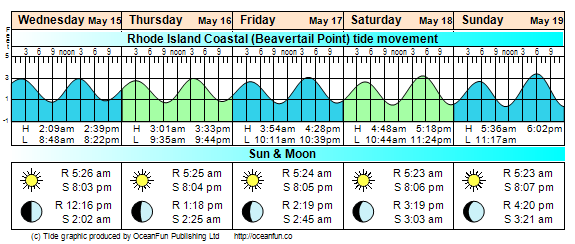
Tide data:
|
When Lightning Strikes- Remember this come Summer
| 
Every year in the heat of the summer when we face frequent afternoon thunderstorms that often include lightning, I think about an event that occurred in 1976 when a good friend and I were in Baxter State Park in Maine, rock climbing on Mt. Katahdin during the Labor Day weekend. During part of that weekend there were storms bringing rain, wind, thunder and some lightning. On Labor Day we decided not to climb but to stay low- off the higher elevations due to the thunder. Others forged ahead and attempted to traverse the Knife Edge, Katahdin's dangerous and highly exposed summit ridge. Five people were struck by lightning on that dangerous and exposed ridge that afternoon, three were knocked unconscious and had head wounds. My friend and I led a search and rescue effort in the dark to climb to the summit and pick our way along he knife edge with headlamps partially lighting the way to locate and consolidate these people, and then administer whatever medical care we could provide until formal search and rescue personnel from the Maine Fish and Wildlife and Forest Service Rangers could assist. Everyone spent the night on the summit in icy and very windy conditions as it was too dangerous to descend, and the following day the injured climbers were medivaced via helicopter to a hospital in Bangor. Everyone survived but they were very lucky to do so.
Now 37 years later I hear about and see anglers and boaters who pay little attention to thunder and lightning, who feel they can skirt the storm or claim that the lightning is too far away to be dangerous. In the mid-70's LLBean was housed in an old warehouse facility in Freeport, ME. It had exposed cielings, crooked wooden floors, no sprinklers, bad lighting and was very drafty in the winter months. It was a genuine outfitter that didn't sell all sorts of cutesy clothing and have pictures of yuppies in it's catalog. Bean's catalog was pretty spartan and all about hardcore field sports, camping and mountaineering equipment and clothing.
This was a time way before personal computers, websites and of course ordering product via the internet. You ordered product through the mail, and if I recall correctly you could order product over the telephone using a credit card, and of course you could buy what you needed when you visited the store (that never closed, just like today). Whenever we made our way north to Millinocket and Baxter State Park, we would detour from the interstate highway and stop at Bean's for supplies etc. More often than not because of our late departure from our respective jobs on a Friday afternoon, it wouldn't be until very early in the morning that we would pull into Freeport to make that obligatory stop.
There was an old gentlemen who worked in the camping department who I used to look for to say hello whenever we dropped into Beans, he had to have been in his late 70's maybe older. He had been a Maine Guide in his younger years and was very weathered- unquestionably a very experienced woodsman. When I would find him in the camping department on those late nights, oftentimes he would be asleep using the counter top of the display case as his pillow. On that Friday night of the long Labor Day weekend we needed some updated topo maps and I needed his assistance to find them. As usual I had to awaken him for assistance. When I told him what map sets I needed he asked about our plan. I told him we were on our way to Mt. Katahdin to put in some unclimbed technical climbing routes on the walls below Pamola Peak, the summit of Katahdin.
I will always remember that night and the life saving advice I got from that old timer. Upon hearing our plan he pointed his arthritic and very crooked finger at me, and shaking that finger in my face he gave me some invaluable advice- "looky hear, when you boys see your barometer start to drop and you hear distant thunder, you are close enough to get hit by lightnin'- and you damn well better get your asses off that mountain."
As we completed our visit to Bean's that night, we circled back to say goodbye, but decided to let our friend resume his beauty sleep. A precious man, that for us may have been life saving advice.
|
Featured Fly Pattern- Jack's Stone Crab
| |
Jack's Stone Crab
Jack Samson described this pattern as follows: "This little CRITTER is fun to make and EASY TO CAST, and it catches BIG FISH on the flats." Although originally designed for fishing for permit and bonefish in the Yucatan, Honduras, and Belize... this pattern works very well for Striped bass in our local waters and particularly on our sand flats. Stripers love crustaceans (crabs, shrimp, lobsters etc), and although some of us don't frequently fish with crab patterns, we should. It's really an easy and fun tie and if you like to wade fish the flats or if you like to sneak onto them in your boat or kayak... you should have success fishing this pattern. I love to fish Jack's Stone Crab on the Little Narragansett Bay flats, just south of Sandy Point. Great stuff, can't wait for spring!
Materials:
Hook: Stainless steel saltwater hook, sizes 4 to 1/0 (Gamakatsu SC15, Mustad 34007, or similar hook)
Weight: Extra-small lead dumbbell
Tail: Tuft of saddle hackle fibers
Eyes: Melted 100- pound monofilament
Claws: Medium-wide rubber bands. Knot the rubber bands to make joints, trim the ends to resemble claws, and color the claws black
Legs: Thin rubber bands or Sili-Legs
Body: The soft, "loop" sides of two round, 5/8-inch hook-and-loop fasteners. Velcro "coins" are available in sewing, craft, and department stores.
|
|
I hope this newsletter contained information of interest to you and again, I welcome input for future topics you may be interested in knowing more about. Get ready you northeast U.S. fly fishers, it won't be long now!
My best,
Capt. Jim Barr
|
|
|
|
|
|
|



