Greetings!
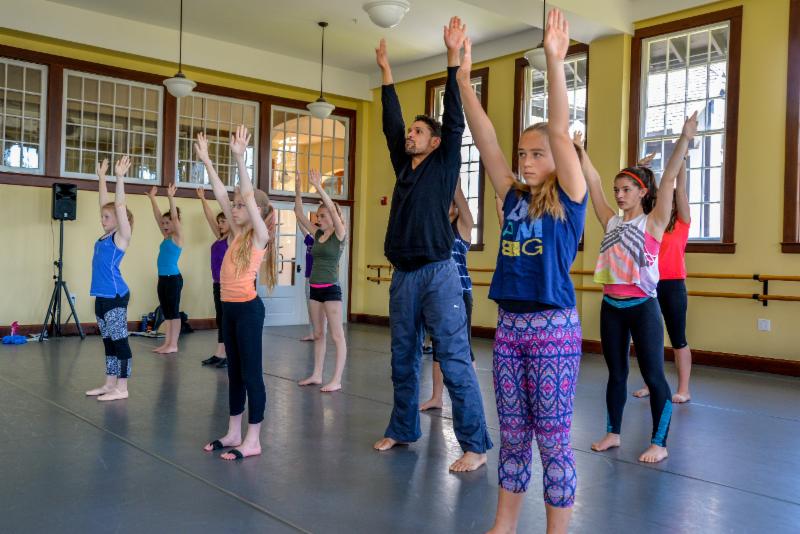
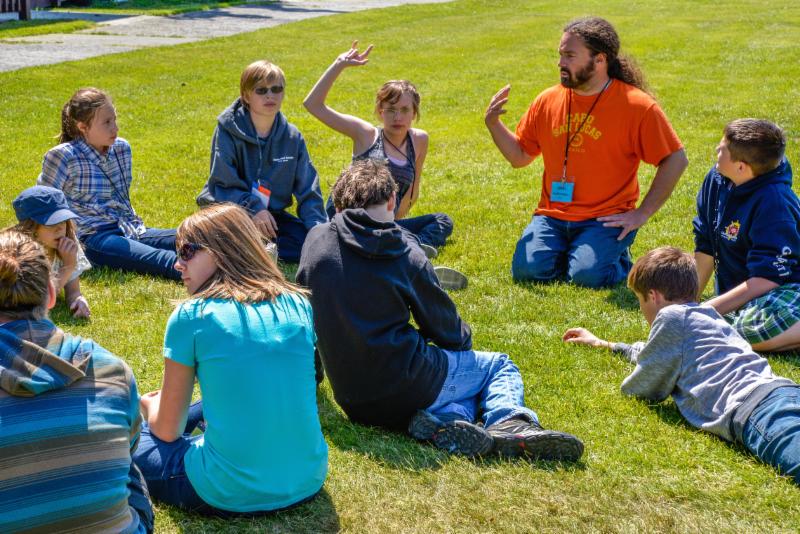
We are wrapping up our second week of the Middle School session here at Sitka Fine Arts Camp. We've had classes and creative energy in almost every building on campus. As promised, we're profiling the Middle School Camp experience, from the perspective of faculty and students. To do so, SFAC summer staff member Jacob Peterson caught up with several students and faculty members to get a better sense of what SFAC's unique, two week intensive arts experience is all about:
It is Amanda Mattes's first summer teaching at SFAC, and she is offering opportunities to students that have never before been offered at Camp. Her classes involve designing costumes and working with textiles.
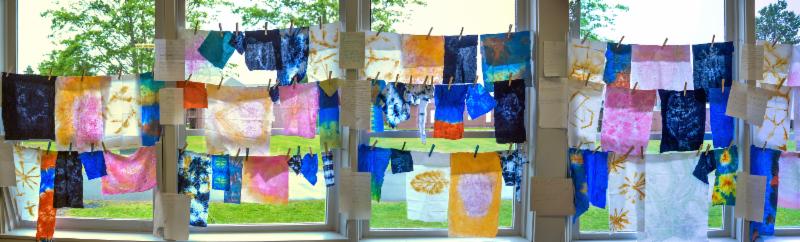
Student work in an Amanda Mattes class - Photo by Alethea Busch
I asked her if anything had surprised her in the week and a half she had been here in Sitka. She responded with a story of a camper who showed an intrinsic grasp of hidden meaning in costuming a character:
"I was asking her why she chose to do this mixed color dress on the character. And she said: 'Well it's a hidden meaning when you look at the character. We talked about what color means. So, color, right here, means power, but she's also passionate, but then she has the blue fading into it because she's also a very cold person, and so, it's like her power and her passion fades into this coldness when she takes control.' And I sat back and was like 'yes, see, that is design....' We hadn't talked about the hidden meaning, we had talked about analysis and how we could portray the character. But this student...just sort of getting it, and then explaining shadow on a figure, and how to convey that and the tonality of color. I didn't even have to draw it out, she just got it."
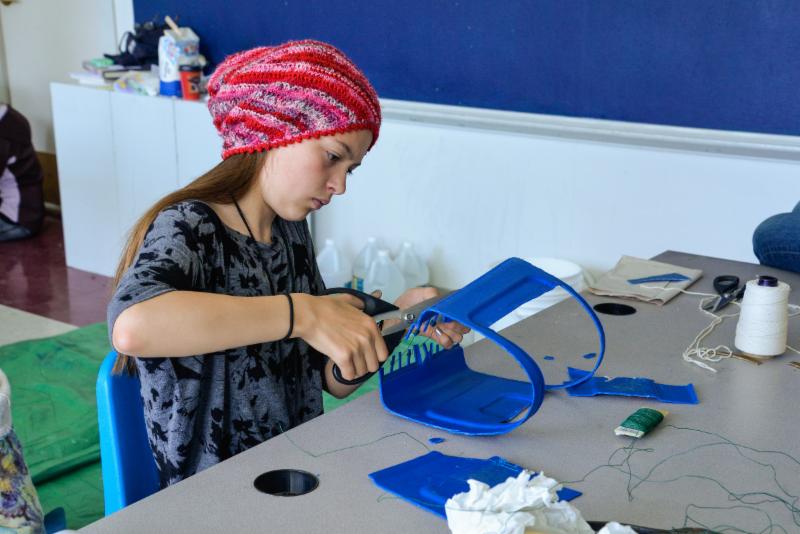
Learning costuming in one of Amanda Mattes's classes - Photo by Alethea Busch
A youthful, intrinsic understanding of the arts that are being explored is a familiar observation among the faculty I've talked with, here at the Camp. Adam McKinney, a first year dance faculty member at SFAC, talks about the multidisciplinary nature of learning and teaching at the Camp, almost a kind of synesthetic appreciation and practice of the arts:
"Most of my students here take classes in other disciplines. We were talking about a musical term -sforzando (I was a musician before I was a dancer), and relating musical terminology to physical movement. We also spoke about contrasted movements, and relating movement to the color wheel. I asked, 'if you saw a painting that was all red, how boring would that be? You might just pass right by it. But if there were a little bit of yellow in there, it would be appealing to the eye.' So, I think metaphor and relating dance to other content areas and artistic disciplines has been really useful at SFAC. And the students understand it because they are able to connect these seemingly different artistic disciplines that are absolutely interconnected."
This interconnectedness drives thrilling faculty collaborations in Art Shares, which in turn motivate students to explore disciplines they might not otherwise explore. Furthermore, SFAC faculty members approach teaching in novel and unique ways. McKinney, when asked about his pedagogical style, had this to say:
"I am interested in teaching life skills, community building, self-awareness, and empowerment through the teaching of dance technique. How can we embody excellence, focus, and full engagement; and how can that reflect who we are in the world? I feel that the reason we have art is for us to remember that we're not alone, and that we can show our best selves as human beings, and communicate that through a form that is not necessarily literal, and without words. Art is about communicating feeling, and to be able to translate this to other areas of one's life is most interesting to me as a teacher."
Throughout this week and the last, the exercise of the fine arts has been making better people. These faculty members, professional artists, are interested in not only sharing what they are so passionate about, but are also interested in helping to increase a student's ability to thrive.
Karen Hannahoe, who teaches one of SFAC's largest and perennially popular classes, Choir, details the importance of "letting kids know that their dreams and their souls are important." When I visited Hannahoe's class, she was working with her students on the last few bars of Tindley's "The Storm Is Passing Over," a traditional gospel song. She encouraged students to tap into the difficulties they had faced in their lives in order to understand and appreciate more fully what they were creating together.
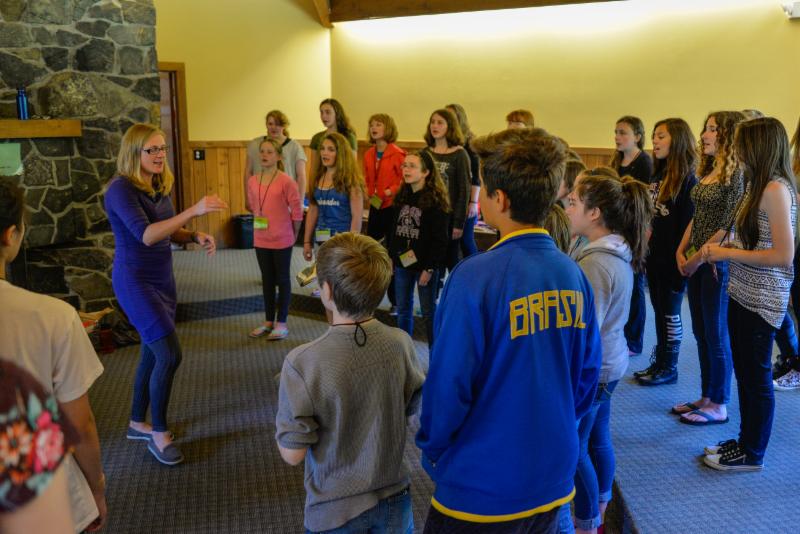
Choir in Action, With Karen Hannahoe - Photo by Alethea Busch
In a conversation after class, three of her students, Tyler, Dillon, and Jada, conveyed a sincere engagement both with what they were learning in the class and at Camp more generally, and with the methods Hannahoe uses to build a sense of trust among her students:
Tyler: I like the things we do in choir. If it were some other people that weren't used to Karen, they'd be really confused. But with the things we do, like "eyebrows activate" or "classic stance." It's really fun. ... We do eyebrow pushups.
In the interview, when I asked the students about sources of artistic inspiration, the kids seemed to struggle to understand my admittedly obtuse wording. Hannahoe, a veteran teacher, asked if she could rephrase the question, vividly getting to the crux of what I intended to ask in an understandable way.
"What puts the fire inside you?" she asked.
Jada: The energy. Everybody is so excited to sing.
Dillon: The classes. I learned to juggle, write fairy tales, do video production. It's helping me be more social.
Later, as Hannahoe detailed some of the high points of the past week and a half at Camp, she stated, "The quickness of building trust with kids and adults has been super cool. ... Because I was nervous, coming in, about how I was going to learn not just the names of 42 students, but also who they are as people...in nine days. And they've graciously opened their hearts to me so I can do that."
(Continued in sidebar...)