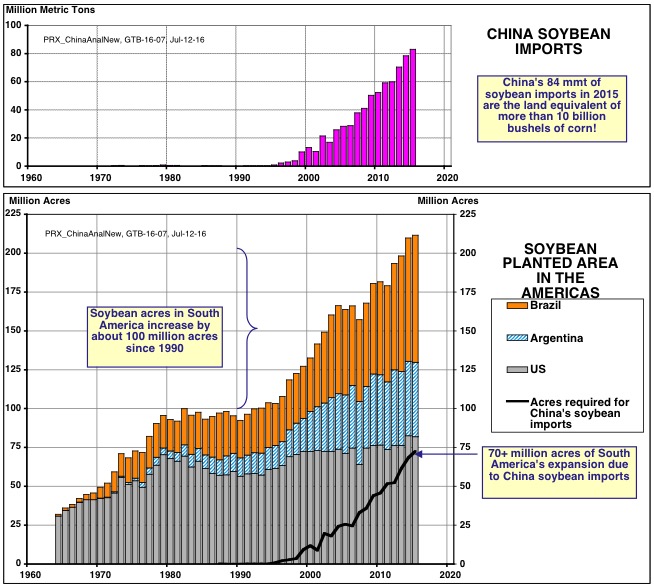
The first chart below shows the increasing volume of soybean imports during what we have called "the rise of China," since the mid-1990s. The 84 mmt of soybean imports in 2015 represents an increase of more than 70 million acres of planted area for soybeans--in the Americas.
During the past two decades, in other words, the rise of China and its associated soybean import demand absorbed most of the acreage expansion in Argentina and Brazil (including the "cerrado expansion"), which was about 100 million acres. (Second chart below.)
A further astonishing comparison: This 70 million acres of additional China soybean demand, in terms of corn yields in the Americas, would be equivalent to more than 10 billion bushels!
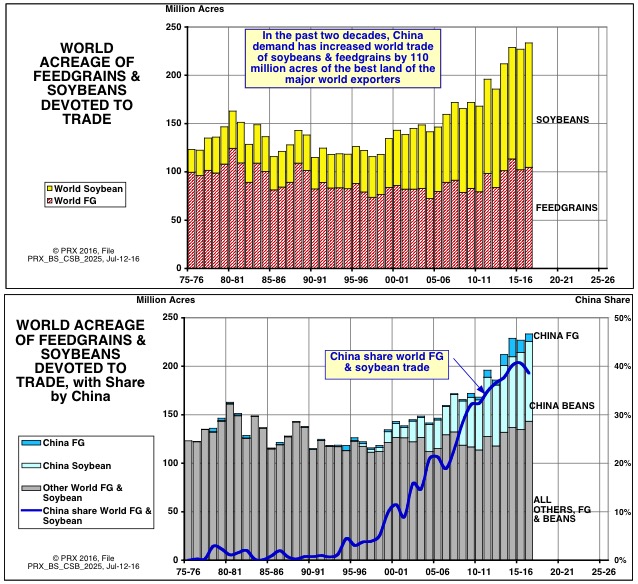
Impact of the rise of China on structure of world feedgrain and soybean trade. (Third chart below.) In terms of acreage devoted to world trade, by the major Export Hubs, soybeans and feedgrains are now roughly equal--and China buys the output of over 40 percent of these combined acres.
If not for the rise of China, and its limited resources for oilseed meal for meat and vegetable oil for cooking, "who on earth" would have needed (paid for) the additional 70 million acres of planted area? As US corn and soybean yields improved, and as Brazilian planting of the cerrado rapidly expanded, where would corn and soybean prices have been without "the rise of China"?
I have called this rise "a political-economic demand episode," a type of thing we have often seen before in the history of world grain trade, but an expansion which usually has a "beginning, a middle, and an end."
But let's be very careful about the word "end." Certainly I don't want to argue that "China's soybean demand will quickly stop." What I'm trying to build is an outlook for how much its rate of growth will slow, and when.
In the next Note, I'll look at how and why it was so "easy" for the major grain/oilseed Export Hubs to meet the needs of China, and of biofuels too, at the same time! (Recall that environmentalist Lester Brown, in his 1995 essay "Who Will Feed China," said it couldn't be done!)
Early bird registration is here (only 2 days remaining for $200 early bird discount). View the agenda here.