With regard to my assertion of China's increasing import dependence on oilseeds, I have received a number of client comments along the line that "It would make sense for China to increase its soybean area compared to corn and other feedgrains."
"Yes," I answer, "but that's the opposite of what's actually been happening over the past ten years."
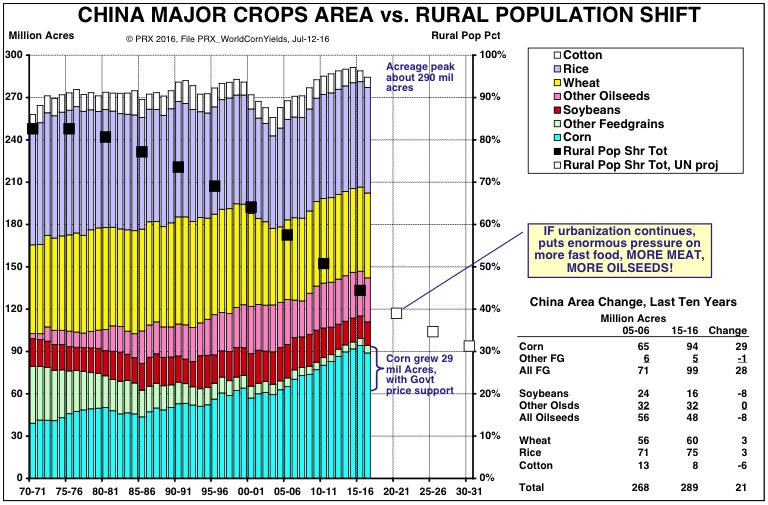
Please study for a moment the top chart below of China's total major crop area.
- The total area available for all major crops has peaked at about 291 million acres (compared to the US at about 402 million acres, per EPA).
- The figures come from the latest USDA PSD database. Years ago, in the 1970s, China's "crop area harvested" numbers were state secrets, and under-reporting took place--except that visitors could see and estimate the amount of so-called "black land" that was actually being used. Then, with the advent of satellites, the official numbers squared up. Today, there's no way to doubt that China's crop area is limited, and that something like 290-300 million acres is the limit--even with continued urbanization, moving people off the farmland and replacing them with crops and commuting.
- Notice that the current corn area harvested has increased from 65 up to 94 million acres in the last ten years, while soybean area has gone from 24 down to 16 million acres.
- This confirms that in China we do not see the practice of corn-soybean rotation, we see corn mainly in one place, soybeans in another. The domestic soybeans today are mainly a specialty crop, often non-GMO for soy sauce and other foods.
- China has increased corn area dramatically by subsidizing the rural farm prices, at the peak a couple years of about $10 per bushel--despite the fact that Gulf corn cif China was several dollars per bushel cheaper!
- It is an important comment on the efficacy of the China Communist Party's degree of "command" over the country's economy that its subsidies resulted in (1) prodigious amounts of surplus corn, degrading in storage, and (2) commercial work-arounds to import much cheaper sorghum from world exporters, especially the USA.
So the prospects for a shift of significant acreage into soybeans or other oilseeds (today, peanuts + rapeseed + sunflower = about 31 million acres) are quite unlikely. Maybe a very few million acres.
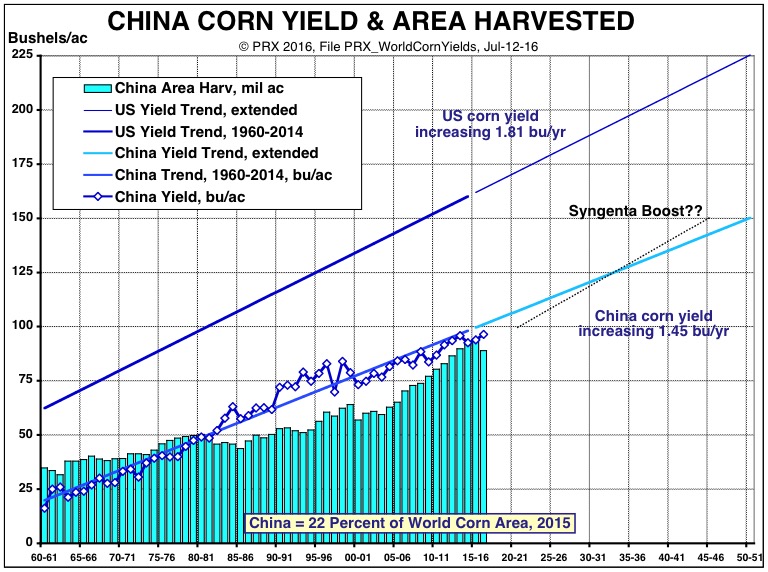
As to yield gains, note the second chart below on China's corn yield versus that of the United States. The "corn on corn" in China is farmed on much smaller plots than in the US, and generally the corn "crop residue" is removed in toto, to provide fuel for home heating. Thus the soil is deprived of both natural nutrients and structural "tilth," holding down annual yield gains, well below that of the American cornbelt.
The option for China to obtain more modern and better seeds is certainly open, as attested by the acquisition of Syngenta. I have indicated on the chart a possible yield trend increase in the longer term, but again: The overall potential of China's being able to continue its current rate of meat per capita and food oil per capita increase WITHOUT massive imports from the main world Export Hubs is very limited.
We'll cover the question of whether the Export Hubs can keep up (they can!) next week, but first we'll move to another more quixotic approach that the China Communist Party is taking, plus the question of how well its economy may perform, or not!
Early bird registration is here (only 3 days remaining for $200 early bird discount). View the agenda here.