The Energy Security and Independence Act of 2007 was signed in December of that year as crude oil price neared $100/barrel. EISA 2007 is famous for its dramatic expansion of the Renewable Fuel Standard, setting inclusion targets for domestic biofuels of 36 billion gallons in 2022. But another aspect of the Act was its equally dramatic re-setting of CAFE Standards.
The magnitude of the CAFE reset can best be judged by the change in the DOE's Annual Energy Outlook (AEO) before and after the Act. The 2007 AEO (before EISA) forecast US motor gasoline volume in 2030 at 193 billion gallons. The 2008 AEO (after EISA) forecast 2030 at 136 billion gallons, a reduction of 57 billion gallons, or about 30 percent. This projected decline was completely separate from the fact that, as already mentioned, EISA ordered that the remaining 136 billion gallons (or whatever the volume might be) would include 36 billion gallons of blended biofuels (21 Advanced and 15 Conventional).
Congress was not, of course, in the position during 2007 to know what the DOE would project in 2008, but many have argued that it "should have been"--because if the 36 billion gallons of RFS biofuels were all to be in the form of ethanol, then the blending rate would require E26, rather than what has become the legal limit of E10 (with a modernized part of the fleet at E15 and some flex fuel portion at E85).
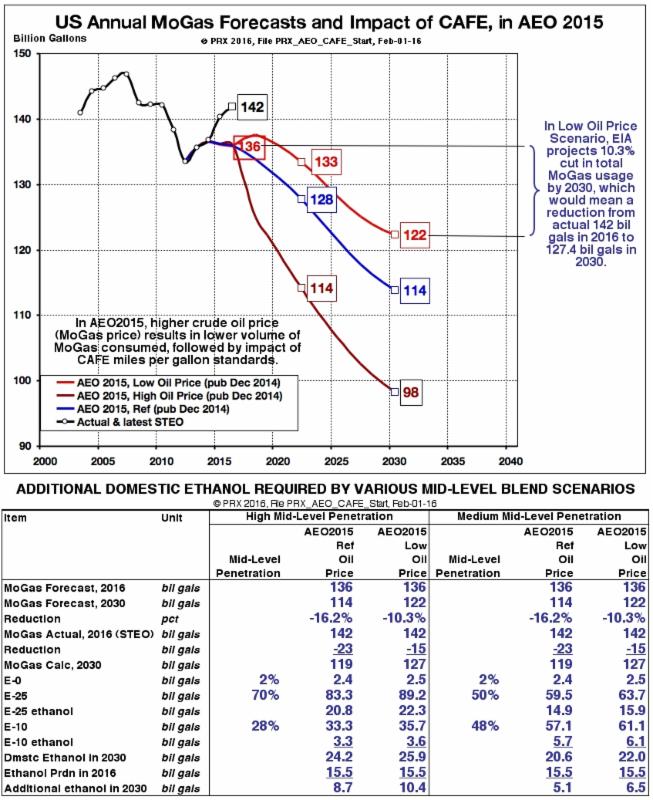
Currently, as a result of the 2007 CAFE reset and another in 2012 (to cover mainly the 2017-2025 period), the 2015 AEO forecast that US motor gasoline in 2030 would be about 114 billion gallons at moderate crude oil prices, 122 billion gallons with cheaper oil (as we are now seeing), and 98 billion gallons with much more expensive oil. Currently, the annual usage of gasoline is about 142 billion gallons. In other words, the impact of the 2012 CAFE reset is seen to be a reduction of gasoline by another 10 to 15 percent in the next 15 years. Altogether, the GHG reductions in transportation fuels due to CAFE are a very major part of what the Administration pledges will be contributed by the United States toward reducing future global warming.
Achieving the latest CAFE Standard, characterized as close to an average of 50 miles per gallon, will be a tough job. Will Americans all drive smaller cars? Will electric cars be ready and cheap enough for adoption by the majority of drivers?
What about the possibility of an alternative such as high compression engines using high octane (high ethanol) fuels? The auto industry says this would be one way to achieve the CAFE, if 50 to 70 percent of the fleet uses E25.
The chart and table below show the range of AEO gasoline forecasts, and a simplistic "snapshot" of how much more ethanol would be required for "high compression" option to work--something on the order of 5 to 10 billion more gallons.
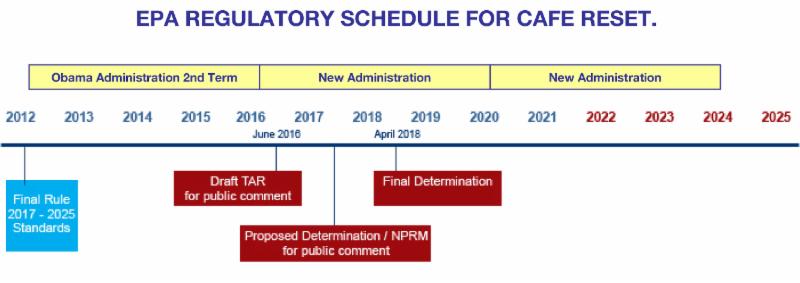
One problem with the scheme is obtaining cooperation from EPA, who would have to regulate fuel and engines simultaneously, a novel course. This problem is exacerbated by the existing schedule of rule making:
The "TAR" or Technical Assessment Report, for Auto Industry Comment is due this summer (in the middle of election season), the Proposed New Rule a year later, and the Final Rule in April 2018--both under a new Administration. With respect to the TAR, the auto industry may well ask EPA to extend the compliance schedule beyond 2025 in light of changed circumstances (from 2012), including the low price of gasoline, which is making it harder to sell smaller, high-efficiency vehicles.
This Spring I shared my snapshot with the Ag-Auto-Ethanol Working Group (comprised of all the major auto companies, and led I believe by Ford and General Motors, and with participation in from various state Corn Grower Associations). One key question the Group had was whether there would be enough corn available in 2030 for a mid-level blend approach. I showed them that an additional 10 billion gallons of ethanol in 2030 might require another 2.8 billion bushels of corn (allowing for 1.3 billion bushels of corn equivalent feed value of the added DDG), which would be below the 3.1 billion bushels of corn expected from gains in corn trend yield and steady area planted.
Conclusion. I have no idea of how EPA will extend (or not) CAFE, and I certainly have no inside idea of how the Ag-Auto-Ethanol Working Group will proceed. Plus, who knows whether enough addition of mid-level blends can be made at the pump. But it does seem reasonable to me that some "efficiency progress" will be made, and in the present Blue Sky #41 Model, we allow another billion gallons or so of domestic ethanol blending (beyond E10) to likely occur by 2025. We'll discuss this whole potential at the May 18 Roundtable.
Question. What happened to the AEO 2016 forecast by DOE, wasn't it due last December? Yes, but apparently the current crude oil price picture then and now is just too difficult to model! It may come out this summer, but there is talk is of going to AEOs every other year.