I strongly recommend reading (slowly) the actual, full text of the Law:
PUBLIC LAW 110-140-DEC. 19, 2007
SEC. 202. RENEWABLE FUEL STANDARD.
(2) APPLICABLE VOLUMES OF RENEWABLE FUEL.
(i) CALENDAR YEARS AFTER 2005.-- [From 4 billion gallons/yr in 2006 to 36 billion gallons in 2022, broken into Total Renewable, Advanced, Cellulosic, and Biomass-based Diesel]
(ii) OTHER CALENDAR YEARS.--For the purposes of subparagraph (A) [in Clean Air Act], the applicable volumes of each fuel specified in the tables in clause (i) for calendar years after the calendar years specified in the tables [2006-2022] shall be determined by the Administrator [of EPA], in coordination with the Secretary of Energy and the Secretary of Agriculture, based on a review of the implementation of the program during calendar years specified in the tables, and an analysis of--
(I) the impact of the production and use of renewable fuels on the environment, including on air quality, climate change, conversion of wetlands, ecosystems, wildlife habitat, water quality, and water supply;
(II) the impact of renewable fuels on the energy security of the United States;
(III) the expected annual rate of future commercial production of renewable fuels, including advanced biofuels in each category (cellulosic biofuel and biomass-based diesel);
(IV) the impact of renewable fuels on the infrastructure of the United States, including deliverability of materials, goods, and products other than renewable fuel, and the sufficiency of infrastructure to deliver and use renewable fuel;
(V) the impact of the use of renewable fuels on the cost to consumers of transportation fuel and on the cost to transport goods; and
(VI) the impact of the use of renewable fuels on other factors, including job creation, the price and supply of agricultural commodities, rural economic development, and food prices.
The Administrator shall promulgate rules establishing the applicable volumes under this clause no later than 14 months before the first year for which such applicable volume will apply. [i.e., October, 2021]
RFS After 2022, per EISA 2007, in Plain Language. If Congress does nothing between now and 2022, then the EPA, in coordination with DOE and USDA will determine--for (all) calendar years after 2022--the (annual) Applicable Volumes of all classes of Renewable Fuels, based on an analysis of the impact of biofuels on the environment, energy security, future production potential, infrastructure, cost to consumers, job creation, commodity prices, rural economic development, and food prices. The Law does not define how the three-agency analysis shall be "coordinated," nor what the relative importance should be among the nine or ten factors the agencies should consider. The Law also does not set specific minimums or maximums!
RFS After 2022, per EISA 2007, an Administrative and Legal Donnybrook? (British for "an inordinately wild fight or contentious dispute; brawl; free-for-all"). I have heard officials and lawyers say that there's more for EPA to go on than just the raw text quoted above, but I have no idea what they mean. Depending on which political party is in control of the Administration, doesn't the text of the Law seem to invite a re-visit by Congress? But which political party will be in control of Congress?
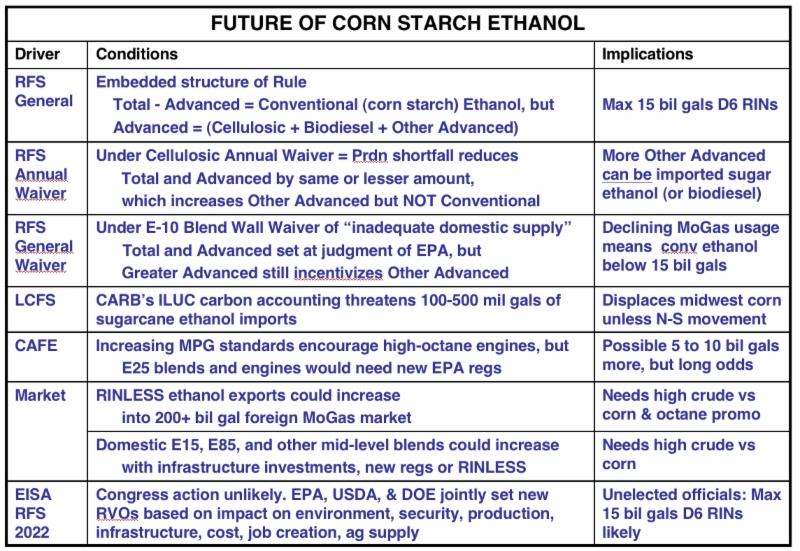
Point for Commercial Agribusiness Strategy. The issue of long-range American biofuel policy is complete guesswork. Below is the discussion framework that PRX will suggest at our Strategic Roundtable on May 18 in Kansas City (agenda here).