A week ago, I started this series of essays with a possible "glitch" in China's current pork production volume, which I extended to overall world meat consumption--and then I estimated the annual tonnage of world meat usage every year, along with the amount of corn and soybeans needed to support that growth.
I found from official USDA data that the trend of world meat consumption was growing at 4.465 million metric tons per year, carcass weight basis. I also showed that this annual increase required about 156 million bushels per year of traded corn and 52 million bushels per year of traded soybeans.
Next, by examining the past ten years of declining US export competitiveness versus Argentina, Brazil, and the Black Sea, I showed that the US share of this annual world "meat demand" for corn and soybeans was about 49 million bushels of corn per year and 18 million bushels of soybeans.
The next logical question is whether world meat demand, as roughly quantified in my snap-shot method, will suffice to absorb the coming crop production increases ahead, in terms of expected acreage and yield gains--in terms of the world's Three Major Export Hubs (the US, the Black Sea, and the Argentina-Brazil area of South America).
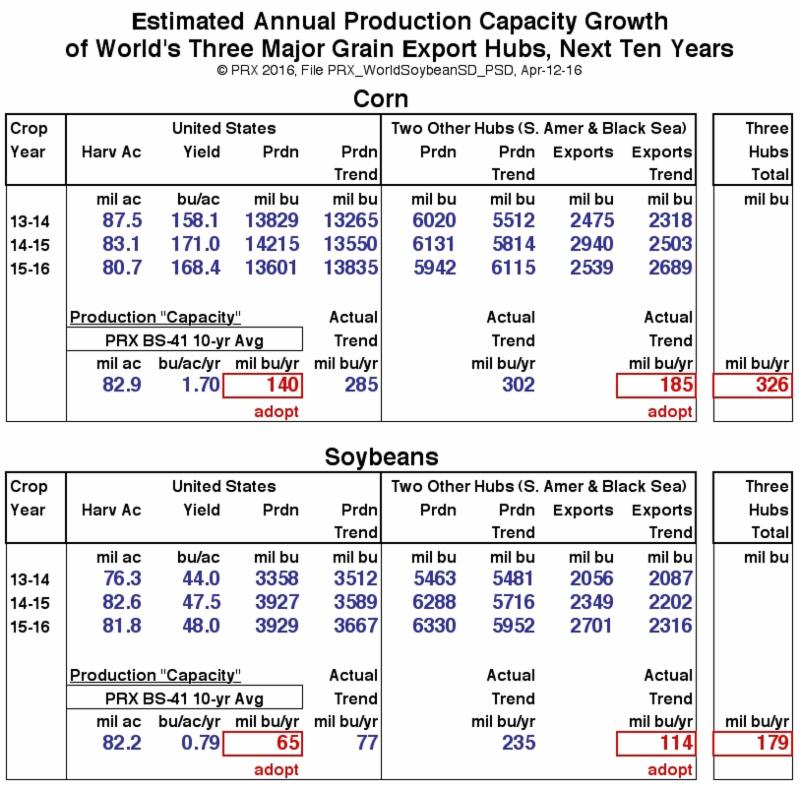
The table below is my snap-shot calculation of how I think the Hubs' production capacity will grow, first with corn and then with soybeans. This is not complex mathematics.
The recent 10-year trend in US corn production has been growing at about 285 million bushels per year, counting both acreage and yield. In PRX Blue Sky #41, we project less than that actual growth. We hold corn harvested acreage at an average of 82.9 million acres over the next ten years, with a technological trend growth of 1.70 bushels/acre per year, resulting in an annual gain of 140 million bushels per year. For the other two main Hubs, the table shows both reported production and reported exports. Let's assume that production continues up, and that exports continue on their ten-year trend, which would mean 185 million bushels per year, or a total annual gain for all three Hubs of 326 million bushels per year.
For soybeans, the Blue Sky #41 projection is 65 million bushels per year growth for the US, and 114 million bushels per year for the other two Hubs--or a three-Hub total of 179 million bushels.
Conclusion. The potential for continuing production capacity easily overshadows demand gains or mainly from greater meat consumption, and portends larger and larger surpluses. The critical question for commercial strategy is whether the future will welcome "Food AND Fuel" as opposed to the so-called policy issue of "Food VERSUS Fuel."
I'll pull the data for the two markets together in my next analysis, and this question will be one of our main items at the
PRX Roundtable on May 18th. (A few seats are still available.)