Last November, China's Ministry of Agriculture announced plans to cut and modernize its corn production, and this theme of transforming the country's feedgrains sector carried through to the overall "13th Five-Year Plan" for all of China published last month. The language of these announcements, however, is idealistic and imprecise.
However, on April 8, 2016, the USDA's "China Grain and Feed Annual" by the FAS Attache Office in China said that "2016 is shaping up to be a pivotal year in Chinese agricultural policy," referencing a March 28, 2016 policy declaration by the National Development and Reform Commission, with special focus on corn and other feedgrains.
[1]
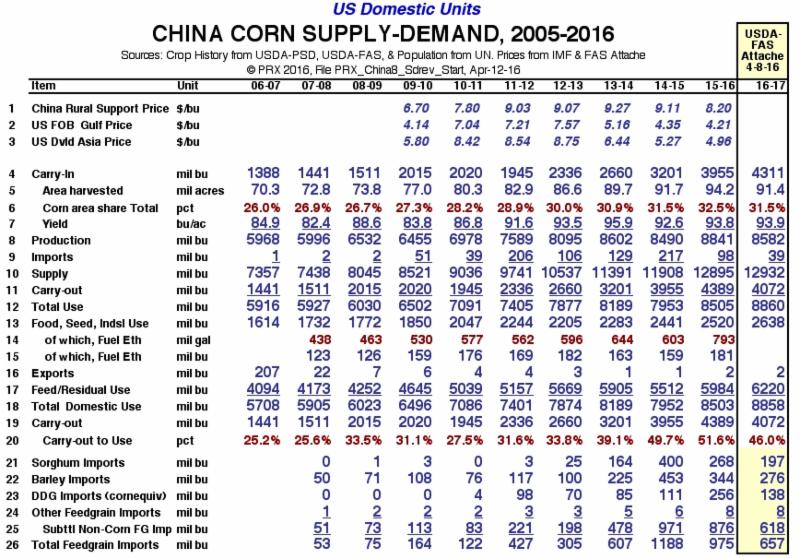
Below is the China Corn Supply-Demand Table with crop year 16-17 according to the Attache, and translated to domestic units of acres and bushels. (The WAOB will issue its own version of this and all other 16-17 tables on May 10, 2016.)
As we have pointed out previously, China's area for corn has expanded from 70 million acres ten years ago to over 90 million acres today--most recently with the help of rural support prices in the range of $9 per bushel. Carryout stocks have tripled to above 4 billion bushels, with a carry-out-to-use ratio of about 50%. Clearly, the support prices have led to a giant surplus of corn, now looking for a home somewhere in the demand part of the table. But practically speaking, commercial users have sought cheaper and better quality feedgrains from world sources, such as US sorghum and Black Sea barley.
Note that in lines 21-26 of the table, the FAS Attache expects a dramatic decline in China's overall feedgrain IMPORTS for crop year 16-17 of over 300 million bushels, including corn, sorghum, and barley. The DDG decline is my own estimate, based on the FAS forecast of lower pork production next year. (The FAS has not yet issued its view of soybean imports, but it may well be that a pause in the remarkable growth of soybeans for meal and oil may also lie ahead.)
Longer term, we really can't say much. The Five-Year Plan certainly recognizes that China has much to do in preparing its agriculture for the expanding demand ahead, assuming that the country successfully negotiates the rough waters of slowing economic growth with overall less dramatic manufacturing exports. Also, the "cuts" in the Plan focus on marginal lands, not the heart of high producing soils--which will want to see improving technology and output. There is a tone still of "maintaining feedgrain self-sufficiency," which seems completely impossible, and which altogether ignores the country's actual willingness to import over 3 billion bushels of soybeans every year for a key part of meat and food oil job already at hand.
Once again, take a look at the
agenda for our upcoming May 18 Roundtable. We will have a call-in with Dr. Fred Gale, the Senior China Economist for USDA.