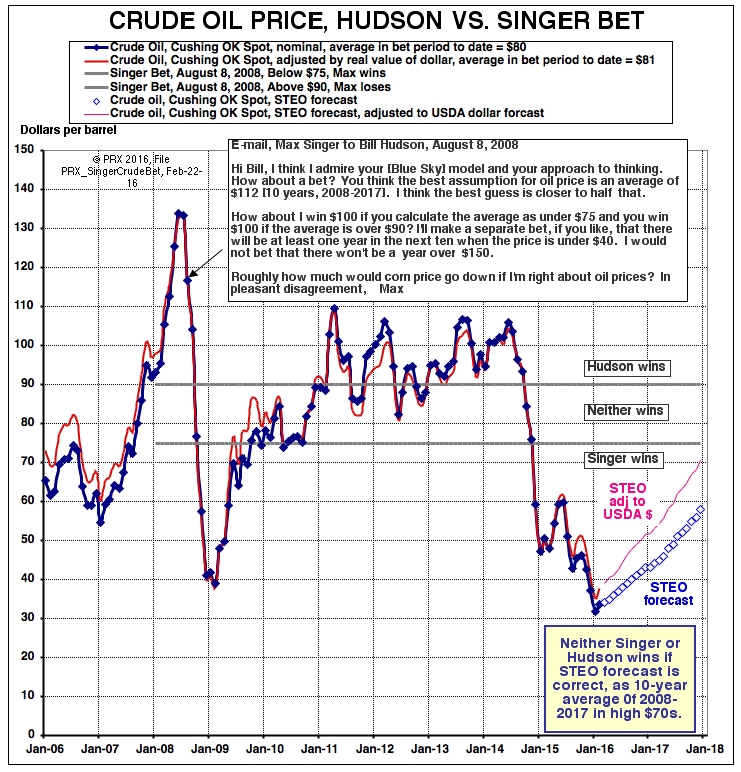
The chart below gives the details of Max Singer's 2008 bet with me on the price of crude oil, in an e-mail I received shortly after his presentation to the August PRX Summer Seminar in Kansas City. Max had told our audience in a general way his view of cheaper energy prices ahead, but after his return home he quantified the details--and I have shared his ideas at least once a year since then.
But now let me join with the many clients who probably want to ask, "How could you have possibly been so stupid?" (As though, "We all knew that crude oil price would collapse below $40 in 2015!" Ha-ha.)
In the summer of 2008, I and many others in US corn-soybean agriculture were captivated by two things: (1) The economic rise of China and the price of crude oil surging above $100/barrel, and (2) The domestic expansion of corn ethanol, brought on by the high price of crude and cheap price of corn, and majestically enhanced (we thought) by the Energy Act of 2007 and its so-called "mandate," the Renewable Fuel Standard.
I called this situation a new "Political/Economic EPISODE," like a half dozen other events in the past century, like World War One, World War Two, the OPEC Oil Embargo, and the Soviet Grain Robbery in the 1970s. I think I was correct in labeling China/Ethanol a Special Episode--but I know now that I did not realize how VERY SPECIAL it was! At no other time in history has anything like this occurred, in which over the course of a single decade a billion new low cost but able workers were added to the world economy, as a giant outsource for all world manufacturing! Never in such a short time have more than 200 million people been moved from rural areas to urban, and housed in dozens of newly constructed, modern mega-cities--needing vastly more energy, food, and everything else, including the kitchen sink!
We know too, at this juncture, that the methods of the China Communist Party worked well to conduct this expansion, but that the same methods do not seem to work very well in transforming the country from a global export workshop to a genuinely free and vigorous domestic economy. We know that the CCP methods can be used to set $8 to $10 per bushel rural prices for corn--and get abundant production, cutting off imports at half the price. We know, too, that the CCP seems not to have any equivalent policy tricks for soybeans--that they must import 70+ mmt/year from the Americas for their pork and vegetable oil supply. But amidst the economic difficulties the CCP now displays, we have to ask, "Will they run out of money for both corn subsidies and soybean imports?"
Another aspect of the crude oil price collapse has to do with the truism, "Nothing cures high price like high price." In 2008, very few of us were thinking in such terms about US fracking, but today it's easy to see that the seven-year period of crude prices above $80 to $90 enabled this technological advance to take place.
Let's come back to Max's e-mail, where he says, "Bill, I think I admire your Blue Sky model and approach to thinking." What I know Max means here is that our ten-year forecast is a "rolling 'control case' of our assumptions," and that we involve interested clients and many outside experts in setting the assumptions. We "roll" this model at least once a quarter, and we reacted rapidly to oil price decline as it happened.
One more thing we do--originally to reduce arguments among ourselves--was to deliberately "accept" the Short Term Energy Outlook (STEO) issued each month by the USDOE. It's not that we think they're going to be right, their track record is zilch. But it's a way to calm our own intuitions and not react over-quickly.
I notice, by the way, that if the February version of oil price in the STEO is correct, I won't lose my bet with Max! See the chart, neither of us will win, the 2008-2017 average price will be above $75.
You might say, however, and I hope you do, "Who cares about a decade-average of ANY price? It's the highs and lows that make the difference to successful commercial trading and investment!" I agree.
A reminder again about our March 21-22 Seminar, which will offer much more on the crude oil, China, and corn-soybean situation described above. Register here.