| |
PRX Analysis: When Will China Start Importing Lots of Corn?!
|
|
|
|
|
 |
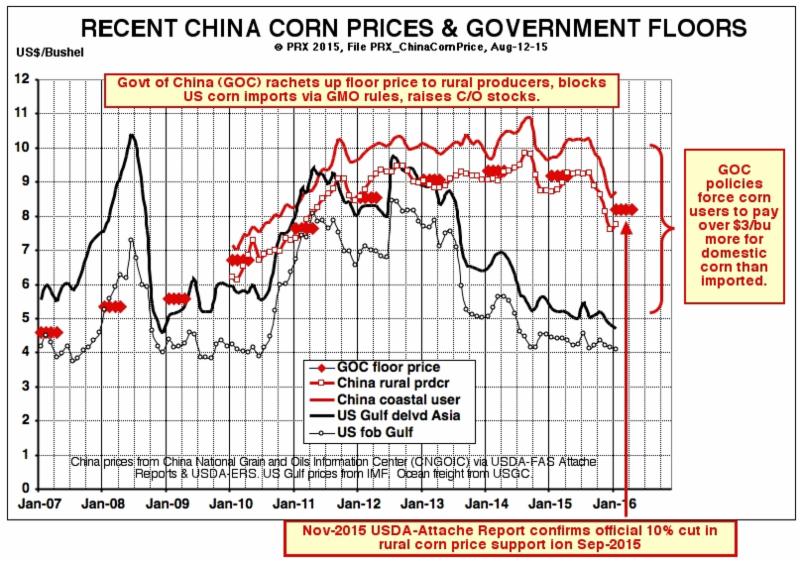
Alternative titles for this piece might be, "Getting Used to the Ways of China--It Is Not Exactly a Command Economy", or "How China Kept the Price Super-Cycle in Place for Its Own Corn Sector for Three More Years, at Least Through 2016!" The key here, of course, is China's policies on rural corn price support--and the country's ratcheting UP of these price supports for several years in a row, before finally making a 10 percent cut last September 2015. That cut, by the way, in terms of US dollars, brings the Jilin farm price down to something between $7.50 and $8.00 per bushel. I have prepared a short slide deck and podcast of the policies and their impact on supply-demand and trade. [1] (In some cases, I have converted the international metric units to domestic bushels and acres, which always helps me get the best "feel" for the numbers.) During the past ten years, as China's corn price has gone up from $5.00/bu to $10.00/bu and above, China has added over 25 million acres to its corn area harvested, and its production has increased by over 3 billion bushels. Its C/O in 15-16 is estimated by USDA at 4.5 billion bushels (about 113 million tons), and its C/O to use ratio is over 50%. If these numbers sound fantastical, then this is what I mean by "China is not exactly a command economy," at least as we might ideally think of such a thing, a process driven by "perfect reasoning" or "operated in a military style." Consider the commercial users of this high-priced corn. To successfully compete with each other, they seek lower priced corn, or its equivalent in other feedgrains. When they find such substitutes, they import them, pronto--providing they don't break the Country's trade rules. In comes US sorghum, for instance, which is non-GMO, versus US corn--but corn that is limited in volume by Tariff Rate Quotas. In comes DDG as well, but because the policy-makers want to force spoiling corn out of bulging domestic warehouses, new rules are sought to keep DDG out. So commercial efforts are met by more and more new rules, not only national but regional. Subsidies are issued to encourage damaged corn to go to ethanol processing instead of feed mills. On and on the "mad symphony of command" plays.We might not have minded the China government's raising corn prices, say in the years 2007 to 2013, while all international commodities were also rising, but we vigorously object to China keeping corn prices up when international prices started collapsing, in 2013 to 2016, and probably beyond. Today we have corn that's $3 or $4/bu cheaper than they do, and "Economics" says they should buy it! But to whom do we complain? In fact, doesn't the whole China corn price story have a familiar echo in our own laws, rules, and bureaucracies? I've listened to a lot of the political debates, and I'm not sure Americans know what they want to do. Fix things? Sure, but how and by whom? One encouraging China chart is on page 4, showing the changes in China's total crop area since 1970. Even with the share of rural population in China going down from over 80% to 45% now, the total area for all crops has grown only about 20 million acres. There's really no more acres for devoting to crops. And the more mega-cities, the more fast food is needed, and the more meat! At some point, I am quite sure, China will need corn imports as badly as it does soybeans. But not right now! More on all this by several speakers at the annual seminar, March 20-21.
[1] Slide 2 is from Fred Gale, the senior China economist at USDA-ERS, who told me by e-mail last week, "The Chinese corn S&D is very problematic now. Corn use is hard to pin down and may have shrunk. Imports of corn substitutes were over 40 mmt in CY2015 and I think MY2014/15, which displaced Chinese corn, sending it into stocks. These imports are in the crosshairs of Chinese officials. The DDGS antidumping is the first shot. Supposedly they are going to finally liberalize the corn price but haven't figured out how to do it without farmers income taking a big hit." [Fred is planning to attend our May-18 PRX Roundtable in Kansas City this Spring.]
Bill
--
Bill Hudson
The ProExporter Network
11770 Cherry Lane, Olathe, KS 66061
913-782-2462 Cell 913-226-9345
|
|
|
|
©2016 The ProExporter Network®. All Rights Reserved.
The analysis above is not intended as a trade recommendation. The analysis and forecasts are based on available public data and on the best judgment of PRX, but cannot be guaranteed to conform to future reality.
|
|
|
|