I recall many years ago a Saudi Oil Minister saying, "Where the price of oil goes, nobody knows," but as I started this essay, I could not remember his name--so I googled his quotation. Dozens and dozens of similar quotes came up, many quite recent. "Nobody knows the oil price, except Allah," said the current Minister, Ali Al-Naimi, on May 5, 2015. I'm not sure, of course, but I presume that divine powers are keeping quiet on this topic.
Lots of the google entries were along the line, "Black Gold and Black Swans," implying that the forward price of crude oil is essentially random. But in my view, the fact that "nobody knows" does not mean that a principal economic variable in the world is actually random. Besides, there is no way not to have an opinion. Our job as strategic forecasters is to come closer to the reality than our competitors, if only "slightly sooner by a tiny amount."
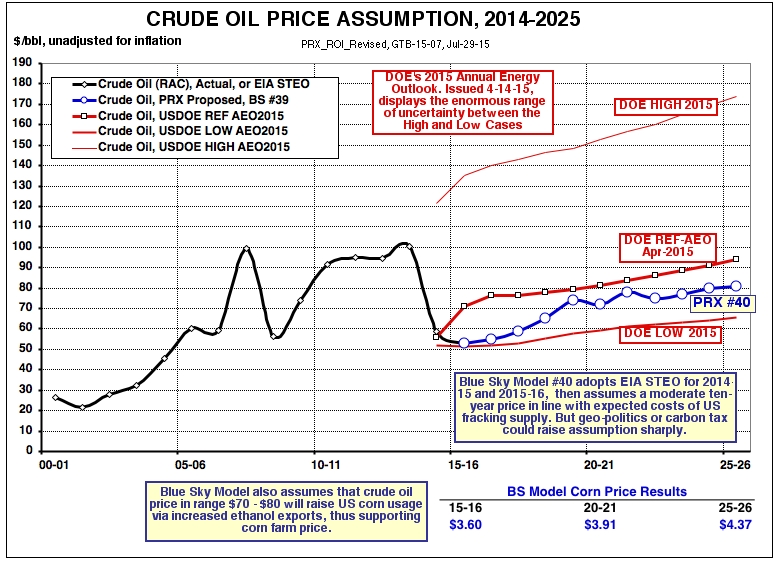
In developing the PRX Blue Sky Approach, our team has come around to the following approach: (1) We link our forecast for the next 18 months to the DOE's Short Term Energy Outlook (STEO); (2) We study and display the next 10 years of the DOE's latest Annual Energy Outlook (AEO); (3) We discuss the subject among ourselves and key clients twice a year at Roundtable meetings; and (4) We state our reasoning and take our best shot.
The result is shown in the chart below. The track record of the AEO forecast over the past 25 years is of course lousy, and DOE officials will candidly agree. But the highs and lows of the official 2015 forecast are striking this most recent AEO: Notice the enormous range between the low scenario and the high scenario, and then notice the bias of the "Reference Case" toward the low side. "Nobody knows," the DOE economic team is saying, "but we bet it's on the lower side more than the higher, and then with prices back up to the $90 range."
The same thing goes on with the STEO team, only more frequently, every month in fact, and we track how and what direction the team's monthly forecasts change--versus what the market price has done, and what oil futures say. The next STEO is August 11, and we think the DOE will come down. If this is true, then we'll change our ideas of 14-15 through the next few years as shown, closer to the low side of the range, but still ascending in several years to $70 of $80 per barrel (WTI).
What Does the Forecast Mean? As we have previously discussed, we use a five-factor regression model for corn farm price that relies on crude oil price as a proxy independent variable for speculative interest in commodities. In fact, each $10/bbl change in crude means about a 20 ct/bu change in corn. Our revised crude forecast, then, if all other corn fundamentals are held constant, would mean corn prices in the range of $3.50 to $4.50 (rounded) in the next ten years.
How Does This Compare with USDA's Baseline Forecast? PRX is higher by at least 50-75 cents, and we think rightly so--or "logically so." As far as we can determine, the USDA baseline does not connect corn price with crude oil price directly, but instead with smooth trends of the global economy. This ignores, in our view, the existence of a 15-billion gallon corn ethanol processing industry, which (in its own profit-seeking interest) will export corn ethanol if world crude oil prices are high enough (in the range, as we guess, of $70-$80 per barrel).
In a way, our approach is that the new American ethanol value-added business provides a kind of "support" for corn farm price, particularly when domestic ethanol demand is constrained by regulatory measures. If corn price is low, but world crude oil price goes up, then the world fuel market jumps in to buy corn ethanol--and the US farm corn price responds.
But what about the case of corn being cheap and crude oil staying cheap "forever" too? Maybe, but it's difficult to look at the big crude oil powers -- Iran, Iraq, Saudi Arabia, Russia, and the rest -- and have confidence in long-term peace and stability. With low prices now, constraining forward investment, our opinion is that a new "story" will unfold, with a new episode of higher prices fairly soon.
Much more on this at the Aug-25/26 PRX Seminar. Seminar registration is here.