|
|
PRESIDENT'S REPORT
|
|
From Susan Landes
Summer Samba 2015
Hello Connumity,
Yesterday Ken and I took a motorcycle ride up past Grass Valley, and Downieville to Lake Almanor. Today we are in the little town of Chester heading to Mt. Lassen. It was a lovely ride through the Sierras with gorgeous views of mountains, pine trees and rivers. It is times like these that I feel grateful to live in the Sierra foothills. While riding I was thinking about our community at SFPRG. For over 20 years I have been able to rely on this community in so many ways. Although it has been nice to have received referrals from members of the community, it has not been my biggest motivation for staying involved. It is said that in a work environment recognition and praise are more important than title and pay. As a therapist who has often worked alone, having community support has greatly enhanced my work. When I have felt stuck with a client or caught up in a passive into active test having other like minded professionals to rely on for consultation has been invaluable. Recently, I was stuck on a case and Norman Sohn gave me an incredible piece of insight that resolved my confusion in about ten minutes. I believe we all need community to continue to provide the quality service that we strive for. Every year the clinic produces some of the most talented therapists I have met. Let's all do whatever we can to support these wonderful young therapists for they are the future of our community.
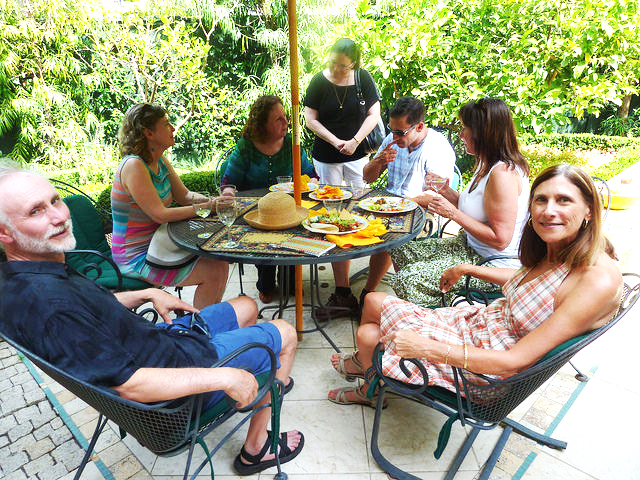
In other news: the Summer Samba membership party at Broitman-Basri home was very nice. A big thank you to Jessica and Gibor. The food, the music and the company were all great fun. I appreciated that three of our new interns were there. I would like to announce that we have a new board member, Camerin Ross. We now have five former interns on our Board of Directors! As Fall approaches please mark your calendars for two events, The Annual Honorary Dinner, September 19th, honoring Dr. Steve Foreman. The Fall Conference on Using Patient Feedback to Improve Psychotherapy Effectiveness, Nov. 7th. Please see below for details.
Enjoy the rest of your summer,
Susan Landes
|
|
Membership Drive/Directory
|
|
|
We have extended the deadline for our Membership Drive! It is not too late to make it in to the new printed Membership Directory. Please support this organization by renewing your membership. If you are not a member, now is the time to become one!
Please use the form that you have received in the mail. If you cannot find it, please contact the office and ask for a copy.
Although our Member Directory has been online for several years, some of our members prefer to use a hard-copy paper Directory. We will be mailing out a new Member Directory that lists our dues paying members sometime this fall.
Thank you to those who have renewed their membership!
|
|
2015 SFPRG Honorary Dinner honoring Steve Foreman
|
|
|
Get your tickets now for the dinner where we will honor our past president Steve Foreman. (click here)
This year we have the privilege of honoring Steve Foreman for his prodigious contributions to both SFPRG and Control Mastery Theory. After receiving his BA from Cornell University with Distinction in all Subjects and his MD from Thomas Jefferson University Medical School, he came to San Francisco to do his residency at UCSF's Langley Porter Psychiatric Institute. That was in 1979. While in residency at UCSF, Irwin Gootnick introduced Steve to Control Mastery Theory and the Mt. Zion Psychotherapy Research Group, our original name. Steve has been actively involved with SFPRG ever since. He has served on the Board of Directors from 1985 to the present, and at different times he served as chairman of the Education Committee, the Continuing Medical Education Committee, the Fundraising Committee and the Research Committee. He was Treasurer from 1995 - 99 and President of he Board from 2008 -14. Currently Steve serves on the Board as the Past President.
Steve has been involved in research, teaching, and supervising from a Control Mastery perspective from almost the beginning of his career as a psychiatrist. He has taught courses on subjects such as Child Psychotherapy, Mutuality and Intimacy, Child and Family Therapy, Couples Therapy, Treatment of Adolescents, and Psychotherapy Theory. He has taught a course on Special Aspects of CMT, a Post Graduate Course on CMT, and a course on New Directions in CMT. He has been teaching a continuous case conference seminar, The Therapeutic Process, at SFPRG since taking it over from Hal Sampson after Hal retired in 2004. Steve has also supervised interns at SFPRG since 2002. Steve is one of the mainstays of the San Francisco Psychotherapy Research Group. He is a highly skilled and collaborative physician, an original thinker, a prolific writer, and a major contributor to Control Mastery Theory.
The dinner is a fundraiser at $125. Everyone who attended last year's dinner raved about the restaurant, Piatti's Ristorante in Mill Valley. So delicious! Purchase your seat now for the September 19th event! Click here.
|
|
Clinic Report
|
|
Ginger Rhodes
Summer is coming to an end and that means we are busy, busy in the clinic gearing up for the new rotation year that begins in September.
We say goodbye to several of our trainees this month. Camerin Ross ends her fourth year at the clinic this August. She will concentrate on taking her exams for licensure this fall and her growing private practice in Sausalito. (Keep her in mind for referrals!) Camerin will continue to work with the clinic though as the coordinator for our group training. She is on the didactic training schedule this fall and will help those interested get some psycho-education groups. She has been working to get a process group started and hopes to make that happen sometime this fall. Camerin has played an instrumental and enthusiastic role in establish groups in the clinic. Josh Rothenberg and Lindsay Durgan will also be completing their training with us but later this fall.
Goodbyes make room for hellos. And we have eight new people that we will welcome this September including two people from Norway. We will welcome Alisha Eastwood from Palo Alto University, Denise Stilwell from California Institute of Integral Studies, Elizabeth Wake from Alliant University, John Sanders from California Institute of Integral Studies, Jay Reid working toward a Licensed Professional Clinical Counselor, and Noah Asch from John F. Kennedy University. From Norway we welcome Ase Mattson and Katrine Nodtvedt. We have posted their photographs and short bios in the kitchen of Building 9. Take a look and be prepared to give them a good welcome if you see them in the building.
We have a very full house in the clinic this year. We have nine trainees returning this year and eight new people joining us. That is 17 people, all hungry to work with good referrals. So please, keep us in mind!
|
|
Fall Conference
|
|
|
Using Patient Feedback to Improve Psychotherapy Effectiveness, which will be held on Saturday, November 7th at the Jewish Community Center in San Francisco from 9-4:15pm (6 CEs available). This workshop is co-sponsored by the North American Chapter of the Society for Psychotherapy Research, and features:
- George Silberschatz, PhD, Clinical Professor, Department of Psychiatry, University of California San Francisco
- Leonard M. Horowitz, PhD, Professor of Psychology, Emeritus, Stanford University
- Janie Hong, PhD, Partner, Cognitive Behavior Therapy and Science Center, Assistant Clinical Professor, University of California Berkeley
- Victoria Lemle Beckner, PhD, SF Group for Evidence-Based Psychotherapy, UCSF Department of Psychiatry
- John Snyder, PsyD, Research Director, SFPRG Clinic and Training Center
- Discussant: John Curtis, PhD, Clinical Professor, Department of Psychiatry, University of California San Francisco
We anticipate this workshop will generate a lot of interest and be well attended. Space is limited, so register today at sfprg.org. The cost for SFPRG and SPR members is $60, non-members $80, & students/interns can attend for $20!
|
|
Hal Sampson's Presentation to Associazone Fiorentina Degli Psicoanalisti Neo-Freudiani
|
|
Harold Sampson, Ph.D.
This is the seventh installment of the lecture given by Hal Sampson in April 1997 in Italy. See the previous newsletters for the beginning. Our newsletter Archive is accessible from our website homepage, on the right hand menu below the newsletter sign-up.
Research
I will conclude my talk by telling you a little bit about the research program our group has carried out over the past 25-30 years. My main purpose in doing so is to illustrate the heuristic as well as explanatory and predictive power of Weiss's plan concept. Our research also provides evidence that therapeutic processes are understandable and lawful.
In carrying out research, we are engaging in a characteristic human enterprise that expresses a spirit of inquiry and a quest for understanding. Our research is not an arcane activity remote from clinical practice. Our studies are directly related to practice, and have influenced our own clinical work. We test out whether certain ideas derived from clinic work hold up when we examine them more closely, and try to control for some potential sources of bias and error. Out central question is the same as that which guided Weiss's earliest process notes studies: How does psychotherapy work? How do we actually help a patient to become more aware of his mental life, and more able to experience himself and his relational world in new ways? Stolorow (1992) described our work as showing "how research guided by psychoanalytic theory that is both experience-near and relational can produce findings that are highly relevant to clinical practice."
Our studies of the therapeutic process have been carried out on verbatim transcripts of psychotherapies or analyses. I will describe one of our research studies in order to give you a more concrete idea of our methods, as well as to illustrate the relation between our finding s as some broad conclusions I shall draw from them.
This study was carried out by Dr. Polly Fretter (1984; and Silberschatz, Fretter & Curtis, 1986). She investigated the hypothesis that a certain type of case-specific interpretation will lead to immediate patient progress. This type of interpretation is one that a patient can use in his efforts to carry out his unconscious plan to overcome his problems. We refer to such interpretations as "plan compatible," or "pro-plan." In order to make Fretter's study understandable, I must present a clinic vignette to illustrate the concept of pro-plan and anit-plan interpretations.
Mr. Gray, a 24-year-old single man, unconsciously believed that the analyst, like his mother in childhood, would be threatened by his independence, would be possessive, and would desire to keep him dependent and to "own" him. Until he disconfirmed these beliefs, he could not safely rely on the analyst and use his help on other issues. From studying the opening weeks of the analysis, we inferred that Mr. Gray's initial plan was to work to try to understand and change these beliefs. He worked to do so by repeatedly testing whether the analyst was hurt or threatened by his independence. He unconsciously hoped the analyst would not be threatened, as this would help him disconfirm his beliefs. He also tested whether the analyst was pleased when he behaved despondently, and he unconsciously hoped the analyst would not be.
Mr. Gray construed virtually every interpretation during the first 16 months of his analysis from the single-minded perspective of his plan to overcome his belief that the analyst wished to own him. An interpretation by the analyst that Mr. Gray felt uncomfortable about not needing the analyst during the analyst's recent vacation was "pro-plan" for this patient. It meant to him that the analyst was not threatened by his independence from him. This interpretation also pointed to Mr. Gray's discomfort about independence, and led directly to his recall of childhood situations connected to that discomfort. Mr. Gray recalled his perception, in childhood, that his mother was hurt and depressed when he began to form friendships outside of the home.
In contrast to the pro-plan interpretation, the interpretation that Mr. Gray was afraid of closeness to the analyst was anti-plan. Mr. Gray construed that interpretation to mean that the analyst wanted Mr. Gray to become close and dependent on him. Mr. Gray responded to this interpretation with anxiety, confusion, and hesitation in talking. The interpretation may have been correct, but it was not useful at this time because it did not help Mr. Gray to carry out his immediate therapy plan.
To be continued in next month's newsletter.
|
|
Save the Dates!
|
|
|
Please put these dates in your calendar!
Our Annual Honorary Dinner will be on September 19th where we will be honoring our recent Past President, Steven Foreman. Steve has been a stalwart member, teacher, supervisor and board member for many years.
November 7th - a day-long conference "Using patient feedback to improve psychotherapy effectiveness"
|
|
Bring a CMT conference to your area
|
|
|
If you live outside of the Bay Area, SFPRG needs your help!
We want to present conferences on CMT outside of the Bay Area. Do you have connections with an organization that could either sponsor us or allow us use of a mailing list? We are APA approved so we can give CE hours anywhere in the U.S. If you know of an organization that would sponsor us, we can provide a lecturer; if you can get us a mailing list and leads on venues, we can do the rest.
Please contact Rob in our office (rob@sfprg.org) if you can help!
|
|
Do You Use Amazon.com?
|
|
Support SFPRG!
Amazon.com has a program called AmazonSmile which will give a small donation from your purchase to the nonprofit of your choice. Thank you to those who are participating. We have already received small checks from Amazon! Please bookmark AmazonSmile and designate the San Francisco Psychotherapy Research Group as your charity of choice! Link to AmazonSmile here
|
|
|