|
|
PRESIDENT'S REPORT
|
|
From Susan Landes
Hello Community,
The New Year is underway and I am excited about many of the events that are in the works. First, we have the upcoming International Conference on Control Mastery Theory. This year we have an inspiring group of teachers bringing you many new and interesting ways to challenge and improve your clinical work. Second, on March 28, Valerie Crawford is going to teach a class on Emotionally Focused Therapy. I went to a conference with Dr. Sue Johnson last week and was very impressed with her compassionate, relational approach to treating couples. Thirdly, my plans for the Ladies Luncheon are coming together. We will be schmoozing, having lunch and listening to a speaker at the Delancey Street Restaurant on the Embarcadero. Date to be announced soon. If any of you have a recommendation for a speaker on, Current Trends in Treating Women or Practicing Psychotherapy Across The Lifespan, or another related topic, please let me know. Continuing Educations hours will be provided.
Board members are working hard on following through with the projects that were generated out of the last retreat. The board has also created a sub-committee to develop a contract that spells out the role and responsibilities of board members including time and financial commitments. A big thank you to the board for your contributions.
As I write this, I'm sitting on a plane to Las Vegas. I'm thinking about gambling. Not that I am much of a gambler, but I am not risk adverse. Getting involved in board service with a non-profit involves a level of risk. When Steve Foreman asked me to join the Education Committee four years ago I was both honored and scared. Looking back, it has been a very rewarding experience and a way of giving back that which was given to me. I am asking some of you to take a risk too and join us in our efforts to bring quality clinical services to those who have limited means and to support our ongoing efforts to bring Control Mastery to a larger audience. We have tasks that can take just a few hours. For example, we could use a couple of people to help publish another paper directory of our membership. If you can donate a few hours to help please contact Rob in the office or me.
|
|
Education Report
|
|
Jack Maslow, Committee Chair
It's almost time for the Annual Conference again and we are looking forward to another year of excellent presentations and an opportunity to learn and explore in depth the many dimensions of Control Mastery Theory. For those of you who have attended the workshops in the past, you know about the high caliber of the faculty, and the opportunity for stimulating exchanges. New workshops this year include Steve Foreman and Jamine Ergas presenting on transference and counter transference issues regarding sexuality in the therapeutic setting, and Norm Sohn presenting on Interruptions in the Authority of the Self. Marshall Bush will also be presenting research on dreams and their role in stress management.
This is the one time of the year when colleagues from around the country and around the world gather to present, to learn and to share their work and ideas. There are courses and trainings for clinicians of all levels of experience. We welcome and encourage the participation of highly experienced Control Mastery practitioners as well as students and "newly minted' therapists.
Look in the next newsletter for times and dates of two more educational events taking place this Spring: a presentation by former SFPRG intern Valerie Crawford on EFT and Control Mastery, and a conference in late Spring With Diane Sufffridge and Susan Landes looking at psychotherapy through the lens of psychoanalyst Nancy McWilliams, CBT and Control Mastery theory. Dates of these conferences will be announced.
Control Mastery is Alive and Well in Thailand
Last month my wife, Sheryl, and I had the opportunity to be in Chiang Mai Thailand and have dinner with Tinakon Wongpakaran and his wife Nahathai, both of whom are psychiatrists teaching at Chiang Mai University. Some of you know Tinakon from his attendance at the March workshop a few years ago, and as a strong proponent of Control Mastery Theory. We had an absolutely delightful time with them talking about their work, and sharing with them what is happening at SFPRG. Tinakon first learned of Control Mastery while studying at the University of Toronto, where a supervisor gave him a copy of How Psychotherapy Works.
Of particular interest is that the research and the clinical application of Control Mastery seems to transcend culturally boundaries and differences. This is demonstrated in an article published by Tinakon and colleagues in July, 2014 on "Using Control-Mastery and Jungian Theories to Treat Nightmare Disorder: A Case from Thailand". This is a very interesting article, and anyone interested in obtaining a copy can email me at: maslowj@comcast.net. I will gladly forward you a copy.
Continuing Education courses are on the website.
Information and registration for our weekly case conferences is on our website. Spring weekly conferences starting up now.
|
|
Mark Your Calendars!
|
|
|
Annual International Conference on Control Mastery Theory. March 2 - 6, 2015. We will have classes you should not miss! Information here.
Please let your colleagues know about our Introduction to CMT class on Saturday, February 28.
|
|
Estelle Weiss 1921 - 2015
|
|
Jessica Broitman
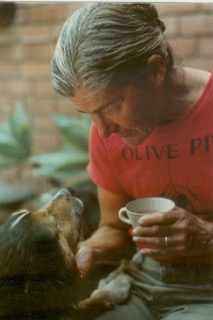
It is with great sadness that I inform the SFPRG community of the death of Joe Weiss's beloved wife Estelle. Estelle Miller Rogers Weiss was born in Galveston, Texas in 1921 where her parents ran an oyster farm and seafood restaurant. She graduated from the University of Texas, Austin for her undergraduate degree and attended medical school at UT in Gavelston. She then studied pediatrics and psychiatry in St. Louis and San Francisco where she met Joe.
In addition to being a psychoanalyst, Estelle was an artist, poet, a William Blake scholar and naturalist. She had a unique command and love of words a very dry, wicked original sense of humor.
Estelle worked closely and acted as a sounding board with her husband Joe in developing the Control Mastery theory for many years in their San Francisco home. She read and edited every word he wrote, and was famous for hosting endless tennis lunches and SFPRG parties!
Estelle also had a deep love of her dogs; from Snapper, Mahjong and Blue from her childhood days to Mickey, Sage, Clover, Mullein, Jimbo and Space. Estelle painted many portraits of these dogs and Joe, in various poses, during her lifetime.
She lived at the Redwoods in Mill Valley, CA for the last seven and a half years of her life.
She is survived by her son John, and two daughters Martha, Elizabeth and her three grandchildren Annie, Isabel, and Eli; as well as a number of very close friends including Martha Walters who provided much love and support to Estelle. A family memorial is planed in the near future.
|
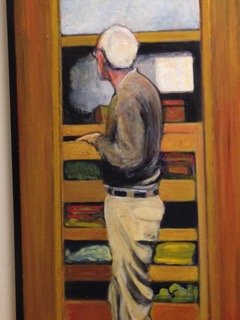
Painting of Joe at the closet by Estelle Weiss
|
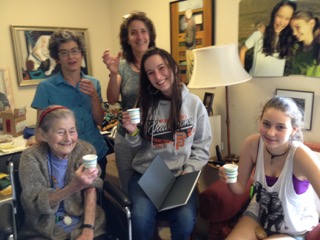
Estelle with her daughters and granddaughters
|
|
Hal Sampson's Presentation to Associazone Fiorentina Degli Psicoanalisti Neo-Freudiani
|
|
Harold Sampson, Ph.D.
This month, continuing our series of presenting talks by our founders, we begin to serialize a lecture given by Hal Sampson in April 1997 in Italy.
I am please to be in Firenze. This city, during the Renaissance, celebrated the value of the individual human being, and the power and glory of the creative human mind. Here too arose the bold conviction that man may learn directly from nature as well as from authority. These ideals of the Florentine Renaissance are still relevant to our work today as psychoanalysts and psychotherapists. We value long-term, intensive psychological therapy which allows the individual the freedom, safety, and leisure to explore and to come to terms with his childhood and his unconscious mental life. We seek to help liberate the individual's own potential and creativity. We are committed to learning from the observation of nature as well as from the teaching of authorities.
I am also pleased and honored to present to this Association which combines an appreciation of our common psychoanalytic traditions with an openness to new ideas and new observations. In this spirit, you have welcomed the ideas of such pioneers of independent thought as Harry Stack Sullivan and Karen Horney. These pioneers recognized that the human infant has from the beginning a primary motivation toward relationships, a primary motive to seek and maintain his all important ties to his parents. For Sullivan, need satisfaction is from the beginning based on interpersonal needs, and these needs integrate the infant with the significant other. Both Sullivan and Horney recognized that anything that disturbs the infant's sense of security in relation to his parents causes anxiety. For both theorists, it is this relational anxiety, and the strategies or security operations used to cope with it, that is central to the development of psychopathology.
Today I am going to present the work of Joseph Weiss, myself, and our colleagues in the San Francisco Psychotherapy Research Group. As you will hear, this work is in many important ways compatible with the contributions of Sullivan and Horney, as well as of other relational theorists past and present.
I shall introduce the work of our group informally by telling you a little bit about its early history. My purpose in doing so is to give you some orienting intuitions about us, our ways of thinking, and our assumptions, as well as about the project in which Weiss and I have been engaged for more than 30 years.
A few years before Weiss and I began our collaboration, Weiss undertook a study of process notes of psychoanalyses. Process notes are the notes that the analyst makes after each session for his own use or for use in clinical supervision. Weiss began to study process notes because he was not entirely satisfied with the theories of therapy he had be taught in psychoanalytic training. These theories did not help him to understand just what enable his patients to make progress. Therefore, her started his study of process notes with this broad question: what brings about therapeutic change in psychoanalytic treatment?
Weiss addressed this question empirically: that is, by putting aside preconceptions and examining closely what changes took place and how these changes could be explained. His first step was to identify in the process notes every clear instance of significant therapeutic process. Examples of progress included a patient becoming aware of previously inaccessible thoughts or fantasies or memories; or experiencing new affects such as anger, sadness or joy; or developing new insights; or showing greater freedom, liveliness or playfulness in analytic sessions or in daily life. Weiss referred to all such changes as "the emergence of new themes in analysis."
What brought about these significant changes? To answer this question, Weiss first looked at what the analyst had done shortly before a new theme emerged. Somewhat to his surprise, he found that quite often the analyst had not done anything. More precisely, the analyst had not done anything prescribed by psychoanalytic theories of technique. The analyst had not interpreted a transference or resistance; had not pointed to patterns in the patient's associations; had not interpreted a relational drama taking place between the patient and analyst; had not confronted the patient's defenses; had not inquired into or communicated his empathic understanding of the patient's feelings, motives or behavior. We know that all of these typical analytic interventions may be useful; but Weiss' interesting discovery was that a patient frequently makes important progress without the benefit of such interventions.
What did this observation mean? It did not mean that the analyst had no impact on the patient's progress, for the change did take place in the course of their collaborative work. The observation, however, suggested that psychoanalytic theories of therapy - at least back in those days some 30 years ago - were incomplete. These theories did not explain just why a particular change took place. They certainly did not explain what enable the patient to make progress at just this time. These theories did not explain just how the analyst, in the absence of technical interventions, had helped his patient to make progress.
To be continued in next month's newsletter.
|
|
Bring a CMT conference to your area
|
|
|
If you live outside of the Bay Area, SFPRG needs your help!
We want to present conferences on CMT outside of the Bay Area. Do you have connections with an organization that could either sponsor us or allow us use of a mailing list? We are APA approved so we can give CE hours anywhere in the U.S. If you know of an organization that would sponsor us, we can provide a lecturer; if you can get us a mailing list and leads on venues, we can do the rest.
Please contact Rob in our office (rob@sfprg.org) if you can help!
|
|
Do You Use Amazon.com?
|
|
Support SFPRG!
Amazon.com has a program called AmazonSmile which will give a small donation from your purchase to the nonprofit of your choice. Thank you to those who are participating. We have already received small checks from Amazon! Please bookmark AmazonSmile and designate the San Francisco Psychotherapy Research Group as your charity of choice! Link to AmazonSmile here
|
|
|
