Sent to all NY State ESRD provider staff, PAC members and LAN SMEs with valid e-mail addresses in CROWNWeb.


Please feel free to forward this e-mail to your peers.


IPRO ESRD Network 2 has developed this bulletin to provide you with important information on how to improve your vascular access rates.


Look for upcoming issues which will provide useful information on topics that include: access planning, maturing accesses and strategies to overcome barriers. Please share this newsletter with others in your facility who would be interested.


How to subscribe: Please visit our Vascular Access Webpage to subscribe to 'Access for Success'

When a New Patient Starts with a Catheter

Did you know?

  • A majority of dialysis patients begin treatment with only a catheter; a small percentage of patients begin treatment with a catheter and a maturing access -- either an arterial venous fistula (AVF) or arterial venous graft (AVG). The table below provides a percentages breakdown for patients who started dialysis in December 2014.

Incident Patients: Type of Access at Initiation of Hemodialysis


Network

National

AVF

22.64%

19.2%

AVG

5.74%

4.85%

Catheter w/maturing access*

1.89%

3.47%

Catheter only

71.03%

72.84%

Data based on 12/2014 Fistula First Catheter Last Dashboard, http://esrdncc.org/ffcl/for-ffcl-professionals/
 
*Catheter w/maturing access - AVF or AVG


  • It is best to have a permanent access prior to the patient starting hemodialysis. If the access is not in place prior to starting dialysis, the goal should be to have the access placed during the initial in-hospital start of dialysis.
     
  •  If a patient doesn't have a permanent access (AVF or AVG) placed before starting dialysis as an outpatient, he or she will need a minimum of five appointments before having access surgery. These appointments are for vein mapping, meeting with the surgeon, cardiac clearance, pre-op testing and medical clearance. Remember that these appointments must be made to accommodate the patient's 3 day a week dialysis schedule. Even if access is not placed while the patient is in the hospital, it's helpful if some of the steps can be completed prior to discharge.
     
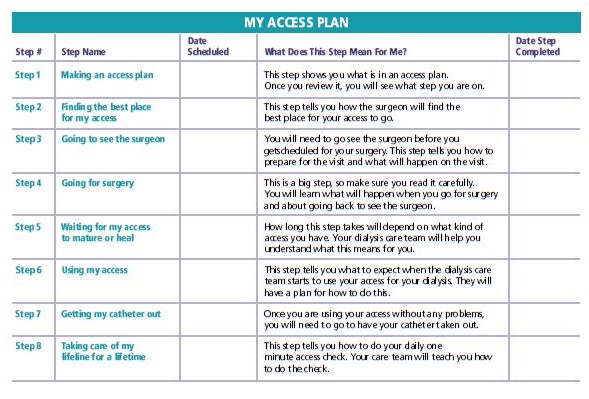
  • There are eight steps for vascular access planning from the time it is determined that the patient needs a permanent vascular access to when the access is successfully used and the catheter is removed. They are: Step 1 - making an access plan; Step 2 - finding the best place for the access; Step 3 - going to see the surgeon; Step 4, going for surgery; Step 5 - waiting for the access to mature/heal; Step 6 - using my access; Step 7 -- removing the catheter; and Step 8 - the one-minute access check.
     
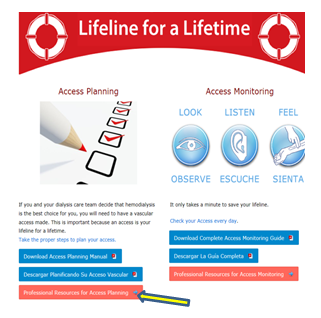
  • The National Coordinating Center (NCC) has a vascular access planning guide available for patients and for facility staff to work with patients. The guide, which includes detailed steps and a patient check list, is available online at the NCC Resource Center http://esrdncc.org/navigating-your-esrd-journey/lifeline-for-a-lifetime/esrd-ncc-resource-downloads/. You can download the guide to your computer. The access check list may be printed separately for the patient to use. 


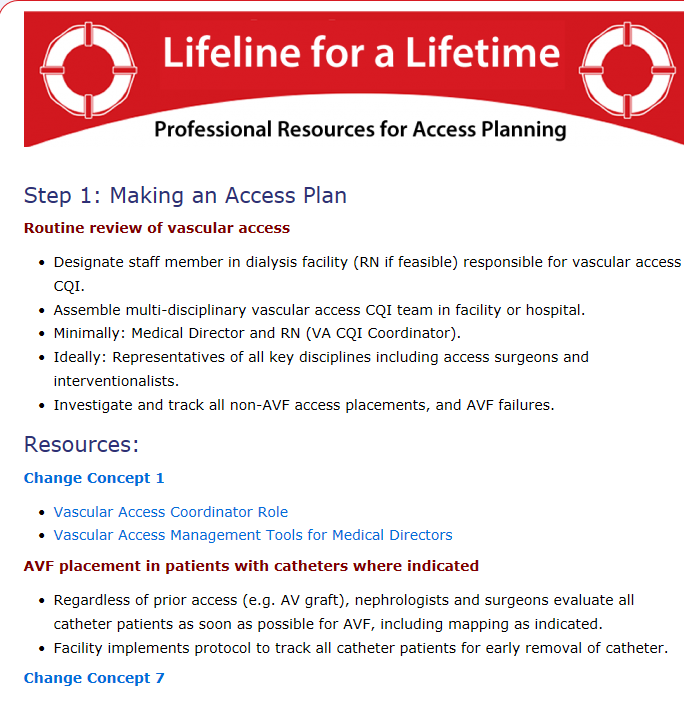
  • The NCC offers professional resources for access planning on its we bsite. This is a comprehensive overview of access planning with many useful tools. There are individuals pages for each of the eight steps.  


Frequently Asked Questions:

Q: I am completing the Monthly Data Reporting Form. My question is: if my patient is currently in the hospital and was not treated in the facility from 1/25/15 until 2/5/15, do I still count them on my monthly reporting form? That patient is still included in our census but is not actively receiving treatment here because of the hospitalization.

A: For the monthly reporting form for the vascular access project, you should report the patient's access as of the last treatment date s/he dialyzed in the dialysis unit during the reporting month. This would be the same for CROWNWeb reporting

Q: If the patient was in the hospital for the entire month, should I include the patient in the monthly report?

A: If the patient did not have a dialysis treatment in the facility for the entire month you would not include the patient in the vascular access project's monthly report and for CROWNWeb you would check the NA box.


Additional Vascular Access Resources:  If you have questions for improving your vascular access rates or are looking for information related to vascular access send emails to vascularaccess@nw2.esrd.net