|
|
|
| Greetings! | |
Natural resources have always been linked to conflict both directly and indirectly, as they impact a wide swath of economic and social structures. And while the transition toward peace for post-conflict countries can be difficult and complicated, natural resources are becoming increasingly recognized for their role in both motivating and resolving conflicts. In this regard, natural resources cut across various sectors and should be considered a multidisciplinary transition initiatives that address gender issues, political schemes, trade, finance, livelihoods, etc.
 | | (Photo Credit: Carl Bruch, ELI) |
In this issue, we discuss how natural resources play a role in post-conflict peacebuilding and feature a recent webinar with peacebuilding experts on FRAMEweb.
|
| Stay Engaged on FRAME: | |
Online Community: Continue the discussion and find more resources about Peacebuilding through NRM
Karishma's Corner: Weekly blogs to keep you up-to-date on events and what members are discussing
Twitter: Real-time updates on FRAME content and what members/partners are up to around the web
|
|
|
| Notes from the Field | |
Webinar Review: Managing Natural Resources for Post-Conflict Peacebuilding
On Novemeber 14, FRAMEweb members joined us for the webinar "Managing Natural Resources for Post-Conflict Peacebuilding " with Carl Bruch of the Environmental Law Institute (ELI) and Chris Huggins, a consultant and PhD candidate at Carleton University . The webinar discussed the role natural resources play in a period of post-conflict transition to peace and explored lessons learned from case studies around Africa.
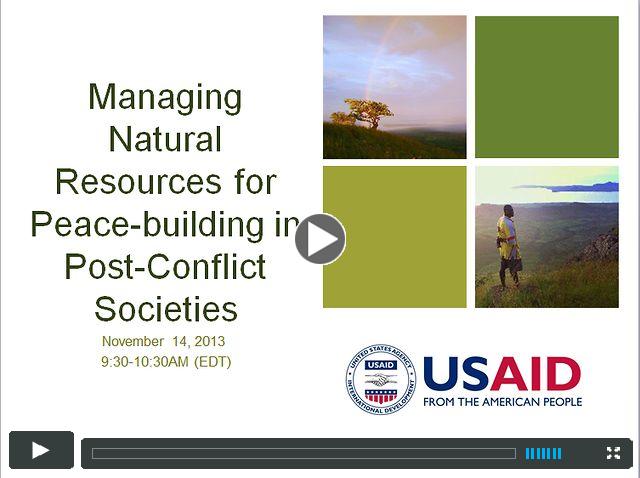 | | Managing Natural Resources for Peace-building in Post-Conflict Societies |
Chris Huggins presented several case studies from the Great Lakes Region of Africa that demonstrate lessons learned around post-conflict natural resource management. These information-rich case studies include the reintegration of refugees in Burundi, mediating land disputes in the DRC, the unintended impact of environmental policies on society in Rwanda, and a successful participatory method implemented in Uganda.
|
Discussion Spotlight
|
Here are some of the issues FRAMEweb members are talking about:At what point should post-conflict interventions be considered? At what point should post-conflict interventions be considered -- while conflict is still ongoing or when it's clear some sort of peace will be in put in place? What are the major strengths and weaknesses of the Nature, Wealth and Power framework and approach? USAID is undertaking an assessment of "Nature, Wealth and Power: Emerging Best Practice for Revitalizing Rural Africa" (NWP) a rural development framework developed in 2002 [link here]. NWP it is a systematic and systemic approach developed by analyzing lessons learned from field experience. The analysis showed that the links between technical resource management (nature), economics and markets (wealth), and governance (power) are essential for project and program success. We would like to get broad input to the process of assessment. Click here to respond Do you have feedback or suggestions regarding the development of an effective guide for an environmental and social impact assessment in Guinea? The two year-old Guinean Office of Environmental Studies and Evaluation (Bureau Guineen des Etudes et Evaluations Environnementales - BGEEE) is improving its Environmental and Social Impact Assessment (ESIA) procedures and practices. The ESIA is one of the few tools currently in use in Guinea to afford some level of protection for the flora and fauna of the country, as well as human beings, which are under extremely heavy pollution and ecological degradation pressures from the mining and other infrastructure-related sectors. The ESIA is fast becoming a critically important tool which the BGEEE is using to improve the sustainable development impacts of infrastructure projects in Guinea. However, there is still plenty of work to do before the ESIA reaches its full potential concerning sustainable development, biodiversity conservation, and natural resources management. Please find attached two documents (in French), which are currently open to constructive criticism by the partners and stakeholders. Such constructive criticism will enable the BGEEE Director, Director Seydou Bari Sidibe, to develop a more effective guide on how to perform and use the ESIA tool. This guide will most likely become a pillar concerning how Guinea manages the mining and other sectors. Click here to comment Do you have a question or comment you want to post on FRAMEweb? Sign-in, click on a Community Topic or Partner Page and click on the ask button or icon:  
Need help? Send us an e-mail and we will walk you through it!
|
|
Take a Look
|
Expand your knowledge on natural resource management and peacebuilding with these helpful resources.

From Conflict to Peacebuilding: The Role of Natural Resources and the Environment
With a view to offering independent expertise and advice to the Commission and the wider peacebuilding community, the United Nations Environment Programme (UNEP) established an Expert Advisory Group on Environment, Conflict and Peacebuilding in February 2008. Consisting of leading academics, think tanks and non-governmental organizations with combined experience from over 30 conflict-affected countries (annex 4 in the publication), the Group provides policy inputs, develops tools, and identifies best practice in using natural resources and the environment in ways that contribute to peacebuilding and prevent relapse into conflict.
Click here to see the UNEP publication
Strengthening Post-Conflict Peacebuilding through Natural Resource Management Series by Environmental Law Institute 
The Environmental Law Institute (ELI), United Nations Environment Programme (UNEP), the University of Tokyo and McGill University are developing a series of edited volumes that assess experiences in strengthening post-conflict peacebuilding through natural resource management. This four-year research and publication project has yielded more than 150 peer-reviewed case studies and analyses by over 230 scholars, practitioners, and decision makers from 50 countries. These case studies and analyses have been assembled into a set of six edited books - all published by Earthscan - each focusing on: (1) high-value natural resources; (2) land; (3) assessment and restoration of natural resources; (4) water; (5)resources for livelihoods; and (6) governance.
Minerals & Conflict: A toolkit for intervention
This toolkit: 1) examines the relationship between valuable minerals, such as diamonds or coltan, and violence; 2) discusses lessons learned in developing programs to deal with "conflict commodities"; 3) presents a range of program options; 4) provides a survey instrument that identifies key questions related to minerals and conflict; and 5) identifies relevant USAID mechanisms and implementing partners. Monitoring and evaluation tools are being developed. Together, the elements of this toolkit are designed to raise awareness about the linkages among valuable minerals, development assistance, and conflict; and to help integrate a conflict perspective into development programming.
Leveraging high-value natural resources to restore the rule of law: The role of the Liberia Forest Initiative in Liberia's transition to stability

Liberia has been engaged in civil conflict for the majority of the last two decades. Throughout the fourteen years of civil conflict, "conflict timber" along with "blood diamonds" played an important role in perpetuating conflict within Liberia and its neighboring countries. Following the cessation of violence, the UN Security Council issued a ban on the import of Liberian timber. That same year, the Liberia Forest Initiative (LFI) was established to "promote and assist reforms in Liberia's forestry sector" and ensure the transparent management of forest resources. Using the "three Cs" approach to forestry policy--which seeks to balance community, conservation, and commercial priorities-- the LFI, in four short years, has developed a forest management regime anchored by good governance and the rule of law.
Beyond Boundaries: Transboundary Natural Resource Management in Sub-Saharan Africa
Published in 2001, this publication aims to present a framework for transboundary natural resource management (TBNRM) including general concepts, the transboundary process, and lessons learned, based on a review and analysis of TBNRM experiences to date in sub-Saharan Africa. this publication is written both for people who are considering embarking on TBNRM for the first time, and for people who have many years of experience in TBNRM. It also covers a wide range of TBNRM situations, from transboundary protected areas to natural resource management integrated in regional development.
Click here to access the publication.
|
New on FRAMEweb
|
The Integrated Approaches Community of Practice: Nature, Wealth, & Power
In 2002, USAID's Africa Bureau and partners published a discussion paper entitled: "Nature,

Wealth, and Power (NWP): Emerging Best Practice for Revitalizing Rural Africa." The paper investigates how to integrate environmental management, economic concerns, and good governance to have promising and sustainable results in rural areas of the world.
The Integrated Approaches Community was set up in November to update and incorporate new successes from NWP and expand participation and contributions from the broader NRM community.
Get involved, find out more on FRAMEweb, and look out for updates in your inbox.
|
Experts on FRAMEweb
| 
Find a colleague who shares an interest or expertise in conflict learn more about your network.
Log-in to FRAMEweb and click on the link below to find 41 experts on FRAMEweb related to health.
Conflict Experts
Note: you won't see the results until you are logged in!
|
|
| Featured Member | 
FRAMEgram features a member in the newsletter who has been exceptionally active! This section will also give you a chance to learn more about other FRAMEweb members. This Edition's Featured Member is...
 Shreya Mehta Shreya Mehta
After learning about the Bottom of the Pyramid paradigm and working with rural female farmers in India, I became interested in the relationship between the natural environment and rural development. In my current project I assess the successful linkages between Nature, Wealth and Power in the developing world. FRAMEweb has become an essential tool for me to engage with experts in this field on how to harness the environment and natural resources in order to improve the livelihoods of rural people.
* Remember to see Shreya's profile, login at the prompt first. |
|