When Geopier ground improvement was originally introduced in the 1990's to engineers and contractors, people became excited that fills and low blow count soils could be improved to a point where the allowable bearing pressure of the soil could be increased by 2 to 2.5 times which resulted in:
Smaller Footings = Savings in Concrete Costs
No Over-Excavation = Lower Site Costs + Time Savings
Recommendations for allowable bearing pressures using Geopier elements for weak soils such as soft clays typically start at 5 ksf, but are normally in the 6 ksf to 8 ksf range on projects where marginal fills or low blow count residual soils are encountered and as high as 10 ksf for stiffer soils. With the introduction of Geopier rigid Inclusions, 6 to 8 ksf can easily be obtained even in soft or organic soils.
In the late 1990's when Geopier was introduced in the Mid-Atlantic Region of the United States, geotechnical engineers regularly consulted with GeoStructures to develop site specific recommendations so that the footing designs could be optimized at the preliminary design phase of the project. However, as ground improvement has evolved, recommendations found in many geotechnical reports have become less specific, more generic, and often read:
"In order to facilitate design, we recommend the design/build contractor provide a system of aggregate piers capable of supporting an allowable bearing pressure on the order of 4000 to 6000 psf."
Or
"The improved bearing capacity will primarily depend on the diameter, depth and spacing of the Geopier elements utilized in the ground improvement scheme. Depending on design, the ground improvement system should be capable of development of an allowable bearing pressure on the order of 4 kips per square foot (ksf) to 6 ksf."
The intent of these recommendations is for the structural engineer to contact the specialty contractor to provide specific recommendations based on the soils report. However, unfortunately structural engineers are conditioned to using the recommendations for bearing pressure they get from the geotechnical engineer and the result is often to use the lower end of the geotechnical recommendation (4 ksf). This results in a very conservative design that does not utilize the benefits of ground improvement and the typical design sequence for the Structural Engineer, GC and Owner is as follows:
- Structural Engineer reviews the geotechnical engineering report and designs footings for 4 ksf.
- Footings sized based on 4 ksf go on plans and that goes out to bid.
- GC asks the specialty contractor for pricing based on the 4 ksf plans.
- The specialty contractor develops a Geopier cost estimate based on the plans.
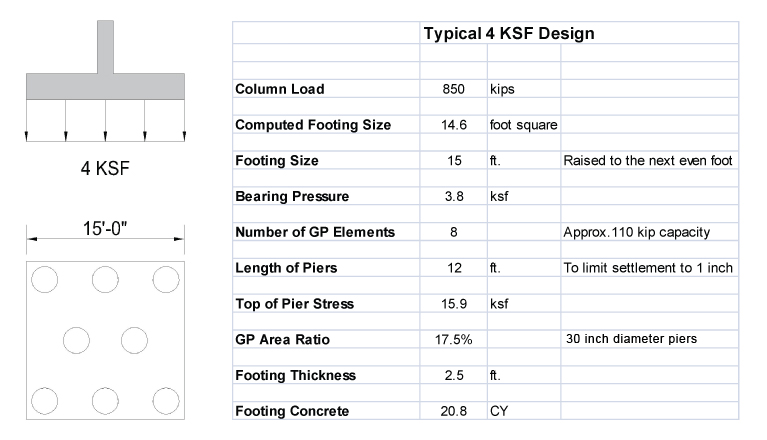
4 ksf Design with a Typical Footing with a Column Load of 850 kips
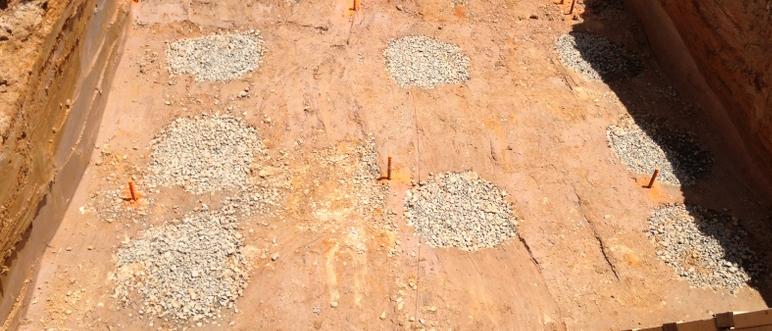
The result is widely spaced piers underneath a very large footing.
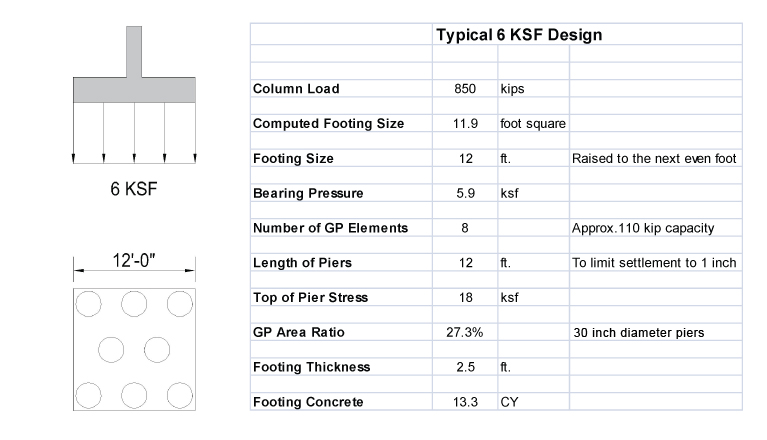
From the Geopier designer perspective (based on the soil profiles), a bearing pressure of 7 ksf could easily be achieved. However, the Geopier designer offers an alternative using 6 ksf bearing since the Geotechnical report "allows" it. The 6 ksf design results in:
- Smaller Footings
- No change in the Geopier Design (same pier counts and lengths).
End Result
The Geopier Cost is the same - 8 piers - 12 feet long < 1 inch Settlement
The footing concrete volume is 36% less for the 6 ksf design vs. the 4 ksf design
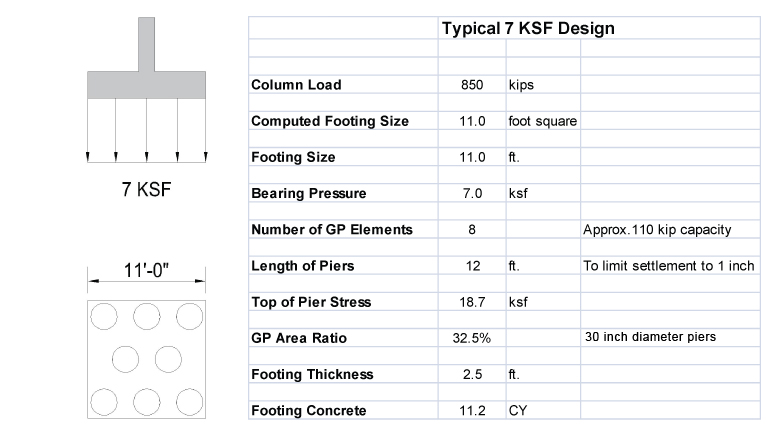
Optimizing the Footing Design - Given the chance to review the borings prior to the footings being designed, GeoStructures would have recommended a 7 ksf bearing pressure that would have resulted in the following design:
End Result
The Geopier Cost is the same - 8 piers - 12 feet long < 1 inch Settlement
The footing concrete volume is 46% less for the 7 ksf design vs. the 4 ksf design
Other Benefits - Smaller footings can result in shorter pier elements for high column loads and potentially fewer issues with adjacent footing stress since the distance between footings will be greater.
Lesson Learned - Get site-specific ground improvement recommendations to optimize foundation design and cost.
Tightly spaced piers with an optimized footing design
The Bottom Line
Geotechnical Engineers can provide value to their customers by contacting GeoStructures for site-specific ground improvement recommendations as soon as they have field exploration results. Then a single allowable composite bearing pressure recommendation can be made from which structural engineers can proceed with sizing footings.
Structural Engineers can provide value to their customers by providing GeoStructures column, wall, elevator and mat loading and settlement criteria, before sizing footings. From this data the size and type of ground improvement can further be evaluated and footing designs optimized based on using the actual structural loading conditions.
General Contractors can provide value to their customers by understanding that each ground improvement project GeoStructures works on is design-build. Therefore, bringing GeoStructures on early in the design process allows the rest of the design team to benefit by optimizing both the structural and ground improvement design. This can result in savings in concrete volume, ground improvement elements, and eliminating conflicts with shoring and utilities which can add up to schedule and project cost savings.
Do you want help in optimizing your Geopier and slab or footing design? Click here for a project assessment.