|
Monthly Special - HD Casters

* Heavy loads keep on rolling with these rugged cold-forged constructed casters.
* One-piece swivel horn/fork design with no welds distributes loads across the larger portion of the ball race.
One-piece combination lower ball race and king pin improves structure rigidity and easier swiveling. 3/4" king pin is orbital cold formed for superior strength and stability. Swivel casters feature grease seals, keeping dirt out of top raceway and increasing life. Epoxy powder-coated finish. Meets ASME B56.11-1 Industry Standards.
Click here for pricing
FOB Shipping Point.
|
| Lines Represented: |  |
|
|
|
E. D. Farrell Co., Inc. Monthly Newsletter
March Edition |
|
Employee Spotlight
 Sam Powers - Sales Coordinator - 10 Months -
While still a relatively new team member here at E. D. Farrell Co., Inc., Sam has proved his worth to our team and customers with his commitment to detail and his strong work ethic. Sam began in our Shipping/Receiving department and was quickly moved into our Sales Coordinator position to utilize his skill sets more.
If you need a quote fast, it's likely that Sam is the one working behind the scenes with our Sales Team to make that happen! Sam is also the support network behind our Field Sales Reps when they are unavailable.
Feel free to contact Sam with any of your materials handling needs.
Sam Powers
spowers@edfarrell.com
(716) 668-2722
|
|
Product Feature: Is your Forklift ready to retire?
Wondering whether to keep that lift truck going a little longer or put it out to pasture? Here are some things to consider when making that decision.
Lift trucks are the "workhorses of the warehouse"-essential tools for shipping, receiving, picking, and put away. But no piece of equipment can last forever; sooner or later, every lift truck will reach the point when it should be put out to pasture, so to speak.
How do you know when it's time to say goodbye? If you lease the equipment, it's not an issue-the "retirement" date will be set as part of the leasing agreement. But if you own the equipment, this can be a tough call. The key, experts say, is determining when a lift truck has reached the end of its "economic life." That's the point when the cost to operate a vehicle exceeds the value it provides, and keeping it going would be akin to throwing money away. Several factors play into that decision, including hours of operation, operating conditions, utilization rates, maintenance costs, and productivity.
HOURS ON THE JOB
For an automobile, mileage is a better indicator than age of expected longevity. Similarly, the number of operating hours a lift truck has logged is a more reliable measure of its expected lifespan than its age. The typical lift truck engine is good for 10,000 to 20,000 hours, although some last much longer. Read More
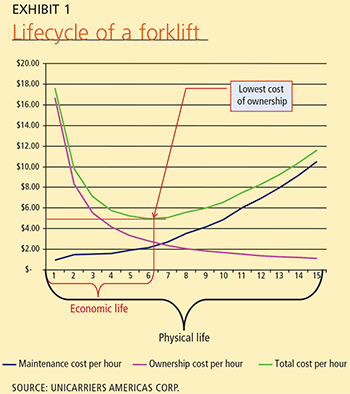
THE COST OF MAINTENANCE
For companies that buy their trucks rather than lease or rent them, it's tempting to focus on getting as many hours as possible out of each piece of equipment. But that approach is counterproductive. Experts advise fleet owners to pay equal attention to maintenance costs, because these can eventually outweigh the benefits of keeping an older truck running. Read More
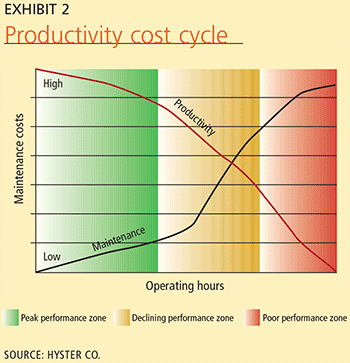 BETTER PRODUCTIVITY If a lift truck is becoming a drag on productivity, it's probably time to replace it, Craver says. There are several reasons that might happen: excessive downtime for repairs, inadequate ergonomics or outdated safety features, or the truck simply wasn't designed for its current (or future) job. Read More
THE FINANCE ANGLE
The decision to retire a forklift should take into account not only the factors mentioned above, but also a truck's "book" value and its resale value. One common problem, McKean says, is that a company's finance department may insist on keeping a lift truck on the books for seven or more years until it is fully depreciated, without considering the vehicle's hours, maintenance costs, or resale value. Read More
 Exciting New Yale Equipment now Available! - Yale Materials Handling Model MO25 center rider Center rider lift truck boosts second-level order picking. The MO25 center rider lift truck by Yale eases second-level order picking through a fully adjustable electronic power steering wheel that reduces steering effort by 90%. For operator safety and security, the vehicle includes automatic speed reduction when cornering and a suspended platform with an operator-sensing floor mat. To boost ergonomics and efficiency, the control handle reduces the arm movement needed to change directions, cutting fatigue, increasing productivity and allowing the operator to remain inside the truck footprint for protection. The truck's electro-mechanical disc brakes are top mounted for ease of maintenance or inspection. Truck Price $ 16,835.00 -F.O.B. - Delivered -Battery and charger included
|
Parts Feature:
Chargers to keep you Powered Up!
Get the Power You Need to Get the Job Done

In stock and ready to ship now! Our complete line of chargers for personnel and burden carriers, sweeper/scrubbers and aerial work platforms will keep you fully charged.
Make sure your batteries are ready to go when you need them with our chargers from:
* Lester * Signet * MAC * Quick Charge * Delta Q * SPE
Part # - Description - Brand - Equipment Price
- CU809256 - CHARGER - 24V 15A 120AC AUTOMATIC TIMER Mac PBC - $ 430.77
- EZ602718 - CHARGER - 36V 21A 120VAC 60HZ LESTRONIC II Lester PBC - $ 460.00
- MD3102302001 - CHARGER - HF 36V Delta Q - PBC - $ 846.15
- TA79-303-40 - CHARGER - BATTERY 36V 20A Signet - PBC - $ 576.92
- TA7930305 - CHARGER - BATTERY 24 VOLT Quick Charge - PBC - $ 615.38
- AD56395101 - CHARGER - 36EL21-6 SCR E-SERIES Lester - SSB - $ 436.15
- AM0875-124 - CHARGER - 24V 25A 115VAC 60HZ E-SERIES Lester - SSB - $ 453.85
- FC240-2441 - CHARGER - 12-48V 15-30A MULTI - 12-48V SPE SSB 115AC 60HZ - $ 500.00
- TN50050 - CHARGER - SIGNET HB600-24B 24V19A OUTLET - NO CORD INCLUDED Mac SSB IEC C13 - $ 492.31
- TN65570 - CHARGER - 120VAC 36VDC 20 AMP Signet SSB - $ 615.38
- GN45044 - CHARGER - 36V 40A 115VAC 60HZ LESTRONIC II Lester AWP - $ 736.92
- JL0400170 - CHARGER - 24V 20A 120VAC Mac AWP - $ 584.62
- SJ108592 - CHARGER - 24V 40A 120VAC 60HZ LESTRONIC II Lester AWP - $ 661.54
- SN300909 - CHARGER - 24V 25A 120VAC 60HZ LESTRONIC II Lester AWP - $ 730.77
- UP063944-001 - CHARGER - 24 VOLT Lester AWP - $ 476.92
Call our parts department today (716) 668-2722
|
Service Feature: Battery Recycling -Do's & Don'ts
Article from MATERIAL HANDLING July 23, 2012 MATERIAL HANDLING UPDATE | BATTERIES/CHARGERS
The basics of battery recycling
Lift truck battery given up the ghost? You can't just put it out with the trash. Here's what to do instead.
No lift truck battery lasts forever. No matter how carefully monitored or well maintained a battery may be, there comes a time when it's best to call it quits. But once this costly piece of equipment has reached the end of its useful life, what should you do with it?
Industrial batteries contain materials that could potentially harm people, facilities, and the environment if not properly handled. So you can't simply put a used battery out with the trash. Nor can you burn it or chop it up like a discarded wooden pallet.
There's only one real option for disposing of worn-out lift truck batteries today: recycling. Battery recycling is far more complicated than the household version we're all familiar with. It's governed by federal, state, and municipal laws and regulations, and there are special considerations when handling and transporting used batteries. We can't get into all the technical details here, of course, but this look at battery-recycling basics will get you started.
KNOW WHEN TO FOLD 'EM
How do you know when a lift truck battery is ready for recycling? A battery has reached the end of its useful life when it can no longer deliver 80 percent of its rated capacity, says Doug Bouquard, vice president and general manager of sales for East Penn's Motive Power Division. In simplified terms, the rated capacity refers to the number of amperes of electrical current a battery will deliver over a specified time period under specific temperature conditions. Read More
HANDLE WITH CARE
As you might expect when heavy metals and chemicals are involved, federal, state, and municipal regulators have a say in who handles used batteries and how they do it. While most of the regulations governing battery recycling are issued by the federal government, they are also enforced on the state level, says Bouquard. According to Battery Council International, 38 states have battery-recycling laws, and another five have disposal laws. (BCI's website includes links to some of the state agencies that oversee these activities.) Read More
SAFETY ABOVE ALL
Lift truck battery disposal and recycling is a complicated activity, and we've only been able to scratch the surface in this article. Experts agree that the two most important areas to focus on are safety and regulatory compliance. They also recommend familiarizing yourself with the many information resources available-industry associations, of course, but also battery manufacturers and distributors, lift truck distributors, licensed battery recyclers and transporters, and so forth. Read More
Free Battery Recycling from E. D. Farrell!
Call our shop to schedule a pickup. (716) 668-2722
|
Safety Feature: Tips to keep you safe!
Every year 100 workers are killed and thousands seriously injured in forklift accidents. OSHA has strict requirements for forklift operators. Follow these forklift safety tips to prevent accidents and injuries:
* Operators must receive thorough training, evaluation, and testing.
* Forklifts must be inspected for safety before each shift.
Over one-quarter of forklift accidents are the result of a lift tipping over.
* Drivers should always wear seat belts to prevent being thrown out and crushed if the vehicle falls over. In case of a tip over, the vehicle's frame will offer protection.
* See video: http://www.youtube.com/watch?v=ZoPOI32tSkM
Excess loads can cause the forklift to be top-heavy and tip over.
* Never load a truck beyond its rated capacity.
* Make sure the load is secure before moving.
Forklift operators should always watch out for other people on foot. Their visibility may be partially blocked by the load or the vehicle itself.
* Whenever they reach an intersection or other location where vision is obstructed, they should always slow down and sound the horn.
o See video: http://www.youtube.com/watch?v=yCR9wBHSyxQ
* Never drive up to anyone standing in front of a fixed object--even an unloaded forklift can easily weigh twice as much as the average auto and cannot stop quickly. Many accidents are caused by a load or debris falling on a worker. * Loads should be placed as far back by the mast as possible--not forward--for extra stability.
* No person should be allowed to stand or pass under the forks, whether they are loaded or empty.
Forklifts do not operate the same as an automobile--most forklifts steer from the rear. This means that the back of the forklift swings wide on a turn.
* Always drive, turn, and stop slowly and smoothly.
* Sudden turns can throw a forklift off balance, especially when it is loaded.
* Drivers should slow down on grades, ramps, or inclines.
You can prevent forklift accidents--use these forklift safety tips and always follow the safety rules.
How good are your forklift drivers? Can they stop on a dime? Are they accomplished enough drivers to perform this maneuver shown in this video clip:
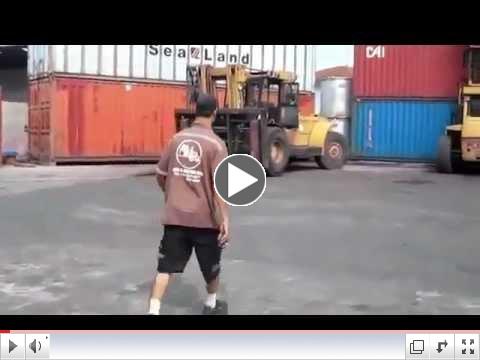 | | Amazing Coin Trick with Fork Lift |
To ensure that you're keeping your facility and employees safe, click here!
|
|
Rental Feature: Narrow Aisle Warehouse Rentals
Narrow aisle single reach rental trucks available right now!
Yale narrow aisle single reach trucks make great rental units. Yale® Narrow Aisle Lift Trucks have the ergonomic comfort and the specifications you need. Yale designs and builds narrow aisle trucks that are industry and application specific. Drive motors are application proven for efficiency, performance, and reliability. Yale Hi-Vis masts incorporate innovative engineering for unsurpassed visibility and solid construction.
|
|
|
As always, we appreciate your business, and hope that this newsletter served the same important role we hope to serve for each and every customer. Until our next newsletter, have a great month!
Sincerely,
E. D. Farrell Co., Inc. |
|
|



