Twin Springs Fruit Farm
Growing better since 1979
 
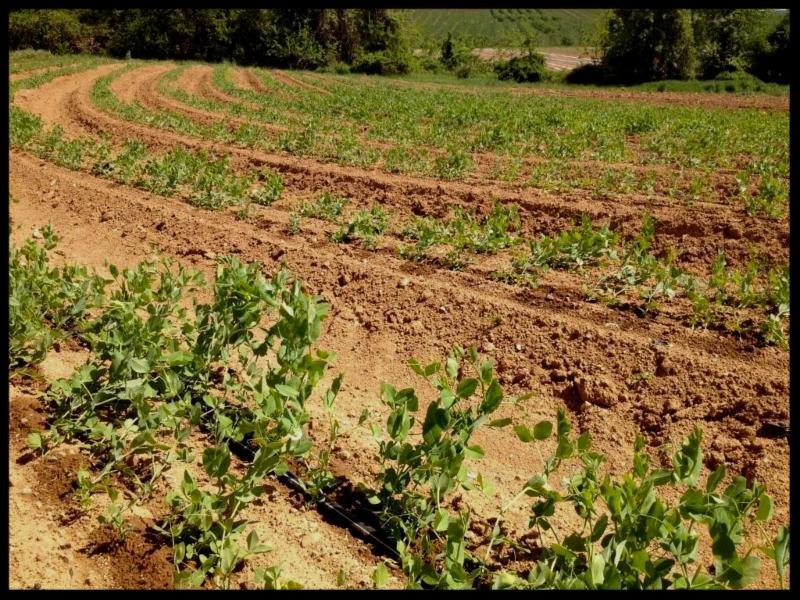
Our pea planting a couple of weeks ago


For what's at market this week see the bottom section.
For times and locations please  

For a history of the farm and a write-up on our
Green Practices please Click Here.

Short but Sweet

    The window for growing and harvesting both of the kinds of peas which Twin Springs raises is all too short. There is a reason why we associate peas with England, and it has to do with climate. As with field lettuce, spinach and various other crops, the Sugar Snap and English Peas we grow must be planted early, as in March, and they will start to bear right around now, early June.
    Pea plants thrive in damp cool weather, interspersed with sunny, but not overly hot, days; you know, just like Spring in the English countryside.
    The plants are pretty tough as far as freezes go, but stop flowering and putting on new peas as the days start to heat up and get longer. Fresh shelled peas are a wonderful thing and must really be enjoyed "in season", though freezing for later enjoyment is a great thing to do. They will be delicious if done properly and promptly, but never as good as shelled out the day they were bought at market and quickly cooked, or even eaten raw. 
    The Sugar Snaps are, of course, not grown to be shelled, though that can be done with the mature ones, but to be consumed pod and all, merely de-stemmed at the top. These are often added raw to salads, and as with shelled peas are great if only briefly cooked.
    I just stir fry my own in a bit of browned butter; keep it simple! They don't need a lot of frou frou cooking and saucing; enjoy the sweetness and subtle flavor of something so fresh. This is how I invariably prepare both shelled peas and Sugar Snaps. Adding them to any sort of soup, stew, stir fry or curry dish is also very appropriate.
    
Preserving Peas

    In studying up on directions for freezing peas, whether shelled ones or those consumed whole, I found a number of sites which indicated you could just skip blanching, freeze the rinsed raw peas on a cookie sheet for a few hours, and subsequently pour them into freezer bags to be placed in the freezer. 
   Other sites, like the one from which I adapted the below instructions, make it clear that there is great value nutritionally, as well as flavor-wise, storage life, and even safety, which make it advisable to not skip the step. It is pretty simple and brief, requiring only 90 seconds in boiling water.
    I really, really, am a believer in using a vacuum sealing appliance for almost any freezing task. I use one for the hops I grow for brewing at home, but, of course, fruits and veggies, and even meats keep way better if handled this way. Remember to pre-freeze the filled bags before running a vacuum cycle.
    If you don't use a vacuum device, at least use really good freezer bags, or some sort of well sealed storage container

Directions for Freezing peas

 Ingredients and Equipment
  • fresh peas - any quantity. I figure one handful per serving.
  • Plenty of ice on hand - perhaps get a bag at your local grocery or convenience store for a large freezing project.
  • Vacuum food sealer or "ziploc" type freezer bags (the freezer bag version is heavier than an ordinary storage bag, and protects better against freezer burn).
  • 1 Large pot of boiling water
  • 2 large bowls, one filled with cold water and ice.
  • 1 sharp knife
 

Quality
  You need peas that are FRESH and crisp. I'd suggest getting them from Twin Springs Fruit Farm, or grow your own! Plan on doing the task ASAP, like you would with sweet corn, both lose sugars fairly rapidly after harvest.

Quantities

   About 14 pounds of peas makes 7 quarts of shucked peas; or 9 pounds is needed for 9 pints. 

Wash the Peas 

   Whether whole pod Sugar Snap Peas or shelled out English Peas it is always best to give them a good rinse. Even though Twin Springs gets everything like berries, peas and spinach picked with blue nitrile gloves on, we recommend this step, if just for peace of mind.
 
Hull the Peas 

   I find it easiest to just grab the stem end, and press my thumbnail into the seam, squeezing the pod gently.  It usually opens right up, and I can use a finger to push the peas out. A knife may be used to help get things started if you can't get the hang of shelling.
   Obviously, this step is unnecessary for edible-podded peas like snap peas.  Just snap off the tips and pull the "strings" off. Don't fret if you don't find any strings, modern varieties are fairly stringless. 

Get the pots ready

   Get the pot of boiling water ready, bigger is better than smaller, as you want the water to return to a boil as rapidly as possible after pouring in the raw peas, and a LARGE bowl with ice and cold water.
 
Step 5 - Blanch the peas. 
 
  All fruits and vegetables contain enzymes and bacteria that, over time, break down and destroy nutrients and change the color, flavor, and texture of food during frozen storage. 
   Peas requires a brief heat treatment, called blanching, in boiling water or steam, to destroy the enzymes before freezing. Blanching times for peas is 90 seconds - the duration is just long enough to stop the action of the enzymes and kill the bacteria.
   Begin counting the blanching time as soon as you place the peas in the boiling water. Cover the kettle and boil at a high temperature for the required length of time. You may use the same blanching water several times (up to 5). Be sure to add more hot water from the tap from time to time to keep the water level at the required height.

Cool the peas

 Cool peas immediately in ice water. Drain the peas thoroughly. After vegetables are blanched, cool them quickly to prevent overcooking. Scoop them out with something, or drain through a colander or large strainer, but keep the water for another batch.
   Plunge the peas into a large quantity of ice-cold water (I keep adding more ice to it). A good rule of thumb: Cool for the same amount of time as the blanch step. For instance, if you blanch sweet peas for 90 seconds, then cool in ice water for at least 90 seconds. 
   Drain thoroughly. 

 Bag the peas

  I love my FoodSaver with its vacuum sealing; these things really work.  You can get a very good one at Amazon for a good price; It'll be delivered in just one or two days, and will pay for itself in nutrients retained.
   It is advisable to freeze the filled bags, perhaps closing them off with a rubber band or clothes pin, for a few hours or overnight, to get the peas good and hard. Proceed to "vacuum and seal" later in the day, or the next morning. 
   
   If you don't own a vacuum food sealer to package foods, to prevent drying and freezer burn place food in a Ziploc bag, zip the top shut but leave enough space to insert the tip of a soda straw. When straw is in place, remove air by sucking the it out. To remove the straw, press the straw closed, where inserted, and finish pressing the bag closed as you remove the straw.


 Pop them into the freezer. Freezing keeps greens safe to eat almost indefinitely, but the recommended maximum storage time of 12 months is best for taste and quality. The quality of the frozen greens is maintained best in a very cold freezer (deep freezer), and one that keeps them frozen completely with no thaw cycles. 


Over the peak but still out there ripening

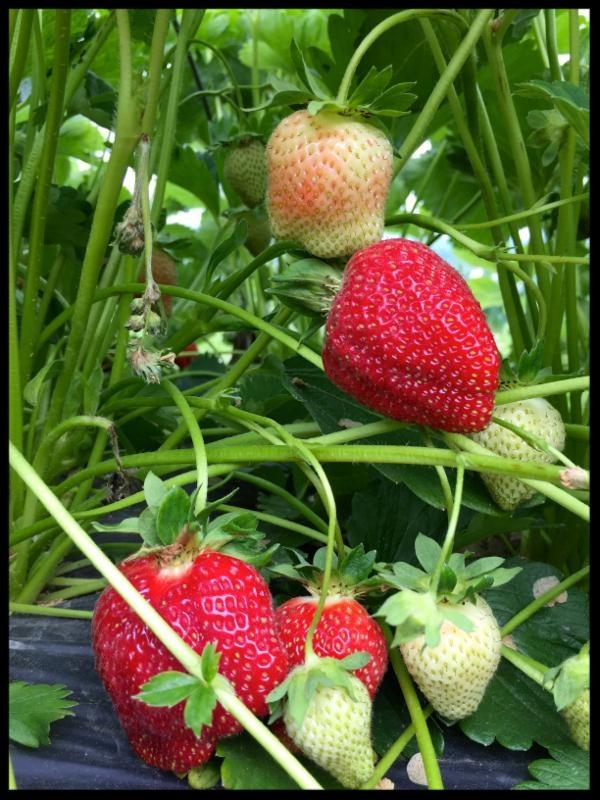
    While we are ending the sale the guys are picking a lot of really fantastic strawberries. Many customers are commenting on the high quality, flavor, sweetness and texture, while also mentioning their keeping power. Yesterday a lady said that the quality in a quart box was equivalent to when she went out and picked her own. 
   A testament to all of this is my sweet, and pretty elderly, lady customer at Mt. Vernon, who always buys three flats from which she makes jam; she gives jars out as Christmas presents to friends and family. She came and got her three flats yesterday; I had no warning or order but was really glad that she got there in time to get what she needed; I did sell out about a half hour early. I'm hoping she gets some help on her project as 24 quarts of berries is a lot to process, but then she's been doing it for years, always coming to me for the fruit.
   I have another customer who gets a couple of flats each year to give boxes of berries to teachers at the end of school; I think that she gets someone to put them in teachers' "cubbys" to surprise them at the end of the day.
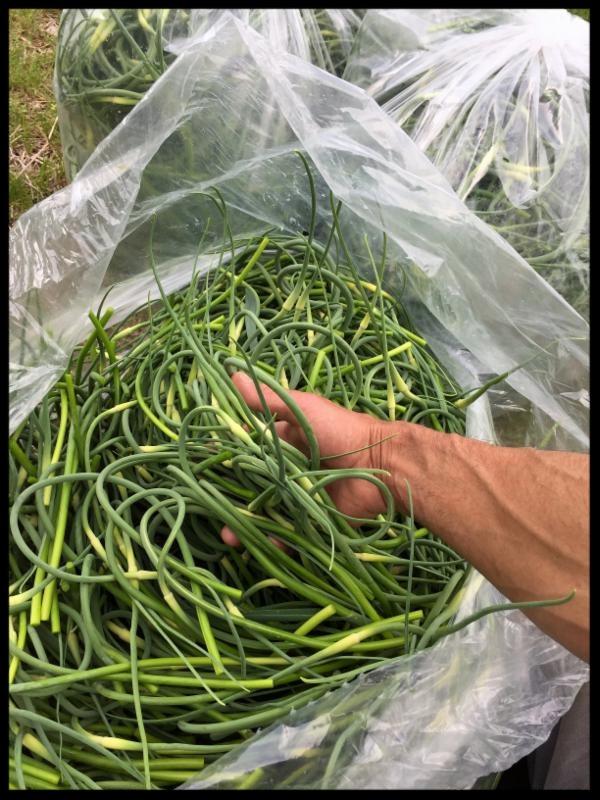
Garlic Scapes cut and bagged

   The new crop of scapes is looking good and will be available for a couple more weeks. 
   I'm going to link to an article from "Bon Appétit" which has nice pictures as well as 10 ways to use scapes, a couple I'd never thought of. Pickled scapes anyone?


Raspberries

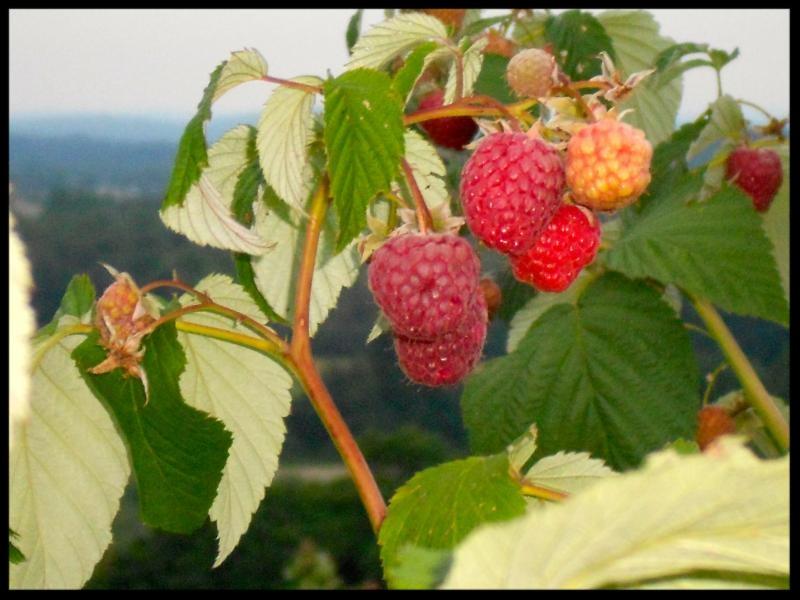
   Although there won't be enough to spread around this weekend, it will be time for the first picking of the earliest variety of red raspberry. 
   Yields, of course, will amp up over the coming weeks, and we anticipate a large crop again this year.
   We are thankful that the Spring freeze which damaged so much of the stone fruit crops had no effect on most of the berry flowers.
Clear out those freezers and shelves of last seasons bounty and get ready for new crops. It's time to get started!
(I know I'm trying to use up stuff preserved from last season, and am finally seeing the bottom of my freezer.)
Aubrey, and the Twin Springs crew

WHAT'S AT MARKET THIS WEEK
Here is a list of what we expect to carry at 
ALL LOCATIONS this week


Peas - Both Sugar Snap and Hull Peas will be available at all locations. We look forward to a large crop, and so far what I've tasted have been phenomenal. Don't miss this all too short seasoned crop. The plants don't like hot weather and will only produce a fine crop for two to three weeks.
Radishes - We will have more of our bunched radishes this week.
Sweet Peppers - Our greenhouse grown peppers are sweet, delicious and beautiful, being fully colored, plentiful and picked fully ripe. 
Hot Peppers - We are picking a few of both Jalapeños and New Mexican Chiles (AKA Hatch or Anaheim). The New Mexican Chiles are the longer and narrower ones on display, and are quite mild, while we pick the jalapeños green, usually, and they are pretty hot.
Chandler Strawberies - While we will have plenty, the sale is over as of today Friday June 10th. The pickings are yielding fewer, and often smaller berries; therefore the enterprise becomes less efficient and productive, but the quality remains high.
Trust, slicing Tomatoes - Picked red ripe, we've got plenty.
Sungold & Dasher - The guys are picking a limited amount this week.
Sungold are the orange variety, and are about as sweet as you would care to have them.
Dasher are a small red pear shaped cherry tomato with a strong, but not overly sweet tomato flavor; I go back and forth as to which is my favorite.
Kahlua, these are the brownish, large, at least for a cherry tomato, ones you may see displayed along with the above two varieties.
Basil - I'm told there will be plenty for all markets; goes well with all those wonderful tomatoes.
Manar Cucumbers - While we are picking a lot of these I'm not sure that there will be enough to get through the day at any given location, so get out early if you want to be assured of getting some.
Lettuce - There is plenty of the Green ButterCrunch for the week ahead.
Arugula - There is plenty at this time.
Baby Eggplant - A few of both the traditional black, as well as our lavender colored eggplant will be seen at markets.
Spring Mix - There will be a small showing.
Apple Varieties - GoldRush, Aztec Fuji and Stayman
For cooking purposes at this time I would stick to GoldRush and Stayman.
We are on track to have GoldRush for about 1 more week; Stayman and Fuji into July, most likely.
Sweet Potatoes Beauregard (A.K.A. Orleans), we still have a fair supply of these traditional orange fleshed sweet potatoes.
Vivaldi Potatoes - Still having a good supply you will see, above, that we have lowered the price to $1.49 per pound.
Bagged Potatoes - These are medium to large Vivaldi potatoes,bagged at five pounds and selling for the new price of $5.00 a bag.
Purple Carrots - Will now be available in both 1 and 2 pound bags.
Orange Carrots - Available for a bit longer at the lowered price, in 2 pound bags for $4.00 rather than the usual $5.50.
Pink Lady Dried Apples - Very popular as a good-for-you delicious snack, our dried apples have no sugar or preservatives added, as well as no sulfur; many commercial ones use sulfites to prevent browning.
Patty's Apple Cider Caramels - We will run out of these all too soon.
Twin Spring's Own Products - Jarred Peaches, Hot Pepper Jelly, Marinara Sauce, Apple Butter and Apple Sauce. All may be purchased individually, or by the 12 jar case, for10% off.
...................................................................................................
In addition, we will offer the following products at 
OUR OWN Markets, where we are the sole vendor, all of which are open to the general public, with the exception of Goddard Space Flight Center.
 
All from the field from local Amish growers, and long time growers who do a lot of planting to supply us, as well as the Leola Produce Auction we attend twice a week:
New potatoes, asparagus, green beans, spring onions, kale, both red and green leaf lettucesrhubarb, zucchini (green and gold), and radishes
Flowers - A few bunches of fresh flowers will be offered.
Allen's fresh local eggs - Brought to Twin Springs weekly, both white and brown eggs from happy "free walking" hens, raised just outside of Gettysburg.
Elizabeth's Breakfast Loaves - Hand made and baked the evening before market.
Fresh Hard Pretzels - Locally produced, coming in both regular and Honey Whole Wheat. Hand made and freshly baked in the D.C. area.
Artisanal Cheeses - Twin Springs carries Ed's fresh local: Sharp Cheddar, Cheddar, Smoked Cheddar as well as Smoked Jalapeño; also available are his Goat Gouda and Goat Cheddar, as well as the new "Conall's Lava Cheddar", with a special salt and a unique mottled appearance.
Local Wildflower Honey - Jim Small has kept us supplied with his pure, raw honey, much of it drawn from hives kept year-round on our farm.
Maple Syrup and Maple Sugar - tapped and bottled on the Patterson Farm in Pennsylvania.
McCutcheon's Products - We carry an extensive line of their jams, some fruit sweetened, ie. no cane sugar or corn syrup, and jellies, as well as many other great products created right in Frederick Maryland.
Baked Goods - From Stonehearth Bakery, also in Frederick; all items are baked "that" morning: Baguettes, innumerable kinds of fresh breads, both sliced and unsliced, as well as croissants, scones and cookies

 Twin Springs Fruit Farm            717-334-4582 info@twinspringsfruitfarm.com  
STAY CONNECTED: