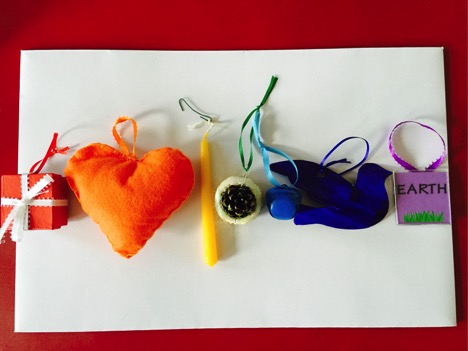
We started with the tree. I told the story of how Christmas trees came to be in our country, and the story of Rev. Charles Follen. We spent time creating ornaments reflecting the 7 principles. We wanted to be able to look at our tree and be reminded of our faith. Using language from the Spirit Play curriculum, each ornament represents:
-
 Red gift: Respect all
 - Orange heart: Offer love
- Yellow flame: Yearn to learn about ourselves, each other, and the mystery
- Green fir tree: Grow in our understanding of what is right and true
- Blue bell: Believe in our ideas and act on them
- Indigo dove: Insist on liberty, justice and freedom for all
- Violet world: Value the earth, our home which we share with so many others
We've made and shared about 100 sets of these ornaments over the years. I like to imagine families hanging each one and reflecting on their faith as they prepare for the season. I like knowing that this tradition of my childhood has been adapted to feel like an expression of my faith.
As Unitarian Universalists, we draw on our many sources, including Christian, Jewish, and earth-centered teachings. Many congregations will honor these teachings in some way this month by celebrating Christmas, lighting the menorah, holding a Winter Solstice service, and more. Of course, our families will have their own time-honored traditions to share as well.
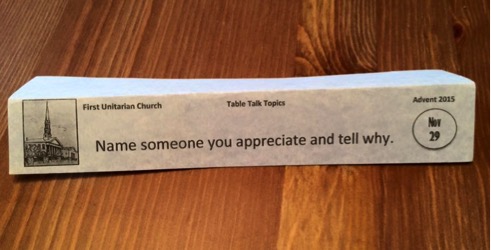
Our congregations are helping families to establish traditions and bring their faith into their homes. At First Unitarian Church in Worcester, MA, families are provided with table tent conversation starters for each day of Advent to encourage dialogue and reflection.
Ralph Roberts created a page a day Advent calendar "offered in the spirit of holding up and delighting in the ways that our Unitarian and Universalist ancestors had a foundational role in many of the winter holidays and the innumerable ways they're celebrated by people everywhere."
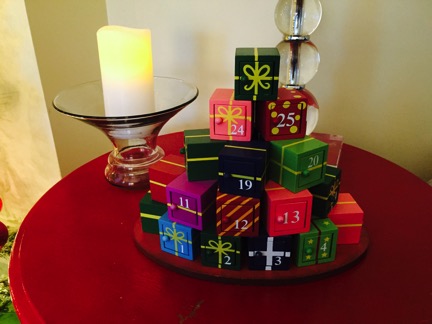
In my own home, our Advent calendar is filled with words from a magnetic poetry kit. On the first day, my teenagers opened the door expecting to find chocolate, but instead were greeted by the word: LOVE. Despite the initial reaction of "Our mom is so weird," they have been excited each day to see what the word is, take a picture of something that reminds them of that word throughout their day, and then share it and reflect upon it together at the end of the day. (It's hard being the kid of any religious professional.)
These are traditions that work for my family right now. I invite you to think about the ways in which Unitarian Universalism could play a role in the celebration of your own traditions of celebrating Christmas, Hanukkah, Kwanza, or Solstice.
It's taken some time, but I know that I am getting better at practicing what I preach. When traditions no longer meet your needs the way they once did, it's okay to say thank you, acknowledge that they were indeed meaningful and important, then move forward and make new ones. This is as true in our homes as it is in our programs and congregations.
As you make your way through this season, I hope you are able to find comfort in traditions new or old, and experience the love and grace of Unitarian Universalism.
In faith,
Kim Sweeney


 Traditions: