|
Day in the Life of...

Andrea Turnbull,
Public Health Nurse
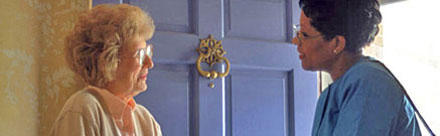
Andrea Turnbull, Public Health Nurse, always knew she wanted to help people. She never envisioned she would be providing care to residents while helping them stay in their homes.
Turnbull started her journey two weeks after high school. "I got married and traveled with my husband to Georgia as he was stationed at Fort Stewart with the Army," she said. While in Georgia, Turnbull took general education classes at Georgia Southern University towards a degree in elementary education. Turnbull realized nursing was her calling when her husband got transferred to Germany. "There was an EMT [Emergency Medical Technician] course available for military members and spouses," she stated. "I gave it a try and realized nursing was my future."
Shortly after Turnbull and her family returned to the United States, she started in the nursing program at North Iowa Area Community College (NIACC). While in school, Turnbull shadowed a Public Health Nurse with the Cerro Gordo County Department of Public Health. "This experience opened my eyes and made me realize I would love to help individuals while they maintain their independence at home," Turnbull says. She graduated from NIACC with her Associate's Degree in Nursing and started working for Mercy North Iowa as a nurse on the cardiac step down floor. "I provided care to patients by checking on their IV's, heart monitors and other patient care needs," she noted. A couple years later, she joined the Internal Medicine Clinic as a Registered Nurse. "In this position, I helped the physicians with procedures such as joint injections and I would also check in the clients before the physician saw them," Turnbull stated. "One of the neatest parts of the job was providing travel injections for clients who were traveling internationally."
In 2004, the Health Department had an opening for a Public Health Nurse. Turnbull applied for the position and has been here ever since. As a Public Health Nurse, Turnbull is responsible for client care as they remain in their homes. "I help clients with managing their medicines, changing wound dressings, drawing blood, performing home care aide supervisions and completing additional nursing duties."
Throughout her years at the Health Department, Turnbull believes the best part of this job is the clients. "I have some of same clients since I started nine years ago," she said. "I love being able to build a relationship with them." She also views the fun staff and their positive attitudes as another benefit of working for the Health Department. "It's a good group of people to work with," she stated. Turnbull looks at the future of the Health Department with great success. She believes the Health Department will continue to serve more clients on a large scale.
We are glad that Andrea Turnbull's college nursing experience shadowing the Health Department persuaded her to join our staff!
|
|
Department Quick Links...
Scan this QR code with your smartphone for a direct link to our website. |
 |
What is Cholesterol? HDL? LDL? Good cholesterol? Bad cholesterol? I often find myself like most of you wondering what cholesterol really is. I know it isn't good for my body or my heart, but why? September is National Cholesterol Education Month, so here are the facts about cholesterol. What is cholesterol? Cholesterol is a waxy substance, like a fat that your body requires. Your body may need it, but you don't want too much cholesterol in your body. If you do in fact have too much cholesterol, it can build on the walls of your arteries and form blockages. Those blockages can lead to heart disease, stroke and heart attack. Your body creates two types of cholesterol, high-density lipoprotein (HDL) cholesterol and low-density lipoprotein (LDL) cholesterol. HDL cholesterol is known as the good type, which keeps the LDL (bad) cholesterol from embedding into your artery walls. When your body has a higher amount of LDL cholesterol than HDL cholesterol, it moves into the blood which can clog your arteries and increase your risk for a heart attack or stroke. Even though your body produces LDL cholesterol, your genetics play a large role when dealing with cholesterol. Your family members may carry a gene passed down to you that causes your body to develop more LDL cholesterol. Our diet also plays a significant role with LDL cholesterol. Eating saturated fat, trans fats and dietary cholesterol can again increase your levels of LDL cholesterol. Over 71 million adults in the United States have high cholesterol and a staggering one-third of our population don't have their cholesterol under control. Reasoning behind this stems from the fact that having bad cholesterol does not have any symptoms. Simply, we don't know our cholesterol is bad until we visit our physician or health care provider. Use September, National Cholesterol Education Month to get educated about your cholesterol. Call your health care provider and make an appointment to check your cholesterol. A simple blood test is all that is needed to determine your levels of HDL and LDL cholesterol. The National Education Program recommends that adults over the age of 20 need to have their cholesterol checked every five years. There are several lifestyle choices you can partake in to lower your risk of high cholesterol: - Eat healthy. Avoid foods that contain trans fats and saturated fats, which enhances your risk of LDL cholesterol. Eating foods high in fiber and with polyunsaturated fats can lower your levels of cholesterol.
- Exercise. Physical activity can help decrease your cholesterol levels. Adults should exercise for two hours and 30 minutes every week at a moderate-intensity level.
- Watch your weight. Being overweight and/or obese can raise your cholesterol levels. Losing weight can help your cholesterol.
- Don't smoke. If you do smoke, quit as soon as possible to lower your risk of LDL cholesterol.
For additional information regarding cholesterol, visit the Centers for Disease Control and Prevention's website at www.cdc.gov or the American Heart Association's website at www.heart.org Information provided by the Centers for Disease Control and Prevention and American Heart Association. |
|
|
|
|
September is here!
With fall and winter soon approaching, our public flu clinics are up and running. Visit our website at www.cghealth.com to get a full list of outreach public flu clinics for locations around the county. If you are not able to make one of the clinics, our Immunization Clinic is open Monday - Friday from 10:00 AM - Noon and 12:30 PM - 4:00 PM. We also have extended hours the first Monday of every month and several Saturday morning flu clinics throughout October and November.
In this month's edition of the Public Health Communicator, we highlight the differences of good and bad cholesterol and ways to prevent bad cholesterol in honor of National Cholesterol Education Month. September is National Preparedness Month; we provide information on how to prepare your family and home in case of a natural disaster. Children are back to school and that increases their risk of coming in contact with head lice, so we include information about lice and how to treat it in recognition of Head Lice Prevention Month. Enjoy!
Like us on Facebook or follow us on Twitter to stay up-to-date on all the current information surrounding the Health Department. Make sure to check out the left side of our newsletter, which features our Quick Response (QR) Code. Scan it with your smartphone to get directly to our website.
For more information about our services, visit our website at www.cghealth.com.
Best wishes,
Nola Aigner
Public Information Officer
Cerro Gordo County Department of Public Health
|
|
Get Prepared for National Preparedness Month!

The human tendency is to believe "it will never happen to me," but house fires, tornadoes, flooding and winter storms are all, unfortunately, events that do occur. If these types of disasters would happen to affect you, your family or your community, would you be able to deal with them?
September is National Preparedness month, which serves as a reminder of the importance for individuals and communities to be prepared. Anyone can take part by developing emergency plans, building a disaster supply kit, and becoming familiar with the types of disasters that may take place in your area. Here are three simple steps to get you well on your way:
MAKE A PLAN: Everyone in your household should help develop an emergency plan and know what they should do if something occurs. The plan should include:
- Ways to contact and find one another. Include two places to meet - one near the home in case of a sudden emergency like a fire, and one outside the area in case circumstances prevent people from returning home. If an emergency occurs while your child is in school and you are at work, how will you re-connect?
- Identify an emergency contact person from outside the area in case local telephone lines are overloaded or out of service.
- Become familiar with emergency plans for additional places you spend time during the day (school, work, etc.).
BUILD A KIT: Most people have a false sense of security by thinking the flashlight they have stored in the kitchen drawer and the band-aids in the bathroom cabinet are sufficient for dealing with emergencies. It is extremely important that every family have an emergency kit that is portable, and put together, as opposed to scattered throughout the house. Some basic items to include in a more portable kit might be:
- Water
- Non-perishable food
- Manual can opener
- Flashlight
- Battery powered or hand crank radio
- Extra batteries
- Cell phone with charger
- First aid kit
- Seven day supply of medications
- Sanitation and personal hygiene items
- Local maps
- Copies of important documents
In addition to the "grab and go" kit, it is recommended to have at least two weeks worth of emergency supplies stored at home as well. These items should be stored in a sealed container and kept in a cool, dry location. Check all stored supplies every six months. Rotate out any perishable items (including such things as batteries), and use them for daily needs. Replace them in the kit with fresh supplies.
BE INFORMED: Emergency preparedness is for all of us to know about, no matter where you may be, at home or on vacation. These basic protective actions are a lot the same no matter what the hazard. Keep up to date with the latest information about emergency preparedness.
Disasters affect everyone. And so it takes everyone, youth, parents and community members to help prepare. We encourage you to take the month of September to develop a game plan to make sure your household is ready for the next emergency or disaster that may come your way!
|
|
|
Ahh! My Child has Head Lice!
The scenario: your child gets home from school and complains their head itches. You decide to take a look and notice little bugs crawling in your child's hair. You realize it's head lice! You are now questioning how your child came in contact with head lice.
Don't be alarmed. The Centers for Disease Control and Prevention estimate that six to 12 million children between the ages of three and 11 get head lice each year. As children get more involved with school and after school activities, it is important for parents and guardians to be familiar with head lice treatment and prevention methods.
According to Mayo Clinic, head lice are tiny, wingless parasitic insects that live and feed on the blood from your scalp. Head lice can also be found in eyebrows and eyelashes. This probably sounds pretty gross, but the good news is head lice is not known to spread disease.
Head lice move by crawling. They are spread by direct contact from the hair of an infested person. The contact is head-to-head so that means sharing items like caps, hats, scarves, brushes and combs, hair accessories such as a barrette and headphones. If a head louse is left behind on an item in the house like a pillow, towel, head rest, blanket or even clothing, it is possible for it to infest another individual whose head comes in contact with that area.
Head lice have three forms: the egg known as a nit, the nymph and the adult. Nits are lice eggs laid by the adult lice at the shaft of the hair closest to the scalp. The nits will be firmly attached to the shaft of the hair and are white or yellow in color. Nits are often confused as dandruff, scabs or hair spray droplets. The nits take about eight to nine days to hatch. After the nit hatches, it becomes a nymph. A nymph is an immature louse that is smaller than an adult louse. The nymph will become an adult louse nine to 12 days after hatching. Adults are about the size of a sesame seed and tan or gray in color. The adult louse can live up to 30 days on a person's scalp, however, if it falls off the head, the louse will only live for one to two days.
Head lice symptoms include:
- Itching caused by the louse biting the scalp
- Difficulty sleeping, head lice are more active in the dark
- Sores on the head and scalp caused by scratching
Treatment can come in the form of over-the-counter products or prescription medications. Over-the-counter shampoos like Rid or Nix are normally the first option to remove head lice. Read the directions carefully in order for the product to work appropriately. Your physician or health care provider can also prescribe medications such as a cream, lotion or a shampoo. Follow the directions carefully to remove the nits and lice effectively.
With children coming in close contact with one another and their personal belongings, it is difficult to prevent the spread of head lice. Talk to your child about not sharing their belongings such as hats, coats, combs and hair accessories with their friends or classmates. Girls with long hair should pull their hair back into a ponytail to eliminate direct contact. This can help reduce the spread of head lice.
For more information about head lice, treatment and prevention, please visit our website at www.cghealth.com.
*Information provided by the Centers for Disease Control and Prevention and Mayo Clinic.
|
Wellness Corner
The Whole Grain Mystery  Why is whole-grain bread healthier than white bread? Bread is made out of flour that comes from grain kernels - usually wheat. A grain kernel has 3 parts: the bran, the endosperm, and the germ (the part the grows into a new plant). Whole grains contain all 3 parts of the grain kernel. But refined (white) grains, like flour used to make white bread, have had the fiber-dense bran and the nutrient-rich germ processed out, leaving only the starchy endosperm. This means that refined grain is not as rich in essential fatty acids, fiber, vitamin E, magnesium, and zinc. Some flour and bread manufacturers "enrich" the bread by adding extra vitamins back in. But it's still better to eat a whole grain. The fiber and protein from the bran and germ provide a more constant source of energy. The fiber in the bran can also mean whole-grain foods help people feel full longer, preventing overeating. When buying bread or flour products, be sure to read the label. Choose products with "whole grain" or "whole wheat" listed as one of the first ingredients in the ingredient list! Whole wheat foods : - Whole wheat pastas
- Whole wheat crackers
- Whole wheat tortilla shells
- Whole wheat chips
- Whole wheat flour
- Whole wheat cereals
- Whole wheat frozen waffles, pancakes, muffins and bagels
High Fiber Grains (Gluten - Free): - Brown Rice
- Oatmeal
- Quinoa
- Cornmeal
- Amaranth
Wellness Corner
|
Help us promote Public Health services. Forward this electronic newsletter to your friends, family, co-workers and associates. Thank you for choosing the Cerro Gordo County Department of Public Health! Our Mission Statement: The Cerro Gordo County Department of Public Health works to optimize the health of all people in Cerro Gordo County. Our Vision Statement:
We will be the leader in making Cerro Gordo County the healthiest
county in Iowa.
Our Value Statement:
We believe in human dignity, respect for individual choices, promotion for wellness and personal safety, protection of the environment, prevention of disease and access to quality health services.

|
|
|
|
|