|
Day in the Life of...
 Dixie Fullerton, Dixie Fullerton,
Environmental Health Specialist
Dixie Fullerton, Environmental Health Specialist is no stranger to longevity and dedication to the Health Department. For over 21 years, she has played a pivotal role in the Environmental Health Service Section.
Before Fullerton landed at the Health Department, her professional career consisted of working for a marketing research company and owning a craft shop and a small motel in Charles City. In 1991, the Health Department expanded their food establishment inspections to 14 counties and a job opportunity arose for Fullerton. "I was a rookie in the field of food establishment inspections," Fullerton said. "I didn't have on-the-job training nor internship experience."
Throughout her time at the Health Department, Fullerton has become well rounded in the field of Environmental Health to include everything from inspecting nuisances, tattoo facilities, swimming pools, tanning salons, public and private wells and septic systems. Yet, her true passion is inspecting food establishments. Fullerton is responsible for inspecting food establishments throughout our county. "I provide another set of eyes for food establishments," she stated. "It is my job to education owners and managers and provide advice and guidance on proper food safety." She inspects food establishments between two to three times a year based on their risk level. "Each food establishment is different based on their risk level," Fullerton notes. "A risk level is based on the amount of food preparation, number of hours the food establishment is open and size of the menu." For example, a convenience store is considered a low risk because there is not a lot of food prepared and a buffet restaurant is considered a high risk because a large amount of food is prepared at the establishment. Fullerton is also responsible for establishing and instructing the ServSafe Certification Class for the Health Department. The class was created by the National Restaurant Association with the purpose of educating restaurant owners, supervisors, managers and employees about the dangers of food-borne illnesses and how to avoid them. She also helps with the establishment of new restaurants by reviewing floor plans and pre-inspections.
In 2007, Fullerton's career in the food inspections realm took her to England. She received the National Environmental Health Association Sabbatical Exchange Ambassador Award. During the sabbatical exchange, Fullerton focused on food safety, nuisances and education programs. She was able to glean and develop new food safety practices and tips from food safety experts around the world. She was the first Iowan chosen to participate in the exchange.
Through her dedication and work ethic to the field of food safety, she received her the Galen Award in 2010. The qualifications for the award state that a potential recipient must be an Iowa Environmental Health Association member in good standing, must work in the field of food inspections, and demonstrate belief in importance of inspections. The recipient must use practical and common sense in the inspection process, must display a professional and courteous manner while conducting an inspection and have at least three years of experience in the field. A big contribution to receiving this award was instructing the ServSafe classes. Fullerton is also certified as a food safety professional.
Fullerton's position has provided her with many opportunities. One of them involved assisting with the development of a food safety manual distributed to retail food operations. The manual was created so that anyone in the food safety business can use it, from the retail operators to the general public. "I am incredibly proud of our manual and the hard work and dedication that went into creating such an extensive document," she notes. Another benefit of her position is being able to keep the public safe. However, one of the challenges is getting food establishment owners and managers to understand that she is not the enemy. She is there to help educate food establishment staff to provide food safety for their customers. Environmental Health offers several opportunities. "We function so well as a team," Fullerton stated. "The staff is always willing to step up to the plate and help someone out. It's just an awesome bunch of people to work with."
Yet, Fullerton says her most rewarding experience was during the floods of 1993 when she was able to provide assistance to residents in Des Moines. "The Core of Engineers asked us to come and test the portable water units to make sure the residents had safe drinking water," Fullerton said. "I was very honored to provide them assistance during their time of need."
Fullerton has helped to develop and expand the programs and services offered at the Health Department and will continue to play that pivotal role which enhances our success and client satisfaction!
|
|
Department Quick Links...
Scan this QR code with your smartphone for a direct link to our website. |
 |
|
November is National Home Care Month.
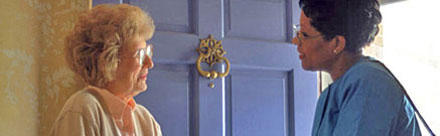
Since before the establishment of the Health Department in 1990, our county nurses have played an active role through home care services in keeping our residents healthy and independent at home. We offer care to over 150 county residents. Throughout the year, our public health nurses and home care aides have made 347 visits to provide skilled nursing care and have spent over 1000 hours to ensure residents are comfortable in their living environment.
The Health Department has six registered nurses who are able to provide care to Cerro Gordo clients 24 hours a day, seven days a week. Public health nurses keep your physician updated on your recovery. They perform skilled tasks such as drawing blood for lab tests, giving medicine by injection, caring for a wound or teaching you and loved ones about medications and treatments. Our nurses are skilled in many areas to help improve client's recovery and enhance their health conditions.
Our nursing team can provide the following services:
- Evaluate client's nursing needs.
- Initiate the physician ordered plan of care and necessary revisions.
- Provide any services requiring skilled nursing such as injections, blood draws, dressing changes, diabetic teaching, refilling of insulin syringes, etc.
- Coordinate all services required by the client.
- Assist frail and elderly in long-term planning to stay in home or nursing home placement.
- Client and family health teaching.
Yet, the team would not be complete without the help of the department's home care aides. The Health Department home care aide team includes 10 aides, both part-time and full-time. Each aide must complete a 75-hour Certified Nursing Assistant course prior to employment and must participate in continuing education classes.
Home care aides can provide a wide variety of services that include personal care services such as bathing and foot care to household chores such as laundry and dusting. These additional services are also provided:
- Provide personal care such as bathing, skin and hair care.
- Assistance with budgeting, home management and light housekeeping.
- Assistance with grocery shopping and laundry.
- Assistance with meal planning and preparation.
- Assistance with rehabilitation and exercise therapy.
Home care services are funded by Medicare, Medicaid, private insurances, grants, Elderbridge Agency on Aging and the Cerro Gordo County Board of Supervisors. Our home care services are available to all members of the county, but you need to ask for it when you visit your health care provider.
With over 30 years of home care services and public health nursing experience, give the Cerro Gordo County Department of Public Health a try. Know us before you need us!
|
|
|
|
Happy November!
Can you believe it's already November? It feels like yesterday was August and before we know it, the holidays will be here. Make sure your holiday season is a safe and healthy one. Our Immunization Clinic is open Monday-Friday from 10:00 AM - Noon and 12:30 - 4:00 PM. This Saturday, November 17, our Immunization Clinic will also be open from 9:00 AM - Noon. Make sure to stop in for your flu shot/mist and other vaccine needs.
We have been seeing an increase of pertussis in our county. The most common symptoms of pertussis in children are fits of coughing, followed by vomiting, a 'whooping' sound as air is inhaled and difficulty sleeping. In adults, however, only a lingering cough that can last for weeks is often seen. This is why many adults do not realize they have pertussis. While treatment with antibiotics will prevent an individual from spreading the disease further after being diagnosed with pertussis, the cough may continue to last for weeks. According to the CDC, people who are not vaccinated have eight times the risk of infection compared to people who are fully vaccinated against pertussis. If someone who has been vaccinated does get pertussis, the disease is usually less serious and they're far less likely to spread the virus to someone else. Individuals who need the pertussis vaccine can receive it from either their local health care provider or at the Health Department.
In this month's Public Health Communicator, we provide an article regarding winter weather preparedness. November is known for National Home Care Month and the Great American Smoke Out, which are both included in this newsletter. As always, we feature the "Day in the Life of" column and the Wellness Corner.
Like us on Facebook or follow us on Twitter to stay up-to-date on all the current information surrounding the Health Department. Make sure to check out the left side of our newsletter, which features our Quick Response (QR) Code. Scan it with your smartphone to get directly to our website.
Best wishes,
Nola Aigner
Public Information Officer
Cerro Gordo County Department of Public Health
|
|
PREPARE FOR WINTER!

Snow, ice, wind and much colder temperatures are just around the corner, which can cause many winter weather hazards. Winter weather hazards are caused by exposure to cold temperatures, vehicle accidents due to road conditions, fires due to dangerous use of heaters and being trapped at home or in your car without utilities or other assistance. The Health Department would like to provide our residents with winter weather preparedness tips to ensure a safe and healthy winter.
Keep a winter weather travel kit in your vehicle that includes:
- Cell phone and charger or extra batteries
- Blankets and extra clothing such as a hat and mittens
- Flashlight
- First aid kit
- Container of sand or kitty litter and a shovel
- High calorie, non-perishable foods
- Ice scraper
- Battery booster cables
TIP: When traveling, make sure your gas tank is near full.
Make sure to prepare a winter weather kit for your house or office which contains: extra flashlights and batteries, battery powered radio, extra food and water, extra medicine and baby supplies, first aid supplies, heating fuel, emergency heat source and fire extinguisher/smoke detector.
If you are caught in a winter storm in a vehicle, remember to:
- Stay in the vehicle
- Run the engine about 10 minutes every hour for heat
- Crack a window while running the engine to avoid carbon monoxide poisoning
- Make sure the exhaust isn't blocked by snow
- Be visible to rescuers by turning on dome light when running the engine
- Exercise to keep warm
Winterizing your home as just as important as your vehicle. Here are several tips to make sure your home is ready for elements of mother nature:
- Clear rain gutters; repair roof leaks and cut away tree branches that could fall on a house or other structure during a storm.
- Maintain heating equipment and chimneys by having them cleaned and inspected every year.
- Insulate pipes with insulation or newspapers and plastic and allow faucets to drip a little during cold weather to avoid freezing. Running water, even at a trickle, helps prevent pipes from freezing.
- All fuel-burning equipment should be vented to the outside and kept clear.
- Keep fire extinguishers on hand, and make sure everyone in your house knows how to use them.
- Learn how to shut off water valves (in case a pipe bursts).
- Insulate your home by installing storm windows or covering windows with plastic from the inside to keep cold air out.
When caught in a winter storm in your home, make sure to:
- Remain inside if possible and stay warm using an alternative heat source if needed
- Close off un-needed rooms if your heat is off
- Cover windows at night
- Wear layers of clothing
For more winter weather preparedness tips, visit www.cghealth.com |
|
Health Department Announces Schedule of Events for Great American Smoke Out
 The Cerro Gordo County Department of Public Health, the Partnership for a Tobacco Free Cerro Gordo County, and Cerro Gordo Students for Tobacco Education and Prevention (CG-STEP) are working together to encourage smokers to take a break for the day on November 15, 2012. The Great American Smoke Out (GASO) is a designated day to quit smoking. Quitting even for a day can make a difference. It can be a big step towards improved health for the tobacco user and those subject to their second hand smoke. As early as 24 hours after quitting, a tobacco user's chance of a heart attack begins to decrease. Within eight hours of not smoking, the carbon monoxide levels in the blood return to normal. The Cerro Gordo County Department of Public Health, the Partnership for a Tobacco Free Cerro Gordo County, and Cerro Gordo Students for Tobacco Education and Prevention (CG-STEP) are working together to encourage smokers to take a break for the day on November 15, 2012. The Great American Smoke Out (GASO) is a designated day to quit smoking. Quitting even for a day can make a difference. It can be a big step towards improved health for the tobacco user and those subject to their second hand smoke. As early as 24 hours after quitting, a tobacco user's chance of a heart attack begins to decrease. Within eight hours of not smoking, the carbon monoxide levels in the blood return to normal.
This year's focus in Cerro Gordo County is all about creating one more opportunity to QUIT. The Tobacco Partnership works year around to provide cessation opportunities and resources and in recognition of the Great American Smoke Out, will offer these opportunities in November:
Free Fresh Start classes designed to help tobacco users make a plan to quit - offered through Kaplan University.
Tobacco cessation and education resources at Southbridge Mall Monday, November 12 - Saturday, November 17, 2012.
Tobacco Partnership Representatives will be discussing options for tobacco cessation and distributing cessation tools at Southbridge Mall Wednesday, November 14, 2012 from 4-6 PM.
Youth-led tobacco prevention campaign at Southbridge Mall Saturday, November 17, 2012 from 2-3 PM.
"Quitting is more than just not smoking. For most people it takes a number of attempts to achieve success. Cold turkey works for some, while a lot of creativity goes into a quit plan for others. We encourage people to keep trying and to stay educated on the various opportunities available for cessation," states Penny McCaslin, Tobacco Program Manager for the Cerro Gordo County Department of Public Health. Visit any of the upcoming Great American Smoke Out opportunities to begin your quest to a smoke free life.
For more information, visit our website at www.cghealth.com
|
|
Check our new home care commercial!
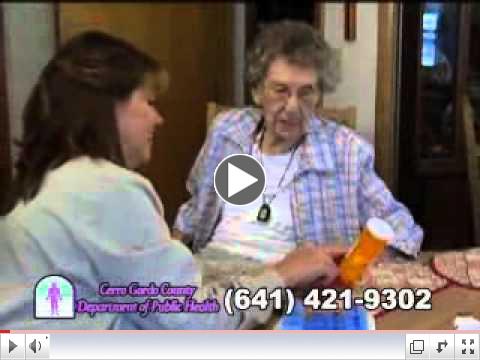 | | Cerro Gordo Co. Dept. of Public Health Home Care Commercial |
|
|
Wellness Corner
Diabetes Myths and Misconceptions
November is Diabetes Awareness Month, yet there are several myths and misconceptions surrounding the understanding and knowledge of diabetes. Here are a couple of facts to put the diabetes myths and misconceptions to rest.
Myth: Diabetes is not that serious of a disease.
Fact: Diabetes causes more deaths a year than breast cancer and AIDS combined. Two out of three people with diabetes die from heart disease or stroke.
Myth: If you are overweight or obese, you will eventually develop type 2 diabetes.
Fact: Being overweight is a risk factor for developing this disease, but other risk factors such as family history, ethnicity and age also play a role. Unfortunately, too many people disregard the other risk factors for diabetes and think that weight is the only risk factor for type 2 diabetes. Most overweight people never develop type 2 diabetes, and many people with type 2 diabetes are at a normal weight or only moderately overweight.
Myth: People with diabetes can't eat sweets or chocolate.
Fact: If eaten as part of a healthy meal plan, or combined with exercise, sweets and desserts can be eaten by people with diabetes. They are no more "off limits" to people with diabetes than they are to people without diabetes. The key to sweets is to have a very small portion and save them for special occasions so you focus your meal on more healthy foods. |
Help us promote Public Health services. Forward this electronic newsletter to your friends, family, co-workers and associates. Thank you for choosing the Cerro Gordo County Department of Public Health! Our Mission Statement: The Cerro Gordo County Department of Public Health works to optimize the health of all people in Cerro Gordo County. Our Vision Statement:
We will be the leader in making Cerro Gordo County the healthiest
county in Iowa.
Our Value Statement:
We believe in human dignity, respect for individual choices, promotion for wellness and personal safety, protection of the environment, prevention of disease and access to quality health services.

|
|
|
|
|