|
|
|
|
|
|
Will 2016 Be a Breakout Year for Housing?
By Charles C. Shinn, Jr., Ph.D., Builder Partnerships

The housing industry is entering the seventh year of a rather lackluster recovery since the great housing recession. 2015 was forecast to be the break-out year for housing. Even though it has been a good year for the industry, it has fallen short of the experts original expectations.
The year began with a repeat of the severe winter weather patterns of 2014 and a very wet spring in Texas impacting housing starts. In spite of the rough start , by August the housing starts were running 13.8% ahead of 2014, and new home sales were outpacing 2014's rate by 21.5%. Most of our builders were experiencing sales in excess of 20% to 30% above their sales forecasts.
It looked like the breakout year everyone was waiting for until it stalled during the second half. Now it looks like 2015 is going to finish with about a 9.6% increase in housing starts or approximately 1.1 million, and a 14.8% gain in new home sales, which will just exceeding 500,000. So, once again we had a potential breakout year lose its steam.
Now we look to 2016 for the breakout. In the seventh year of this cycle, the economy is weak but still is getting very mature. We are seeing some very aggressive forecasts for the coming year. We just did a survey of our builders that showed they anticipate an increase in starts of almost 25%. The average builder is growing from 106 homes to 133 homes.
|
Turn Your Builder Program into a Manufacturing Program in 2016
By Stephen Crouch, Builder Partnerships

As we kick off 2016, manufacturers are reinforcing their builder-focused sales efforts. For most manufacturers, these efforts will include a builder program. When implemented correctly, builder programs can be very effective tools for a manufacturer sales team to pull demand for their products through their channel. When programs are implemented incorrectly, though, they can be a waste of time and money. Throughout 2016, our monthly newsletter will include a series of articles that address builder program best practices. Following is a preview, focusing on four ways manufacturers can make their programs work for them, not just the builder.
Communicate How Builder Programs Fit Into Your Sales Strategy Since most manufacturers do not have direct transactions with builders, their programs are the basis for their builder relationship. Usually, manufacturers focus the majority of their research and development, and engineering efforts on the needs and wants of the builder. However, when it comes to marketing and selling their products, they depend on their channel partners to communicate the benefits.
It should be clearly communicated to the entire marketing and sales team that the primary objective for calling on builders and offering a program is to open a new, direct channel of communication. The entire team needs to know the purpose is to support its loyal channel partners, not go around them.
|
|
Financial Study: Watch Your Direct Costs
By Emma S. Shinn, CPA, Builder Partnerships
 In our 22nd Annual Financial and Operational Study, we see further proof of an industry in transition as builders strive to develop efficient, profitable operations that meet the increasing demands of a growing market. The strongest indicator of this struggle is in the increases in direct costs and how that affected profitability. But let's begin back in 2006 when the profit performance of builders reached its peak and 20% of the builders performed above the 12% target. 7% performed above 20% net profit before taxes. In 2014, only 7% of the builders participating in the study performed above the 12% target, with none above 20%. The highest profit achieved in 2014 is 16.3% in contrast to profits reaching 40% in 2006. The losses have gone from a maximum of slightly over 50% with more than 50% of the builders reporting losses in 2008 to losses under 4% in 2014 with 11% of the builders reporting a loss, which is in line with results reported prior to the downturn. When looking at the economic trends together with the financial trends experienced since 2006, it is not difficult to see what caused the dramatic drop in profitability. The industry had to adjust to a significant drop in volume as well as a sizable drop in sales prices. These changes affected not only the cost structure of the product, but also the operational structure of each entity as it required adjusting operating expenses to new sales levels. 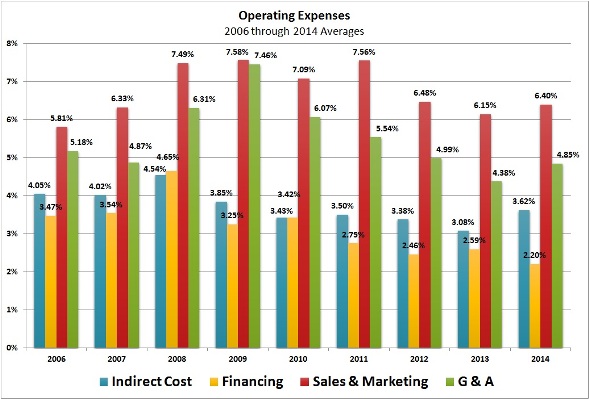
|
|
New Product Feasibility
By Ed Hauck, Builder Partnerships
 Here at Builder Partnerships, we've been seeing builders really start to ramp up new products to meet the increasing demand for homes. It's great to see after such a long, tough stretch. But with the development of new product comes some thorny issues about pricing and value. Too often builders are investing in their models, but the investment is not in a way that gets a return from the buyers. The homes they put on the market are underperforming in two areas. The inappropriate investment is increasing costs on one side, and not meeting consumer needs on the other. In short, costs are going up on new products, but price is declining or holding steady. That's a recipe for declining sales and decreased profitability. Helping builders identify where to save money and where to invest is a large part of my efforts here at Builder Partnerships. A key element of that analysis is a new product feasibility exercise that I walk my builder clients through. How It Works I ask a builder to take his best performing, most consistent plan. By that I mean I want a top seller that is a leader in the company's profit producing homes. Cost and sales value are at an optimum.
|
Build Your Team to Peak Performance: Become the Employer of Choice
By Charles C. Shinn, Jr., Ph.D., Builder Partnerships

The economy is improving, and companies are hiring again. According to a study done by Sageworks published in Forbes magazine ( here), five of the 10 fastest growing industries in small business are tied to construction. Construction spending has been climbing this year, and unemployment in the sector is so low (lowest level since 2006) that wage pressure and labor shortages are growing. Privately held businesses in residential building construction have grown 12.8% over last year, notably faster than the 8.5% average for all small businesses.
This is good and bad news? More jobs equals more income, which I hope will result in more home sales. However, if you look at the impact on your company, the more jobs that are available, the more demand there is for quality labor. That means it is becoming more difficult to keep high-quality staff committed to your company and the pool of available high-quality workers in the industry is lacking at best.
If you pick up any trade publication, you will notice that the biggest concern for builders right now is the ability to find quality staff and trade contractors. Builders are worried about construction schedule delays and low quality work on their jobs. It is tough finding ANY workers, much less experienced staff, since many people left the industry during the downturn ( Wall Street Journal). However, high-quality workers are out there AND, I would argue, if you look for quality, demand it and provide a desirable work environment, you will have no shortage of quality workers wanting to work for your business.
But, how does one do that? Become an Employer of Choice in your local market.
|
Importance of Training Now More than Ever
By Monica Wheaton, Builder Partnerships
With the challenges in the home building industry, it has been difficult for management to justify spending hard-earned dollars on providing developmental training for their staff. Most organizations were just not able to make the investment to provide the training needed by their employees and, understandably, just made it work so they could survive. Employees were hanging on and making it work because, frankly, they really didn't have any other options.
Now that the industry is improving, things are different. We have seen quite a few builders lose high-quality staff to other companies or even other industries because employees are disenchanted or looking for opportunities for growth. The movement in this high-quality staff that helped lead their companies through the downturn can have detrimental impacts and have caused many builders to seriously revisit what they need to do in order to keep these leaders in their companies. Employees are jumping ship for several reasons, but, it can be argued, some of the most prominent reasons are because employees are not feeling engaged or appreciated for their efforts. They do not see a path for opportunity and may not feel that management is watching out for their development and growth.
|
Builder Partnerships at IBS
|
Celebrate Builder Partnerships' 11th Anniversary at our IBS Reception
11th Annual Builder Partnerships Reception
January 18, 2016
5:30 - 8:00 pm
Embassy Suites Convention Center, Las Vegas
The night before IBS opens, the place to gather is at the Builder Partnerships Annual reception. Every year, hundreds of builders, manufacturers and friends gather to catch up with old friends and prime the pump for the big show. Space is limited so RSVP early and get your name on the list.
|
|
|
|
Live Events in Atlanta

Purchasing, Estimating and Job Costing
Feb. 10-12, 2016
Atlanta
Purchasing, Estimating and Job Costing is a comprehensive seminar designed to improve profitability through a more accurate and effective estimating and purchasing department. Good estimating and purchasing is critical to obtaining superior profitability, and can increase your bottom line by as much as 5%. Our goal is to provide a wide range of tools that attendees can use to realize results immediately upon return to their companies.
For more information, click here.
Superintendent's Job: Front Line Manager
Feb. 18-20, 2016 Atlanta
The Superintendent's Job - Front Line Manager is designed as an interactive experience to help your team improve job site management techniques. It will provide the necessary tools to increase overall profitability and customer satisfaction through a strong focus on building the house right the first time: on quality, on budget, and on time.
For more information, click here.
Managing for Profit
March 2-4, 2016 Atlanta
Managing for Profit is an intensive seminar designed to put you on track to improved profitability. Loaded with valuable insight on management techniques specific to home building companies, this seminar will provide tools you can use to realize improved results across the entire organization. Systems, procedures and forms will be demonstrated so you can begin using concepts learned immediately upon return to your company.
For more information, click here.
Live Events in Colorado
Whizard Summit-Building Material Sales and Marketing
April 6-7, 2016
Boulder, Colo.
Mark Mitchell, Whizard Strategies, hosts his annual two-day seminar on building materials sales and marketing. This is the only event designed to help you stay current with the knowledge and strategies you need to sell today's demanding builder, architect. contractor, dealer, distributor or big box. The way you reach these people and the messages you need to use are changing. This is only part of what you will learn at the Whizard Summit.
For more information, click here
Production Management
May 9 - 11, 2016 Denver
Streamline processes, increase efficiencies, and cut costs in your production department to significantly increase your profits.The Production Management seminar introduces effective ways to organize and operate a construction management department.
For more information, click here.
Purchasing, Estimating and Job Costing
September 21 - 23, 2016
Denver
Purchasing, Estimating and Job Costing is a comprehensive seminar designed to improve profitability through a more accurate and effective estimating and purchasing department. Good estimating and purchasing is critical to obtaining superior profitability, and can increase your bottom line by as much as 5%. Our goal is to provide a wide range of tools that attendees can use to realize results immediately upon return to their companies.
For more information, click here. Superintendent's Job: Front Line Manager
October 6 - 8, 2016 Denver
The Superintendent's Job - Front Line Manager is designed as an interactive experience to help your team improve job site management techniques. It will provide the necessary tools to increase overall profitability and customer satisfaction through a strong focus on building the house right the first time: on quality, on budget, and on time.
For more information, click here. Managing for Profit November 2 - 4, 2016 Denver
Managing for Profit is an intensive seminar designed to put you on track to improved profitability. Loaded with valuable insight on management techniques specific to home building companies, this seminar will provide tools you can use to realize improved results across the entire organization. Systems, procedures and forms will be demonstrated so you can begin using concepts learned immediately upon return to your company.
For more information, click here.
For the Complete list of events, click here
|
|
Builder Partnerships
Builder Partnerships is a member organization focused on providing management training and support to help builders improve their performance and profit. Currently we represents approximately 650 builders in the United States and Canada who have projected about 80,000 homes built collectively this year. With over 75 manufacturer and service providers associated with our group, Builder Partnerships also manages highly competitive rebate and incentive programs and works to strengthen relationships between builders, manufacturers and other service providers in the home building industry.
For more information, visit www.builderpartnerships.com
|
|