|
QUICK
LINKS:
TASC Connect hours and locations and other help
General information about the test
Online resources Including skill review and practice
Recursos en espaņol
Website
of the Month
Click below for a great website on writing compare and contrast essays.
Essay help

Good news
for test retakers!
If you took the GED test between 2002 and 2013 and passed any of the 5 subject tests, your passing scores will count until the end of 2015!
|
|
|
Study online for the TASC!
Learning Express has courses
on all 5 TASC subjects.

Follow the steps below:
- www.firstfind.org
- Get Your GED/TASC
- Learning Express Library
- Learning Express 3
- High School Equivalency Center
- Prepare for the TASC Test
- TASC Test Preparation Tutorial
Please call us at 914-231-3264, if you need help with the online programs. We can work with you over the phone while you're on the computer.
|
|
Our wonderful tutors are waiting to help you with TASC subjects, online learning, one-to-one tutoring, and questions about the test!
Click below for a schedule of TASC Connect Sessions.
|
|
Video of the month!
Social Studies -
the 3 branches of government
|
|
Practice Tests
and Sample Questions
Practice tests will help you focus your studying, develop test-taking skills, and improve your score!
Sample Question* from the Writing Practice Test:
Which of these sentences contains an error or errors in capitalization?
A. Every Autumn, the residents of Plattesville organize a road cleanup.
B. They start on Main Street and work outward to the north, south,
east, and west.
C. One group cleans along Route 225 all the way to the town line.
D. Another works eastward toward the boundary with Clark County.
Answer: A - The names of the seasons are not capitalized in English,
so "Autumn" should be "autumn."
______________________________________________________
Click on the links below for more help with capitalization.
Capitalization Rules - Quick Guide
Video on Capitalization
Video 2 on Capitalization
Fun Game to Practice Capitalization
More Practice with Capitalization
Click on the link below for online practice tests with Learning Express.
TASC Practice Tests
*Taken from TASC: The Most Authoritative Guide to the New High School Equivalency Exam, 2014, McGraw-Hill Education.
|
Exponents
and
Square Roots
Exponents
Exponents are a quick way to write multiplication when one number is being multiplied by itself a certain number of times.
For example, instead of writing 5 x 5 x 5 x 5, we could write
54
|
The format for writing exponents is:
baseexponent - The base is the factor to be multiplied by itself and the exponent is the number of times the base is to be multiplied by itself.

|
In the example in the box above, the exponent 3 tells us how many times to multiply the base 2 by itself. The product, or the result we get when we do multiplication, is 8. The product is also called the standard form. A factor is a number being multiplied.
As you can see from the table below, the exponential form is a much easier and quicker way to write multiplication when the same factor is being multiplied by itself repeatedly.
|
Exponential
Form
|
Factor
Form
|
Standard
Form
| |
22 =
|
2 x 2 =
|
4
| |
23 =
|
2 x 2 x 2 =
|
8
| |
24 =
|
2 x 2 x 2 x 2 =
|
16
| |
25 =
|
2 x 2 x 2 x 2 x 2 =
|
32
| |
26 =
|
2 x 2 x 2 x 2 x 2 x 2 =
|
64
| |
27 =
|
2 x 2 x 2 x 2 x 2 x 2 x 2 =
|
128
| |
28 =
|
2 x 2 x 2 x 2 x 2 x 2 x 2 x 2 =
|
256
|
Quick tip: A common mistake is to think that the exponent is saying multiply the base by the exponent. Remember, the exponent tells us how many times to multiply the base by itself. So 32 is 3 x 3, not 3 x 2.
1) Let's try another example.
What is the product of 43?
Answer: 4 x 4 x 4 = 64.
|
Another way of expressing exponents is "powers."
For example, 75 is called "7 raised to the fifth power."
|
The following rules apply to numbers with exponents of 0, 1, 2, and 3.*
|
Rule
|
Example
| |
Any number (except 0) raised to the zero power is equal to 1.
|
1490 = 1
| |
Any number raised to the first power is always equal to itself.
|
81 = 8
| |
If a number is raised to the second power, we say it is squared.
|
32 is read as three squared
| |
If a number is raised to the third power, we say it is cubed.
|
43 is read as four cubed
|
Perfect squares are numbers that are the product of two equal whole numbers. For example, 9 is a perfect square because 3 x 3 = 9. 8 is not a perfect square because there is no number that can be multiplied by itself to get 8.
TASC study tip: Memorize the most common squares and cubes. This will help you save time on the test. Here is a table listing them: 
_____________________________________________________________
Click on the links below for further explanation, practice and videos on exponents.
___________________________________________
Square Roots
Many mathematical operations have an inverse, or opposite, operation. Subtraction is the opposite of addition, division is the inverse of multiplication, and so on.
Squaring has an inverse too, called "finding the square root." Remember, the square of a number is that number times itself. The perfect squares are the squares of the whole numbers: 1, 4, 9, 16, 25, 36, 49, 64, 81, 100 ... **
We write the square root with a special symbol called the radical:

The square root of any number, n, written  , is the number that gives n when multiplied by itself. For example, , is the number that gives n when multiplied by itself. For example,
 because 10 x 10 = 100 because 10 x 10 = 100
Here are the square roots of all the perfect squares from 1 to 100.
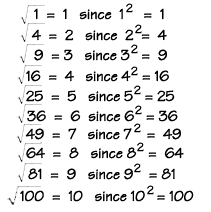
TASC study tip: Memorizing the perfect squares will help you find square roots. For example, if you know that 15 x 15 = 225, then figuring out that the square root of 225 is 15 is easy!
____________________________________________
Click on the links below for extra lessons and practice on square roots.
Square roots - Math is Fun
Square roots and the Pythagorean Theory - to use with right triangles (triangles that have a 90 degree angle).
** From http://www.math.com/school/subject1/lessons/S1U1L9DP.html
|
If you ...
- have a question
- want feedback on an essay
- think of a great idea to help other students
|
|
|
|
|
|
|
Lisa Kahn - TASC Connect! - Westchester Library System - 914-231-3264
|
|
|
|




