Website     About     Faculty/Staff     News/Events     Projects/Programs
October 2015 | Volume 3, Issue 4
EVIDENCE IN ACTION
A quarterly research brief from the
Center on Trauma and Children
The Intersection of Trauma and Substance Misuse in Adolescents 
This issue of Evidence in Action highlights the role of the Center on Trauma and Children in the Adolescent Health and Recovery Treatment and Training (AHARTT) project at the University of Kentucky Department of Psychiatry. AHARTT, funded as part of the Kentucky Kids Recovery Project, trains and supports behavioral health professionals to provide evidence-based, adolescent substance misuse interventions to youth in need across the state. Examination of the baseline data for clients seen across the state reveals important connections between trauma and adolescent substance misuse described here.
 
What do we know about trauma and adolescent substance use?
 The comorbidity of posttraumatic stress and substance use disorders in adolescents with trauma exposure has been pretty well-established (Najavits et al 2006; Kilpatrick et al, 2003; DeBellis, 2002). Increased risks for adolescent substance use disorder, early initiation of substance use, and other risk-taking behavior have been correlated to the amount (Ford et al 2010; Dube et al 2006; Dube et al 2003; MacDonald et al 2010) and nature (Begle et al, 2011) of childhood trauma exposure. The presence of post-traumatic stress disorder has also been found to contribute to adolescent substance abuse (Cornelius et al, 2010) and may serve as a means of self-medication (Garland et al, 2013).
 
Who are these adolescents?  
This clinical sample of youth (n = 89) range in age from 12 - 19 with a mean age of 15.72. They are predominantly Caucasian (89.9%), non-Hispanic (95.5%), with more boys (64%) than girls. Referrals come from the courts, child protective services, schools and other professionals; clients are seen in a variety of settings including outpatient clinics, in-home services, residential facilities and school-based services.

What is their trauma exposure and response?
A vast majority of the clients reported trauma exposure: 77.5% of all clients endorsed having been trauma exposed and of those exposed, 66.6% characterized the exposure as chronic.
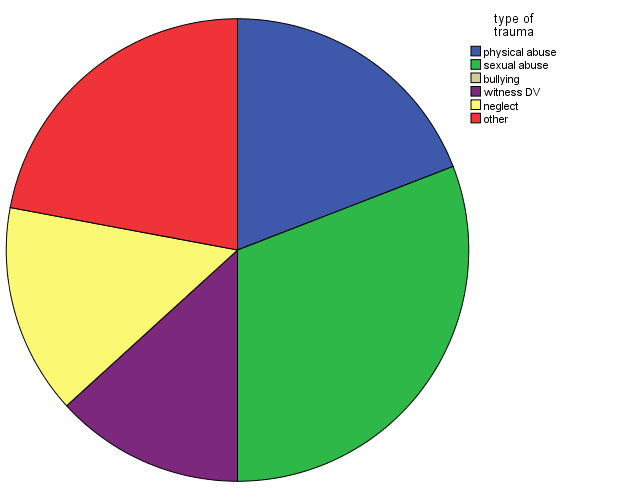
The types of traumas reported included physical abuse, sexual abuse, neglect, bullying, witnessing domestic violence and "other" (e.g. witnessing the death of a loved one, finding a parent after a suicide attempt/ losing a parent to suicide or drug overdose, parental abandonment, robbery and assault, and car accident) with the most serious trauma reported represented in Figure 1.

Figure
1.


Traumatic stress symptoms were assessed using the Child PTSD Symptom Scale (CPSS); scores on the CPSS may range from 0 to 51 with the threshold for PTSD placed at 15. CPSS Scores for the adolescents in this AHARTT sample ranged from 0 to 45, with a mean score of 17.25.   Girls scored overall higher, with a mean CPSS score of 24.77, while boys had a mean score of 13.09; gender was found to be significantly correlated to CPSS score (r = .436, p = .000). 

What types of substances and how much are they using?
These adolescent clients reported abusing an average of 4.54 different substances over the previous 12 months, ranging from using none to as many as twelve different substances, with 40.4% reporting having used more than four substances in the previous year.
  • The most commonly used non-tobacco substances are marijuana and alcohol
  • 34.8% report having used some kind of "hard drug" including heroin, methamphetamine, cocaine, crack, or hallucinogens.
  • 48.3% reported using some type of pills, including opioid narcotics (i.e. oxycodone, lortab, percocet), sedatives or tranquilizers (i.e. Xanax, Valium), stimulants (Adderall or other ADHD medications), or synthetic narcotics (methadone, suboxone, buprenorphine)
  • 84.3% reported having used some type of tobacco (cigarettes, smokeless tobacco or e-cigarettes) in the previous year
  • The mean number of days reported using substances in the previous month was 17.56, but amounts varied greatly according to circumstances: some clients had tried to cut down on their own in the month prior to starting AHARTT services, others had been in detention or residential facilities, and others reported using every day.
Clients reported first regular use of these substances ranging from age 7 through 17, with a mean age of first abuse of alcohol or other substances at 12.67; by the time they were 14 years old 56.2% of these adolescents were already abusing drugs or alcohol.

What is the relationship between traumatic stress symptoms and polysubstance abuse?
A regression model found that higher scores on the CPSS predicted a greater number of substances used: Age, gender and CPSS scores predicted 29% of the variance in polysubstance abuse, with CPSS scores contributing more than 10%.    
What does this mean for practice? 
 

1.  Adolescents with substance abuse, especially polysubstance abuse, should be screened for traumatic stress symptoms and trauma exposure. This type of screening using a short, standardized and publicly available measure can be done not only in behavioral health and substance abuse agencies but also in schools, detention centers, residential treatment centers, courts, medical facilities and other places adolescents are served. Some examples of free screening tools include:

  • UCLA PTSD-Reaction Index for DSM-5 (Pynoos et al., 1998): Targets trauma exposure and symptoms and can be used as a screener
  • Traumatic Events Screening Inventory (TESI-SRR) and parent version (TESI-PRR) (Ippen et al., 2002): Screens for trauma exposure
  • Childhood Trauma Questionnaire (Bernstein & Fink, 1994): Screens for trauma exposure
  • Child PTSD Symptom Scale (Foa, Johnson, Feeney, Treadwell, 2001): Targets trauma symptoms and can be used as a screener and adjunct to assessment

2.  Adolescents known to have trauma exposure should also be assessed for substance misuse and polysubstance abuse. This may include interviews and questionnaires, biological testing or a combination of the two. Behavioral health providers should be cross-trained to screen for and recognize polysubstance abuse in teens.


3.  Professionals working with adolescents with or at risk for substance misuse should be trained in and familiar with trauma-informed practices and interventions and find ways to infuse it into their work. A trauma-informed approach should be part of any professional response to adolescents engaging in high risk or delinquent behaviors.

REFERENCES
Begle, A.M., Hanson, R.F., Danielson, C.K., McCart, M.R., Ruggiero, K.J., Amstadter, A.B., Resnick, H.S., Saunders, B.E., & Kilpatrick, D.G. (2011). Longitudinal pathways of victimization, substance use, and delinquency: Findings from the National Survey of Adolescents. Addictive Behaviors, 36, 682-89.

Bernstein, D.P., Fink, L., Handeisman, L., Foote, J., Lovejoy, M., Wenzel, K., Sapareto, E., & Ruggiero, J. (1994). Initial reliability and validity of a new retrospective measure of child abuse and neglect. American Journal of Psychiatry, 151, 1132-36.

DeBellis, M.D. (2002). Developmental traumatology: A contributory mechanism for alcohol and substance use disorders. Psychoendocrinology, 27, 155-70.

Dube, S.R., Miller, J.W., Brown, D.W., Giles, W.H., Felitti, V.J., Dong, M., & Anda, R.F. (2006). Adverse childhood experiences and the association with ever using alcohol and initiating alcohol use during adolescence. Journal of Adolescent Health, 38, 444e1 - 444e10.

Dube, S.R., Felitti, V.J., Dong, M., Chapman, D.P., Giles, W.H., & Anda, R..F. (2003). Childhood abuse, neglect, and household dysfunction and the risk of illicit drug use: The Adverse Childhood Experiences study. Pediatrics, 111(3), 564-72.

Foa, E. B., Johnson, K. M., Feeny, N. C., & Treadwell, K. R. H. (2001). The Child PTSD Symptom Scale: A preliminary examination of its psychometric properties. Journal of Clinical Child Psychology, 30, 376-384.

Ford, J.D., Elhai, J.D., Connor, D.F., & Frueh, B.C. (2010). Poly-victimization and risk of posttraumatic, depressive, and substance use disorders and involvement in delinquency in a national sample of adolescents. Journal of Adolescent Health, 46, 545-52.

Garland, E.L., Pettus-Davis, C., & Howard, M.O. (2013). Self-medication among traumatized youth: Structural equation modeling of pathways between trauma history, substance misuse, and psychological distress. Journal of Behavioral Medicine, 36(2), 175-185.

Ippen, C. G., Ford, J., Racusin, R., Acker, M., Bosquet, M., Rogers, K., Ellis, C., Schiffman, J., Ribbe, D.,Cone, P., Lukovitz, M., & Edwards, J. (2002). Traumatic Events Screening Inventory - Parent Report Revised.

Jaycox, L.H., Ebener, P., Damasek, L., & Becker, K. (2004). Trauma exposure and retention in adolescent substance abuse treatment. Journal of Traumatic Stress, 17(2), 113-21.

Kilpatrick, D.G., Ruggiero, K.J., Acierno, R., Saunders, B.E., Resnick, H.S., Best, C.L. (2003). Violence and risk of PTSD, major depression, substance abuse/dependence, and comorbidity: Results from the National Survey of Adolescents. Journal of Consulting and Clinical Psychology, 71(4), 692-700.

MacDonald, A., Danielson, C.K., Resnick, H.S., Saunders, B.E., Kilpatrick, D.G. (2010). PTSD and comorbid disorders in a representative sample of adolescents: The risk associated with multiple exposures to potentially traumatic events. Child Abuse and Neglect, 34, 773-83.

Najavits, L.M., Gallop, R.J. & Weiss, R.D. (2006). Seeking Safety Therapy for Adolescent Girls with PTSD and Substance Use Disorder: A randomized controlled trial. Journal of Behavioral Health Services and Research, 33(4), 453-63.

Pynoos, R., Rodriguez, N., Steinberg, A., Stuber, M., & Frederick, C. (1998). UCLA PTSD Index for DSM-IV.
University of Kentucky Center on Trauma and Children
859-218-6901 | alwhit4@uky.edu | http://www.uky.edu/ctac


 Like us on Facebook   Follow us on Twitter   View our videos on YouTube   View our photos on flickr