In celebration of the 125th anniversary of the Lord's Day Alliance, Lord's Day Alliance and Academy of Preachers welcome Young Preachers to share 15-minute sermons on the theme:
"Truth-Telling: Democracy in an Age Without Facts"
 
|
|
Listen to one of the Young Preachers!
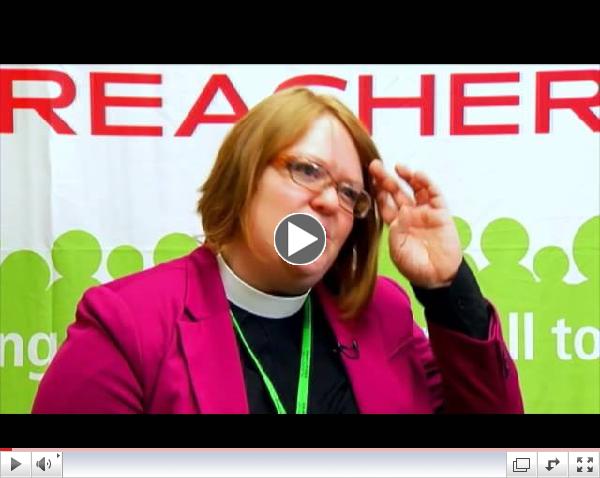 | | Kristina Heise, AoP '12 |
More Reading and Resources
Register Now for 2014 National Festival in Indianapolis
Order the book of 2012 sermons: Uncommon Sense
_________________________________________
"Riding the mule in the land of Secretariat"
Dear God, as I proclaim this message for the last time this summer, take my lips and speak through them. Take our minds and think through them. Take our hearts and do with them what only you can do. Amen
My father is a fountain of idioms and witticisms that although seem simple on the surface level, they carry a much deeper meaning. Of all of his sayings, one in particular has stood out to me. It goes something like this:
You have to ride the mule before you can ride the white horse.
Read More>

|

Faith and Philanthropy
By Dwight A. Moody
Philanthropy is at the center of the Academy of Preachers. Many have given to us generously; and we have given to others with equal delight. Which is why I so enjoyed the four-day seminar at St. Meinrad this past month on the subject, "Faith and Fundraising."
The seminar was hosted by St. Meinrad Seminary and their Institute for Priests and Presbyters, a ministry to Roman Catholic priests led by Fr. Ron Knott; Fr. Knott was the pastor to led the revitalization of the Cathedral of the Assumption in Louisville, our ecclesiastical host for the 2011 and 2012 National Festivals of Young Preachers. .
The Lilly Family School of Philanthropy in Indianapolis and the Lake Institute for Faith and Giving were the sponsors and leaders of the St. Meinrad seminar. The Lake Institute was launched ten years ago by the estate and family of Tom Lake, long time CEO of the Lilly Pharmaceutical Corporation of Indianapolis. Read More>
 
Founding Partner Update 
By Allan Moody, AoP Office Manager
The Christian Theological Seminary (An Academy of Preachers Founding Partner) and Butler University have joined in partnership to create The Desmond Tutu Center. We honor CTS and Butler today for creating North America's first and only academic center in a university and seminary context named for Archbishop Emeritus Tutu. The center will focus on leadership development in social justice and reconciliation, international relationships, and inter religious bridge-building. I encourage you to explore the CTS website and discover their unique partnership.
The Washington Post interviewed Tutu just before the ceremony at CTS and he was asked:
How do you feel about this center named after you?
I'm blushing. Naming a center after a person who is still alive can make it seem that an individual somehow on their own was able to accomplish what he accomplished. It was our people. I am thrilled and yet am so aware that any achievement has an aspect that we owe it to the people.
Word for the Month:
The Cantor, sometimes Precentor, or the Protopsaltes (Gr. πρωτοψάλτης, "first of the singers"; from Gr. ψάλτης, "singer") is the chief singer, and usually instructor, employed in a cathedral or monastery with responsibilities for the ecclesiastical choir and the preparation of the divine services in the context of a secular or monastic liturgy. The cantor's duties and qualifications have varied considerably according to time, place, and rite, and often its prestige was so high that it came close to the highest offices in the ecclesiatical hierarchy, for instance monastic cantors promoted to the office of an abbot or abbess. Sometimes the office was connected with administrative, militaric, and governmental duties (the " Maestro di Capella" at San Marco di Venezia), even with those of a school teacher, as in case of the Thomaskantor in charge of the Thomasschule zu Leipzig. But generally a cantor must be competent to chose and to conduct the vocals for the choir, to start any chant on demand, and to be able to identify and correct the missteps of singers placed under him. He may be held accountable for the immediate rendering of the music, showing the course of the melody by movements of the hand(s) (cheironomia), similar to a conductor.
|



