August 2016 Features
Announcements
Contact Us |
RFA-CA-16-015 (R21)
U.S.-Russia Bilateral Collaborative Research Partnerships on Cancer
Applications Due: November 4, 2016
Expiration Date: November 5, 2016
NOT-OD-16-123
HHS Small Business Innovation Research (SBIR) Program Contract Solicitation (PHS 2017-1)
Closing Date: October 21, 2016, 5:00PM EDT
RFA-ES-16-010 (R24)
Big Data to Knowledge (BD2K) Community-based Data and Metadata Standards Efforts
Applications Due: October 19, 2016 & October 19, 2017
Expiration Date: October 20, 2017
RFA-MD-16-002 (R25)BD2K Enhancing Diversity in Biomedical Data Science
Applications Due: November 14, 2016
Expiration Date: November 15, 2016
RFA-HL-17-018 (UG1)Core Clinical Centers for the Blood and Marrow Transplant Clinical Trials Network
Applications Due: November 10, 2016
Expiration Date: November 11, 2016
RFA-HL-17-019 (U24)
Limited Competition: Data Coordinating Center for the Blood and Marrow Transplant Clinical Trials Network
Applications Due: November 10, 2016
Expiration Date: November 11, 2016
Applications Due (for all): November 15, 2016 Expiration Date (for all): November 16, 2016
NCI Outstanding Investigator Award Applications Due: November 22, 2016 Expiration Date: January 8, 2017
Understanding and Addressing the Multi-level Influences of Uptake and Adherence to HIV Prevention Strategies Among Adolescent Girls and Young Women in Sub-Saharan Africa Applications Due: December 20, 2016
Expiration Date: December 21, 2016
PA-16-394 (R03)
PA-16-395 (R01)
Secondary Analyses of Alcohol and Chronic Disease
Applications Due: Standard dates apply
Expiration Date: September 8, 2019
PAR-16-399 (K23)
PAR-16-400 (K08)
PAR-16-401 (K01)
NCI Mentored Patient-Oriented Research Career Development Award to Promote Diversity
Applications Due: Standard dates apply
Expiration Date: January 8, 2018
PAR-16-404 (R01)*
NLM Express Research Grants in Biomedical Informatics
Applications Due: Standard dates apply
Expiration Date: September 8, 2019
NCI Small Grants Program for Cancer Research
Applications Due: February 28, 2017; June 27, 2017; October 26, 2017; February 27, 2018; June 29, 2018; October 26, 2018; February 26, 2019; June 28, 2019; October 25, 2019
Expiration Date: January 8, 2020
* NCI is not participating in these funding opportunities. |
NOT-OD-16-129
New Policy Eliminates Most Appendix Material for NIH/AHRQ/NIOSH Applications Submitted for Due Dates On or After January 25, 2017
NOT-OD-16-130
Changes to the NIH/AHRQ/NIOSH Policy on Post-Submission Materials for Applications Submitted for Due Dates On or After January 25, 2017 |
NOT-AI-16-076
Suitable Datasets for Use in Examining HIV Transmission Dynamics and Estimating the Impact of Prevention Intervention
Responses Due: September 23, 2016
NOT-OD-16-133
Metrics to Assess Value of Biomedical Digital Repositories
Responses Due: September 30, 2016
NOT-CA-16-067
Epidemiology Research on Novel Infectious Agents and Cancer Occurrence and Outcomes
Responses Due: October 31, 2016 |
|
September 9, 2016
Bethesda, MD
Note: Registration closes Sept 6
September 18-22, 2016 Bethesda, MD
September 27-29, 2016 Bethesda, MD |
The Epidemiology and Genomics Research Program (EGRP) in the Division of Cancer Control and Population Sciences (DCCPS) funds research in human populations to understand the causes of cancer and related outcomes.
The Program fosters interdisciplinary collaborations, as well as the development and use of resources and technologies to advance cancer research and translation of this research, which serve as the basis for clinical and public health interventions. |
|
 |

The Role of the NIH (and EGRP) in Microbiome Research
|
Interest in the role of the microbiome--the microorganisms living in association with the human body--in disease is increasing, as evidenced by the May 2016 announcement of the National Microbiome Initiative (NMI), a program which aims to advance microbiome science in order to aid in the development of useful applications in areas such as health care, food production, and environmental restoration. The National Institutes of Health (NIH) is planning to invest $20 million into microbiome research as part of the NMI in FY2016 and FY2017, with particular emphasis on multi-ecosystem comparison studies and the design of new tools to explore and understand microbiomes.
NIH has been funding the Human Microbiome Project (HMP) through its Common Fund since 2008. The mission of the HMP has been to generate research resources to enable comprehensive characterization of the human microbiota, which includes bacteria, viruses, archaea, fungi, and protozoa, and analysis of their role in human health and disease. Phase I spanned over five years, and achieved the following:
- Over 1,300 reference strains isolated from the human body have been sequenced;
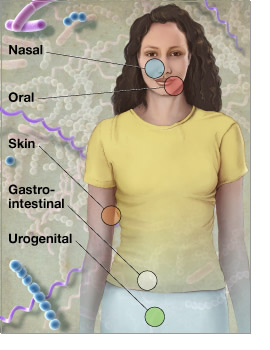
- 300 healthy adults between the ages of 18 and 40 were sampled at five major body sites: oral cavity, nasal cavity, skin, gastrointestinal tract, and urogenital tract;
- Data for both reference and metagenomics strains were made available through the HMPDACC Data Browser; and
- Over 500 scientific publications have been produced.
|
| |
Anatomical diagram of the five major body sites: nasal, oral, skin, gastrointestinal, and urogenital
|
Phase II of the HMP, also known as the Integrative Human Microbiome Project (iHMP), began in 2014. The mission of Phase II, which is ongoing, is to integrate longitudinal datasets of biological properties from both the microbiome and host from three different cohort studies of microbiome-associated conditions using multiple "omics" technologies. Microbiome research may yield information that assists with exposure assessment and prediction of cancer risk or progression, and research is being conducted to determine if dysbiosis, a microbial imbalance or maladaptation on or inside the body, may contribute to cancer development.
For the past few years, the Epidemiology and Genomics Program (EGRP) in the National Cancer Institute's (NCI) Division of Cancer Control and Population Sciences (DCCPS), has funded a small number of microbiome research projects focusing primarily on the human oral, foregut, and fecal microbiome in relation to gastric, pancreatic, colorectal, and lung cancers. To learn more about these funded projects, visit EGRP's active grants webpage and search project titles by "microbiome." One project in EGRP's portfolio of funded projects, led by Dominique Michaud, Sc.D., of Tufts University, is investigating the role of bacteria in pancreatic cancer, the evidence for which was summarized in a 2014 review published in The Cancer Journal.
|
Funding Opportunities for Next-Generation Cancer Technologies
|
NCI's Small Business Innovation Research (NCI SBIR) program provides contract support for research and development of new or improved technologies and methodologies that have the potential to succeed as commercial products. The goal of the SBIR program is to stimulate technological innovation and increase small business participation in federally funded research. Federal agencies such as NIH, with an extramural research and development (R&D) budget of more than $100 million, must set aside 2.9% of their budgets for the SBIR program.
NCI has released a solicitation ( NOT-OD-16-123) for 15 SBIR contract topics that span an array of areas relevant to ongoing research priorities across the Institute. Five of the proposed topics focus specifically on issues related to cancer control and population sciences, including: - Modulating the microbiome to improve therapeutic efficacy of cancer therapeutics (Topic #358)
- Technologies for differential isolation of exosomes and oncosomes (Topic #359)
- Informatics tools to measure cancer care coordination (Topic #362)
- Connecting cancer caregivers to care teams: Digital platforms to support informal cancer caregiving (Topic #363)
- Methods and software integration of cancer metabolomics data with other -omic and imaging data (Topic #364)
The deadline to apply to this solicitation is October 21, 2016. Offeror organizations must be a small business, though scientists at research institutions can serve as consultants and/or subcontractors.
Contracts are legally binding agreement for the direct use or benefit of the government, and involve deliverables at the end. SBIR requires that Principal Investigators (PIs) have their primary employment with a small business at the time of award and throughout the duration of the project. Cancer epidemiologists at academic institutions can participate in SBIR projects as co-PIs, co-investigators, or subcontractors. Learn more about SBIR eligibility criteria.
Proposals are due by October 21, 2016, 5:00 PM EDT. Please direct all questions regarding contracts to the NCI Office of Acquisitions at ncioasbir@mail.nih.gov.
|
Fellowship and Career Development Awards in Cancer Research
|
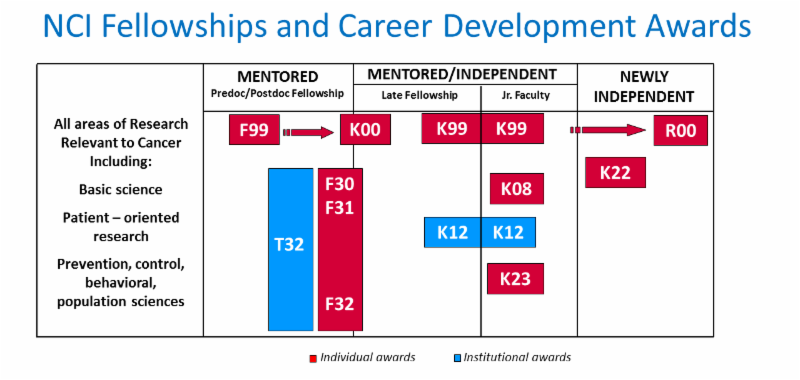
One of the goals of the NIH is to develop, maintain, and renew scientific human and physical resources that will ensure the Nation's capability to prevent disease. To that end, the NIH supports a variety of research training and career development programs to help prepare individuals for careers in biomedical, behavioral, social, and clinical research.
At the NIH and NCI, there are dedicated training grant mechanisms that support individuals at a variety of educational levels and career stages, ranging from mentored predoctoral training grants to awards for late-stage graduate students and postdoctoral fellows that help them to transition into their next career stages. NCI also has career development awards for individuals with a Ph.D., M.D., or other research or professional doctorate degree who are committed to careers in all fields of cancer research including cancer prevention, control, behavioral, or population sciences. There are also NCI training funding mechanisms that support institutional training and education grants to develop or enhance research training opportunities for pre- and post-doctoral fellows. Many of these awards are managed by NCI's Center for Cancer Training.
The Center to Reduce Cancer Health Disparities (CRCHD) leads NCI's efforts to fund training for students and investigators from diverse populations. Eligible individuals include those from racial and ethnic groups underrepresented in cancer-related biomedical, behavioral, clinical, or social science research; individuals with disabilities; those who are first-generation college graduates; or those from disadvantaged backgrounds. Available CRCHD training mechanisms range from diversity supplements and supplements to promote re-entry to biomedical research careers to existing NIH parent grant awards to grant mechanisms under the Partnerships to Advance Cancer Health Equity (PACHE) program (P20 and U54 mechanisms).
An outcomes evaluation of NCI training awards was published a few years ago and found that K award recipients have improved odds of subsequent research funding, tend to be more highly published than non-awardees, are more involved in the scientific community, and are more likely to remain involved in the broader scientific enterprise.
To learn more, visit the:
|
Introducing the EGRP Video Library!
|

EGRP recently updated its News & Media webpage to include a library of archived webinars hosted by EGRP and related videos. Now, the videos that you want to watch can be found in one convenient location!
|
|