|
TURI Calendar
SAB Meeting
January 7, 2015
Boston, MA
TURA Advisory Committee Meeting
February 4, 2015
Boston, MA
EMS Workshops
This training assists in integrating TUR Planning into an Environmental Management System. TUR Planners certifying EMS in lieu of traditional TUR plans must complete this training and become certified.
Live classroom session: March 26, 2015 at UMass Lowell
Online session: April 2, 2015
Final session: Continuing Education Conference, April 9, 2015 in Bedford, MA
ALL sessions, plus 4 hours of homework, are required for credit.
Register here.
Spring TURA Continuing Education
Conference
April 9, 2015
Bedford, MA
Greener Materials Symposium
Leading academic researchers will join Massachusetts companies to explore ways to develop safer materials and processes for TUR.
May 19, 2015
UMass Lowell
|
TURI's free bi-weekly e-bulletin features previews of recent publications and websites relevant to reducing the use of toxic chemicals.
|
|
|
|
|
Governor Declares November 20, 2014 Massachusetts Toxics Use Reduction Planner Day
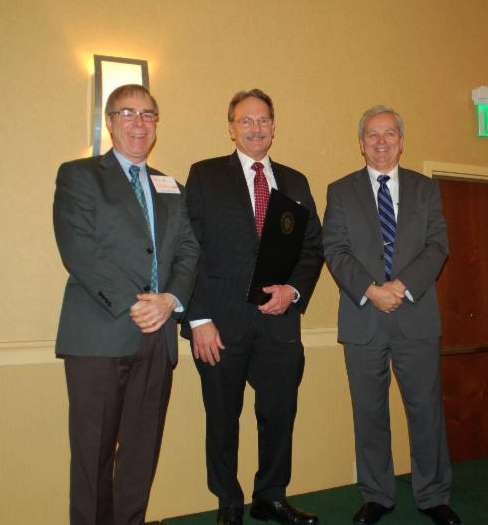 | |
Rich Bizzozero, OTA, Bill Judd, TURPA, Marty Suuberg, EOEEA.
Bill is holding the proclamation after Marty Suuberg presented it to him on behalf of the Governor
|
At the Continuing Education Conference on November 20, Marty Suuberg, Massachusetts Undersecretary for the 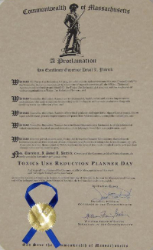 Environment, presented the Governor's proclamation that November 20th be Massachusetts Toxics Use Reduction Planners Day. Governor Patrick issued the proclamation in recognition of the 25 years of service by TUR Planners in reducing toxics in the Commonwealth. The proclamation was accepted by Bill Judd, President of the Toxics Use Reduction Planners Association, on behalf of all planners. Environment, presented the Governor's proclamation that November 20th be Massachusetts Toxics Use Reduction Planners Day. Governor Patrick issued the proclamation in recognition of the 25 years of service by TUR Planners in reducing toxics in the Commonwealth. The proclamation was accepted by Bill Judd, President of the Toxics Use Reduction Planners Association, on behalf of all planners.
|
|
TURA Continuing Education Conference held on November 20
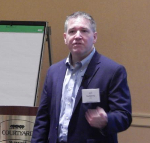 | |
Jim Sweeney, PTC, providing a global regulatory update
|
The Continuing Education conference covered several topics:
- resource conservation techniques
- the business case for TUR,
- updates on REACH and RoHS and future implications for regulation in general
Planners also learned some practical "how-to's" for alternatives, like switching from nPB to aqueous and updated research on hex chrome alternatives. At the end of the day, everyone enjoyed a reception, cohosted by TURPA, celebrating 25 years of toxics use reduction planning.
See archives of conference presentations for more detail.
|
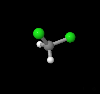 | |
Credit: ChemEd Digital Library
|
Methylene Chloride
Methylene Chloride is a Higher Hazard Substance under TURA. See TURI's new Fact Sheet on Methylene Chloride.
Do our Fact Sheets meet your needs? Please answer four short questions.
|
|
IARC's Review of Carbon Nanotubes: Substantiating Early Warnings of Harm
This fall, the International Agency for Research on Cancer (IARC) convened 21 experts from ten countries to assess the carcinogenicity of carbon nanotubes (CNTs), a class of nanomaterials. What did they find? As published in the October 31, 2014 issue of The Lancet Oncology Online, their conclusion was this: there is sufficient evidence from existing toxicological studies to warrant a classification of "possibly carcinogenic to humans (Group 2B)" for one type of CNTs - multi-walled carbon nanotube-7 (MWCNT-7).[1] These IARC findings reveal complexities facing our growing understanding of the hazards posed by CNTs, and the need to act on early predictions of harm.
Read more...
If you have questions about the health and safety of nanomaterials, please contact Dr. Michael Ellenbecker at TURI.
|
|
New Resource for Municipalities and Schools
See TURI's updated guide on artificial turf for assisting in  deciding whether or not to install artificial turf. This subject guide includes background research, policy guidelines, and industry information. deciding whether or not to install artificial turf. This subject guide includes background research, policy guidelines, and industry information.
TURI subject guide: Artificial Turf
|
|
New TURI Staff Journal Article about Carcinogens in Massachusetts
Reducing the use of carcinogens: the Massachusetts experience
Toxics use reduction (TUR) is one part of a comprehensive cancer prevention strategy. TUR emphasizes reducing the use of cancer-causing chemicals by improving manufacturing processes and identifying and adopting safer alternatives. This analysis draws on 20 years of data collected from industries reporting to the Massachusetts Toxics Use Reduction Act (TURA) program to assess trends in the use and release of chemicals associated with cancer.
Authors: M. Jacobs, R. Massey, H. Tenney, E. Harriman
Read more...
This article is based on a TURI report.
|
|
Nominations due for the Presidential Green Chemistry Challenge
The U.S. Environmental Protection Agency (EPA) announced its call for nominations for the 2015 Presidential Green Chemistry Challenge Awards for companies or institutions that have developed a new process or product that helps protect public health and the environment.
"The Presidential Green Chemistry Challenge is an opportunity for EPA to recognize green solutions and help solve critical environmental problems," said Jim Jones, EPA's Assistant Administrator for Chemical Safety and Pollution Prevention.
Nominations for innovative technologies in six categories are due to the agency by December 31, 2014. The categories are: academic; small business; greener synthetic pathways; greener reaction conditions and designing greener chemicals; and a new category for climate change.
More information on past award winners and how to submit entries may be found at: http://www2.epa.gov/green-chemistry
|
|
UMass Lowell Receives NIOSH Grant
To find the right balance between fighting infections and using safer cleaning and disinfection methods and products, the National Institute for Occupational Safety and Health (NIOSH) awarded Prof. Margaret Quinn of the Department of Work Environment a $2.4 million four-year grant.
A project of the Lowell Center for Sustainable Production, the Safe Home Care Cleaning and Disinfection project research team will determine which infectious agents found in the homecare environment can be reduced by using different cleaning and disinfecting options. Researchers will evaluate the health effects of respiratory exposure from cleaning practices and identify safer, and possibly more effective methods of disinfecting patient homes - an enormous benefit to both patients and medical workers.
Quinn will work in collaboration with Asst. Prof. Nancy Goodyear of the Department of Clinical Laboratory and Nutritional Sciences and Department of Work Environment faculty members Assoc. Prof. Manuel Cifuentes and Research Profs. Pia Markkanen and Susan Sama. The work will be conducted in partnership with Toxics Use Reduction Institute (TURI) and the Massachusetts Department of Public Health.
Read more...
|
|
Greener Studio Challenge
Can artists achieve excellence using safer and healthier materials and practices? Can safer and less toxic materials and supplies be developed for use by artists?
Open to students attending colleges, universities and art schools in New England, the Greener Studio Challenge is a competition and exhibit featuring the creation of works fo art using more sustainable materials and/or practices , as well as safer and less hazardous art materials, media and supplies.
Submitted works will be displayed in Lowell, MA beginning April 9, 2015. Awards will be given.
For more information, email Greener_Studio_Challenge@uml.edu.
|
|
|
|
|

