| International Peace & Security Institute |
|
PEACE & SECURITY REPORT
IPSI's Peace & Security Report (PSR) is a concise weekly e-publication intended to brief busy students, academics, advocates, and practitioners in the conflict management community on pertinent global news, events, and trends. Meticulously researched and written by IPSI, the PSR empowers us all to take a step back from our immediate deadlines each Friday and gain a greater understanding of the week's global events.
|
|
|
Featured Article
Trial by Error: Justice in Post-Qadhafi Libya
International Crisis Group

There are many necessary cures to Libya's pervasive insecurity, but few more urgent than repairing its judicial system. Qadhafi-era victims, distrusting an apparatus they view as a relic, take matters in their hands; some armed groups, sceptical of the state's ability to carry out justice, arbitrarily detain, torture or assassinate presumed Qadhafi loyalists; others, taking advantage of disorder, do violence for political or criminal aims. All this triggers more grievances, further undermining confidence in the state. Breaking this cycle requires multi-pronged action: delivering justice to former regime victims by reforming the judiciary and kick-starting transitional justice; screening out ex-regime loyalists guilty of crimes while avoiding witch-hunts; and reining in armed groups, including those operating under a state umbrella. Unless there is a clear message - the justice system is being reformed; no violence or abuse, done in the past by Qadhafi-era officials or in the present by armed groups will be tolerated - there is a real risk of escalating targeted assassinations, urban violence and communal conflicts.
Read Full Report >>
|
Africa
CENTRAL AFRICAN REPUBLIC: Violence persists in Bangui
On Tuesday, Seleka rebels launched a reprisal raid in the Boy-Rabe district of Bangui after former President Bozize's supporters killed seven and wounded five Seleka soldiers on Monday evening. The soldiers had been disarmed by the military police in an effort to restore order to the neighborhood which has been the site of pillaging and looting since Bozize's overthrow in March. There have been no reports of casualties from Tuesday's raid; however, 20 died over the weekend in clashes that erupted between the rebels and civilians when the rebels attempted to search for hidden weapons. Comment: As the security situation in Bangui becomes increasingly fragile, Seleka leader Michel Djotodia has continued to struggle to gain legitimacy and recognition from other African leaders, despite his formation of a 105-member transitional council headed by a member of the opposition. At a conference in Chad on Friday, the Economic Community of Central African States (ECCAS) accepted Djotodia as the CAR's transitional leader but said he should not be called president. At the summit, members of ECCAS also agreed to deploy 2,000 troops to help restore security to Bangui. (Al-Jazeera, BBC, Reuters, RFI)
CHAD: Deby announces withdrawal of soldiers from Mali
Following the death of three Chadian soldiers in a suicide bombing in northern Mali last Friday, Chad's parliament voted overwhelmingly to withdraw all Chadian troops from the country, three months after the French-led mission to oust militants in Mali's north began. President Idriss Déby stated, "Chad's army has no ability to face the kind of guerrilla fighting that is emerging in northern Mali. Our soldiers are going to return to Chad. They have accomplished their mission." Déby left open the possibility that Chad may still contribute troops to the UN Peacekeeping Mission currently under consideration. Comment: In spite of President Déby's assertion, analysts argue that Chadians are actually the best suited amongst the African troop contributors to fight in northern Mali's mountainous terrain and have made crucial contributions to the campaign thus far, including the killing of two top Islamist leaders. The departure of Chad's 2,250 troops lowers the number of African troops on the ground to 4,000 and raises questions about the feasibility of France's plans to withdraw their own troops by the end of the year. Other African countries contributing troops include Burkina Faso, Ghana, Guinea, Niger, Nigeria, Senegal, and Togo. (Associated Press, BBC, Deutsche Welle)
IVORY COAST: Drones requested to monitor Liberian border
On Tuesday, Ivory Coast's Ambassador to the UN, Youssoufu Bamba, requested the UN Security Council consider deploying surveillance drones to help monitor the heavily forested area near the Liberian border in order to offset upcoming cuts to the UN Operation in Ivory Coast (UNOCI) peacekeeping mission. UNOCI, which was deployed in 2004 to help implement a peace agreement and played a role in securing peace following the 2010-2011 electoral crisis, is set to reduce its size by one battalion by July 31. UN Secretary General Ban Ki-Moon supported the request arguing it may be a good idea to use drones to "enhance situational awareness and monitoring ability, with a view to strengthening the ability of UNOCI to efficiently and effectively carry out its mandate, including the protection of civilians." Comment: Though controversial, Ivory Coast's request is not without precedent. In January, the UN Security Council approved a plan to deploy drones to assist the UN peacekeeping mission in the DRC in monitoring the mountainous Eastern regions bordering Rwanda and Uganda; a move still opposed by Rwanda. At that time, members of the UN Security Council insisted that this should not set a precedent for other African countries; however, UNOCI has stated it will closely watch the situation in the DRC to assess the viability of this option for Ivory Coast. (BBC, The Guardian, New Democrat, Reuters)
Researched/Written by Janene Sawers
|
Americas
UNITED STATES: Guantánamo hunger strike continues
On Wednesday, the number of inmates participating in an ongoing hunger strike at Guantánamo Bay reached 52, while 15 participants remain hospitalized and force fed in order to avoid starvation. Lawyers for inmates claim that the hunger strikes were triggered by guards' mishandling of Korans during cell sweeps. Violence also erupted at the prison last Saturday when authorities moved prisoners out of communal rooms because they had covered surveillance mechanisms. Comment: Hunger strikes have been frequent at Guantánamo Bay; however, the current strike has lasted the longest. Human rights groups claim the most recent hunger strike expresses frustration on the part of detainees with the military's inability to decide on the future of over 100 detainees who have been cleared for release but remain partially due to congressional restrictions. The U.S. opened the Guantánamo Bay base in 2002, and today, there are 166 inmates held at the facility. (BBC, Miami Herald, WP, NPR)
VENEZUELA: Maduro wins presidential election
On Monday, Nicolas Maduro, Hugo Chavez's chosen successor, won the presidential election by a narrow victory with 50.8 percent of the vote. Opposition leader Henrique Capriles, who finished with 49 percent of the vote, has alleged voter fraud and is calling for a full recount of the ballots. Opposition-led protests of the results led to eight deaths, while the government has vowed to take legal action against Capriles. The U.S. government signaled support for a recount and has not yet decided whether to recognize President-elect Maduro. Comment: According to international analysts, Maduro´s victory demonstrates the continuing influence of Chavista power over Venezuelan politics. Maduro inherits Chavez's 14 years of leadership and campaigned on a pledge to continue Chavez's politics. (Reuters, Al Jazeera, El Tiempo, Huffington post, Al Jazeera)
REGIONAL: Brazil issues permits to Haitians
Last week, the region of Acre declared a state of emergency after close to 1,700 Haitian immigrants arrived over a period of two weeks. On Tuesday, Acre announced that more than 900 of these Haitian immigrants will be granted residency and work permits. The move by the federal task force comes just months after the government said it would step up border checks after granting residence visas to approximately 4,000 Haitians already living in Brazil. Comment: Each year, the government grants 1,200 work visas to families from Haiti, but the demand exceeds the annual quota. Brazil's growing economy and work opportunities in construction projects for the 2014 football World Cup and the 2016 Olympic Games are seen as influential factors over the growing number of immigrants coming to the county. (AP, BBC, Info Sur Hoy)
|
|
East Asia
CHINA: Bird flu cases increase through "mysterious" infections
On Wednesday, China confirmed 82 cases of the H7N9 virus, the latest form of avian flu to affect humans; 17 people have died. The majority of cases have occurred in Shanghai with 31 patients, 11 of whom havedied, Jiangsu province with 20 cases and three deaths, and Zhejiang, with 25 cases and two deaths. H7N9 is a "triple reassortant" virus - a mixture of three types of bird flu - and researchers debate how Chinese birds became infected, attributing it to possible contact with European birds or other East Asian fowl. Comment: Isolated cases are appearing in other provinces, but medical researchers are puzzled by the fact that 40 percent of the patients had no contact with poultry; Chinese Center for Disease Control and Prevention dubbed it a "mystery." The Chinese government insists human-to-human transmission is not occurring, and so far the World Health Organization confirms Beijing's statements, but is currently conducting an investigation. (Reuters, South Morning China Post, Xinhua)
NEW ZEALAND: Gay marriage nationally legalized
On Thursday, New Zealand became the thirteenth country to legalize same-sex marriage and the first in the Asia-Pacific region. The legislation passed 77 to 44 in the Parliament on Wednesday night, and jubilant crowds broke into an indigenous Maori love song "Pokarekare Ana." For Australians, the struggle continues, and now it is anticipated that up to 1,000 Australians may travel to New Zealand to marry, which could potentially be a huge boost for New Zealand tourism. Comment: Since 2005, New Zealand has allowed civil unions. Changes in the new law, which are to take effect in late August, will be the legalization of joint adoptions and international recognition of the marriage. Some of the population continues to oppose gay marriage; about 75,000 people have signed petitions against the law. Australian Prime Minister Julia Gillard stated that she is opposed to legalizing same-sex marriage. (NZ Hearld, AP, Aljazeera)
PHILIPPINES: Endangered animals found frozen aboard Chinese vessel
Two thousand specimens of pangolins, an endangered type of toothless anteater, were found aboard the Chinese fishing vessel that hit the Tubbataha coral reef in the Philippines on April 8. About 22,000 pounds of the protected animals were frozen with their scales removed. Investigators are not yet sure what type of the four Asian pangolin species they belong to. In addition to the USD 300,000 fine and 12 years of prison for poaching, the 12 men could be sentenced to six years of jail and fined for possessing pangolin meat. Comment: An international ban on pangolins has been in place since 2002, but illegal trade continues, as the meat and scales are worth hundreds of USD in China for their medicinal properties. The World Wide Fund for Nature Philippines expressed it was "simply deplorable" that in addition to damaging the coral reef, the Chinese poachers are trafficking endangered animals. (AP, Philstar, GMA)
REGIONAL: Cambodia and Thailand go to court over territorial dispute
On Wednesday, Cambodia and Thailand appeared before the International Court of Justice (ICJ) for a four day hearing concerning a 4.6 sq km territorial dispute over land containing the Preah Vihear, a 1,000 year old temple dedicated to the Hindu god Shiva, along their borders. Following Cambodia's independence from France in 1953, conflict between Cambodia and Thailand over the territory resulted in a 1962 ruling by the ICJ that favored Cambodia, which upheld French maps designating Cambodia's territory agreed upon by Thailand in the 1900s. Thailand states that the 1962 decision did not clearly demarcate borders and has reopened the case. Comment: After 1962, the dispute was largely forgotten until UNESCO named Preah Vihear a World Heritage site in 2008, sparking a violent conflict that resulted in the creation of a demilitarized zone surrounding the temple in 2011 by the ICJ. Preah Vihear is a popular tourist destination, and Cambodian Foreign Minister Hor Namhong stated that this trial "darkened relations" between the two nations. (Phnom Penh Post, Bangkok Times, Aljazeera)
|
Europe & Central Asia
RUSSIA: Trial for high-profile opposition figure
On Wednesday, the trial for Alexei Navalny began in the city of Kirov, about 500 miles outside of Moscow. Navalny is accused of embezzling close to USD 500,000 worth of timber from a state-run company in 2009. Although Russian officials stated that this is not a political trial, Navalny is a high-profile opponent to President Vladimir Putin and led mass protests last year; in early 2011, he called President Putin and the United Russia Party "crooks and thieves" through his blog. Comment: Navalny was an adviser to a regional government in 2009. An investigation into the embezzling began in December 2010, but was closed due to lack of evidence until early 2011, after his statement regarding President Putin. Navalny has stated that he expects a guilty ruling due to Russia's low rate of acquittals in criminal cases, which will likely put him in jail for 10 years. (BBC, Guardian, RIA Novosti).
SERBIA/KOSOVO: Ninth round of talks cause delay of report
The European Commission's report on the progress made in the talks between the Serbian and Kosovar prime ministers, due out on Tuesday, was delayed as the talks went into an unplanned ninth round on Wednesday. Despite over 14 hours of negotiation, mediated by the European Union's (EU) foreign policy chief Catherine Ashton, an agreement was not reached, further jeopardizing Serbia's accession to the EU. On April 22, the European Council will discuss the findings of the Commission's report; these findings will determine whether or not the EU will grant Serbia accession negotiations in June. Comment: The talks began in 2011 to address the ethnic tensions and divisions in northern Kosovo. Two weeks ago, Serbia rejected an EU-brokered deal, and although differences remain, Ashton expressed these differences to be "narrow and very shallow," further stressing that an agreement can be reached before April 22. (Reuters, EU Observer, Balkan Insight)
TURKEY: Slow progress in the peace process
On Monday, Turkish Prime Minister Tayyip Erdoğan called again for militants of the Kurdistan Worker's Party (PKK) to disarm before withdrawing from Turkish territory to the mountains of northern Iraq. In response, a high level Kurdish politician stated that it will be increasingly difficult for Kurdish militants to disarm prior to leaving Turkey due to a lack of legal protection. Prime Minister Erdoğan created, on April 4, the Wise People's Commission in an effort to gain public support for the peace process, thereby taking preventive action for Kurdish fighters to deport peacefully without interference from the Turkish military. A letter from the jailed PKK leader Abdullah Öcalan, which is currently in the Ministry of Justice, is said to outline details of a potential withdrawal that could improve the peace process. Comment: The mistrust between Kurdish fighters and Turkish military stems from clashes in 1999 in which hundreds of PKK members were killed during a PKK withdrawal phase. Last month, a unilateral ceasefire was implemented on Öcalan's orders, and between 2,000 and 2,500 Kurdish militants are expected to leave Turkish territory. (Reuters, Hurriyet Daily News, Eurasianet)
|
Middle East & North Africa
IRAQ: Series of coordinated explosions throughout the country
A string of bombings, which included 14 car bombs and 3 roadside explosives, swept through the country on Monday, killing at least 33 people and wounding around 200 others. The single deadliest attack was in Baghdad, killing 15. The attacks come ahead of next week's provincial elections, the first since the U.S. troop withdrawal in December 2011. The credibility of the elections has dwindled as 14 candidates have been murdered in recent weeks and only 12 of the 18 provinces will actually participate in the elections. Comment: Reports have also indicated that the death toll could be as high as 55. There was no immediate responsibility taken for the bombings, but the attacks parallel those committed in the past by the Islamic State of Iraq (ISI), the al-Qaeda affiliate in the country. Analysts say that the growing relationship between ISI and Syria's al-Nusra Front is helping ISI grow stronger since ISI can now easily resupply itself with arms and fighters. (Al Jazeera, Al Arabiya, Daily Star)
JORDAN/SYRIA: Syrian conflict creates instability in Jordan
In an interview with the al-Ikhbariya channel on Wednesday, Syrian President Bashar al-Assad threatened that the Syrian conflict could easily spill into Jordan. President Assad warned Jordan that the firing would not simply stop at the country's borders. He also used the interview to declare that he would not surrender. On Thursday, Jordan reaffirmed its commitment against military intervention in the Syrian conflict, but gave no comment on Assad's remarks. Currently, Jordan houses over 500,000 Syrian refugees. Comment: President Assad's warnings come as the U.S. announced it is sending 200 troops to Jordan to assist in securing the country's border with Syria to prevent any spillover effects. The warnings also come as Jordanian citizens are becoming increasingly disgruntled with hosting the growing number of refugees. Last week, Jordan was forced to open a new 13,000 acre camp east of Amman to accommodate for the continuing influx of Syrians fleeing the conflict. (Saudi Gazette, Jordan Times, Al Arabiya, Al Arabiya)
LEBANON/SYRIA: Shells fired onto Hezbollah stronghold from Syria
On Sunday, Syrian shells hit the border town of Qasr in Lebanon, killing one person and wounding three others. The town is predominately home to Shi'ite Muslims, and tensions between the border town and Syria's Sunni rebels have grown in recent weeks as Hezbollah continues to actively support Assad's army. Although it is not new for Syrian shells to find their way into Lebanon, Sunday's events marked the first time that civilians were killed in a Hezbollah stronghold. The artillery fire apparently continued into Monday. Comment: The Syrian National Coalition, the umbrella group of the Syrian opposition, called on the Lebanese government to secure its borders to protect the innocent lives of the civilians living in the area. As long as Hezbollah continues its military operations within Syria, Lebanon's border towns will continue to be under threat from Syrian rebel fire. (Daily Star, CNN, Al Arabiya, Al Arabiya)
Researched/Written by Kevin Coughlin
|
South Asia
INDIA: Blast at BJP office in Bangalore
An explosion outside the office of the Hindu Nationalist Party (BJP) in Bangalore on Wednesday injured 16 people, including 11 police personnel, as well as two male and three female civilians. The blast originated from a motorcycle parked near the building. The attack took place on the last day of nominations for the May 6elections to be held in the state of Karnataka, which is run by a BJP government. Investigators from the National Investigation Agency and the National Security Guard are examining forensic evidence to determine who initiated the attack, although no group has yet to claim responsibility. Comment: Correspondents claim that Bangalore is considered "a soft target" for terrorists as it houses many large IT companies like IBM and Microsoft. It was the fourth terror attack that has taken place in Bangalore in eight years. (Hindustan Times, Reuters, BBC)
PAKISTAN: Arrest warrant for former General Musharraf
On Wednesday, a Pakistani court ordered the arrest of ex-President Pervez Musharraf on charges relating to his dismissal of judges after imposing emergency rule in 2007. A day before, an election tribunal banned former President Musharraf from participating in the upcoming general elections in May. Musharraf, who had recently returned to Pakistan after four years of exile, filed nomination papers for four seats of the National Assembly Constituencies in the hope to lead his All Pakistan Muslim League (APML) in elections. Although he initially received approval from Chitral, he was rejected by Karachi, Islamabad, and Kasur on the grounds that he broke constitutional law by enforcing emergency rule during his regime in 2007. Musharraf is planning to file an appeal. Comment: The former President seized power in a military coup in 1999 and was defeated in elections in 2008. He left the country after facing charges of treason and for his failure to provide enough security for Benazir Bhutto before the opposition leader's assassination in 2007. In addition to the legal proceedings, the Pakistani Taliban has also threatened Musharraf. (Dawn, Al Jazeera, BBC)
PAKISTAN/IRAN: Iran earthquake affects Pakistan
A 7.8 magnitude earthquake on the border of Iran and Pakistan on Tuesday killed at least 30 and injured over 150 people. Although the epicenter was in the Iranian city of Khash, it was the city of Mashkhel, three kilometers from the Iran-Pakistan border that was hardest hit. In Mashkhel, one of the most severely struck areas, hundreds of buildings and shops were destroyed. One of the residents, Abdul Ghaffour, claimed the earthquake had been "the worst I've ever seen in my life." Pakistani troops and helicopters were deployed to bring aid to those who suffered heavy losses. The impact of the earthquake reached as far as Karachi, hundreds of miles southeast of the epicenter, and the Gulf countries where residential and office buildings had to be evacuated. Comment: The region has been plagued with devastating tremors such as the Bam earthquake in Iran 2003, which killed more than 26,000 people and the 2005 earthquake in Pakistani-administered Kashmir, where more than 73,000 died. (Dawn, Al Jazeera, CNN)
|
|
|
|
|
IPSI Training

The Bologna, Italy Symposium on Conflict Prevention, Resolution, & Reconciliation
June-July 2013

Final Application deadline in less than TWO WEEKS on May 1st.
Limited spots remaining!!!
Apply Now >>
___________________ |
IPSI Training

The Hague Symposium on Post-Conflict Transitions & International Justice
July - August 2013
Final Application deadline on May 20th.
Learn More >>
___________________ |
IPSI Event
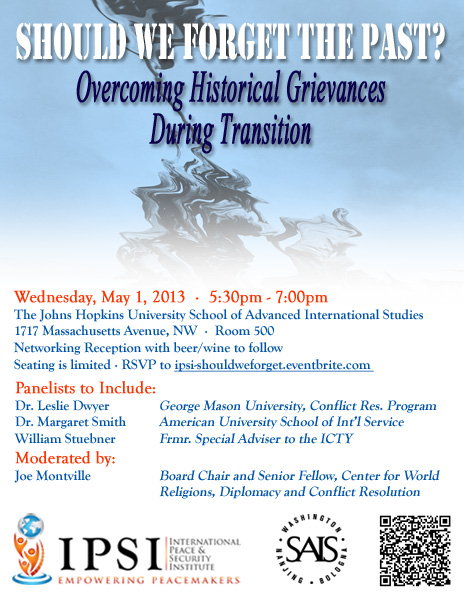
Should We Forget the Past? Overcoming Historical Grievances During Transition
May 1, 2013
Washington, DC
RSVP Here >>
___________________ |
IPSI News
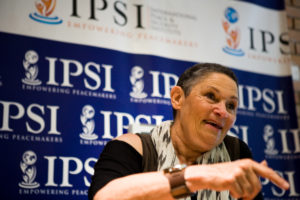
The documentary "One Day After Peace" featuring IPSI Bologna Symposium trauma healing trainer, Robi Damelin, won the audience award and a special mention for the activist at the "Amnesty International Films that Matter Festival" in the Hague!
Learn More >>
___________________ |
IPSI Leadership
Cameron M. Chisholm Dr. I. William Zartman
Dr. P. Terrence Hopmann
Chic Dambach George Foote Melanie Greenberg Alexander Little
Kevin Melton William Stuebner
Pamela Aall
Ahmedou Ould-Abdallah
Betty Bigombe Dr. Francis Deng
Jan Eliasson
Gareth Evans
Dr. Ted Robert Gurr
Amb. Jacques Paul Klein
Peter Kyle
Dr. Jean Paul Lederach
Jeffrey Mapendere
John Marks
Susan Collin Marks
Dr. Joyce Neu John Prendergast Dr. Valerie Rosoux
Dr. Ruth Wedgwood Dr. Craig Zelizer About Us >> ___________________ |
|