| International Peace & Security Institute |
|
PEACE & SECURITY REPORT
IPSI's Peace & Security Report (PSR) is a concise weekly e-publication intended to brief busy students, academics, advocates, and practitioners in the conflict management community on pertinent global news, events, and trends. Meticulously researched and written by IPSI, the PSR empowers us all to take a step back from our immediate deadlines each Friday and gain a greater understanding of the week's global events.
|
|
Featured Article
In the Neighborhood: The Growing Role of Regional Organizations in Disaster Risk Management
Brookings
Global demographic trends suggest that more people are living in areas vulnerable to sudden-onset natural disasters even as scientists predict that the frequency and intensity of these disasters are likely to increase as a result of the effects of climate change. These trends, coupled with recent high-profile mega-disasters, are raising global awareness of the need to build the capacity of national governments, civil society organizations and international actors to prevent, respond to and recover from natural disasters.
Read Report >>
|
Africa
DRC: Fighting erupts in M23 territory
On Sunday, just as 11 African leaders signed a UN-brokered accord agreeing to support an end to violence in the Congo, fighting erupted deep in M23 rebel group territory that killed at least eight people, most of which were civilians. The violence in Rutshuru, a town 43 miles north of Goma, allegedly resulted from a power struggle within the rebel movement. M23 denies the existence of any split within their movement or that they were involved in the fighting on Sunday, instead blaming Rwanda's Democratic Forces for the Liberation of Rwanda (FDLR) for the deaths. Comment: Following M23's capture and the quick withdrawal from the provincial capital of Goma last December, M23 and the Congolese government began peace negotiations in Uganda. Factional infighting has the potential to undermine these negotiations, particularly if one faction decides to continue fighting. Reports vary as to which members of M23 are involved in this disagreement and what is driving their actions. (BBC, The New Times, Reuters)
GUINEA: Anti-government protests injure over 100
Clashes between anti-government protestors and security forces in Conakry have left over 100 injured and at least one police officer in critical condition. Thousands of opposition protestors took to the street on Wednesday to demonstrate against the parliamentary elections scheduled for May that protestors fear will be rigged. On Thursday, government spokesman Damantang Albert Camara called for calm,stating "The street is not the place to resolve political disagreements." Comment: These protests come after the opposition coalition announced they would not participate in May's elections. The opposition claims the government chose the poll date without their consultation, and that the companies chosen to update voter registration rolls skewed the list in President Conde's favor. This vote was originally scheduled to take place in 2011, but has been postponed a number of times. (AFP, All Africa, Reuters)
KENYA: Kenyatta's ICC trial delayed
On Tuesday, lead ICC prosecutor Fatou Bensouda announced that the trial of Kenyan Deputy Prime Minster and presidential candidate Uhuru Kenyatta for crimes against humanity is unlikely to begin until August 2013. Reports indicate that the defense team requested additional time in order to be better prepared for the trial, specifically to better acquaint themselves with evidence from the prosecutor's office and deal with the revelation of a new witness. The trial was originally scheduled to begin on April 11. Comment: This delay will leave Kenyatta, who has pledged to attend his trial in The Hague, free to participate in a run-off. According to polls, Kenyatta is currently running neck and neck with Prime Minister Ralia Odinga. If neither candidate receives over 50 percent of the votes, a run-off will occur in April. (BBC, Capital FM, Reuters)
MALI: Car bomb explodes in Kidal
On Tuesday, a car bomb killed up to seven in Kidal, a city in Northern Mali that was previously held by Islamists until the French drove them out last month. The attack targeted a checkpoint manned by Tuaregs, who are supporting the French-led military offensive. While the Tuaregs had initially formed a coalition with other Islamist rebel groups involved in the 2012 rebellion, after France's military action in the region, the Tuaregs have since switched their allegiances. Comment: Incidents like this underscore the instability that keeps the 430,000 people that initially fled their homes during the conflict unwilling to return in spite of the improving security situation. While Islamist militants have been driven out of cities like Kidal, they continue to stage raids and bombings. According to a UN official, Tuaregs may also fear reprisals on the part of the Malian army for their initial role in the rebellion. (AFP, BBC, Tunis Afrique Presse, Reuters)
Researched/Written by Janene Sawers
|
Americas
COLOMBIA: Coffee growers on strike
Last Monday, 15,000 coffee producers took to the streets of Antioquia, Huila, Risaralda, Quindío and Tolima - departments in Colombia - demanding increased government support and larger subsidies to protect against falling international prices and strong local currency. Colombia is the fourth largest coffee producer in the world, making coffee one of the biggest exports for the country with more than half a million families reliant on the crop for their livelihoods. Comment: The strike mobilized more than 200,000 coffee growers and halted farm production for a week. Local authorities reported clashes between the police and farmers on the outskirts of the village of Garzon and in the village of La Jagua. Confrontations with protesters resulted in 21 injuries, none of which were considered life-threatening, and reports indicate that most of the protests have been peaceful. (BBC, El Tiempo, Today Colombia, El Universal)
CUBA: Castro era to end in 2018
During a public speech last Sunday, Cuban President Raul Castro confirmed he would step down from power in 2018 when his second term as president is set to end. The announcement came shortly after lawmakers re-elected him to a second five-year term. Following this statement, the new Parliament also made public that Miguel Diaz Canel - a member of the political bureau who rose through the Communist Party ranks in the provinces - has been appointed as his new first vice president, putting him next in line to succeed the current president. Comment: This decision marks the beginning of the long awaited transition to younger leadership on the island. Moreover, it impacts U.S.-Cuba ties due to a stipulation in the 51-year economic embargo on the island that specifies it cannot be lifted while a Castro is in charge. (El Nuevo Herald, CNN, Reuters, The Huffington Post)
HAITI: UN rejects claim for direct compensation to victims of cholera epidemic
On Monday, UN Secretary General Ban Ki-moon informed the Haitian president that the UN will not provide direct financial compensation for the more than 8,000 Haitians who died and the 646,000 sickened by cholera since the disease struck the country following the 2010 earthquake. Evidence suggests cholera was introduced to Haiti through leaking sewage pipes at a UN base. The UN has not acknowledged responsibility for the outbreak, saying it is impossible to pinpoint the exact source of the disease, despite the mounting evidence the epidemic was caused by poor sanitation at a camp housing infected Nepalese peacekeepers. The UN says it is immune from such monetary claims under the UN's Convention on the Privileges and Immunities of the UN. Comment: For more than two years, the UN has been investigating the claims that its own peacekeepers started the cholera epidemic. According to local authorities, the disease was spread through infected human waste entering Haiti's ineffective sewage disposal system. (BBC, New York Times, Al Jazeera, Foreign Policy)
|
East Asia
MYANMAR: U.S. lifts sanctions on four banks, commits to economic investment
On Tuesday, the U.S. Chamber of Commerce, represented by 50 American businesses, signed a Memorandum of Understanding with the Union of Myanmar Federation of Chambers of Commerce and Industry (UMFCCI) during the U.S.-Myanmar Trade and Investment Conference in Yangon. The trade agreements follow the U.S. Treasury announcement on February 22 that lifted sanctions on four Myanmar banks, authorizing transactions but not allowing U.S. companies to directly invest or pursue joint ventures with the banks. Human rights groups such as U.S. Campaign for Burma criticized the U.S. decision to pursue financial gains while the Myanmar government continues to persecute ethnic minorities. Comment: U.S. Assistant Secretary of State for Economic and Business Affairs Jose Fernandez stressed the importance of social responsibility, reminding U.S. businesses to be aware of challenges such as corruption while engaging in trade with Myanmar. Furthermore, Fernandez encouraged businesses to report to the U.S. government any issues or problems they encounter while normalizing economic relations. U Nyan Htun Oo, minister for Electric Power in Yangon, stated that the U.S. could be constructive in Myanmar's development and modernization. (AP, Mizzima, Myanmar Times)
TAIWAN: Nationalist Party honorary chairman visits China
Lien Chan, honorary chairman of the Nationalist Party (KMT) of Taiwan, visited Xi Jinping, General Secretary of the Chinese Communist Party on Monday in Beijing. During the meeting, Xi stressed commitment to the one-China policy, while promoting cross-strait relations and cooperation so that both sides can realize the "Chinese dream," possibly referring to unification. Lien agreed to remain within the one-China policy framework, adding that Taiwan and China must address major issues so that negotiations can eventually include difficult topics such as politics. Lien is the highest-level official representing Taiwan to be received by Xi, and he also met with soon-to-leave office President Hu Jintao and political chairman Jia Qinglin. Comment: The one-China policy, otherwise known as the 1992 Consensus, is an agreement between the Republic of China (Taiwan) and the People's Republic of China that there is "one China," although each side is allowed its own interpretation of the term. Taiwan's opposition party, the Democratic Progressive Party (DPP), stated that Lien's remarks on the one-China policy damaged Taiwanese dignity. President Ma's office and Lien agree the trip was a non-official one, and Lien's office stated that he discussed his views on China with Ma before the meetings in Beijing. (Taipei Times, AP, Xinhua)
THAILAND/MALAYSIA: Cooperation to resolve unrest in southern border
Thai Prime Minister Yingluck Shinawatra and Malaysian Prime Minister Najib Razak met on Thursday for the annual Thai-Malaysia consultation in Putrajaya to discuss the restoration of peace in southern Thailand. The two nations are working together to address conflict spillover at the border, while pursuing bilateral agreements on cross-border transportation and economic ties. Thai National Security Council chief Paradon Pattanathabutr stated that Malaysia will act as a facilitator between the Thai government and separatist groups, and while demands for separation will not be discussed, the Thai government plans to meet with all groups to find a resolution. Comment: An estimated 5,300 people have been killed since 2004 due to conflicts in southern Thailand, according to local conflict monitor Deep South Watch. Some are skeptical to what degree Malaysia can help the situation. (The National, Bernama, Bangkok Post)
REGIONAL: Standoff in Malaysia's Sabah state between Sulu Sultan and authorities continues
On Wednesday, Philippine President Benigno Aquino demanded that the Sultan of Sulu withdraw from the Malaysian state of Sabah which he and about 100 armed men have occupied since February 12, while peaceful negotiations are still possible. The intruders have been cut off from food supplies and electricity, but Sultan Jamalul Karim III refuses to leave the coastal village of Kampung Tanduo, ignoring the Malaysian deadline to leave by February 24. Malaysia insists they do not want foreign interference in the matter, and the Deputy Inspector-General of Police Sri Khalid Abu Bakar stated that the situation would be resolved soon, but did not specify a date. Comment: Aquino warned Jamalul that he may be guilty of serious crimes, such as inciting war, but the Sultan replied that they have not broken any laws and will lay down arms if terms of Sabah's economic development are renegotiated, which could be worth millions of dollars. The situation in Sabah is not expected to negatively impact the peace talks in the Philippines between the government and the Moro Islamic Liberation Front, and Aquino has called for an investigation of the legality of Jamalul's claims to Sabah. (Bernama, NST, Philstar)
|
Europe & Central Asia
CYPRUS: Election outcomes to address the financial crisis
On Sunday, the conservative Democratic Rally candidate, Nicos Anastasiades, decisively won the presidential election with 57.5 percent of the votes, with Communist-backed Stavros Malas in second place with 42.5 percent. The top priority for Greek Cyprus will be to address the country's financial crisis; President-elected Anastasiades has expressed interest in negotiating a potential bailout with the European Union (EU), the European Central Bank, and International Monetary Fund (IMF). Although the bailout talks have been ongoing for the past eight months, no actions have been taken, which could be related to the previous Communist-led government's aim to receive aid from Russia. Comment: In preparation for a bailout, wages could be cut and taxes increased; in protest, many eligible voters cast blank ballots in Sunday's election. Unemployment is currently at 15 percent, compounded by depleting funds and a USD 1.9 billion debt to be paid in June; a "quick-fixed" bailout as Anastasiades is asking for will cost approximately USD 24 billion. (Reuters, Al Jazeera, Cyprus Mail, Hurriyet Daily News)
ITALY: Inconclusive polls cause fear of political deadlock
After Monday's national election, no single party received enough votes to claim a majority in the upper house or to form a government since it requires a minimum of 158 seats in the Senate. Despite winning a slight majority in the lower house, the center-left Democratic Party, led by Pier Lugi Bersani, only received 121 seats in the Senate; without a Senate majority, the party will not be able to pass laws. There are possible options for coalitions to be formed during the bargaining phase, which will conclude in a negotiation with President Giorgio Napolitano in two weeks, but it is unclear what the composition of a government would look like. Comment: The election outcome represents the lack of unity in the country as Italy tackles increasing unemployment and public debt, and there are chances of political deadlock that could further affect the existing economic crisis. President Napolitano is faced with several options: one includes negotiating with political leaders to enhance government formation, and a second would be the creation of a caretaker government that will write a new electoral law in order to improve the formation of a majority in the Senate. (Reuters, BBC, France 24, Al Jazeera, Corriere Della Sera)
RUSSIA: Homosexuality bill under pressure
On Tuesday, Foreign Minister Sergei Lavrov defended a bill that prohibits "homosexual propaganda" directed to minors from criticism by the Dutch government and the European Union (EU). Lavrov argued that the bill does not discriminate against the LGBT community in Russia nor does it infringe any Russian commitments towards international obligations. The bill passed the first reading in Duma, the lower house of parliament, in January with a vote of 338 to one, and at the end of May, Kremlin, the upper house will decide whether or not it will pass. Before a second reading, the government will have to prescribe a legal definition of "homosexual propaganda," since it remains unclear what constitutes such propaganda. Comment: The United Russia Party, a pro-Kremlin party, has expressed support for the bill. In January, LGBT activists clashed with supporters of the bill in Moscow outside of the lower house Duma, and last year, a Russian court upheld a ban on pro-LGBT marches such as "Gay Pride" in the capital. (BBC, France 24, RIA Novosti, Hurriyet Daily News)
SWITZERLAND: Three killed in factory shooting
A wood processing factory outside of the city of Lucerne was attacked Wednesday morning by a current employee who opened fire, injuring seven and killing three, including himself. The assailant had been working at the plant for a decade and has been described as quiet; his motives remain unknown. Comment: This is the second multi-fatal shooting in Switzerland in the past two months. The Swiss parliament will most likely continue the debate on provisional restrictions that would initiate stricter gun legislation since Switzerland has one of the highest rates of gun ownership in the world. According to current law, eligible men between the ages of 18 and 34 are obligated to complete military service, and upon completion of the service, they are permitted to keep their firearms. In a 2011 referendum on tightening the gun law, the majority of the citizens rejected a proposal that suggested lockups of firearms when off service. (Reuters, BBC, Associated Press)
|
Middle East & North Africa
IRAN: New centrifuges reported as nuclear talks resume
The International Atomic Energy Agency (IAEA) reported that 180 IR-2m centrifuges are in the process of being installed at Iran's main uranium enrichment plant in Natanz. The report indicated that there was no sign that the newest installments had military motives. This week, diplomats from the U.S., Britain, France, Germany, China and Russia met with Iranian representatives in Kazakhstan to discuss the future of Iran's nuclear program. On Wednesday, the gathering ended with an agreement to meet again in Istanbul on March 18to discuss Iran's enriching of 20 percent uranium and the possibility of closing down its underground Fordo plant. Comment: The fear is that the new centrifuges will speed up the accumulation of uranium needed to construct a nuclear weapon despite Iran's insistence that its nuclear program is for peaceful purposes. Iran currently faces a UN sanction forbidding the enrichment of uranium; however, after the meeting, the country's chief negotiator, Saeed Jalili, said that the other sides are "coming closer to Iran's viewpoint." (Al Jazeera, CNN, Al Arabiya)
ISRAEL/PALESTINE: Rocket launched from Gaza as protests gain strength
Palestinian officials are saying that the Arafat Jaradat, who died on Saturday while in an Israeli prison, was tortured to death while Israeli reports are saying that he died of a heart attack. Over 10,000 people gathered for Jaradat's funeral procession in Sair of southern West Bank on Sunday, including militants of the al-Asqa Brigade, the armed group of the Fatah movement of which Jaradat was a member. On Tuesday, a rocket from Gaza hit Ashkelon in southern Israel, but no deaths or injuries were reported. The al-Asqa Brigade took responsibility for the strike saying that it was a preliminary response to Jaradat's death. Comment: Jaradat's death came amidst growing protests to release the roughly 4,500 Palestinians being held by Israeli authorities. Tuesday's attack was the first rocket launched since the cease-fire ended fighting last November. Israeli Major General Amos Gilad said that the Palestinians are not interested in a third uprising, but future incidents should be expected as the al-Asqa Brigade categorized their rocket launch as a "preliminary" reaction, indicating future attacks. (Al Arabiya, Haaretz, Al Jazeera)
TUNISIA: New prime minister appointed
Over the weekend, President Moncef Marzouki confirmed Interior Minister Ali Larayedh as the new prime minister to succeed Hamadi Jebali. As the chosen candidate, he now has two weeks to form a new coalition government. In a news conference, Larayedh said that he would form a government that is based on the belief that men and women have equal rights and duties. Comment: In a similar move, ruling party Ennahda's founder, Rached Ghannouchi, said the new coalition government will be expanded from including three parties to five parties, including Ennahda, Wafa, The Islamic Block of Freedom and Dignity, Ettakatol, and the Congress for the Republic. True to Ghannouchi's statement, on Wednesday, the Ennahda party has agreed to hand down key ministry positions to independents. In a separate development, two men were arrested on Monday for the murder of Chokri Belaid on February 6; the assassination was the catalyst for the current political crisis. (Al Arabiya, Tunisia-Live, BBC, Al Jazeera)
Researched/Written by Kevin Coughlin
|
South Asia
AFGHANISTAN: NATO admits false report of decline in Taliban attacks
On Tuesday, NATO's International Security Assistance Force (ISAF) admitted that there had been no change in Taliban attacks over the last year, despite having released a report inaccurately claiming a seven percent decline in attacks in Afghanistan from 2011-2012. ISAF representative, Erin Stattel, stated the false report was due to incorrect data entry, although she maintained that despite the error, the "assessment of progress in Afghanistan remains positive." It was not until the Associated Press questioned why the data had been removed from the ISAF site that any explanation was given. Comment: In the past, U.S. officials have emphasized the decline of violence in Afghanistan as a measure of success for the ISAF mission. This raises concerns about whether Afghan forces are yet capable enough to manage security in the region once troops withdraw by the end of next year. (Dawn, Reuters, BBC)
AFGHANISTAN: 17 killed in Taliban attack on police post
On Wednesday, 17 people, including 11 policemen and six civilians, were killed by Taliban insurgents at an Afghan Local Police (ALP) outpost in the central-eastern Ghazni province. Officials reported that a local policeman involved in the attack drugged all 17 people in the outpost, including seven new recruits undergoing training, before the insurgents broke into the base and subsequently shot them in their sleep. Police reported that two guards have been arrested for failing to prevent the attack. The attack at the ALP outpost is part of a series of attacks across the region in recent months. Comment: The ALP program is a U.S. initiative created to recruit local Afghan men as security officers for their home region. Afghanistan brought the training program to a halt in September due to an increase in attacks on soldiers. The Wednesday attack came one day after ISAF announced an error in their report of a decrease in Taliban attacks. (Pajhwok, Reuters, BBC)
MALDIVES: 15-year-old rape victim could receive flogging for adultery
A 15-year-old Maldivian girl whose stepfather is accused of raping her may be sentenced to flogging for committing adultery with another man. During the rape investigation, officials found evidence of the girl engaging in consensual sex, an offense punishable by flogging under Maldivian law; however, since the girl is a minor, the 100 lashes flogging would have to take place once she turns 18. Her stepfather has also been charged with murdering a baby that resulted from the rape, and both parents are charged with hiding the baby's body. Comment: This story follows the case of a 23-year-old student who was raped and killed on a bus in New Delhi last December. An increase in rape awareness in South Asia has incited protests against violence against women across the region. (Haveeru, Huffington Post, BBC)
SRI LANKA: HRW study reports rape and torture against Tamil detainees
On February 26, Human Rights Watch (HRW) released a study revealing Sri Lankan forces used torture and rape against suspected Tamil separatists during and after the civil war that ended almost four years ago. HRW claimed the sexual abuse was used as a politically motivated means to punish and gain confessions from those who were detained from 2006-2012 due to possible connections with Tamil Tigers. The study reported 75 instances of rape and torture against suspects, including 31 men, 41 women, and three minors. Government spokesman Rambukwella denies the claims, calling the allegations "a well-timed effort" as the country is awaiting a war crimes ruling by the UN Human Rights Council this week. Comment: The Sri Lankan government has been on the radar of Human Rights groups for years due to alleged war crimes. Nonetheless, it has rejected all claims and refused to allow independent investigation into the matter. (The New York Times, Reuters, BBC)
|
|
|
|
|
IPSI Training

The Hague Symposium on Post-Conflict Transitions & International Justice
July - August 2013
Applications due Mar 11
Learn More >>
___________________ |
IPSI Training

The Bologna, Italy Symposium on Conflict Prevention, Resolution, & Reconciliation
June-July 2013
Applications due Mar 11
Learn More >>
___________________ |
IPSI News
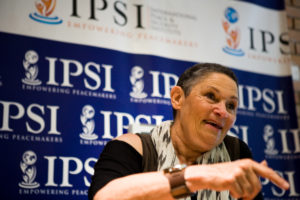
A documentary featuring Robi Damelin, Bologna Symposium faculty, titled "One Day After Peace" won the "Grand Prix" at the Human Rights Film Festival in Paris-France.
Watch the Trailer >>
___________________ |
The Story of IPSI

IPSI President Cameron M. Chisholm tells the Story of IPSI in this 5 minute video from ICD's recent conference in Washington.
Watch the Video >>
___________________ |
IPSI Leadership
Cameron M. Chisholm Dr. I. William Zartman
Dr. P. Terrence Hopmann
Chic Dambach George Foote Melanie Greenberg Alexander Little
Kevin Melton William Stuebner
Pamela Aall
Ahmedou Ould-Abdallah
Betty Bigombe Dr. Francis Deng
Jan Eliasson
Gareth Evans
Dr. Ted Robert Gurr
Amb. Jacques Paul Klein
Peter Kyle
Dr. Jean Paul Lederach
Jeffrey Mapendere
John Marks
Susan Collin Marks
Dr. Joyce Neu John Prendergast Dr. Valerie Rosoux
Dr. Ruth Wedgwood Dr. Craig Zelizer About Us >> ___________________ |
|