NACD Newsletter - Volume 8, Issue 1 - April 2015
In this issue:- Memory--and Norfolk Pines
- Goals
- Our Bad
- Announcing TSI: Focused Attention 2!
- Upcoming Evaluation Dates
|
|
Short-Term Memory, Working Memory, Long-Term Memory and Norfolk Pines by Bob Doman
|
I just returned from an outstanding trip to Sydney, Australia. I worked with some great folks and evaluated many kids whose potential I can't wait to help unlock. I also met with some great open-minded folks at the University of Sydney to discuss a research project with our Simply Smarter System and creating NACD courses for their continuing education programs.
You might surmise from the title of this article that it has something to do with brains; but what is the link to Norfolk pines and what is a Norfolk pine?
I have always thought that the little Norfolk pines that I would see in grocery stores around Christmas, overlooking the glitter they often put on them, were rather exotic and interesting. I had never had the time, opportunity, or actual inclination to investigate them; but I still found them to be curious little 18" plants, particularly since they were a species of pine tree. However, upon recent investigation, I discovered why I thought they were curious pines-- they are not actually pine trees at all. Okay, lest you think I am having some kind of senior moment and running off on a tangent, let me start trying to connect some dots.
While visiting Sydney we spent a weekend at Manly Beach, just outside of Sydney. Shortly after arriving, we went out to check out the sights. The beach and the area were really spectacular. We admired the beautiful sandy beach, watched the surfers, and started appraising the dozens of tempting restaurants. But some of the most prominent features of the area were these very spectacular, exotic hundred-plus-foot high evergreens that were everywhere. My son, Laird, wondered aloud what kind of trees they were, and I realized that I recognized them as huge specimens of those little plants with glitter--Norfolk pines. I decided that when I got home I needed to go find one of the 18-inch versions for my house and another for Laird and his wife to commemorate our trip to Australia.
Fast-forward a couple of weeks. I'm back in the mountains of Utah, where we have many "real" pines and evergreens. I was home watching the news and dozing a bit when a commercial came on. I rarely pay any attention to commercials, with the exception of the occasional Jaguar commercial, and I really didn't pay any attention to this one either, or so I thought. But actually, my brain did. Something in my peripheral vision caught my brain's attention. I stopped the commercial and rewound it. I still couldn't tell you what they were trying to sell, or why my brain said, "Hey, there was just something of significance;" but after I rewound the commercial, I discovered that in one very fleeting scene, as they were rapidly flashing across an office, there sitting on a shelf was a little potted Norfolk pine.
Click here to read the rest of this article
|
 |
Goals
by Lori Riggs, M.A., CCC/SLP
|

When I was in college I took flying lessons. My dad, whose curriculum vitae included private pilot since age 16, instructor pilot, fighter pilot, and airline pilot, did not teach me. However, coming to visit me in Waco one weekend, he was happy to fly with me to see what I had learned, and I was anxious to show off my newly acquired skills. I had flown with him many times, but never from the left seat and never as the PIC (pilot in command). We went up for a pleasant little jaunt, and I flew brilliantly. (Anyone can take off and fly around. It's just not that hard.) Then came the real piloting part-landing. I really wanted to make a good impression and diligently went through each step just like my instructor had taught me--enter downwind, power back at just the right moment, put in 10 degrees of flaps right when your shoulder is even with the touchdown point--I said each one aloud to make sure I wasn't missing a step. And to double check, I turned to my dad: "Am I forgetting anything?" I was fully expecting him either to point out a missed detail or to acknowledge that I'd performed impeccably so far. Instead, based on thousands of hours of flying experience, here was his response: "Lori. We are here (pointing to us). You want to be down there (pointing out my window to the runway below). Just do what it takes to get there."
It's easy to get so caught up in the nitty-gritty details sometimes that we lose sight of the big goals. I see this happen all the time with parents trying to accomplish their NACD program activities with their kids. While the details are important-I couldn't have known how to get the plane on the ground without having learned it as a step-by-step procedure first-it's important to understand the goal for a few reasons:
1. Program activities are just tools, not ends in themselves. If a tool isn't used correctly or accurately or efficiently, just going through the motions with it won't get the desired result. Let's use articulation flashcards as an example. Pretend that your program activity says, "Practice words that start with /p/." Frequency is 2, duration is 2 minutes. And I send you some word cards to use for this. If twice a day for two minutes you sit and flash picture cards of words starting with /p/ to your child while he says "uh" for each one, technically you can check off that you accomplished that activity that day. But did you, in reality, accomplish anything at all? No. No learning took place. The story is completely different if you spent that time actually working on each word-emphasizing the /p/ at the beginning, showing him how you put your lips together for the /p/, pinching his lips together to approximate a /p/ sound. Now you've done some therapy. The goal wasn't to get through the stack of cards. The goal was to work towards producing a /p/ sound at the beginning of words.
2. Sometimes for some kids the activities don't work. (What?) Everything we do here is based on the idea that kids' programs should be individualized for them, right?
Click here to read the rest of this article |
|
Our Bad
by Lori Riggs, M.A., CCC/SLP
|
|
I think we forgot to tell you something. At least, we didn't tell you enough.
What We Did Tell You:
- Having a very structured, targeted home program with specific frequencies and durations is an extremely effective way to facilitate-and remediate where needed-your child's development.
- These structured activities are addressing specific developmental "pieces," which all work together to produce results, including in language development.
- Improving your child's sequential processing is fundamental to language development. So all of those sequencing activities you are doing are really important.
- Language Photos, Talk About Picture Books, My First Encyclopedia, etc.-these are all structured activities you may see on your child's program for language building. They give you a very specific way to devote time each day to language, especially language input. Yay for these activities!
What We Mentioned But Didn't Stress Enough:
Language therapy happens all day long!
The structured program activities are great, but they aren't the end-all, be-all. You must have plenty of time throughout your day for regular, normal, this-is-just-how-people-talk-to-each-other interaction. If your planner is so scheduled that in order to have a normal interaction with your child you need a box for that, we have a problem. Interaction, communication, modeling functional language-these are things that should happen simultaneously with everything else you do. Every moment with your child is an opportunity for language therapy. But therapy doesn't have to look like therapy. Let it look like play time, mealtime, relaxed-hanging-out time, riding in the car time, "you-have-my-full-attention-and-I-can't-wait-to-see-what-you'll-try-to-communicate-to-me-next" time. Language therapy happens all day long. You don't need a box for that.
For a child with delayed language skills, we do need to have specific language goals that are addressed in a structured way. For example, perhaps a child doesn't yet have the verb form "-ing" in his repertoire. We can practice that. Or maybe he omits small words like articles and prepositions. We'll address it. But just as important as the 2-minute activity where you drill these forms, is your awareness of them so that you can target them in your typical interactions. Functional contexts-that's where the value lies. That's where the most learning takes place.
And Yet...
Not every moment has to be a teaching moment. (Did she just say that?) Not every syntax error needs to be corrected. Not every /r/ has to be cued. Not every single pragmatic faux pas needs to be pointed out. Talk with your kids. Interact with them. Build the parent/child relationship apart from the parent-as-teacher/child relationship. Have some rapport-building quality time. Have some fun. And guess what? Secondary to what you just accomplished as one human being relating to another, you just did language therapy.
|
|
Announcing
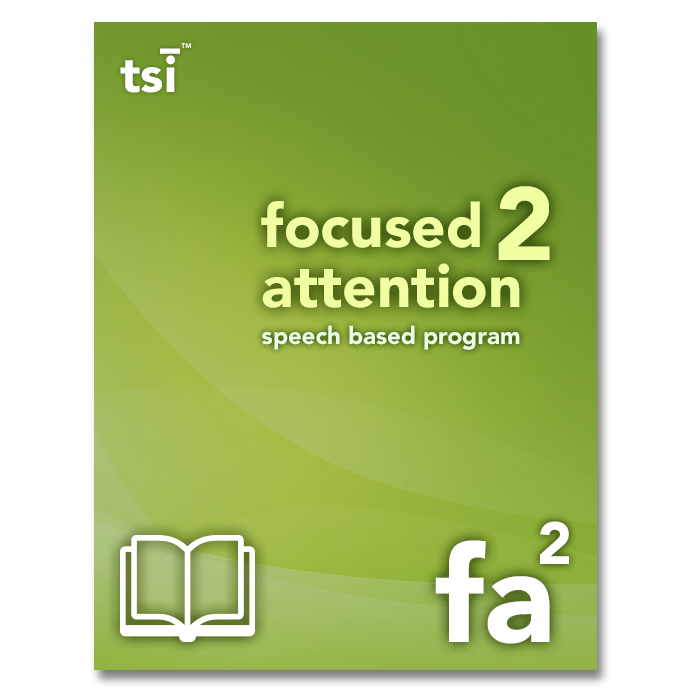
TSI: Focused Attention 2!
|
|
NACD is pleased to announce the release of our newest auditory program:
FA2 is the next step/follow-up to our popular, tried and true TSI: Focused Attention program.
After training your auditory attention and figure-ground processing with Focused Attention, take it to the next level with FA2, a language-based, speech-in-noise program.
See options for purchasing FA2 on our newly redesigned TSI website!
- New packages on the site give you different options for configuring just what you need for any of our TSI products.
- FA2 available in four age levels.
- All TSI products now available as digital downloads or CDs.
Check us out at:
|
|
|
|
|
May 2015
Romania
London
Ogden, UT
Philadelphia, PA
NJ/NY
Bay Area, CA
Seattle, WA
Dallas, TX
India
June 2015
Orlando, FL
Atlanta, GA
Ogden, UT
Charlottesville, VA
Chicago, IL
Minneapolis, MN
Canada
Dallas, TX
India
July 2015
Ogden, UT
St. Louis, MO
Cincinnati, OH
Los Angeles, CA
Philadelphia, PA
Phoenix, AZ
Dallas, TX
India
For more upcoming evaluation dates, please check our website.
|
NACD - The National Association for Child Development
549 25th Street - Ogden, UT 84401
801-621-8606
|
|
|
|
|
|