|
Hydraulic Fracturing in NC - A Geologist's Perspective
|
|
There has been a lot of conversation recently about the possibility and practicality of allowing oil and gas development in North Carolina through the use of hydraulic fracturing (fracking), a technique that has revolutionized the oil and gas industry in the last several years. There are several considerations regarding this technique, including the viability of the potential reserves, the environmental safety of the technique and other impacts on the infrastructure and environment of the state.
|
 | | Deep River Basin Potentially Contains 1.7 Trillion Cubic Feet of Natural Gas (Image from DC Bureau) |
|
|
From a geological point of view, the main consideration appears to be the ability to store, use and dispose the liquid used in the process, which can be in the millions of gallons per well.
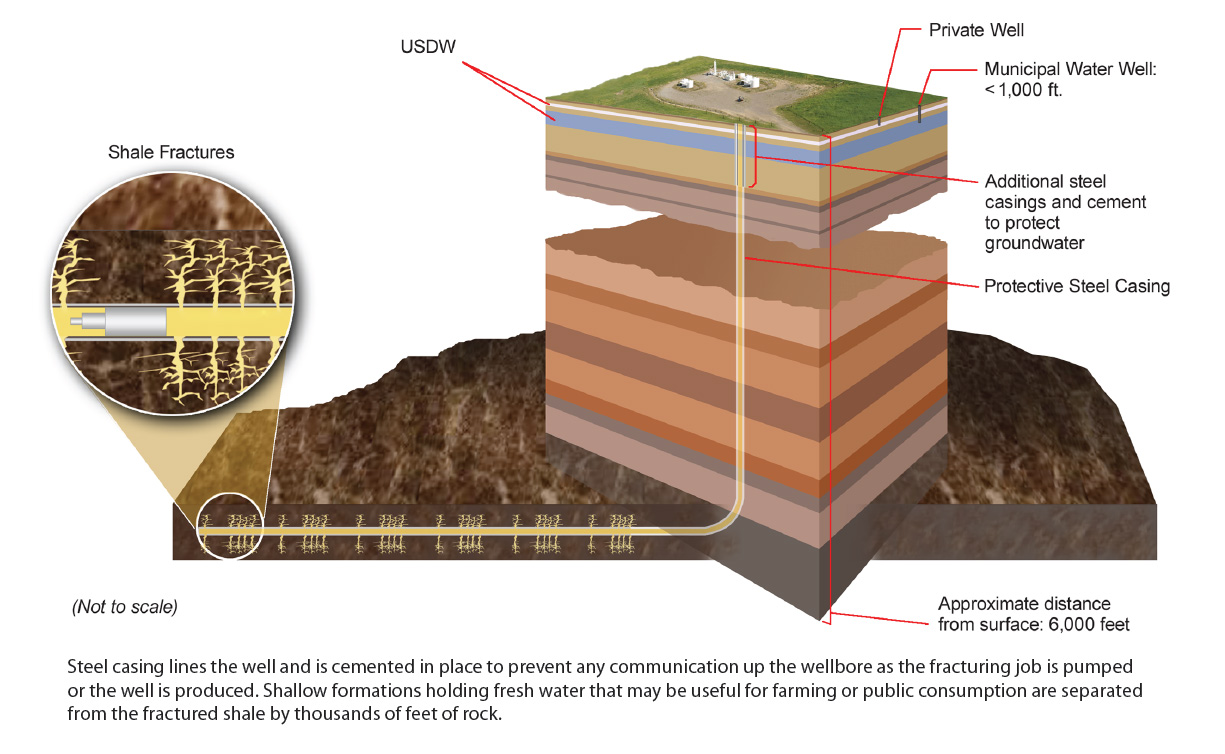
When the liquid mixture is applied to the gas bearing rocks to frack them, it will be at depths much greater than the depths where drinking water is normally found.
It is believed by many that the drilling technology is capable of bypassing drinking water supply levels safely.
|

The fluid mixture used for the fracking process needs to be stored and used at the drilling site and when it has been used, it needs to be stored and eventually disposed of safely. It has been suggested that these fluids could be injected into porous layers of rock in the Coastal Plain. This has caused some concern with residents of that area, and may not be a viable alternative.
Another significant issue in the development of oil and gas with fracking is the amount of potential exploitable reserves that exist. As a former oil and gas geologist, it is my experience that no one really knows the answer to that question until the wells are drilled. But at this time, based on the amount of natural gas available in the United States and the amount of infrastructure investment required for production, it is unlikely that a large oil and gas industry will develop anytime soon in North Carolina.
|
|
|
|
Stay Connected!
Pyramid is a GSA Contract Holder! Contact us to find out more about GSA contracts and our experience with government contract procurement. |
|
|
|
|
 | | Image from the US Department of Energy |
|
|
The Basics of Lead-Based Paint Investigations
|
 | | Image from www.genome.duke.edu |
Due to the lack of regulations regarding the use of lead-based paint in past construction, buildings constructed before 1978 may contain lead based paint. Exposure to this type of paint can result in serious health risks, especially for children and pregnant women. Because of these risks, lead-based paint investigations have become a requirement for certain situations involving the demolition or redevelopment of older structures.
What Are The Ways To Perform a Lead-Based Paint Investigation?
The presence of lead-based paint can be determined by collecting paint chips and having them analyzed by a certified laboratory or by testing with an x-ray fluorescence detector (XRF), a portable handheld unit that can give you on the spot results. Consultants will typically charge $250 - $700 per day for the XRF depending on if they own or rent the device; therefore it is only cost effective if multiple tests are needed. The XRF approach (instrument or device) is essential if you are conducting a lead paint survey on a multi-family housing complex or a large commercial/industrial building. Paint chip sampling may be appropriate for residential property owners who only want to know if lead-based paint is present.
"EPA's Lead Renovation, Repair and Painting Rule (RRP Rule) lowers the risk of lead contamination from home renovation activities. It requires that firms performing renovation, repair, and painting projects that disturb lead-based paint in homes, child care facilities and pre-schools built before 1978 be certified by EPA and use certified renovators who are trained by EPA-approved training providers to follow lead-safe work practices." Learn more at http://www.epa.gov/getleadsafe/
Pyramid Environmental has licensed lead inspectors for North Carolina, South Carolina and Virginia. |
|
Sinkholes - What's the Deal?
|
|
Recent events in the news have highlighted the significance of ground subsidence and collapse associated with sinkhole activity. While catastrophic collapse is the most visible type of sinkhole event seen on television, a wide variety of sinkhole types exist, each of which can create serious problems related to safety, the structural integrity of buildings, and development or redevelopment issues. This month we provide you with some basic information on the general types of sinkholes, and the effects at the ground surface that they can cause.
|
 What is a sinkhole? What is a sinkhole?
A sinkhole is generally defined as a cavity in the ground, especially in a limestone/carbonate formation, caused by water erosion and providing a route for surface water to disappear. While most sinkholes are typically associated with limestone environments such as most of the state of Florida, other erosional processes can result in sinkhole formation in areas like North Carolina. For example, the removal of groundwater from a zone in the subsurface by pumping from a well, or a significant increase in subsurface erosion due to a ruptured/broken water or sewer line can result in the formation of a sinkhole in non-carbonate environments. These situations typically result in a cover-collapse sinkhole.
|
|
What are the types of sinkholes?
To be general, there are three main types of sinkholes:
- Cover-collapse sinkhole - a cavity develops in the subsurface due to the dissolution of limestone, or sometimes simply the removal of groundwater, and the overlying materials can no longer support their own weight, resulting in a collapse at the ground surface. This is the common "open hole" that we see on the news.
- Cover-subsidence sinkhole - dissolution of limestone in the subsurface results in the downward migration of overlying materials as they move to fill in the void spaces left behind, resulting in ground subsidence. The rate of subsidence can depend on the porosity, grain size, and thickness of the materials overlying the limestone.
- Solution sinkhole - limestone is at or near the ground surface, and dissolves as a function of precipitation and surface water runoff, preferentially dissolving along fractures and weak zones in the shallow rock unit, resulting in ground subsidence.
|
 All three of these sinkhole types can create problems for structures, roadways, and ultimately the safety of the people living or working above them. Cover subsidence and solution sinkholes can lead to building foundations undergoing differential settlement, resulting in cracking and structural instability. Cover-collapse sinkholes can cause sections of roadways, bridges, and other structures to collapse. In the best case these collapse events result in repair costs and down-time for the associated structure, and in the worst case injuries or even death can occur.
Pyramid's geologists are well educated in sinkhole development, and our geophysicists can provide rapid analysis of areas that may be prone to the formation of a sinkhole as well as delineating the extents of a known sinkhole feature. Contact us today to learn more! |
|
Need to know what's underground?
Our geophysical services can help!
- Geologic Hazards
- Geotechnical Drilling
- Landfills
- USTs
- Geologic Mapping
- Groundwater
|
Dear ,
Pyramid maintains the most up-to-date knowledge of the industry's regulations, changes, and events, and we will continue to pass this information along to YOU.
Once again, thank you to all our loyal customers, vendors, and employees for your continued support . Pyramid can't do it without you.
Sincerely,
DOUG CANAVELLO
Pyramid Environmental
|
|
|
|