| Join Me:
Women's Leadership Circles of Bennington County
Info Session
September 10, 12:30
Register Here
September 25, 12:00
Register Here
|
New Group Begins Bennington County Fall, 2013!
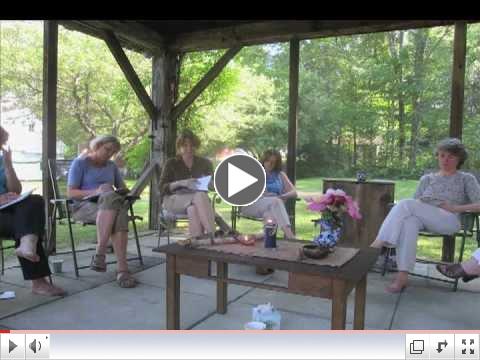 | |
The Women's Leadership Circle of Vermont
|
Run time: 4:48 min
|
Quarterly Quote:
"What's talked about is a dream,
What's envisioned is exciting,
What's planned become possible,
What's scheduled is real."
- Anthony Robbins
|
Great Link!
Murmurations: A short film that follows the journey of two girls in a canoe on the River Shannon and how they stumble across one of nature's greatest phenomenons; a murmuration of starlings. Beautiful! (2:01)
|
Murmuration by Sophie Windsor Clive & Liberty Smith
|
|
|
Reviews
"The Women's Leadership Circle program changed me. I'm so glad I was a part of it."
-Participant
WLC of Washington County
|
Your Thoughts?
Engaging in dialogue
I'd love to hear your reactions and thoughts to this newsletter. To drop a note: click here:
|
Receive the Newsletter:
If this was forwarded to you and you'd like to receive it in the future, please click below:

|
|
Greetings!

We're in the process of finishing up a house project, which unfortunately took much longer than anticipated. It makes me feel like I'm "behind" as I get back into the busy work season, and my frustration is palpable as I keep setting goals to get it all in order, only to come to the end of the day not feeling like we've made much progress. My husband, Jon, tells me this is always the case with projects- and indeed the evidence with all of our other house projects, as well as many of my work projects, is there to confirm this. Yet why am I surprised every time it happens? Why don't I estimate more accurately? How can I set more realistic timeframes that might allow me to live with less stress? Do you ever have this experience? If so, join me in the inquiry- and if you've figured it out, let me know how you do it! Warmly, Kerry |
|
Why We Underestimate How Long Things Take An Interesting Nugget
If you're like most people, you come up with a list of things to do each morning, only to find yourself deflated at the end of the day to realize you haven't completed them all. In fact, you may have only completed a couple on the list. What's going on here? Hofstadter's Law is the principle that things always take longer than we think- even if we know about Hofstadter's Law. And research shows it has to do with the fact that we have no sensory receptors specifically dedicated to perceiving time.
So we can feel better to know that we're not alone, that it's a human nature, and that our brains aren't even working in our favor. But what can we do?
First, it can help merely to know that we've got a cognitive bias toward underestimating how long it can take. (And now you know!).
Next, there are a few tools to help combat the bias:
- Use past reference as an indicator for how long this task will take. When I think about past projects, did they go according to the schedule I had in mind? (For me, not even close- I should double or triple my first estimate).
- Think about how things might not go according to plan and budget in extra time. (So in my case, I should have counted on the contractors running into problems, or figure in that my work projects get delayed by computer issues.)
- Break the project into chunks and estimate how long each portion will take. (I should have broken down the painting by room, ceilings, walls, trim in order to get a more accurate estimate. At work I more accurately anticipate my preparation time for a training when I bullet out the pieces I need to design and then assign a time estimate to each section.)
From my coaching work, when people talk about their frustration with getting things done, I often invite them to track their time for a set period to get a better idea of how they spend their days and how long things.
Finally, I offer the "All I have to do today list": put a maximum of three things on that list. If you finish, great, you can add one to three more, but it prevents you from making a list of 25 things, resulting in demoralizing failure when you only finish a couple. Hofstadter's Law-- look out!
|
Reflection Exercise
Moving from Theory to Action
To support you in deepening your awareness of how you underestimate how long things take (Hofstadter's Law), please consider journaling on the following questions for a week or so.
1. Actively practice the tools to combat Hofstadter's Law (1. Use past reference as an indicator; 2. Consider how things might not go according to plan; and 3. Break the project into chunks. Then base your time on these three strategies).
2. At the end of each day:
- What were my goals for what I wanted to accomplish today? To what extent did I fulfill these expectations? What were the conditions?
- What helped or got in the way?
- What learning would I like to bring to tomorrow?
|
Book Review
Decisive: How To Make Better Choices in Life And Work

I love this book because it breaks down why we err in our decision-making process and what we can do to remedy that. It reminds me a bit of Hofstadter's Law, and so I'm offering it here as a way one can become more intentional about making good decisions. The authors explain their WRAP model to help with good decision-making: 1. Widen your options. 2. Reality-test your assumptions. 3. Attain distance before deciding. 4. Prepare to be wrong. It's not rocket science, but the book gives example after vivid example of ways in which we fail to apply these principles. It's a way to get intentional about how we can use tools to override our decision-making biases. It's definitely worth checking out.
And if you want a visual, here's a good video review that explains the basic principles:
 | Video Review for Decisive
|
|
 Kerry Secrest is a leadership coach for individuals and organizations who inspires the best in individual and organizational performance. Kerry Secrest is a leadership coach for individuals and organizations who inspires the best in individual and organizational performance.
For more about Kerry, click here:
Please feel free to contact me with comments, questions or to find out how I can support you or your organization!
Watershed Coaching, LLC
904 Upper Dummerston Rd.
Brattleboro, VT 05301 · 802-451-0842
| |
|
|
|
|
|
|

