| Quick Links | 
DoctorDoug Website
 | | DoctorDoug Website Tour |
|
|
Join Our List

 |
|
FROM THE DOC
|  |
"We are what we repeatedly do. Excellence, therefore, is not an act....it is a habit."
---Aristotle My wife's father was a beloved physician and assistant professor of urology at Johns Hopkins Hospital, Dr. Walter Smyth. His contemporary was the renowned orthopedic pioneer Dr. David Hungerford. Beyond friends, these were surgeons who prized Excellence and found common cause in that habit. SMIL Radiology was started in the 1970's by recognized national leaders in radiology, and today it is headed by a cadre of the finest radiologists, trained at the finest schools. Not only do they embody Excellence, but I've been a 'secret shopper' on many occasions when I've called SMIL radiology for information about patients and their results, and I've found that all of their staff embody this principle in how they treat our patients. Excellence is the result of what we do at Our office. My staff embodies Excellence, and they do so through habit. We are not alone in our quest, as noted by the above examples of the past and present, but we are part of a long tradition that continues to make Medicine a great profession; a tradition that inspires us to be our best every day.
Yours in good health,
Dr. Lakin
|
|
|
| VOL 11 / Issue: #2 | Spring/ 2015 |
|
Spring Things to Do In Arizona
|
Arizona has a plethora of things to do, here are just a few:
 Butterfly Wonderland Experience a magnificent, lush, rainforest environment where thousands of butterflies from around the world fly freely, alighting on fragrant flowering plants and, quite possibly, on a friendly visitor's shoulder or finger. Open daily, 9 AM - 5 PM. Start planning now at http://www.butterflywonderland.com Butterfly Wonderland Experience a magnificent, lush, rainforest environment where thousands of butterflies from around the world fly freely, alighting on fragrant flowering plants and, quite possibly, on a friendly visitor's shoulder or finger. Open daily, 9 AM - 5 PM. Start planning now at http://www.butterflywonderland.com
Phoenix Zoo  A visit to the Phoenix Zoo opens a wondrous world of curiosity, imagination and discovery. For more than half a century, the Zoo and its animals have amazed guests from across Phoenix and around the globe. With cafés, shops, lush gardens and exciting experiences like Stingray Bay, Giraffe Encounter, Monkey Village, Safari Train and many more, your visit to the Zoo will be memorable for the entire family. Open daily, 9 AM - 5 PM. Start planning now at http://www.phoenixzoo.org A visit to the Phoenix Zoo opens a wondrous world of curiosity, imagination and discovery. For more than half a century, the Zoo and its animals have amazed guests from across Phoenix and around the globe. With cafés, shops, lush gardens and exciting experiences like Stingray Bay, Giraffe Encounter, Monkey Village, Safari Train and many more, your visit to the Zoo will be memorable for the entire family. Open daily, 9 AM - 5 PM. Start planning now at http://www.phoenixzoo.org
 Lowell Observatory Lowell Observatory
Peer through telescopes at night or visit with the instrument that helped Clyde Tombaugh discover Pluto. Tour our facility with friendly, knowledgeable guides. Experience the Universe through widescreen multimedia shows, exhibits, live presentations and SlipherVision, our new immersive space theatre. Open daily, Mon. - Sat. 9 AM - 10 PM; Sunday 10 AM - 5 PM. For more information, visit http://lowell.edu
 Pima Air & Space Museum The more time you have to spend at Pima Air & Space, the better your experience. We have 80 acres and more than 300 airplanes, not to mention all our artifacts (more than 125,000 on display) and the bonus 390 Memorial Museum ("the museum in the museum"), plus the exclusive and impressive "Boneyard" tour. Open daily, 9 AM - 5 PM (last admission at 4 PM). Plan your trip at http://www.pimaair.org Pima Air & Space Museum The more time you have to spend at Pima Air & Space, the better your experience. We have 80 acres and more than 300 airplanes, not to mention all our artifacts (more than 125,000 on display) and the bonus 390 Memorial Museum ("the museum in the museum"), plus the exclusive and impressive "Boneyard" tour. Open daily, 9 AM - 5 PM (last admission at 4 PM). Plan your trip at http://www.pimaair.org
 Verde Canyon Railroad Verde Canyon Railroad
It's not the destination, it's the journey. Today people travel from all over the world to ride the rails into the Verde Canyon - an average of 90,000 people per year. They come to experience the sights and to revel in the casual elegance of train travel as they discover the heritage of the landscape. It's a journey worth taking. It is the scenery that lures them but it is the Railroad that still brings them... because it's always a good day when you're on a train. Open daily, call for hours 800.582.7245. Plan your adventure at http://www.verdecanyonrr.com
 Out of Africa Wildlife Park Call us wild. Call us crazy. Just don't call us a zoo" At Out of Africa Wildlife Park, you get a completely different view of wildlife. That's because this isn't a zoo. Here, exotic animals from all over the world roam in spacious habitats, giving you a chance to see these beautiful creatures and their natural behavior up-close. And, with exciting shows like Tiger Splash, Wonders of Wildlife and Predator Feed, Out of Africa is like nothing you've ever seen. Open daily, 9:30 AM - 5 PM. Plan your adventure at http://www.outofafricapark.com Out of Africa Wildlife Park Call us wild. Call us crazy. Just don't call us a zoo" At Out of Africa Wildlife Park, you get a completely different view of wildlife. That's because this isn't a zoo. Here, exotic animals from all over the world roam in spacious habitats, giving you a chance to see these beautiful creatures and their natural behavior up-close. And, with exciting shows like Tiger Splash, Wonders of Wildlife and Predator Feed, Out of Africa is like nothing you've ever seen. Open daily, 9:30 AM - 5 PM. Plan your adventure at http://www.outofafricapark.com
Back To Top
|
|
Dr Lakin Named "Top Doc" Again For 2015!
| 
Back To Top
Every year the Phoenix Magazine publishes a guide featuring over 500 of the Valley's best physicians. The doctors are selected through a peer-review survey. The theory is that medical professionals are the best qualified to judge medical professionals.
The survey asks the doctors to nominate those doctors who, in their judgment, are the best in their fields.
Once again, Dr. Lakin has been chosen as a TOP DOC among his peers.
Please join us in congratulating Dr. Lakin again for the 13th year! Back To Top |
|
Unmask Hypertension:
Track Your Blood Pressure At Home. . . . . . .
| |
 Your blood-pressure checks at the doctor's office may read normal, but that doesn't necessarily mean you're in the clear: Up to 20% of adults have "masked hypertension," according to some estimates. That's when blood pressure measurements are lower at the physician's office than they are at home. Your blood-pressure checks at the doctor's office may read normal, but that doesn't necessarily mean you're in the clear: Up to 20% of adults have "masked hypertension," according to some estimates. That's when blood pressure measurements are lower at the physician's office than they are at home.
Experts aren't completely certain why it happens, but scientists have recently discovered that people with this form of hidden hypertension have a 55% increased risk for heart attack or stroke, compared with those with normal blood pressure, according to a research review. The same analysis found that home blood-pressure monitoring helps identify masked hypertension.
Doctors may recommend home monitoring (in addition to regular check-ins at that office) for people diagnosed with high blood pressure, those with pre-hypertension, or even people who just have risk factors for the condition, including family history, advanced age or obesity. Left untreated, hypertension can damage your heart, arteries and kidneys and lead to stroke and vision loss, among other complications.
Keep tabs on your pressure at home; that can help doctors make an earlier diagnosis, as well as track your treatment and encourage better blood-pressure control. Talk to your physician; if home blood-pressure monitoring is suggested for you, here are some tips to help you get started:
Choose an arm monitor.
It's more accurate and reliable than the devices that take readings from your wrist or finger. The American Heart Association (AHA) recommends this type of monitor. Measure around your bicep, and choose a monitor that comes with the correct cuff size. Digital devices are more expensive than manual ones, but they're easier to use - they automatically inflate and deflate the cuff (instead of you having to pump), and they provide digital readings, as well as pulse rate; certain manual monitors require the use of a stethoscope.
Measure at the same time every day.
Either in the morning or at night, according to the AHA. Don't smoke, drink caffeinated beverages or exercise 30 minutes before taking a reading. Sit in a chair, with your back straight and both feet flat on the floor and make sure your arm is supported on a flat surface at heart level. Take two or three measurements each time, one minute apart.
Track your results.
Record every reading, including the date and time; the AHA offers online and printable trackers at heart.org. You can also download apps to note your pressure, as well as your weight and other lifestyle factors. Some monitors can store your numbers; others allow you to upload readings to a website. One high reading is not a cause for concern, but if your numbers are consistently elevated, consult your doctor. If your pressure reaches a systolic (top number) of 180 mm Hg or higher or a diastolic (bottom number) of 110 mm Hg or higher, wait a few minutes and take it again, the AHA says; if it's still at or above that level, seek emergency treatment.
-By USA Weekends
Back To Top
|
|
Recognizing Frank "The Colonel"
| |
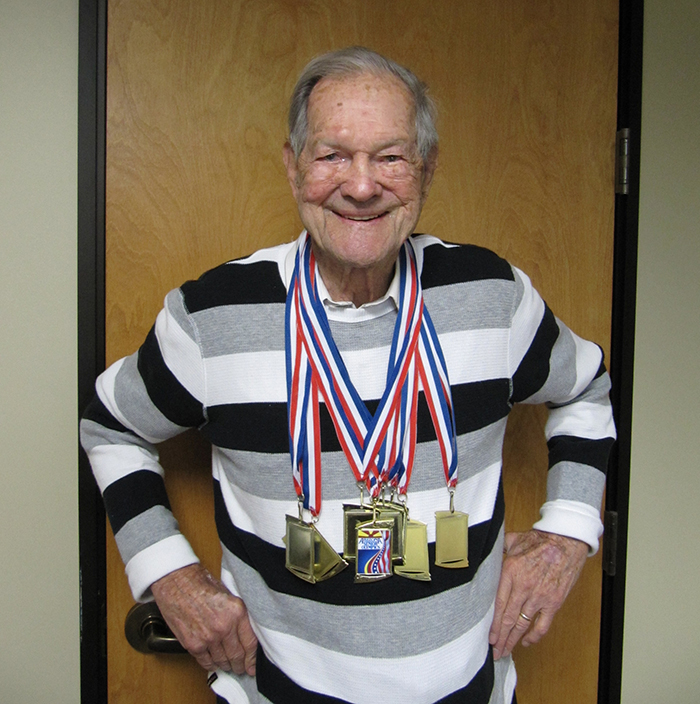 We want to recognize a patient and friend of the office, Frank "The Colonel" for his most recent accomplishments at the Arizona Senior Olympics, winning multiple gold medals in Track & Field this year....at the age of 97. We want to recognize a patient and friend of the office, Frank "The Colonel" for his most recent accomplishments at the Arizona Senior Olympics, winning multiple gold medals in Track & Field this year....at the age of 97.
Frank is a Human Dynamo, and is known to our staff as an Entertainer, having provided numerous harmonica concertos to our staff at events and lunchtime meetings. This self-proclaimed "10th best harmonica player in the world" is truly amazing...and he has the Video to prove it >>>HERE>>>
Throughout his life, Frank has struck the perfect balance of motivation, inspiration, spirituality, and abundance of humor. Whether it was finishing the Boston Marathon and Hawaii Iron-man in his 70's, demonstrating magic and dance, teaching harmonica, or ministering to the sick and homeless, Frank's unwavering enthusiasm for life is what makes him special and someone we want to recognize.
Frank is an Arizona original, and we love him, respect him, and want to give 'Three Cheers' as an Olympian!
Back To Top
|
NEW VIDEO: 
Dr. Lakin Interviewing Dr. Zitomer
|  If you missed the Dr Lakin's Scottsdale Healthcare presentation on March 12th, CLICK HERE! If you missed the Dr Lakin's Scottsdale Healthcare presentation on March 12th, CLICK HERE!
Dr. Norman Zitomer is a gastroenterologist in Scottsdale, Arizona and is affiliated with Scottsdale Healthcare Shea Medical Center. He received his medical degree from State University of New York Downstate Medical Center College of Medicine and has been in practice for 39 years. Gastroenterologists diagnose and treat digestive disorders, such as stomach pain, ulcers, reflux, constipation and Crohn's disease. Back To Top |
|
Priceless Advice on Staying Young!
| |
 Lift weights and eat low-fat yogurt. Lift weights and eat low-fat yogurt.
Not at the same time, of course, but both are key to protecting bones, which weaken as you age. According to current estimates, about 52 million adults older than 50 suffer from osteoporosis or low bone mass.
Muscle-strengthening exercises - with weight machines or elastic bands, for example - help slow bone loss. Weight-bearing workouts, such as jogging or hiking, have similar effects. And low-fat yogurt is an excellent source of bone-building calcium (with about 310 mg in 6 ounces); so is milk (300 mg in 8 ounces) and cheese (1 ounce of mozzarella has 210 mg; cheddar, 205 mg). Collard greens, canned sardines (with bones) and fortified products, such as orange juice and some cereals, offer lots of calcium, too.
Women older than 50 should get 1,200 mg of calcium daily (50 and younger need 1,000 mg); for men age 70 and younger, the recommendation is 1,000 mg per day. Your body also needs vitamin D to absorb calcium. It's naturally found in fatty fish and added to milk and other foods. Talk to your doctor before taking supplements.
Drink before you're thirsty.
Your body needs to stay hydrated to function properly, but with age, you actually lose some of your sense of thirst; plus your body doesn't conserve water as well and some of your medications may contribute to dehydration. Sip liquids throughout the day - water is healthiest; unsweetened tea or low-fat or fat-free milk are OK too. Limit sugary soda and sweetened sports beverages; alcohol is also high in calories with few nutrients. If you do drink alcohol, limit it to one drink daily for women, two for men.
Ask before taking aspirin.
We're not talking about popping a pill to ease a headache or relieve pain - an occasional aspirin or two is safe for most adults. But many Baby Boomers self-prescribe daily baby aspirin because they think it's healthy, says Dr. Jim Sears, co-host on The Doctors. While it's true that taking regular low-dose aspirin has been shown to reduce the risk of heart attacks or stroke for certain people (and even some cancers, according to recent research), daily aspirin therapy can have serious side effects, such as an increased risk for bleeding problems and other complications.
Be cautious with certain supplements too: A new survey shows more than half of Americans think fish oil supplements can prevent heart disease, but experts at the American Heart Association say only those already diagnosed with coronary heart disease or high levels of triglycerides should consider them (with your doctor's approval). Also, the U.S. Preventive Services Task Force recently recommended healthy adults not take vitamin E or beta carotene supplements to help prevent heart disease or cancer.
Get a skin check.
You'll go for a mammogram if the doctor suggests it, and you'll willingly give stool samples to screen for colorectal cancer every couple of years, but getting to the dermatologist for an exam somehow lands at the bottom of your to-do list. It really shouldn't - especially if you're over 50, and even more so if you're a man. That's because the risk of developing skin cancer appears to increase significantly around the half-century mark, according to the American Academy of Dermatology; and rates of melanoma - the most serious form of skin cancer - are higher in older men than in women.
Other risk factors include fair skin, having many or unusual moles, a history of sunburn or excessive UV exposure, or family history of melanoma. The good news: Melanoma is almost always curable when found early. Get a full-body exam; also, become familiar with your own skin so you notice changes.
Walk.
Not at all surprising that it's good for you, but new science gives us more reasons why. In addition to helping you maintain a healthy weight, improving your mood, keeping your mind sharp and reducing your risk of high blood pressure and diabetes, brisk walking (as well as other types of moderate exercise) may cut a woman's risk of stroke by 20%, according to research presented at this year's American Stroke Association's annual conference; being more active was also found to help offset some of the increased stroke risk linked with postmenopausal hormone therapy.
Data collected from another long-term study suggest that even a little walking every week appears to lower the risk of hip fractures in men older than 50. Shoot for at least 30 minutes every day, suggests co-host Dr. Travis Stork; and invite your spouse, kids or friends along for the walk to help you stay motivated and connected with loved ones. If you're heading out solo, however, a word to the wise: don't walk and text at the same time - researchers in Australia found doing so affects posture and balance, causing people to swerve and walk slower.
Try mindful meditation.
It's an increasingly popular relaxation technique that is based on being more present in the moment; on becoming more aware of your thoughts and emotions, but letting them pass without judgment. Research from Carnegie Mellon University found this type of meditation helped reduce feelings of loneliness among older adults, as well as lowered unhealthy levels of inflammation. And a new analysis of studies found mindful meditation also helps manage anxiety, depression and pain.
BONUS: Don't ignore jaw pain.
It's the symptom you're least likely to know, according to recent survey results, but it's one that may indicate heart attack, particularly for women. Researchers at Cleveland Clinic found only 13 percent of Americans identified jaw pain as a possible sign of heart disease. Some statistics on why that's concerning: Heart disease remains the top health threat to men and women; more than 700,000 people in the U.S. have heart attacks each year; and the first few minutes can make the difference between life and death.
Other heart attack symptoms include chest pressure or discomfort; pain in the upper body (in one or both arms, the back, neck, or stomach, as well as jaw); shortness of breath (with or without chest pain); and breaking out in a cold sweat, nausea or lightheadedness. While the most common sign is chest pain, women are more likely than men to experience other symptoms - specifically shortness of breath, nausea or vomiting, back or jaw pain, or even extreme fatigue, according to the American Heart Association. If you experience any of these symptoms, call 911.
BONUS: Floss once, brush twice.
Those are the basics of good oral hygiene, and the best ways to help prevent gum disease - a condition that affects about half of Americans over 30 (prevalence rates jump to 70 percent in adults 65 and older). In its mild form, gingivitis causes irritation, redness and inflammation of your gums. You may not even notice at first; in fact, as many as 75 percent of those affected don't know they have it, adds The Doctors co-host Dr. Jennifer Ashton. But left untreated, it can progress to much more serious periodontitis and eventual tooth loss. See your dentist regularly for cleanings, usually every six to 12 months; and at home, be sure to brush in the morning and before bed, floss at least once before you brush and don't rush - a complete cleaning with a toothbrush and floss should roughly take three to five minutes, according to the Mayo Clinic.
-By USA Weekends
|
|
Be Sure You Have Our Correct Address!
| Paradise Valley Medical Clinic
Ninety Mountain View
9977 N. 90th Street, Suite 180
Scottsdale, AZ 85258
480.614.5800 (Phone)
480.614.6322 (Fax)
**Additional Top Floor Ramp Parking:
The 2nd floor ramp parking is very close to our door, but the entrance is at the VERY NORTH END of the parking area of the two buildings. You drive all the way North...enter at the NORTH END, then drive down to the SOUTH END of the 2nd FLoor Parking to get a space very near the entrance.
Back To Top |
|
Tips for Managing Spring Allergies
|
 Spring officially arrived, bringing with it Spring allergies that cause misery for millions of Americans. But there are ways folks can get relief, a medical expert says. "The key to surviving spring allergies is knowing what triggers your symptoms," Dr. James Sublett, president of the American College of Allergy, Asthma and Immunology, said in a college news release.
"Because there can be millions of pollen particles in the air, finding allergy relief can seem nearly impossible for some. But by knowing what triggers your allergy symptoms and how to avoid these allergens, you can be on your way to a sneeze-free season," he said.
The college offers some tips for dealing with spring allergies:
- Avoid clothing made of synthetic fabrics, which, when rubbed together, can create an electrical charge that attracts pollen. Opt for natural fibers such as cotton, which also breathe better and stay drier, making them less likely to harbor mold.
- Exercise outdoors when pollen counts are at their lowest -- before dawn and in the late afternoon and early evening. Because exercise causes you to breathe more deeply and inhale more pollen, try to do vigorous workouts indoors. If you're going out for an easy walk, take a nondrowsy antihistamine before you go.
- If you garden, take an antihistamine about a half hour before you go outside. Digging up dirt can stir up pollen, so you should wear gloves and a National Institute for Occupational Safety and Health (NIOSH)-rated 95 filter mask. Try not to touch your eyes. When you go back inside, wash your hands, hair and clothes.
- Limit your exposure to indoor allergens to help reduce the severity of your spring allergies. Vacuum your furniture, leave your shoes by the door, shower often, cover floors with washable throw rugs, and use a dehumidifier and an air purifier with a HEPA filter.
- If your allergy medications don't provide sufficient relief, consider allergy shots.
By Robert Preidt, HealthDay Reporter
|
|
Ways to Spring Clean Your Fitness
Routine . . . . .
|
 It's that time of year again-the snow's melting, the sun's shining, and those thick sweaters in the closet are about to go into storage. It's the perfect time to reignite your motivation by breaking away from your boring gym routine and embracing the great outdoors. Kick off spring with a healthy start by getting the right gear, revamping your routine, and doing some "spring cleaning" in your pantry. Here are 20 simple tips to get you started. Book a Physical
Believe it or not, only about 20 percent of Americans get an annual check-up. Be one of them! While you might look and feel just fine (or really hate needles), it's important to keep tabs on things like blood pressure, cholesterol, and vitamin deficiencies before designing your workout program.
Set a Schedule... but Be Realistic
If you haven't been working out much this winter, don't write down that you'll do outdoor cardio exercises for 30 minutes a day, six days a week. You'll only find yourself getting frustrated and will be more likely to give up on your workout program. Post your exercise plan in places you'll look frequently, like the calendar app on your smartphone or at your desk at work.
Spring Training Fitness Tip: Team Up
You're more likely to stick with your plan if you've got a partner in crime. Choose someone who has similar goals who's schedule fits with your own. Your best bet: Get together at the same time four days a week, whether it's before work or just before dinner.
Buy New Running Shoes
If you've been hitting the gym (and the treadmill) all winter, chances are, you're due for a new pair. Most running shoes last somewhere between 300 and 400 miles-but if you use them to walk around or do other parts of your gym routine, that wear and tear counts, too. Go to a running specialty store to get fitted, and have them look at your gait/pronation to find the best shoe for you.
Clean Out Your Pantry
Still have that tin of popcorn from the holidays or a box of chocolates from Valentine's Day? Get rid of them. And while you're at it, throw away other foods low in nutritional value, like chips, pretzels, sugary cereals, white bread and, yes, even those 100 calorie snack packs (a cookies still a cookie, even if you squash it flat and drop five in a bag).
Protect Your Skin
Now that it's warming up, you'll be heading outside again. This means more sunshine (and vitamin D, which is a good thing), but it also means that your skin is exposed to harmful UV rays. Rub waterproof lotion with at least SPF 15 or more over all exposed areas of your body. Don't forget easy-to-miss areas like behind your ears, the back of your neck and the crease near your underarms.
- By Shape Editors
Back To Top |
Question On Your Lab Results?
Check out:
DoctorDoug's Academy
| 
Dr. Lakin's guide videos on how to better understand your lab work results.....
Check the first edition here: | | DoctorDoug's Academy: Lesson #1 CBC |
|
|
Best Spring Dining in Town!
Reviewed By Anita R.
|


Essence Bakery: In the summer of 2014, I had reviewed Essence as an excellent place to get delicious food. When I wrote that review, I had not yet tried the restaurant's traditional croissants and dark chocolate croissants. I felt that I had to mention Essence again since these two items are truly outstanding. They taste as good as any croissants I have eaten in France! And their French-style macaroons are scrumptious as well. (Essence Bakery is located at 3830 E. Indian School Rd., Phoenix. There is also a location in Tempe. For more information, go to: www.essencebakery.com). 
Giuseppe's Italian Kitchen:
Several years ago, Guy Fieri, of the Food Network, had recommended this restaurant, but I hadn't yet visited it. Not long after I saw his review, my husband and I went to try it for ourselves. We were so pleased with the experience that we've been back numerous times. The food is delicious. My favorite dishes are the bolognese ragu, lasagna, and butternut squash ravioli. The desserts are house-made and are also scrumptious, especially the cannoli. The service is excellent. (Giuseppe's on 28th is located at 2824 E Indian School Rd, Suite #10, Phoenix. For more information, go to, www.giuseppeson28th.com). Good eating by Anita! Back To Top |
|
We Need Your Help!
|  Keeping you on your correct medication is as important to us as it is to you. With your help, we can be more efficient and be sure you are getting your refill requests on time and to your correct pharmacy. Keeping you on your correct medication is as important to us as it is to you. With your help, we can be more efficient and be sure you are getting your refill requests on time and to your correct pharmacy.
Tips:
1. If you need a refill, be sure to call your pharmacy FIRST, not our office. They will know if you have more refills, and if not, they will call/fax/electronically message us with your request. Then we will contact you if there is a question or concern.
2. Remember to call your pharmacy in plenty of time so you do not run out of your medications. Sometimes we need up to 48 hours to complete a request and we do not want this to be a hardship for you.
3. Register and use our SECURE PATIENT PORTAL for refill requests. We monitor this continually and again will contact you if there is a problem.
4. Remember we do not refill pain or routine medications on Fridays or weekends and all pain medications must be picked up at our office. We cannot mail or any medications outside our office. Please plan ahead and make arrangements!
We are always here to help you and appreciate the opportunity to care for your healthcare needs!
Yours in good health,
Dr. Lakin & Staff
|
|
Book Reviews By Pat. . . . .
|
 Coming soon!
Watch for Pat's book review in our summer Newsletter!

|
Have You Scheduled Your Physical Yet?
|
 As you all know, Dr Lakin is a strong supporter of annual physicals, and Spring is a time we can visit and explore any unresolved medical problems and any new health issues that need to be addressed. Annual physicals are one of the best ways to safeguard your health. As you all know, Dr Lakin is a strong supporter of annual physicals, and Spring is a time we can visit and explore any unresolved medical problems and any new health issues that need to be addressed. Annual physicals are one of the best ways to safeguard your health.
The American Medical Association recommends that if you are between the ages of 40 - 49 years, physicals should be done every two years. If you are 50 years plus, it is recommend you have yearly exams, especially if you have any chronic medical conditions that need to be monitored. Call to schedule your well care visit today!
Back To Top
|
Are You Registered For Dr. Lakin's Secure Patient Portal?
| 
Now is the time!
For help on how to register and FAQ, check our these videos:
It's as easy as that!
**Please note that our Patient Portal is not 100% optimized for
Internet Explorer 11. Some of the functions will not work as intended. The software development team is working on it. Until then, please use Internet Explorer 8, 9, 10, or Mozilla Firefox, a free browser.
Please contact Nan at nan@doctordoug.com if you have further questions or concerns.
Back To Top
|
AT THE MOVIES WITH BARB A????
| 
Well..... Barb A is actually at the ASU baseball games this Spring, watching
her grandson play magnificently as usual.So, no movie reviews this time, but if you go to the games and see Barb A, be sure to say 'hi'!Go Devils!
 See you in the summer at the movies! Barb A. Back To Top |
|
Spring Chicken in a Pot
|
Casseroles aren't just for winter - this light, vibrant one-pot is packed with spring veg and herby pesto.
- 1 tbsp olive oil
- 1 onion, chopped
- 500g boneless, skinless chicken thighs
- 300g small new potatoes
- 425ml low-salt vegetable stock (such as Kallo low-salt vegetable stock cubes)
- 350g broccoli, cut into small florets
- 350g spring greens, shredded
- 140g petits pois
- bunch spring onion, sliced
- 2 tbsp pesto
- Heat the oil in a large, heavy pan. Add the onion, gently fry for 5 mins until softened, add the chicken, then fry until lightly colored. Add the potatoes, stock and plenty of freshly ground black pepper, then bring to the boil. Cover, then simmer for 30 mins until the potatoes are tender and the chicken is cooked. Can be frozen at this point.
- Add the broccoli, spring greens, petit pois and spring onions, stir well, then return to the boil. Cover, then cook for 5 mins more, stir in the pesto and heat through.
By Mary Cadogan
|
|
|
Have a safe and healthy Spring!
Dr. Douglas Lakin & Staff
Paradise Valley Medical Clinic PC
|
|
|