|
Smartphones, tablets and apps are revolutionizing the gas operations workplace and workers are relying on new technology to work smarter, dramatically improving productivity and safety. PLCS offers a number of new tools to make main renewal more productive and safe.
Breaking Out Cast Iron Pipe
Old Way: Swinging a sledge hammer to break out a cast iron main is laborious, gives rise to back injuries and risks workers and bystanders being struck with flying pieces of pipe.
New Way: MACAW Pipe Crackers are versatile 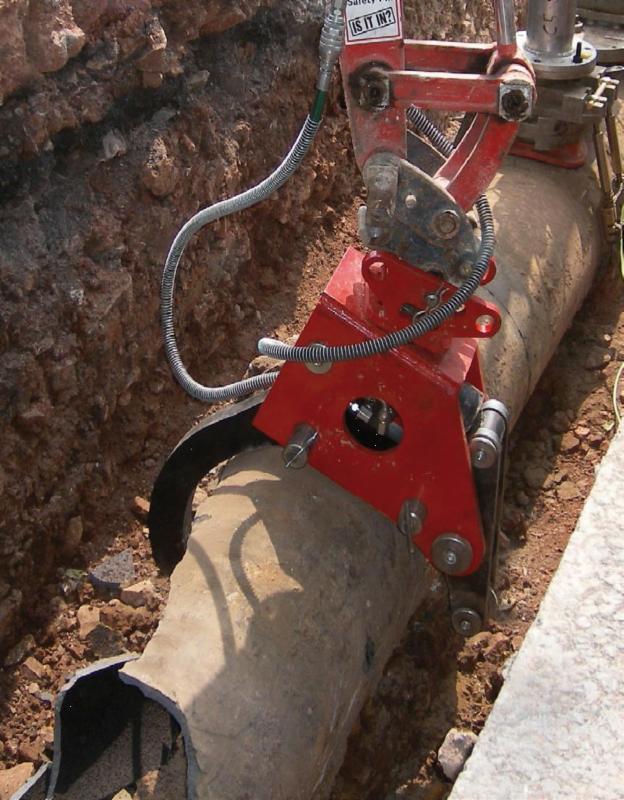 cast iron pipe breakers that can be attached to an excavator's digging arm or used as standalone tools to easily remove old main. The large model handles 8" - 24" pipe and the Mini MACAW handles 4"-8" pipe. They are inherently much safer and faster than any other method. The operator has precise control over the pressure applied to the cracker jaws to easily break the pipe into pieces, leaving any inserted PE pipe undamaged. The MACAW is operated remotely from the cab or road surface and the pipe is gently broken with a squeezing action to prevent flying debris during pipe break out. cast iron pipe breakers that can be attached to an excavator's digging arm or used as standalone tools to easily remove old main. The large model handles 8" - 24" pipe and the Mini MACAW handles 4"-8" pipe. They are inherently much safer and faster than any other method. The operator has precise control over the pressure applied to the cracker jaws to easily break the pipe into pieces, leaving any inserted PE pipe undamaged. The MACAW is operated remotely from the cab or road surface and the pipe is gently broken with a squeezing action to prevent flying debris during pipe break out.
Inserting PE into a Host Pipe for Mains Renewal
Old Way: Pushing or pulling new PE pipe into a host pipe using winches, slings on a backhoe bucket or plain brute strength is slow, labor intensive, potentially dangerous and risks damage to the PE pipe.
 New Way: The Pipe Handler easily grips and maneuvers the PE into the host pipe seamlessly without damage. The unit attaches to the end of an excavator arm and the entire operation is controlled from the cab. Inserting up to 33 feet of pipe per minute with lengths of 1,600 feet or more is now possible. Workers never need to handle the pipe or enter the trench. There are five models available to handle 2" through 24" PE pipe and each can handle a range of pipe diameters. New Way: The Pipe Handler easily grips and maneuvers the PE into the host pipe seamlessly without damage. The unit attaches to the end of an excavator arm and the entire operation is controlled from the cab. Inserting up to 33 feet of pipe per minute with lengths of 1,600 feet or more is now possible. Workers never need to handle the pipe or enter the trench. There are five models available to handle 2" through 24" PE pipe and each can handle a range of pipe diameters.
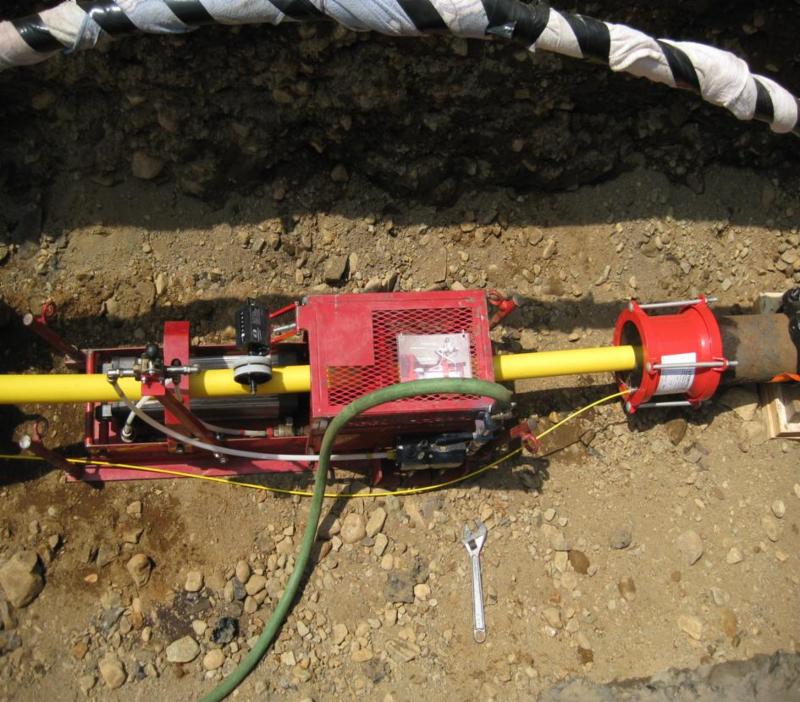 Also available are pneumatic or hydraulic powered Pipe Pushing Machines to handle 2"- 24" PE pipe. These standalone machines are secured in the trench or on the surface. The machine grips the pipe in its jaws and pushes it forward one foot. Then the jaws release and return to the start position to repeat the operation. Depending on the size of the pipe and machine model, pushing speeds range from 13-40 feet per minute with typical push lengths of 500'-1600' or more. The Pushing Machines are extremely easy to operate with the simple touch of a lever. Also available are pneumatic or hydraulic powered Pipe Pushing Machines to handle 2"- 24" PE pipe. These standalone machines are secured in the trench or on the surface. The machine grips the pipe in its jaws and pushes it forward one foot. Then the jaws release and return to the start position to repeat the operation. Depending on the size of the pipe and machine model, pushing speeds range from 13-40 feet per minute with typical push lengths of 500'-1600' or more. The Pushing Machines are extremely easy to operate with the simple touch of a lever.
Laying PE Pipe
Old Way: Installing PE pipe using 40 foot stick lengths consume a substantial amount of time and labor to assemble them on site. Stick pipe requires a fusion at least every 40 ft. Each fusion takes around 20 minutes to complete when considering the moving, fusing and cooling times.
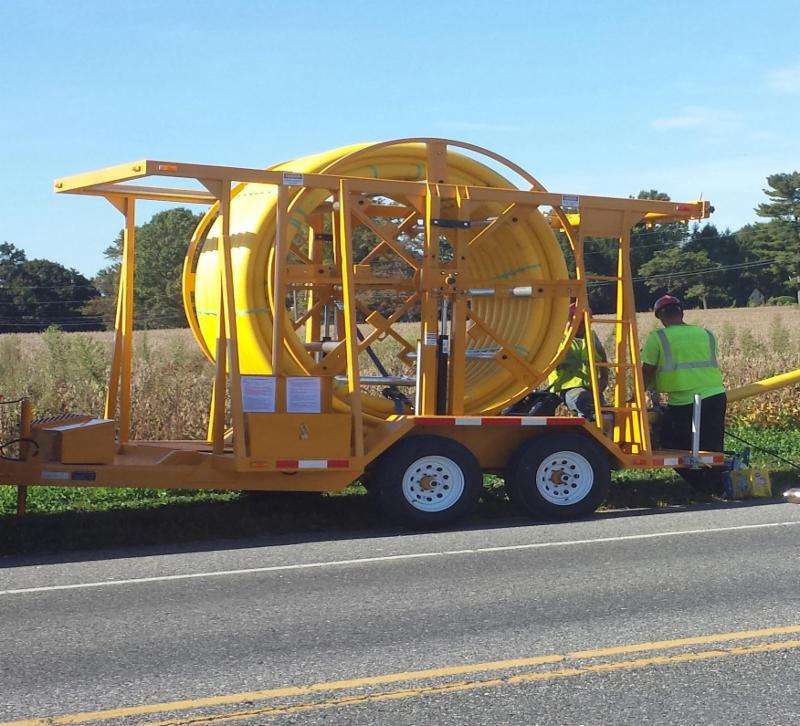 New Way: A 1,000 ft coil of pipe requires only 2 fusion joints versus the 25 required for stick pipe. A PLCS Coil Pipe Trailer is the perfect partner when installing 2"-6" PE coil pipe. The trailer is about the size of a pick-up truck making it invaluable in tight city streets, yet it can also lay high volumes of pipe at high speeds cross-country. The trailer has a solar charged, battery/hydraulic power system for easy handling of every coil size. The pipe is automatically re-rounded and straightened by an integral mechanical "set and forget" combination of rollers. There is no gas engine to start on a cold morning (or to be stolen). The rugged construction will stand up to site conditions and provide ultra safe coil pipe dispensing with minimal maintenance. New Way: A 1,000 ft coil of pipe requires only 2 fusion joints versus the 25 required for stick pipe. A PLCS Coil Pipe Trailer is the perfect partner when installing 2"-6" PE coil pipe. The trailer is about the size of a pick-up truck making it invaluable in tight city streets, yet it can also lay high volumes of pipe at high speeds cross-country. The trailer has a solar charged, battery/hydraulic power system for easy handling of every coil size. The pipe is automatically re-rounded and straightened by an integral mechanical "set and forget" combination of rollers. There is no gas engine to start on a cold morning (or to be stolen). The rugged construction will stand up to site conditions and provide ultra safe coil pipe dispensing with minimal maintenance.
Cutting Windows in Host Pipes to Access the Inserted PE Pipe
Old Way: Removing a section of the host pipe using manual cutters, circular saws or grinding wheels. These methods are difficult, inexact and downright dangerous.
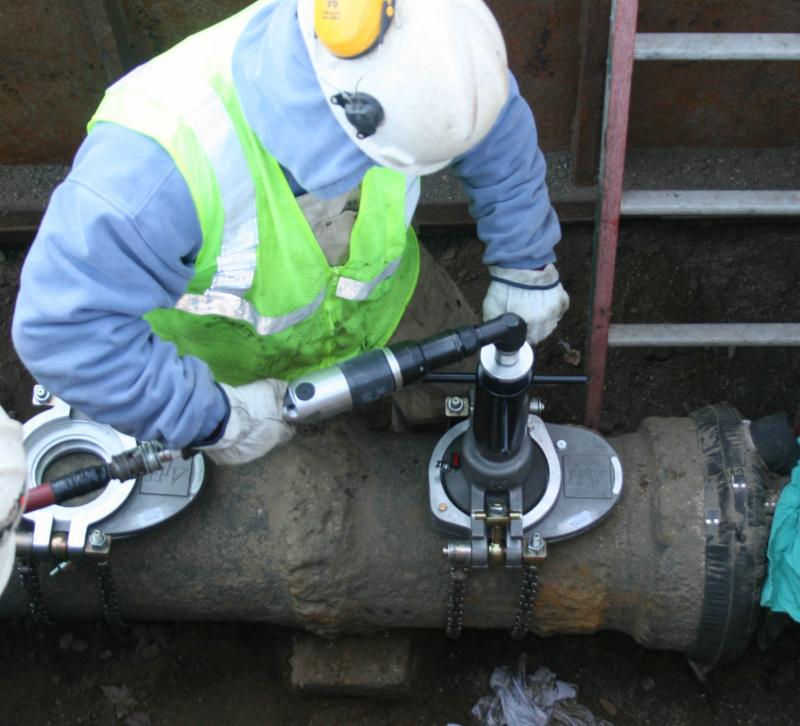
 New Way: Eliminate any room for error by using the Precision Modular Window Cutter. This lightweight pneumatic cutter is specifically designed for the gas industry to quickly make longitudinal and circumferential cuts in pipe sizes from 1 1/2" in diameter upwards with a maximum wall thickness of 0.787". Equipped with a digital depth gauge, the operator can accurately set the cutter to the proper cutting depth without error. An optional ultrasonic meter uses sound waves to measure the pipe wall thickness to eliminate accidentally setting the depth gauge too deep. The tool is easily mounted onto the pipe using chains. To ensure straight cuts, the longitudinal unit travels along a set of rails and the circumferential unit glides easily around the pipe. The unit's ultra-low profile makes it possible for use in tight spaces. A fully enclosed blade and air supply controlled by "dead-mans" handle make for safe operation. The proprietary cold-cutting non-sparking HSS blades can efficiently cut a 10" window in as little as a ½ hour. New Way: Eliminate any room for error by using the Precision Modular Window Cutter. This lightweight pneumatic cutter is specifically designed for the gas industry to quickly make longitudinal and circumferential cuts in pipe sizes from 1 1/2" in diameter upwards with a maximum wall thickness of 0.787". Equipped with a digital depth gauge, the operator can accurately set the cutter to the proper cutting depth without error. An optional ultrasonic meter uses sound waves to measure the pipe wall thickness to eliminate accidentally setting the depth gauge too deep. The tool is easily mounted onto the pipe using chains. To ensure straight cuts, the longitudinal unit travels along a set of rails and the circumferential unit glides easily around the pipe. The unit's ultra-low profile makes it possible for use in tight spaces. A fully enclosed blade and air supply controlled by "dead-mans" handle make for safe operation. The proprietary cold-cutting non-sparking HSS blades can efficiently cut a 10" window in as little as a ½ hour.
Please contact PLCS to discuss any of these pipe handling solutions in detail.
| 
 Unique Products for the Gas Distribution Engineer