What's going on this week?
Calendar
Note: You can subscribe to our calendar with popular calendar programs such as Outlook or iCal.
|
When do I serve in worship next?
|
What's Going On
In the Episcopal Church?
Check out The 
Which brings you news from all over the Episcopal/Anglican World Daily! |
Instant
Evangelism!
Spread the Good News with one click!
Also, note that you can post this issue on Facebook, Twitter, or other methods using the link at the bottom of the e-mail.
|
Join the Diocesan E-mailing List
Due to Constant Contact Policy protecting privacy, we cannot forward the e-newsletter of the Diocese over our own list.
Please take a minute to Sign up here
|
Prayer Resources

|
 Emergency Contacts Fr. David's Cell Phone 262-373-9349 Emergency Contacts Fr. David's Cell Phone 262-373-9349
|
|
|
Fund Raising Informational Meeting, Sunday, March 17, at 11:30am in the church. Any interested people are encouraged to attend. Bring an idea, create an idea, be part of the FUNdraising!
|
|
St. Matthias is now pinning on Pinterest! Follow us for inspirational messages and images!
|
 Help get us ready for Holy Week and join in the fun of making palm crosses! Saturday 3/23 at 9:00 AM in the Fellowship Hall. Bring a pair of scissors Help get us ready for Holy Week and join in the fun of making palm crosses! Saturday 3/23 at 9:00 AM in the Fellowship Hall. Bring a pair of scissors |
Adult Education Schedule - 9AM in the Undercroft:
Lenten Series - Sabbath as Resistance with Vicki Kutz, The Rev. Nancy Hodge, and Susan Kerr
Christians who wish to explore Sabbath keeping need to have a rich and realistic debate about what specific forms Sabbath practice might take today. Within the complexities of contemporary culture, no specific plan will be accessible to all, and it will be important not to turn the Sabbath into a day that reeks of condemnation rather than gift, as some have done in the past. But pondering, discerning, and having hard conversations about what our present way of living in time is doing to us and how we can respond--this is a good thing indeed.
|
A Castle With No Gate  Hear or read the Sunday sermons that ties into Wednesday's program here. Wednesdays in Lent from 5:45 - 7 PM. |
|
Music@Matthias - April 12 @ 7:30 p.m.
Kate the Great, The Songs and Times of Kate Smith
Jeanne Scherkenbach, accompanied by Jamie Johns, celebrates the music and life of American legend Kate Smith. Miss Scherkenbach will take you on a musical journey through Kate's career to remind everyone exactly why Kate was Great. Traversing from World War I thru World War II and into the 1950s television variety shows, the program will include many of Miss Smith's signature songs such as "When the Moon Comes Over the Mountain", "The White Cliffs of Dover", "I'll Be Seeing You", "I Don't Want to Walk Without You" and, of course, "God Bless America" Other forgotten treasures include "Woodpecker Song", "S'Wonderful", "I'm Stepping Out with a Memory Tonight" and "Owed to the Moon" as sung by Kate and Andy Williams.
Click HERE for more information or to buy tickets.
|

Our own Little Free Library is now outside our Pleasant Street entrance. Please bring gently-used books to the Parlor to stock it!
|
 The theme for our Waukesha Food Pantry donations for March is cereal. Please bring items to place in the basket behind the pulpit. |
 Get our bulletin on your Tablet or Smartphone! PDFs of the service bulletins are now available on the Visitor and Worship pages of the Web Site. QR Codes are posted at the church entrances: Get our bulletin on your Tablet or Smartphone! PDFs of the service bulletins are now available on the Visitor and Worship pages of the Web Site. QR Codes are posted at the church entrances:
http://www.stmatthiasonline.org/visitor.html |
|
Service Schedule for This Week:
|
|
|
17-Mar
| |
MINISTRY
|
5:00 p.m.
|
8:00 a.m.
|
Late Svc
| |
Lectors
|
|
Jan Brethauer
|
Scott Peterson
| |
|
|
|
Diane Kiehl
| |
Eucharistic 1
|
|
Cherie Teague
|
John J
| |
Minister 2
|
|
|
| |
Ushers
|
|
J Wimmer
|
Scott Peterson
| |
|
|
M Braaten
|
Charles Thompson
| |
Acolytes
|
|
|
M McCook
| |
|
|
|
A Feldner
| |
Intercessors
|
|
H Schassburger
|
Lee Dreyfus
| |
Altar Guild
|
|
Cherie T
|
Kay H.
| |
|
|
Pat A.
|
Gloria H.
| |
Flower Guild
|
V Lent
| |
Counters
|
Nancy T.
| |
|
Ginny M.
| |
Office Help
|
3/21 Nancy Teschendorf, Ginny Mack
|
|
CYRIL OF JERUSALEM
BISHOP AND THEOLOGIAN (18 MAR 386)
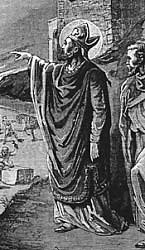 Cyril was born in Jerusalem around 315, and became bishop of that city in about 349. The years between the Council of Nicea (325) and the Council of Constantinople (381) were troubled years, in which the Church, having committed itself at Nicea, over the strenuous protests of the Arians, to the proposition that the Son is "one in being" (homo-ousios) with the Father, began to backtrack and consider whether there was some other formula that would adequately express the Lordship of Christ but not be "divisive." Experience with other ways of stating what Christians believed about the Son and his relation to the Father finally led the Church to conclude that the Nicene formulation was the only way of safeguarding the doctrine that Thomas spoke truly (John 20:28) when he said to Jesus, "My Lord and My God!" But this was not obvious from the beginning, and Cyril was among those who looked for a way of expressing the doctrine that would be acceptable to all parties. As a result, he was exiled from his bishopric three times, for a total of sixteen years, once by the Athanasians and twice by the Arians. He eventually came to the conclusion, as did most other Christians of the time, that there was no alternative to the Nicene formula, and in 381 he attended the Council of Constantinople and voted for that position. Cyril was born in Jerusalem around 315, and became bishop of that city in about 349. The years between the Council of Nicea (325) and the Council of Constantinople (381) were troubled years, in which the Church, having committed itself at Nicea, over the strenuous protests of the Arians, to the proposition that the Son is "one in being" (homo-ousios) with the Father, began to backtrack and consider whether there was some other formula that would adequately express the Lordship of Christ but not be "divisive." Experience with other ways of stating what Christians believed about the Son and his relation to the Father finally led the Church to conclude that the Nicene formulation was the only way of safeguarding the doctrine that Thomas spoke truly (John 20:28) when he said to Jesus, "My Lord and My God!" But this was not obvious from the beginning, and Cyril was among those who looked for a way of expressing the doctrine that would be acceptable to all parties. As a result, he was exiled from his bishopric three times, for a total of sixteen years, once by the Athanasians and twice by the Arians. He eventually came to the conclusion, as did most other Christians of the time, that there was no alternative to the Nicene formula, and in 381 he attended the Council of Constantinople and voted for that position.
Cyril is author of the Catecheses, or Catechatical Lectures on the Christian Faith. These consist of an introductory lecture, then eighteen lectures on the Christian Faith to be delivered during Lent to those about to be baptized at Easter, and then five lectures on the Sacraments to be delivered after Easter to the newly baptized. These have been translated into English (F L Cross, 1951), and are the oldest such lectures surviving. (It is thought that they were used over and over by Cyril and his successors, and that they may have undergone some revision in the process.)
Every year, thousands of Christian pilgrims came to Jerusalem, especially for Holy Week. It is probably Cyril who instituted the liturgical forms for that week as they were observed in Jerusalem at the pilgrimage sites, were spread to other churches by returning pilgrims, and have come down to us today, with the procession with palms on Palm Sunday, and the services for the following days, culminating in the celebration of the Resurrection on Easter Sunday. We have a detailed account of Holy Week observances in Jerusalem in the fourth century, thanks to a a Spanish nun named Egeria who made a pilgrimage to Jerusalem and kept a journal which is a historian's delight.
by James Kiefer
Note: Clicking on the first link above will take you to Amazon.com where you may buy the book if you wish.
|
|
|
|
|
|
|