What's going on this week?
Calendar
Note: You can subscribe to our calendar with popular calendar programs such as Outlook or iCal.
|
When do I serve in worship next?
|
What's Going On
In the Episcopal Church?
Check out The 
Which brings you news from all over the Episcopal/Anglican World Daily! |
Instant
Evangelism!
Spread the Good News with one click!
Also, note that you can post this issue on Facebook, Twitter, or other methods using the link at the bottom of the e-mail.
|
Join the Diocesan E-mailing List
Due to Constant Contact Policy protecting privacy, we cannot forward the e-newsletter of the Diocese over our own list.
Please take a minute to Sign up here
|
 Emergency Contacts Fr. David's Cell Phone 262-373-9349 Emergency Contacts Fr. David's Cell Phone 262-373-9349
|
|
 Fr. David & Bernie Juno of Hebron House are informed by the Rev. Kris Androsky that the concert at First United Methodist Church last week raised over $16,000 for the winter homeless shelter, allowing it to remain open until April. Thanks to all who participated and attended! |
Adult Education Schedule - 9AM in the Undercroft:
2/24/13 - Lenten Series - Sabbath as Resistance with Vicki Kutz, The Rev. Nancy Hodge, and Susan Kerr
Christians who wish to explore Sabbath keeping need to have a rich and realistic debate about what specific forms Sabbath practice might take today. Within the complexities of contemporary culture, no specific plan will be accessible to all, and it will be important not to turn the Sabbath into a day that reeks of condemnation rather than gift, as some have done in the past. But pondering, discerning, and having hard conversations about what our present way of living in time is doing to us and how we can respond--this is a good thing indeed.
|
A Castle With No Gate  Hear or read the sermon from Sunday that ties into Wednesday's program here. Wednesdays in Lent from 5:45 - 7 PM. (Note - we are unable to offer organized childcare - the nursery will be in use by an Alanon group, but children are welcome. Just bring something to keep them occupied.) "We must get ready then- heart, mind, and spirit- for the great struggle of learning to listen to God's word. For what we cannot do in our own strength, let's ask the Master for the help of his grace. If we want to find the life that's really life (and not simply a way of postponing death), then let's run on while there's still time to accomplish these things by the light of life. Let's start to do now those things that will benefit us forever. This is why we want to establish a school for the Lord's service. In drawing up its code of conduct, we hope to avoid anything harsh or burdensome." - Rule of St. Benedict
When Benedict of Nursia penned these words in the 5
th century, he did so in a world that was rapidly changing. As the Roman Empire crumbled around him, he saw that the needs of Christian Communities were also changing. The methods that had educated Christians for several hundred years were no longer effective and something different, a "new school" was needed.
Benedict's Rule, although sometimes seemingly strict and authoritarian by our modern standards, was remarkably egalitarian and gentle by the standards of his day. It encouraged careful care of the sick, elderly, and children and laid out ways to air grievances that were foreign to the feudal culture.. When he wrote it, the Rule was a way to take the treasures of Christianity and make them into something new in response to cultural changes in the world about him. The Rule became the baseline for Western Monasticism, and was in itself adapted over centuries by various communities to suit the needs of their time. Many writers have remarked how the spirit of Benedictine communities suffuses the ethos of Anglicanism, as the Benedictines were influential in England before the English Reformation. We face a changing world. Ours seems to change at the rate of Moore's Law. The edifice of Christendom, which has governed us as Westerners for around 1500 years is collapsing. The American ways of doing church developed around the automobile and near universal attendance that have informed our identity over the last fifty years are becoming a thing of the past. Like Benedict, we face the challenge of taking what is good and seemly from the Christian past and forming our Christian communities for the present. What has not changed since Benedict's time is the need for communities to have boundaries. Boundaries often get a bad reputation in our modern culture, but they are necessary for any sort of a community to form. Communities, whether fraternal orders or teams or political parties, need boundaries in order to have an identity. They are neither positive nor negative in themselves, they are simply a part of being human. The thing that makes boundaries have a moral orientation is how permeable they are. Any group that cuts itself off completely from the outside world through its boundaries sets itself up for dysfunction and abuse. Any group that has no boundaries finds it impossible to stay together over a long stretch of time. A Christian community should be a kind of castle with walls to define the edge of the community. But it should have no moat, no gate, no portcullis. It should have an open portal through which outsiders can become insiders, and through which insiders step outside to serve in Jesus' name. In the times in which we find ourselves, our churches have become geographically and demographically diverse. Time has become a more precious commodity as more families include two wage-earners and parents are pulled in a million directions by children's activities. We long for things to unify us and give us a sense of community, but we have individual needs that require flexibility and forgiveness. A rule of life, of which Benedict's Rule is but one example, is a way to form community through common practice. It is into such practice that this program invites the Christian. A rule of life is something that should challenge and stretch us. But as Benedict observes, it should not be harsh or burdensome. It should be a plumb line by which we can measure our lives, not a weight that bears us down when we fail to live up to it, as we all do at one time or another. A good rule of life is one that allows us to acknowledge our interdependence, live into the Baptismal Covenant, grow in our relationship with God and each other, and go into the world to do ministry in His name. Come, seeker, into the Castle with No Gate.
|

St. Matthias is working on its own Little Free Library! Please bring gently-used books to stock it. The library is currently in the parlor, and will be placed outside our Pleasant Street entrance when ready to go. Thanks to Bill Harland for its construction!
|
 The theme for our Waukesha Food Pantry donations for February is red. Please bring items to place in the basket behind the pulpit. |
 Get our bulletin on your Tablet or Smartphone! PDFs of the service bulletins are now available on the Visitor and Worship pages of the Web Site. QR Codes are posted at the church entrances: Get our bulletin on your Tablet or Smartphone! PDFs of the service bulletins are now available on the Visitor and Worship pages of the Web Site. QR Codes are posted at the church entrances:
http://www.stmatthiasonline.org/visitor.html |
|
Service Schedule for This Week:
|
|
|
24-Feb
| |
MINISTRY
|
5:00 p.m.
|
8:00 a.m.
|
Late Svc
| |
Lectors
|
|
Hank Stillman
|
Peg Nugent
| |
|
|
|
Wayne Konetzki
| |
Eucharistic 1
|
|
Tess Clark
|
Mary B
| |
Minister 2
|
|
|
| |
Ushers
|
|
C Ayers
|
Lyle Haddenham
| |
|
|
P Brethauer
|
Ken Martzahl
| |
Acolytes
|
|
|
N Pellechia
| |
|
|
|
J Pellechia
| |
Intercessors
|
|
Hank Stillman
|
Mike Hoeft
| |
Altar Guild
|
|
Vicki K.
|
Barb H.
| |
|
|
|
Sue M.
| |
Flower Guild
|
II Lent
| |
Counters
|
Robbi H.
| |
|
Richard N.
| |
Office Help
|
2/28 Florence Melster, Sue Mahan
|
|
|
3-Mar
| |
MINISTRY
|
5:00 p.m.
|
8:00 a.m.
|
Late Svc
| |
Lectors
|
|
Pat Ayres
|
Wayne Konetzki
| |
|
|
|
Robbi Heighway
| |
Eucharistic 1
|
|
Randy Canham
|
Richard N
| |
Minister 2
|
|
|
| |
Ushers
|
|
C Ayers
|
Lyle Haddenham
| |
|
|
P Brethauer
|
Ken Martzahl
| |
Acolytes
|
|
|
B Simmons
| |
|
|
|
A Feldner
| |
Intercessors
|
|
Diane Canham
|
Dick Bird
| |
Altar Guild
|
|
Diane C.
|
Georganne P.
| |
|
|
Barb C.
|
| |
Flower Guild
|
III Lent
| |
Counters
|
Terry K.
| |
|
Tammy K.
| |
Office Help
|
3/7 Mary Bird, Carol Schott
|
|
JOHN HENRY NEWMAN
PRIEST AND THEOLOGIAN, 1890
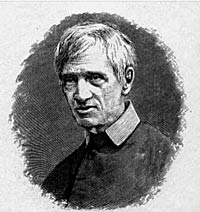 The Venerable John Henry Newman, C.O. (21 February 1801 - 11 August 1890) was a Roman Catholic priest and cardinal, a convert from Anglicanism in October 1845. In his early life, he was a major figure in the Oxford Movement to bring the Church of England back to its Catholic roots. Eventually his studies in history persuaded him to become a Roman Catholic. Both before and after becoming a Roman Catholic, he wrote influential books, including Via Media, Essay on the Development of Christian Doctrine (1845), Apologia Pro Vita Sua (1865-66) and the Grammar of Assent (1870). The Venerable John Henry Newman, C.O. (21 February 1801 - 11 August 1890) was a Roman Catholic priest and cardinal, a convert from Anglicanism in October 1845. In his early life, he was a major figure in the Oxford Movement to bring the Church of England back to its Catholic roots. Eventually his studies in history persuaded him to become a Roman Catholic. Both before and after becoming a Roman Catholic, he wrote influential books, including Via Media, Essay on the Development of Christian Doctrine (1845), Apologia Pro Vita Sua (1865-66) and the Grammar of Assent (1870).
His happy childhood came to an abrupt end in March 1816 when the financial collapse after the Napoleonic Wars forced his father's bank to close. The period from the beginning of August to 21 December, 1816, when the next term ended, Newman always regarded as the turning point of his life. Alone at school and shocked by the family disaster, he fell ill in August. Later he came to see it as one of the three great providential illnesses of his life, for it was in the autumn of 1816 that he underwent a religious conversion under the influence of one of the schoolmasters, Rev. Walter Mayers, who had himself shortly before been converted to a Calvinistic form of evangelicalism. Newman had had a conventional upbringing in an ordinary Church of England home, where the emphasis was on the Bible rather than dogmas or sacraments, and where any sort of evangelical "enthusiasm" would have been frowned upon. The tone of his mind at this time became evangelical and Calvinist, and he held that the Pope was Antichrist.
On Trinity Sunday, 29 May 1825 he was ordained priest in Christ Church Cathedral, Oxford. He became, at the suggestion of Edward Bouverie Pusey, curate of St Clement's, Oxford. Newman later wrote that the influences leading him in a religiously liberal direction were abruptly checked by his suffering first, at the end of 1827, a kind of nervous collapse brought on by overwork and family financial troubles, and then, at the beginning of 1828, the sudden death of his beloved youngest sister, Mary. There was also a crucial theological factor: his fascination since 1816 with the Fathers of the Church, whose works he began to read systematically in the long vacation of 1828. This he regarded as his second formative providential illness. At this date, though still nominally associated with the Evangelicals, Newman's views were gradually assuming a higher ecclesiastical tone.
On 14 July 1833, John Keble preached at St Mary's an assize sermon on "National Apostasy," which Newman afterwards regarded as the inauguration of the Oxford Movement. A few weeks later Newman started, apparently on his own initiative, the Tracts for the Times, from which the movement was subsequently named "Tractarian." Its aim was to secure for the Church of England a definite basis of doctrine and discipline. The teaching of the tracts was supplemented by Newman's Sunday afternoon sermons at St Mary's, the influence of which, especially over the junior members of the university, was increasingly marked during a period of eight years. In 1835 Pusey joined the movement, which, so far as concerned ritual observances, was later called "Puseyite".
His influence in Oxford was supreme about the year 1839 when, however, his study of the monophysite heresy first raised in his mind a doubt as to whether the Anglican position was really tenable on those principles of ecclesiastical authority which he had accepted. He continued his work, however, as a High Anglican controversialist until he had published, in 1841, Tract 90, the last of the series, in which he put forth, as a kind of proof charge, to test the tenability of all Catholic doctrine within the Church of England, a detailed examination of the Thirty-Nine Articles, suggesting that their negations were not directed against the authorized creed of Roman Catholics, but only against popular errors and exaggerations. In 1842 he withdrew to Littlemore, and was largely devoted to the completion of an Essay on the development of Christian doctrine, by which principle he sought to reconcile himself to the more complex creed and the practical system of the Roman Catholic Church.
Newman was formally received into the Roman Catholic Church on 9 October 1845 by Blessed Dominic Barberi, an Italian Passionist, at the College in Littlemore. In October 1846 he proceeded to Rome, where he was ordained priest by Cardinal Giacomo Filippo Fransoni and given the degree of D.D. by Pope Pius IX.
Pope Leo XIII was encouraged by the Duke of Norfolk and other distinguished Roman Catholic laymen to make Newman a cardinal. The distinction was a marked one, because he was neither a bishop nor resident in Rome. The offer was made in February 1879. Newman's elevation to cardinal took place on 12 May, making him Cardinal-Deacon of San Giorgio al Velabro.
For the Roman Catholic Church in Britain, his conversion secured great prestige and the dissipation of many prejudices. Within it, his influence was mainly in the direction of a broader spirit and of a recognition of the important part played by development both in doctrine and in Church government.
- more at Wikipedia
Links to the books above will take you to Amazon.com, where you may buy the books if you wish. They and many, many other works by Newman are also online thanks to the National Institute for Newman Studies.
|
|
|
|
|
|
|






