|
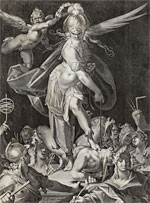
Myth, Allegory, and Faith: The Kirk Edward Long Collection of Mannerist Prints
On view through June 20
Selected from the Kirk Edward Long collection of 16th-century prints, this exhibition illuminates the development of the Mannerist style in Italy, traces its dissemination and adaptation for both secular and religious purposes, and follows its eventual transformation into the Baroque style at the end of the century. On view are more than 180 engravings, etchings, woodcuts, and chiaroscuro woodcuts. Learn about programs, tours and catalogue.
Read the review in the San Francisco Chronicle.
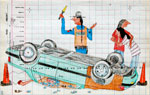 Contemporary Perspectives on the Battle of the Little Bighorn
Opens February 24
Sarah Sadlier enrolled in Professor Scott Sagan's Sophomore College seminar on the Battle of the Little Bighorn, in part because one of her ancestors, "Big Leggins" Bruguier, was an interpreter for Sitting Bull and present in the Little Bighorn camp the day the fighting began. The experience proved so profound that she soon signed up to conduct research for the Cantor exhibition Red Horse: Drawings of the Battle of the Little Bighorn. She also initiated the Stanford course "The Art and Artifacts of the Battle of the Little Bighorn," which she and Isabella Shey Robbins led in the fall. The course culminated in this student-curated exhibition, an exploration of contemporary indigenous perspectives on the historic battle.
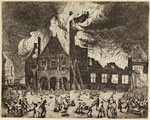 The Wonder of Everyday Life: Dutch Golden Age Prints
Opens February 24
While the Dutch Republic experienced unprecedented economic prosperity in the 17th century, printmakers were exceptionally sensitive-and sometimes obsessive-when rendering the details of everyday life. Their style introduced visual realism to the dramatic and dynamic compositions characteristic of the Baroque. A hallmark of Dutch prints created during this Golden Age is their depiction of the grit, dark corners, and textures present in the mundane objects featured in domestic scenes, landscapes, portraits, and even compositions interpreting literature or religious texts. The 18 prints in this installation explore how Rembrandt van Rijn and his peers depicted the sensual experience of the material world, contemplated life's fleeting and constantly changing nature, and navigated spirituality's role in modern life.
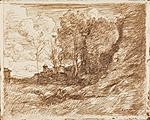 Into the Forest: Landscape as Subject and Studio in 19th-Century France
On view through July 4
Explore how French artists depicted the landscape "en plain air"--in the open air--during the 19th century. The phenomenon of making art outdoors took shape with the experimental Barbizon School of painters, and the movement fully flourished under the Impressionists. Exhibition highlights include photographs by painter James Tissot, a rare cliché-verre--a drawing reproduced using a photographic process--by Jean-Baptiste Camille Corot, and prints by Camille Pissarro.
|
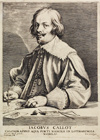
Warriors, Courtiers, and Saints: The Etchings of Jacques Callot
Through February 15
Etcher Jacques Callot revolutionized French printmaking in the 17th century. During his brief career, Callot developed a distinctively light and fluid style to naturalistically depict violent and divisive subjects. The 39 prints in this installation indicate how the political, economic, and social fallout of Europe's devastating Thirty Years' War (1618-1648) shaped Callot's times and influenced his art.
|
Faculty Lecture: Alexander Nemerov & Scott Sagan on Red Horse: Drawings of the Battle of the Little Bighorn
Wednesday, February 17, 5:30 pm, Cantor auditorium
Alexander Nemerov and Scott Sagan offer interdisciplinary perspectives on the Cantor's special exhibition Red Horse: Drawings of the Battle of the Little Bighorn. Doors open at 5:15 pm. Enter through the main lobby or the Diekman (Rodin) Rotunda.
Faculty Panel: Richard Meyer, Ivan Lupic, and Terry Castle, "Queer Mannerism"
Wednesday, February 24, 5:30 pm, Cantor auditorium
Professors Meyer, Lupic, and Castle discuss queer visuality in Mannerist prints. This panel highlights works in the Cantor's special exhibition, Myth, Allegory, and Faith: The Kirk Edward Long Collection of Mannerist Prints. Doors open at 5:15 pm. Enter through the main lobby or the Diekman (Rodin) Rotunda.
|
|
HOURS, DIRECTIONS & MEMBERSHIP
|
|
OPEN SIX DAYS A WEEK: Wednesday-Monday 11 am-5 pm, Thursday until 8 pm.
OPEN President's Day, Monday, February 15, 11 am-5 pm
Visitor parking is always free after 4 pm and all day on weekends.
Location: intersection of Museum Way and Lomita Drive on the Stanford campus, northwest of The Oval and the Main Quad. The Cantor is just one block from Palm Drive, facing the Bing Concert Hall. View a campus map
|
|
Images, top to bottom:
- Aegidius Sadeler II (Flanders, c. 1570-1629) after Bartolomeus Spranger (Flanders, 1546-1611), Wisdom Conquers Ignorance, c. 1600. Engraving. Lent by Kirk Edward Long.
- Dwayne Wilcox (Oglala Lakota, b. 1957), Budweiser Killed More Indians than Custer, 2010. Colored pencil and ink. Courtesy of the artist.
- Jan de Baen (the Netherlands, 1633- 1702). The Burning of the Town Hall in Amsterdam, 1652. Etching. Cantor Arts Center Collection, Alice Meyer Buck Fund, 1983.100.
- Jean-Baptise Camille Corot (1796-1875), Souvenir of Ostia, 1855. Cliché-verre. Committee for Art Acquisitions Fund, 1987.34.
- Lucas Vosterman (the Netherlands, 1595-1675), Portrait of Jacques Callot, c. 1645. Etching and engraving. Robert M. Loeser Collection, 1944.2.60.
Reproduction of these images is prohibited by copyright laws and international conventions without the express written permission from the copyright holder. © 2016 Cantor Arts Center at Stanford University. All rights reserved. |
|
|
 |
|
|
|


