Greetings!
We were on the road for much of October participating in workshops, symposium, committee meetings and events in China, Morocco, Italy, Germany, Peru and the Netherlands. Now most of us are back home again and happy to reconnect with friends and family. But no rest for the weary! We're getting ready to break out the suitcases again soon - to Abu Dhabi in a few weeks to help plan the 2015 Eye on Earth Summit and then on to the 20th session of the Conference of the Parties to the United Nations Framework Convention on Climate Change (COP 20) in December 2014 in Peru.
Much like our organization's early projects in Berkeley California -- daylighting urban streams, depaving, and making streets safer for pedestrians and bicyclists -- our mode of operation today typically focuses on enabling change from the bottom up through engagement and processes that benefit from the participation of citizens, local organizations and institutions. You can read about our early days of ecocitizen action in Richard Register's article, "Happy Birthday Codornices Creek Daylighting" in this edition of Ecocities Emerging.
Also in this edition we're highlighting the Living Planet Report 2014 - it's free online, please take the time to review this critical overview of the state of our planet. As you might guess it's not a good report card. Since the mid 1970s, the human population has exceeded earth's ecological carrying capacity such that today we would need one and a half planets to sustainabily generate the resources consumed over the course of a year. In other words we are quickly drawing down the natural capital of our planet and a mass extinction is currently underway. By draining wetlands, plowing prairies, logging forests, paving and building, we are altering the landscape on an unprecedented scale. Much of this stress on nature is caused by how we build and live. And this is why we work to promote the ecocity and ecocitizenship -- cities and citizens living in closer balance in living systems.
Planning for Ecocity World Summit 2015 Abu Dhabi is now well underway and the Call for Proposals and conference website will launch later this month. The theme for Ecocity 2015 is Ecocities in Challenging Environments - Taking the Vision Forward. The program will focus on enablers of change under four broad themes: 1. urban design for liveability and resilience; 2. urban systems, footprints and metabolism; 3. social systems that facilitate ecocities and 4. cities in balance with nature.
By enablers of change we mean the people, programs, and processes that provide transformational leadership, accelerate change through sharing, harness people power, and provide critical decision support systems and services.
Over the three days of the conference we plan to take you on an Ecocity Journey - Day One will be an introduction and overview of the State of the Art, Day Two looks at Mainstreaming What We Know, and Day Three will peer into The Future of Ecocities.
I'd like to take this opportunity to thank the Ecocity World Summit Strategic Committee for rolling up their sleeves and helping shape what I think will be an outstanding experience next October in Abu Dhabi!
As we build, so shall we live,
Kirstin Miller, Executive Director
Keeper of the International Ecocity Conference Series, Ecocity Builders is a non-profit organization dedicated to reshaping cities, towns and villages for long-term health of human and natural systems.
Ecocity Builders
339 15th Street, Suite 208
Oakland CA 94612 USA
|
Education and technology to increase transparency, access, and collaborative creation of sustainable and equitable communities. LEARN MORE
|
 | |
Ecocitizen World Map Project - trailer
|
|
|
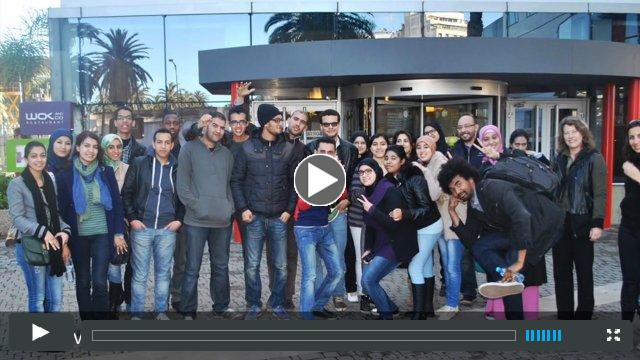
Geoinformation for Sustainable Urban Management Workshop
Casablanca, Morocco

October 13-17th With seedfunds provided by AGEDI under the CSR Special Initiative, the Association of American Geographers and its partners the US Department of State, Esri, Trimble Navigation, Ltd., Ecocity Builders and Mundiapolis University successfully presented a 5 day workshop in Casablanca, Morocco entitled "GeoInformation for Sustainable Urban Management and Resilience." Fifty representatives of the public and private sectors, civil society and academia received training in the use of GIS and GPS for applications to urban problems, as well as participating in discussions of the topics of open data and smart cities. Based on completed evaluation forms, the workshop was very well received and rated as very useful by the participants. The workshop produced a set of strategies and action items designed to ensure the sustainability of the network of organizations created through this event. To continue the productive interactions initiated by the workshop, the Research Center ICT4Dev at Mundiapolis University is hosting a website that will share all the materials from the workshop, share resources on the subjects of Smart Cities and Open Data provided by workshop participants, and develop a newsletter of activities of interest. They will also develop a community for discussions of Open Data and Smart Cities. There are also plans to continue collaboration between Mundiapolis and Cairo University to present the results of the Ecocity Map project in Abu Dhabi in 2015. As a result of the workshop, two additional Moroccan cities expressed interest in developing ecocitizen maps and organizing training. This creates an opportunity for additional collaboration. |
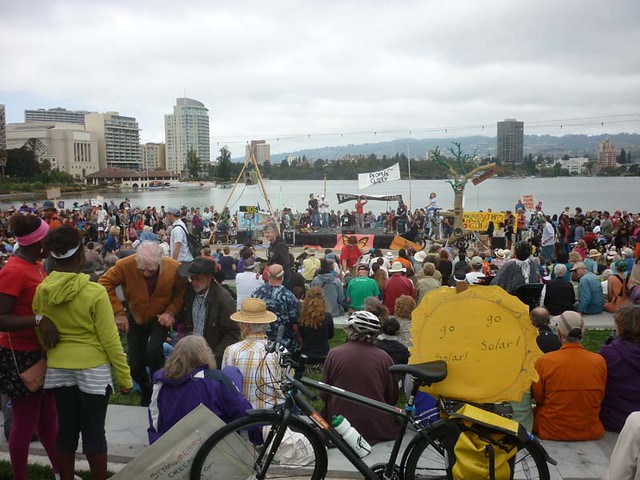
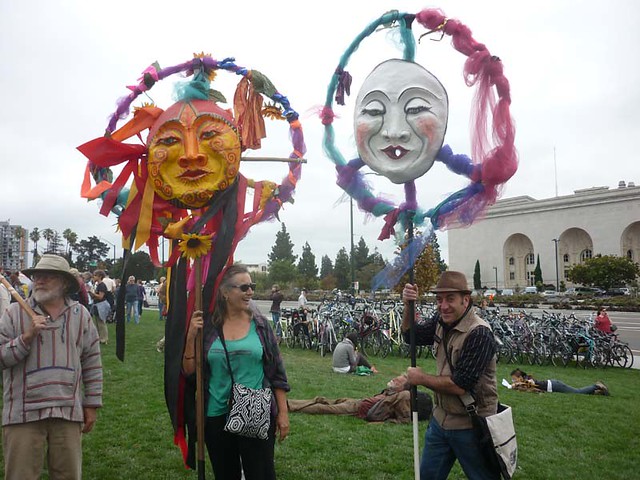
Oakland Climate Action Rally Photo Essay
By Sven Eberlein
Yes, there was the big climate march in New York, the one that everyone has been talking about, except the mainstream media. It was a fantastic success, with 400,000 people flocking to a place that is both the pulsing heart of the world's most wasteful nation as well as the nerve center of the world's governing body, to shout it from the rooftops that a critical mass of earthlings are tired of seeing their home planet trashed right in front of their eyes. But a good movement is like a human body or any other living organism: it can't function with just a heart or a brain. If it is going to survive and thrive, there need to be a lot of other functioning organs or parts that can provide the kind of immunity and resilience required to make it long-term through a diverse and complex ecosystem. So to me, going to a rally 3000 miles west of the main march was like putting my finger on the movement's wrist and checking its pulse. Should there be signs of vitality in such remote regions of this body, I knew that this uprising was meant for the long run. |
ECOCITY INSIGHTS Living Planet Report 2014 Just Released Living Planet Report 2014 Just Released
by Jennie Moore, Director, Sustainable Development
and Environmental Stewardship, British Colombia
Institute of Technology
The World Wide Fund for Nature (also known as the World Wildlife Fund in North America) just published the tenth biennial edition of the Living Planet Report in collaboration with the Zoological Society of London and the Global Footprint Network. The report is available free online: CLICK HERE  The theme of this year's report is "Species and Spaces, People and Places." It examines the issues and impacts of global urbanization. With over half the world's population now living in cities, humanity is in the midst of a global urban transition. Yet our demands on the natural world has also never been greater. A startling finding is that global species have declined 52% since 1970. The greatest losses occurred in Latin America followed by Asia Pacific with freshwater species being the hardest hit. Habitat destruction resulting from human actions is implicated as an underlying cause along with impacts from climate change (driven predominantly from the combustion of fossil fuels). The report measures populations of critical wildlife species, humanity's demand on nature's services, and water use within countries. Humanity's demand on nature, measured by the ecological footprint, has been steadily rising while available biodiversity, measured by a species inventory, has been steadily declining. Since the mid 1970s, the global human population has exceeded earth's ecological carrying capacity such that today we would need one and half earthlike planets to sustainably generate the resources consumed over the course of a year. British Columbia Institute of Technology School of Construction and the Environment is Lead Sponsor of the International Ecocity Framework and Standards Initiative |
Happy Birthday, Codornices Creek Daylighting
by Richard Register
Twenty years ago, toward the end of September 1994, work started on the liberation of Codornices Creek. This creek, comprised of four healthy tributaries becoming one stream near the base of the Berkeley Hills, is the second largest in the Berkeley area. For 50 years it was buried under asphalt between 8th and 9th Street on the Berkeley/Albany border. About eight feet above the forlorn lightless waters in their concrete box culvert were parked oil-dripping cars and a vacant lot covered in 8-foot high fennel. Couldn't see into the fennel forest, or once in it, out of it; a real dry-land jungle. Savory, if you like licorice flavor or smell. This time the bulldozers were on our side. In fact the operator who dug the rough trench to create the small valley the creek now flows through was so delighted to be "building" a creek that for the first time in his life he worked for half pay. Let's see, to do the math, I've been there most Saturdays in the first couple years and Sundays after that, averaging about 35 times a year puttering about watering orchard trees, thinning the natives for maximum biodiversity, planting native trees, bushes and flowers, raking the path, often with company, sometimes without. What's missing are weeks when I was traveling or when there was a nice steady rain. A very heavy rain and I hurried over to see the rushing water. Twice I found the stream leaping and flooding into the streets of University Village where dwell 4,000 UC Berkeley students, their spouses and children, most of them from foreign countries. At 35 times a year that's 20 times 35 equals approximately 700 trips to the creek. My home away from home.
|
 Columbia Architects Conference, permaculture, and the infamous "bell curve" Columbia Architects Conference, permaculture, and the infamous "bell curve"
by Richard Register, President and Founder
Climate change is in the news today as I write and as the United Nations meets in New York City on the subject. Three-hundred thousand pro-future demonstrators in the street greeted the delegates. Down in Bogota, Colombia four weeks earlier it was also a major topic at the Universidad Piloto where the Architecture Program hosted their Tenth Annual International Conference entitled "Designing Nature, Humanity, and Culture: Permaculture for the Sustainable Development of Urban Habitat." This was the second largest audience I'd ever faced, about 2,000 students and public guests. My largest speaking audience was 3,000 at a conference on design - not just sustainable but in general - in Seoul, Korea. Wonderful audiences in both cases, those enthusiastic, bright, young faces. The street in front of the large downtown theater was stuffed with eager audience when we speakers arrived, forcing us through the backstage door like some sort of star entertainers, which of course felt ego-gratifying. We made our way down dark hallways to back stage facing out on a cavernous empty space. Half an hour later even the balcony was almost completely filled.
The main speakers were from Colombia, Canada, Mexico, Cuba and Brazil. From the United States came myself and Tony Brown, Director/Founder of the Icosa Institute in Prescott, Arizona. In the 1970s and 1980s Tony spent 13 years deeply involved in Paolo Soleri's Arcosanti, most of that time as director of construction on site. I hadn't known him well when I lived there in 1976-77, but much enjoyed getting to know him better in Bogota. At Icosa he and a bevy of faculty teach design and architecture from theory based in ecology to hands on workshops and tours to visit Arcosanti about 35 miles away.
The subjects covered were fascinating and the group of speakers and organizers as pleasurable as any ever to host one of my ecocity talks. There was a strong emphasis on permaculture, the study and discipline of a permanent agriculture based on similar principles to our own ecocity thinking in Ecocity Builders, but mainly focused on organic agriculture in a wholes systems context. Permaculture also addresses the built environment of the single homestead and small village to sometimes, though not often, the whole city. The conference also placed a strong emphasis on working with long-term indigenous village communities there in Colombia's swampy Pacific coast where almost all buildings stand on posts in water, with boats and elevated paths, mostly wooden plank paths, uniting the villages.
READ MORE
 |
|
|
SUBMIT
to Ecocities Emerging!
|
|
Upcoming Ecocity Builders events and presentations
UCB colloquium: Where Communities Locate Themselves - Ecological Design and Citizen Participation
UC Berkeley, Rm 112, Wurster Hall, Nov 7, 1-2pm
http://ced.berkeley.edu/events-media/events/arch-242-sustainability-colloquium-tom-mckeag
This is part of the Architectural 242 Sustainability Colloquium series. Featuring presentations by leaders in the Bay Area professional community, topics covered will include: green buildings, perspectives from the fields of architecture, engineering, consulting, urbanism, and research. The public is welcome to attend. Speaker: Kirstin Miller, Executive Director, Ecocity Builders.
Geoinformation for Climate Resilient and Sustainable Cities: the Ecocitizen Approach COP 20, Lima, Peru Side Event #43 on Sustainable Cities, Monday, 1 Dec. 2014 This event will showcase Urbinsight, an integrated urban systems approach to boosting climate resilience led by Ecocity Builders. The approach utilizes geospatial information, education, tools and technologies enabling cities and citizens to adapt, reorganize and evolve into arrangements that improve the resilience of the urban ecosystem, leaving it better prepared for future climate change impacts. Currently active global projects and processes (Colombia, Peru, Morocco, Egypt, Canada, USA) will be showcased featuring the use of online crowd mapping, Participatory GIS (PGIS), participatory Urban Metabolism Information Systems (UMIS), and social media Internet applications to actively engage cities and citizens in learning, sharing and applying climate resilience principles and practices. |
Ecocity Global Spotlight
Sustainable stories and highlights from around the world
Conservative media focus on trash left by climate protestors
An estimated 400,000 people - twice the number of the historic March on Washington - peacefully demonstrated in New York this October. Yet the debris left behind by the large crowd seemed to be the only attention garnered by big media. Read Think Progress's analysis of how this highlights a critical misunderstanding of the call for change as a matter of "individual virtue" vs. systemic change.
Read more
Madrid city center to go car-free
Starting January, the City of Madrid will close off 190 hectares of its central core to traffic, expanding its restricted vehicular areas to 352 hectares. Vehicles not belonging to residents within the city's four most central barrios will be restricted to large avenues.
Read more
Full report, in Spanish
Review of the UN Climate ConferenceGrandstanding, promises, and more calls for action. But will it lead to anything? From CBC News. Read more |

website coming soon
|
Call For Proposals
Ecocity World Summit 2017

Is your city interested in hosting the next Ecocity World Summit?
We now invite expressions of interest from cities and organizations wishing to bid for hosting the next International Ecocity Conference after the event planned for Abu Dhabi, October 2015.
We seek conference hosts who agree that we need both bottom up and top down approaches to solving our urban and environmental problems and that the same applies to approaches for the content of the conferences. We have been, from the first conference on to the present, a conference series with a very international, multi-cultural and social justice-oriented set of events. We have held conferences on all continents except Antarctica.
To receive an information packet on how to apply to host the next Ecocity World Summit, please email Conference Correspondent Richard Register at ecocity@igc.org and cc: Ecocity Builders' Executive Director Kirstin Miller, kirstin@ecocitybuilders.org
|
|
Founded in 1992, Ecocity Builders is a nonprofit organization dedicated to reshaping cities for the long-term health of human and natural systems.

|
|
PRINCIPAL SPONSOR OF THE INTERNATIONAL ECOCITY FRAMEWORK AND STANDARDS
Additional Partners and Sponsors
|
|





 oof Association. "Green Cities in the World" will be published in four languages: Chinese, Japanese, English and Spanish. Richard will have 20 pages including illustrations.


