Greetings, May 2014
The Ecocity team is recently back from an intense and rewarding month on the road meeting with our EcoCitizen World Map Project partners in Egypt, Morocco and Colombia. You can get the highlights in this month's newsletter. At this time we are building out the Project's educational materials, technologies, maps, apps and integrating the framework for assessment. The success of last month's "EcoCitizen Bootcamps" in Morocco and Egypt and our very positive reception at the World Urban Forum in Medellin Colombia are clear indicators that we're on the right track. For those of you new to this newsletter, the Ecocitizen World Map Project is a global initiative connecting neighborhoods on the ground with online crowd-mapping tools designed to explore, understand, and measure holistic urban health from a citizen's perspective. We're seeking to increase social awareness with a broad vision that promotes public participation, integration, cooperation, equity and social justice. Next steps for the project include continuing to work with our partners to further develop the neighborhood assessments we've now initiated in the pilot cities, working with the respective municipalities, local universities, community based organizations and citizens to develop and map neighborhood profiles with aggregated data, including citizen sourced information, about existing conditions as they pertain to the 15 indicators of the Ecocity Framework. From there, Ecocity Builders intends to support the decision-making process leading to ecocity design and implementation of solutions in the pilot cities and neighborhoods -- these case studies will be added to the EcoCompass, the educational materials and resources portal that will be available online. Ecocity Builders is a small organization. Yet with the support and participation of our partners, the sum of our collective efforts delivers a pretty big impact. So I'd like to take this opportunity to express our sincere gratitude and thanks to our key partners and associates in the EcoCitizen Project. This effort requires inspiration and initiative, trust and leadership, and the following people and organizations are bringing it to the table: Marsha Goldberg, Association of American Geographers; Carmelle Terborgh, Esri; Fernando Echavarria, US Department of State, Office of Space and Advanced Technology; Costis Toregas, The George Washington University; Ahmed Abdulmuttaleb Baharoon and the Abu Dhabi Global Environmental Data Initiative; Jennie Moore, British Columbia Institute of Technology; Andrew Griffin, Regional Environment Officer (South America) US Department of State; Richard Huber and the Organization of American States; Tarik Nesh-Nash and Zineb Mahrez, Mundiapolis University, Morocco; Heba Allah Khalil and Dr. Sahar Attia, Cairo University, Egypt; Amadou Tidiane and Wail Tazi, Ushahidi; Etta Jackson, Scott Allen and Keith DeCristo, The Institute for Conscious Global Change; Sebastian Moffatt and Philip Mansfield, Graphical Memes. There are dozens more I could thank but the above people have been essential to the success of our work to date. I also want to thank the talented Ecocity Builders team who routinely goes above and beyond the call of duty: Naomi Grunditz, Sven Eberlein, Ashoka Finley, Dave Ron, Greg Felter, Shivang Patwa, Richard Smith, Jan Elkington, and Richard Register -- founder and president of Ecocity Builders -- who has been making deeper ecocity connections in China lately (see his notes about that below). You can hear Richard talk about his trip to Bhutan on May 23rd at our CoLab in downtown Oakland, see the announcement. The event features Latha Chhetri, Chief Urban Planner for the country of Bhutan.
As we build, so shall we live,
 Kirstin Miller Kirstin MillerExecutive Director
Keeper of the International Ecocity Conference Series, Ecocity Builders is a non-profit organization dedicated to reshaping cities, towns and villages for long-term health of human and natural systems.
Ecocity Builders
339 15th Street, Suite 208
Oakland CA 94612 USA
|
Event: Urban Planning and Design in Bhutan
Lecture and networking at the Ecocity Co-Lab
Join us at the Ecocity Builders office (The Ecocity Co-lab) for a presentation on current development in Bhutan. Latha Chhetri, Chief Urban Planner of Bhutan, will be visiting and discussing her county's policies that blend development with respect for tradition and nature.
Friday, May 23rd, 6-7:30pm
**Please RSVP to naomi@ecocitybuilders.org to ensure your spot**
Light refreshments provided
Free, $10 suggested donation
Download the poster
|
 | |
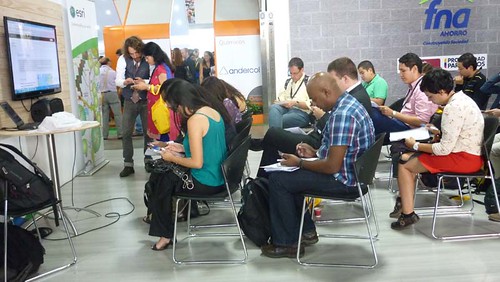
Ecocity Builders' Mapping Workshop at the World Urban Forum, Medellin, Colombia, April 2014
|
Ecocitizen Map Project : Participatory GIS and Community Mapping Techniques
GIS describes is a system designed to capture, store, manipulate, analyze, manage, and present different types of geographical and spatial data. To collect and analyze the data need for the EcoCitizen Map Project we use methods of participatory mapping. Participatory GIS is about communities locating themselves, spatially, according to the environment that shapes their lives. Participatory GIS is also about how communities locate themselves socially within society. Utilizing participatory GIS, the EcoCitizen Project explores ways to address inequities in decision making processes that determine how neighborhoods are planned and resources managed. In the case of the EcoCitizen World Map Project, the participatory methods used can be thought of as a mirror for the community: the map reflects back social, economic and ecological information about the community using visualization techniques. By "seeing" what they look like as a system, citizens are able to get a full picture of the urban condition and therefore more clearly define a vision for their version of an EcoCity. In other words, by knowing where we stand, we can determine where we need to go and how we can get there. There are two main visualization techniques used, through a participatory approach, as part of the Project. The first uses Urban Metabolism Information Systems (UMIS) to represent urban metabolic data. Simply put, UMIS allow us to visualize resources as they flow through a system. UMIS facilitate the description and analysis of material and energy flows within cities, and provides us with a metaphorical framework to study the interactions of natural and human systems in specific regions. These regions can be households, neighborhoods, districts, or entire cities. To collect and analyze the data needed we can apply methods of participatory accounting. Combining these visualization technique provides a holistic and robust picture of the city, its resources and interactions while providing a tangible way for communities to discuss planning strategies, tactics and visions. The second visualization technique uses Geographic Information Systems to represent geographic data. The EcoCitizen World Map Project's data collection techniques include establishing a study area, such as a neighborhood, with a defined boundary. We then collect citizen sourced information using web-based or printed copies of EcoCitizen surveys pertaining to universal urban indicators for healthy cities and neighborhoods into the neighborhood, conduct household audits of water and energy based on different parcel types established for the neighborhood, and test water and air quality and other urban indicators and geo-locating these using environmental and social measurement and GPS devices.
|
|
Reflections on the World Urban Forum
By Sven Eberlein, Ecocity Builders' Community Liaison
Editor's Note: The World Urban Forum is convened every two years by the United Nations. Governments, private sector, international organization, academia, professional and civil society gather to discuss ways cities can be transformed into inclusive, safe, prosperous and harmonious spaces for all. You can read the Medellin Declaration here. For us, a main takeaway is the acknowledgement that cities must do a much better job of planning and reversing sprawl, energy and materials waste, and ensuring that everyone has access to basic services and opportunities to thrive. We found the experience to be a valuable opportunity to both share and learn and we look forward to becoming more involved in helping to shape a new urban vision for the 21st Century. The following article is the first in a series of reports back recounting our experience and lessons learned."
"Is this your first WUF?" is a question commonly asked at the World Urban Forum, a gathering for, by, and about city people that was first convened by UN Habitat in Nairobi in 2002 and descended on Medellín, Colombia last week for its 7th incarnation. While the answer coming out of my mouth was always either "Yes" or "Sí" with a few stray "Ouis" and "Jas" mixed in, the feeling I had for most of the seven days inside the colorful pavilions spread across the Plaza Mayor Convention and Exhibition Center was one of Déjà vu, if not kinship. After all, the question of how we are going to arrange the two percent of planetary space in which 70 percent of humanity is projected to live by 2050 in a sustainable and dignified fashion has been on my mental drafting board since before the Stone (Temple Pilot) Age. And here I found myself in the presence of 22,000 people of all ages and ethnicities, from every pocket of the world, passionate about co-creating the kinds of urban spaces that can exist in harmony with the little round ball we all call home. No Equity, No Sustainability
The WUF7 theme was Urban Equity in Development - Cities for Life. The idea behind it seems obvious - if we invest in the most marginalized communities within our cities that are trapped behind invisible social and economic borders, everyone, including the planet, benefits. Why? Well, it's no secret that the default mechanism of most of our current economic and political systems rewards those who already have a lot with even more while leaving the less fortunate fighting for scraps. This generally applies not only on an individual basis, but on a municipal, national, and global level, where wealthy neighborhoods, cities, and countries add girth just by being, and poor ones can't seem to get a leg up at all. READ MORE
|
ECOCITY INSIGHTS
by Jennie Moore, Director, Sustainable Development
and Environmental Stewardship, British Colombia
Institute of Technology
The IEFS encompasses 15 conditions that together constitute the parameters of an ecocity (www.ecocitystandards.org). Indicators within each condition inform whether a city is achieving ecocity performance. The IEFS encompasses six levels of performance that move a city from an unhealthy and unsustainable condition through three phases of green city development and onward through three levels of ecocity development. Cities that pass the Ecocity 3 threshold would theoretically achieve GAIA status, existing in regenerative symbiosis with nature's ecosystems.
In order to understand what constitutes an ecocity, Ecocity Builders has been working with an IEFS Core Advisor Group to develop the Ecocity 1 performance parameters. This includes identification of a suitable group of indicators within each of the 15 ecocity conditions that if achieved would indicate that a given city is an ecocity, a city in balance with nature.
The fifteen ecocity conditions span ecological, social and economic considerations and comprise the following:
- access by proximity
- clean air
- clean and safe water
- healthy soil
- responsible resources and materials
- clean and renewable energy
- healthy and accessible food
- healthy culture
- community capacity/governance
- healthy and equitable economy
- lifelong education
- well being/quality of life
- healthy biodiversity
- earth's carrying capacity
- ecological integrity
Next steps in developing the IEFS include working with early partner cities to test the applicability and suitability of the indicators within each of the 15 conditions. In some cases the data needed to assess an indicator may not be available or may prove costly to obtain. Strategies for accessing data and obtaining missing information will need to be explored in order to develop the IEFS in such a way that all cities, regardless of their level of development and access to resources, can participate in self-assessment using the IEFS.
British Columbia Institute of Technology School of Construction and the Environment is Lead Sponsor of the International Ecocity Framework and Standards Initiative |
Notes from China 
From Richard Register,
President and Founder, Ecocity Builders
I'm on my way back from China reflecting on some of the best opportunities and heaviest responsibilities I've gotten myself into since starting ecocity work almost 50 years ago. I first gave a plenary talk at the Tenth International Green Building and Technology Conference and Expo in Beijing. Then I spoke to university audiences at Tsinghua University in Beijing, Tongji University, Shanghai; Tianjin University in Tianjin and Southeast University in Nanjing. How my hosts at C&P Architecture in Beijing, especially Mr. Bin Fan, President of C&P, and Ruby Yangxue, my translator, guide and general assistant, pulled it all together is quite amazing-and at very short notice too. The story is long and my space here short, but two photos and two short observations, one something of a confession, are in order. Confessions first, so, as usual with confessions, I can then move on more relaxed. Tall buildings
 In my slide presentations I frequently feature images of the two big towers in Shanghai. I took the picture six years ago. I make the comment that super tall buildings are linear development. They are not integrated into the community in the three-dimensional arrangement of complex living organisms obeying the rule of internal and external "access by proximity." One has to be relatively close to things in the environment (external), both natural and built, to have easy, efficient, healthy access to the benefits of the environment. So too for the organism itself (internally). An organism's internal functions work best with organs close together in a 3-D, not flat (2-D) or linear (1-D), arrangement. In my slide presentations I frequently feature images of the two big towers in Shanghai. I took the picture six years ago. I make the comment that super tall buildings are linear development. They are not integrated into the community in the three-dimensional arrangement of complex living organisms obeying the rule of internal and external "access by proximity." One has to be relatively close to things in the environment (external), both natural and built, to have easy, efficient, healthy access to the benefits of the environment. So too for the organism itself (internally). An organism's internal functions work best with organs close together in a 3-D, not flat (2-D) or linear (1-D), arrangement.
I point out that the super tall buildings require massive commitment to structural strength at the base, hence massive investment in material and energy for whatever service is rendered. Such buildings are also given over very disproportionally to interior transportation, that is elevator shafts and machinery. They make sense only as an extravagance, drawing attention and money, mainly because people are impressed. Confession: I'm impressed. Image: The giant Shanghai tower, 82 stories taller than the Empire State Building rises into the night sky over the also taller than Empire State Buildings Jin Mao Tower and, in bright blue lights, the Shanghai World Finance Center. Cloud Nine is immediately below the brilliant white lights on the top of the Jin Mao Tower on the left. Photo: Richard Register
|
|
Car Free Journey
BY STEVE ATLAS
When thinking of the Pacific Northwest, Seattle and Portland are the two cities that come immediately to mind. However, there are other places in Washington and Oregon that are also good choices for visitors who don't want to drive. Best of all, they are likely to be less crowded and more compact than larger cities.
In this month's Car Free Journey, we will spotlight one of these too-often-overlooked getaway cities: Spokane, Washington.
Spokane has an average of 260 days of sunshine, is close in the midst of the outdoors and has a walkable city center. It is a great choice for visitors who don't want to drive as much of what you need is accessible on foot or bike, and anything outside of downtown can be easily reached by public transportation.
Let's begin our Car Free Journey.
Welcome to Spokane!
Spokane is the largest city in Spokane County of which it is also the county seat. It is the fourth largest city and metropolitan area in the Pacific Northwest region. The city is located on the Spokane River in eastern Washington, 92 miles south of the Canadian border, approximately 20 miles from the Washington-Idaho border, and 232 miles east of Seattle. According to the 2010 Census, the city of Spokane has a population of 208,916. The Spokane Metropolitan Statistical Area (including Spokane, Stevens and Pen Oreille counties) has a population of 532,253.
READ MORE
|
|
|
Ecocity Builders in the Media
Ecocity Builders was interviewed by several media sources at the World Urban Forum 7.
|
|
SUMBIT
to Ecocities Emerging!
|
Ecocity Global Spotlight
Sustainable stories and highlights from around the world
Seoul Demolishes Urban Expressways in favor of Public Transit
via The Guardian
In a continuing move to reduce gridlock, pollution, and safety hazards, the city of Seoul is demolishing the Ahyeon overpass. The move comes one decade after the bold removal of Cheonggyecheon expressway. The latter was replaced by a river in 2005, creating a 5.5 mile green swath through the city center, transforming nearby streets and resulting in a 3.6C drop in average summer temperatures.
Read more
World Watch Institute releases 2014 State of the World Report: Governing for Sustainability
The 2014 WWI report focuses on how local government solutions are leading sustainability initiatives worldwide. Includes case studies, analysis, and recommendations on barriers and successes to environmental planning at the local level.
Read or purchase
In the Bay Area
16 story hotel proposal adds to Center Street and Downtown vision
Via Berkeleyside
A new 16 story hotel is proposed for Shattuck and Center streets. The plans are being cautiously endorsed by most city stakeholders and align with the city's Downtown Master Plan. One side of the hotel would open onto Center street, the site of Ecocity Builders' long advocated pedestrian only plaza.
Read More
|
|
Founded in 1992, Ecocity Builders is a nonprofit organization dedicated to reshaping cities for the long-term health of human and natural systems.

|
 More information coming soon!
|
|
PRINCIPAL SPONSOR OF THE INTERNATIONAL ECOCITY FRAMEWORK AND STANDARDS
Additional Partners and Sponsors
|

Education and technology to increase transparency, access, and collaborative creation of sustainable and equitable communities. LEARN MORE |
|