Greetings! April 2014
This newsletter comes by way of Egypt and Morocco where the EcoCitizen World Map Project has wrapped up the first "ecocitizen bootcamp" training events engaging residents through a direct participatory process. Co-facilitated by students from Cairo and Mundiapolis Universities, residents of neighborhoods in Cairo and Casablanca helped identify local urban issues and assets through a three-part survey process. The surveys included a general quality of life assessment, a parcel audit and household resources survey and an environmental assessment of air and water quality. Results are currently being posted to the online map at www.ecocititzenworldmap.org.
The EcoCitizen Project combines education for ecological design, internet tools, data collection methods and community based research with municipal data and maps to provide a more holistic view of local urban systems and how well they are serving citizens. Citizens use the online platform for adding their insights, information, concerns, and recommendations tagged to corresponding urban elements.
You can see more of the work in progress in Egypt and Morocco at www.ecocitizenworldmap.org along with our third pilot city, Medellín, Colombia. Medellín has undergone a major transformation in the past decade, physically and socially, and we've mapped some of their major successes. We're highlighting all three pilots at the World Urban Forum currently convening in Medellín.
On other fronts, Ecocity Builders' founder and president Richard Register has just returned from China where he spoke at several universities and conferences on urban issues. Closer to Ecocity Oakland headquarters, we are re-engaging with our next door neighbor Berkeley to update the Center Street Plaza plan for downtown under the guidance of urban designer Walter J Hood.
Last but not least, planning meetings for Ecocity World Summit 2015 in Abu Dhabi are beginning, with the first meeting of the Executive Committee planned for June. The Call for Proposals will be issued soon after. The conference website will be launching later this summer. Please keep an eye out for further announcements.
As we build, so shall we live,
 Kirstin Miller Kirstin MillerExecutive Director
Keeper of the International Ecocity Conference Series, Ecocity Builders is a non-profit organization dedicated to reshaping cities, towns and villages for long-term health of human and natural systems.
Ecocity Builders
339 15th Street, Suite 208
Oakland CA 94612 USA
|
 | EcoCitizen Bootcamp, Imbaba, Cairo, Egypt - March 2014
|
|
 | EFE-Maroc - NGO from Casablanca Morocco, EcoCitizen Bootcamp participants
- March 2014 |
|
 ECOCITY BUILDERS AT THE WORLD URBAN FORUM ECOCITY BUILDERS AT THE WORLD URBAN FORUM"The EcoCitizen Map Project: Building Resilience and Equity Through Citizen Participation and Geo Design" Thursday April 10th, 11am - 12pm, UN Habitat City Changer Room (3), White Pavilion Presented by: Ecocity Builders, Association of American Geographers, Esri, Organization of American States, AGEDI, US Department of State This event will showcase the EcoCitizen approach to understanding and designing more sustainable and equitable urban environments. Currently active global projects and processes will be showcased featuring the use of online crowd mapping, GIS and social media Internet applications to actively engage cities and citizens in learning, sharing and applying sustainability principles and practices. Scientific and sociological underpinnings of the Project are based on the International Ecocity Framework and Standards Initiative (IEFS). |
ECOCITY INSIGHTS
by Jennie Moore, Director, Sustainable Development
and Environmental Stewardship, British Colombia
Institute of Technology
Healthy Biodiversity
Biodiversity refers to the vast array of species, both flora and fauna, that populate the Earth. Their interactions create the ecosystems upon which we depend, characterized by various biomes including: deserts, rainforests, grasslands, and coral reefs (Newman and Jennings 2008).
Healthy biodiversity needs intact nutrient cycles, no net loss of soils, and no accumulation of pollutants (in soil, air or water). Although approximately 12% of Earth's wild places have been dedicated as natural reserves, global change processes, including climate change, mean that the systemic conditions needed for these places to thrive are being undermined. Biodiversity losses are being driven in part by urbanization processes that fragment natural habitats and nutrient cycles, deplete soils and aquifers, and increase pollution levels (Newman and Jennings 2008).
 To achieve the "Ecocity: Level 1 Condition" requires that the geo-physical and socio-cultural features of a city are in harmony with its surrounding bioregion (www.ecocitystandards.org). This means that indigenous flora and fauna are allowed to flourish. Equally important, ecocities do not draw down the resources or increase pollution levels in areas outside the bioregion either. This could happen through trade imbalances and/or taking advantage of global common resources, such as the waste sink capacities of oceans and atmosphere. Therefore, ecocities are concerned both with preserving and enabling healthy biodiversity in their bioregion as well as in the world generally.
READ MORE
British Columbia Institute of Technology School of Construction and the Environmentis Lead Sponsor of the International Ecocity Framework and Standards Initiative
|
 | | Richard Register meets with city offiicials in Nanjing, China |
|
"Generous City, City of the Future" 
From Richard Register,
President and Founder, Ecocity Builders
I suggested the title of this article as the overall theme for the 11th International Ecocity Conference in Abu Dhabi, which will be convening next October 2015. This will be the first Ecocity Summit to be held in the Arab region. The official theme is still being discussed and debated, with the hosts leaning towards a regional theme with an emphasis on ecocity adaptations for hot climate conditions. They in Abu Dhabi do have real expertise on this subject to be sure, and it is deeply rooted in their history. Examples of city planning and design that meet the challenges of such an extreme environment of sun and sand date back hundreds of years. High-density towns like Shaban in Yemen, with their heavy building materials of sun-dried earthen bricks - nine stories high in Shaban - and their narrow streets create a pedestrian environment pleasant in temperature and conveniently "mixed use" in the way of complete communities with lively economics and culture. We have a lot to learn from such examples in the Arab Islamic world. Another car-free model, also ancient, is the Medina of Fez, Morocco. While larger in population than the world's other substantially car-free city - Venice, Italy - Medina shares with that Italian city a plan of narrow, shaded and "passively" cooled streets and buildings. In addition, Abu Dhabi is home to one of the most interesting modern ecocity projects I know of: the car-free, once again compact, pedestrian-oriented town of Masdar. Masdar is partially built and has the potential to exert powerful influence around the world in the realm of planning, especially if it pushes boldly in ecocity directions.
 | |
Not to be taken too literally, but rather symbolically: space city comes down to earth as ecocity.
|
|
|
On the road to Cairo, Casablanca, and Medellín
What is the Ecocitizen World Map Project, and why do we need it?
By Sven Eberlein, Ecocity Builders Community Liaison and Blogger

It's been a busy four months since I went into woodshed mode to help create the Ecocitizen World Map Project, a portal where citizens can map their communities and share first-hand information for a holistic assessment of their city's ecological and social health. The one thing I've probably missed the most while wading through oodles of HTML, CSS, and GIS has been some good old fashioned ruminating from the spaces between soil and soul. So, I'm taking this opportunity to yak it up about the project and share a few stories and visuals of Medellín, Colombia, one of our initial three pilot cities. (with Casablanca and Cairo completing the awesome triad!) Speaking of Medellín, we'll be officially launching this groovy tool for sustainable urban 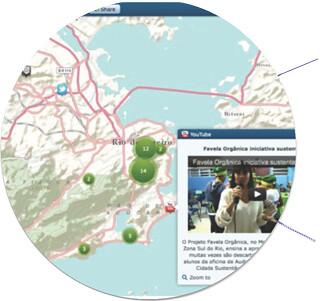 development that links community crowdsourced information to national, regional, and global data sets at the upcoming 7th World Urban Forum from April 5-11th. development that links community crowdsourced information to national, regional, and global data sets at the upcoming 7th World Urban Forum from April 5-11th. More about that a bit further on, but as anyone who's ever been deeply immersed in a multifaceted project can attest to, the danger of making sense only to yourself while sounding like a babbling cryptogram to everyone except the people you're working with increases proportionally with each additional hour you spend your head buried in jargon and code. So at the risk of being a bit long-winded but in the hopes of reclaiming my ability to some day carry a normal conversation at a social gathering again, I will use this opportunity to pretend we're sitting at a pub and you're asking about that crumpled map sticking out of my pocket. |
|
Learning from the European Green Capitals
by Rick Pruetz, FAICP, Member, Board of Directors, Ecocity Builders

Anyone interested in planning sustainable communities can gain insight and inspiration from the first five cities to win the title of European Green Capital. For each of the past five years, the European Commission has named one city its Green Capital as a way of recognizing and promoting cities aiming to reduce their ecological footprint. To win this prize, cities submit applications and are judged by a panel of experts on accomplishments in 12 criteria: climate change mitigation and adaptation, local transport, green urban areas, nature and biodiversity, air quality, noise, waste management, water management, waste water treatment, eco innovations, energy, and integrated environmental management. This article focuses on the diverse ways in which these five winners create networks of green space and nature. In addition to the inherent value of protecting habitat and ecosystems, success in these two criteria promote success in most if not all of the other criteria. For example, greenways and greenbelts benefit water management, reduce energy consumption by offering non-motorized transportation alternatives, and can be used to shape compact cities with efficient public transportation and other infrastructure. These five Green Capitals also illustrate the importance of using green areas and nature to help create inviting cities where people want to live. NANTES, FRANCE

Nantes, France, and its surrounding conurbation, with a total population of 600,000, won the Green Capital award in 2013. Located on the banks of the Loire River, 35 miles upstream from the Atlantic Ocean, Nantes was historically a seaport and an industrial center. But de-industrialization took its toll, most alarmingly with the closing of its shipyards in 1987. Since then, Nantes has revitalized itself with government institutions, corporate offices and recognition as a sustainable community or, as Nantes prefers, a "green and blue city." Perhaps the most striking symbols of this rebirth are the fanciful, animated artworks created in repurposed shipyard buildings, including a 40-foot high mechanical elephant that generates attention whenever it walks around town with 50 passengers on its back. |
|
Car Free Journey
BY STEVE ATLAS
As spring approaches, most of us are eager to spend more time outdoors and travel to destinations that might be too cold for an outdoor visit during winter. Today, we visit Milwaukee, Wisconsin. Located on Lake Michigan, Milwaukee has a River Walk, summer ethnic festivals, a world renowned brewery, museums, major league sports, and numerous restaurants and entertainment options. You will want to stay here longer than a weekend!
This month's column will give you an introduction to the city, a sampling of local attractions, and resources where you can find more details and information.
WELCOME TO MILWAUKEE!

Milwaukee became synonymous with Germans and beer beginning in the 1850s. By 1856 the city boasted more than two dozen breweries, most of them German owned and operated. Today beer halls and taverns are abundant in the city, although only one of the major breweries-Miller-remains in Milwaukee.The historic Milwaukee Brewery, located in "Miller Valley" at 4000 West State Street, is the oldest still-functioning major brewery in the United States.
READ MORE
|
|
|
Ecocity Builders in
the Media
The Ecocitizen World Map Project in Casablanca, Morocco, was featured on Moroccan national news station 2M! Watch from 20:14. Watch Now. |
Ecocity Global Spotlight
Sustainable stories and highlights from around the world
Why Medellín?
Medellín, the host of the World Urban Forum next week, is well worthy of its recent move into the global spotlight. From a city blighted by crime and urban decay, Medellín has embraced innovative urban policy that has drastically improved public safety while focusing on sustainability and public transportation. Learn more about the trail blazing work that is earning this Colombian city international recognition. Read More.
Visualizing Our Melting Planet
National Geographic website has launched a new interactive map that allows users to see just how our melting ice caps will change the world's topography. A sobering and fascinating experience. Visit the map.
In the Bay Area
Oakland Approves New Recycling Policy
Via Eastbayexpress.com
Thanks to the lobbying efforts of the Sierra Club, worker's safety groups, and many other local organizations, the Oakland City Council approved several common-sense resolutions for the city's new recycling contract. Multi-unit residential buildings will now have guaranteed access to curb-side composting and bulk waste pick-up. In addition, the resolution requires recycling contractors provide livable wages and health care for recycling workers. Read More.
Mayor Quan aims to add housing for 10K new residents
Via sfgate.com
Oakland Mayor Jean Quan announces a plan to add 7,500 housing units for up to 10,000 new residents in Oakland. Following up on former mayor Jerry Brown's successful redevelopment of Downtown and Uptown areas, Quan said the new development will focus on all parts of the city, especially transit corridors. But will new developments displace current residents? Read More.
|
|
Founded in 1992, Ecocity Builders is a nonprofit organization dedicated to reshaping cities for the long-term health of human and natural systems.

|
 More information coming soon!
|
|
SUMBIT
to Ecocities Emerging!
|
|
PRINCIPAL SPONSOR OF THE INTERNATIONAL ECOCITY FRAMEWORK AND STANDARDS
Additional Partners and Sponsors
|

Education and technology to increase transparency, access, and collaborative creation of sustainable and equitable communities. LEARN MORE |
|



