|
Ecocities Emerging
To support humanity's transition into the Ecozoic Era
|
Ecocity Builders
September 2013
| |
|
Greetings,
In just a few weeks the global ecocity movement will converge for the 10th time since ecocity pioneer Richard Register launched the series in 1990, in Berkeley, California. This time we will gather in the Loire River Valley in the beautiful City of Nantes, France. Ecocity World Summit 2013 coincides with Nantes' recognition as European Green Capital 2013 and will be the first of the conference series to be held in the European Union.
In order to face up to the challenge of sustainable cities, a broad collaborative approach to designing the conference program was adopted: the call for contributions was launched to institutions, associations, public and private researchers, businesses, and financiers. Over 500 proposals from 43 countries were submitted to the program committee.
The ECOCITY 2013 program is focusing on four priority challenges for the sustainable city.
THINKING: How can we get out of a silo approach? How can we simultaneously address global and local concerns? How do we balance the short term and with the long term?
SHAPING: How can we implement solutions applicable to all cities, beyond testimonials? How can we speed up deployment in a context of crisis?
FINANCING: How can we finance the transition when funding is limited? What economic models and financial instruments can cities adopt?
GOVERNING: How do we engage and combine public and private sectors and form successful partnerships? How do we manage multi-layered regional organization? Above all, how can we achieve greater civic involvement?
The proposals chosen are in line with the spirit of the event and constitute a useful contribution to a set of workable solutions in relation to the current challenges of sustainable cities. The program attempts to answer the four challenges through five major themes that are crucial for today's cities:
- reducing the environmental footprint
- addressing the energy challenges of the city
- organizing the sustainable city
- strengthening solidarity
- mobilizing enabling factors
On behalf of the Board of Directors of Ecocity Builders and the International Ecocity Conference Series Steering Committee, welcome to the ecocity movement. Whether or not you can attend Ecocity 2013 in person, we invite you to participate with us, through your actions and intentions, as global eco-citizens and practitioners working to help usher in the Ecozoic Era.
Thank you for all you do to make a better world for people and nature.
As we build, so shall we live,

Kirstin Miller
Executive Director
Keeper of the International Ecocity Conference Series, Ecocity Builders is a non-profit organization dedicated to reshaping cities, towns and villages for long-term health of human and natural systems.
Ecocity Builders
339 15th Street, Suite 208
Oakland CA 94612 USA
|
|
ECOCITY WORLD SUMMIT 2013
SPEAKERS SPOTLIGHT
Janez Potočnik, European Commissioner for Environment
Janez Potočnik serves as European Commissioner for Environment. He was formerly Slovenia's Minister for European Affairs. Potočnik believes in the development of an information society to create prosperity. He aims to develop the European Research Area (ERA), a system of scientific research programmes integrating the scientific resources of the European Union. Since its inception in 2000, the structure has been concentrated on multinational cooperation in the fields of medical, environmental, industrial, and socioeconomic research.  Joan Clos, Executive Director, UN-HABITAT Joan Clos, Executive Director, UN-HABITATAppointed Executive Director of the United Nations Human Settlements Programme (UN-HABITAT) at the level of Undersecretary-General by the United Nations General Assembly, Dr. Joan Clos took office at the Programme's headquarters in Nairobi, Kenya on 18 October 2010. As a city councillor between 1983 and 1987, he earned a reputation for improving municipal management and for urban renewal projects, notably managing the renovation of downtown Barcelona's Ciutat Vella district.
 Cynthia Rosenzweig, NASA Goddard Institute for Space Studies Cynthia Rosenzweig, NASA Goddard Institute for Space Studies
Cynthia Rosenzweig is a Senior Research Scientist at the NASA Goddard Institute for Space Studies, where she heads the Climate Impacts Group. She is Co-Director of the Urban Climate Change Research Network (UCCRN) and Co-Editor of the First UCCRN Assessment Report on Climate Change and Cities (ARC3), the first-ever global, interdisciplinary, cross-regional, science-based assessment to address climate risks, adaptation, mitigation, and policy mechanisms relevant to cities. She is the founder of AgMIP, a major international collaborative effort to assess the state of global agricultural modeling, understand climate impacts on the agricultural sector, and enhance adaptation capacity, as it pertains to food security, in developing and developed countries. She was named as one of "Nature's 10: Ten People Who Mattered in 2012" by the science journal Nature.
Richard Register, Founder and President, Ecocity Builders
Ecocity theoretician, author, hands-on and policy project instigator, international lecturer and consultant, Richard Register is considered to be the pioneer of the ecocity movement, with 40 years of experience advocating for cities that facilitate humanity's creative and compassionate evolution while contributing to the health of the planet. His book, "Ecocities - Rebuilding Cities in Balance with Nature," is course material in design, planning and architecture schools. Richard is the founder of International Ecocity Conference Series, also known as Ecocity World Summit, the world's premiere and longest running conference series on the subject of ecological cities, towns and villages.
 Rob Hopkins, Founder, Transition Town Rob Hopkins, Founder, Transition Town
Rob Hopkins is the founder of the Transition movement, a radically hopeful and community-driven approach to creating societies independent of fossil fuel. Transition communities have started up projects in areas of food, transport, energy, education, housing, waste, arts etc. as small-scale local responses to the global challenges of climate change, economic hardship and shrinking supplies of cheap energy. Together, these small-scale responses make up something much bigger, and help show the way forward for governments, business and the rest of us. Hopkins is the author of The Transition Handbook: From oil dependency to local resilience (2008), and The Transition Companion (2011). He was the winner of the 2008 Schumacher Award, is an Ashoka Fellow, served 3 years as a Trustee of the Soil Association, and was named by the Independent as one of the UK's top 100 environmentalists.  Severn Cullis-Suzuki, Culture and Environmental Activit and Writer Severn Cullis-Suzuki, Culture and Environmental Activit and WriterA longtime activist for 'intergenerational justice', Severn founded the Environmental Children's Organization with friends at nine years old, which culminated in her speech to the UN at the Rio Earth Summit in 1992 when she was twelve. Severn is an Action Canada Fellow ('04-'05), has published several books in Japan, and was an editor and writer for Notes from Canada's Young Activists (Greystone books, 2007). She holds a B.Sc. in Biology from Yale University and an M.Sc. in Ethnoecology from the University of Victoria, where she studied with elders from the Kwakwaka'wakw First Nations.  Ronan Dantec, Senator of the Loire-Atlantique
Ronan Dantec is Senator of Loire-Atlantique. He is former Vice President of Nantes Metropole and Deputy Mayor at the city of Nantes for Environment and Sustainable Development. Dantec is the chair of the EUROCITIES Working Group on Climate Change. In that position he initiated the EUROCITIES declaration. Dantec advocates for a territorial (regional) approach for cities in developing countries, with coherent actions in transport policies, water and waste management and urban planning. "A consistent territorial approach is the condition of efficient actions against climate change. As such, cities will tomorrow have the possibility to find new incomes for their climate actions through CDM (Clean Development Mechanism) and the Green Fund for Climate."  Dasho Dr. Sonam Tenzin, Secretary, Ministry of Works and Human Settlement, Bhutan Dasho Dr. Sonam Tenzin, Secretary, Ministry of Works and Human Settlement, BhutanDasho Dr. Sonam Tenzin has extensive experience in many fields including rural development and has great interest and passion in the developmental activities that are in line with the culture, tradition, environment and the philosophy of Gross National Happiness. In 2008, he was appointed as a Secretary for the Ministry of Labour and Human Resources. Since 2011, he is the Secretary for the Ministry of Works & Human Settlement for the country of Bhutan. Bhutan is currently considering adapting the ecocity development model for their future city building programs. Nadège Joachim, former Deputy Mayor of Mairie de Port-au-Prince, Haiti
Nadège Joachim is former Deputy Mayor of Mairie de Port-au-Prince, Haiti. Her focus has been is on decentralized cooperation, social development and building strategic partnerships. She is a co creator of CIVITAS - the Association of Mayors of the Metropolitan Area of Port-au-Prince, and has worked to restructure educational policy and school system reform in Haiti.
Yunus Nawandish, Mayor of Kabul, Afghanistan
Mayor Nawandish was appointed Mayor of Kabul by the President of the Islamic Republic of Afghanistan in January, 2010, and governs a City of an estimated five million. Since taking office, the Mayor has initiated an aggressive program of municipal improvements in streets, parks, greenery, revenue collection, environmental control, and solid waste management.  Akira Shinoda, Mayor of Niigata City, Japan Akira Shinoda, Mayor of Niigata City, JapanAkira Shinoda assumed office as the mayor of Niigata City in November 2002. He is currently serving his third term. After taking office, Shinoda continued the practice of maintaining the transparency of information in order to work together with citizens to promote reform and creativity in city politics, and dedicated himself to the safe development of Niigata as a unique city with both a rich environment for sustaining rice-paddies, and advanced urban facilities.  Wolfgang Schuster, President, Council of European Municipalities and Regions (CEMR) Wolfgang Schuster, President, Council of European Municipalities and Regions (CEMR)
Lord Mayor of Stuttgart, Germany from 1997-2013, Schuster Schuster's political agenda is dominated by furthering economic development and construction. He also promotes the interests of intercultural dialogue and the sharing of religious ideas and is the founder of the Stuttgart Religious Round Table. As a representative of the Deutsche Stadtetag, a voluntary coalition of county boroughs and district-affiliated towns in Germany, Schuster is a member of the broadcasting council of SWR radio. Schuster has a declared aim to turn Stuttgart into Germany's most child-friendly city.  John Thackara, Director, Doors of Perception John Thackara, Director, Doors of Perception
For three decades, John Thackara has traveled the world looking for live examples of what a sustainable future can be like. He writes about these stories online, and in books; he uses them in talks and workshops for cities, universities, and business; and, as director of Doors Of Perception, he organizes social harvest festivals in which project leaders share experiences with each other. John is the author of a widely-read column at designobserver.com, and of the best-selling book In the Bubble: Designing In A Complex World. He is a Senior Fellow of the Royal College of Art in London, and a Fellow of The Young Foundation, the UK's social enterprise incubator. He chairs the World Design Forum in The Netherlands, and is a visiting professor at the School of Visual Arts in New York and the Ambedkar University Delhi, in India. He's also an advisor to Banny Banerjee's Change Lab at Stanford University.  Anna Somers Cocks, Executive Director, The Art Newspaper Anna Somers Cocks, Executive Director, The Art Newspaper
In 1990 Somers Cocks founded The Art Newspaper for the Turin publishing house Umberto Allemandi e C srl. and edited it until 2003. Now she is CEO of Umberto Allemandi and Co. Publishing Ltd. From 1999 to 20012 she was Chairman of the Venice in Peril Fund, which restores monuments and works of art in Venice and funds research into the key problems facing Venice including flooding, tourism, demographic change etc. She is a Governor of the Courtauld Institute, a Trustee of the Gilbert Collection at the V&A, and a Member of the Advisory Board of the Sotheby's Institute. In 2006 she was the winner of the Arts and Media Section of the 16 th European Woman of Achievement Awards. In 2011 she was given the "Advocate Award" by the International Institute for Conservation. The same year she was made an Officer of the Order of the British Empire, OBE, for her services to the arts.  Andrew Simms, Fellow, New Economics Foundation Andrew Simms, Fellow, New Economics FoundationAndrew Simms is chief analyst at Global Witness, a fellow of the New Economics Foundation, and the author of Ecological Debt, Tescopoly and Eminent Corporations.  Mike Childs, Head of Policy, Research and Science, Friends of the Earth Mike Childs, Head of Policy, Research and Science, Friends of the EarthMike Childs has worked for Friends of the Earth for more than twenty years. During this time he helped lead Friends of the Earth's Big Ask campaign for the Climate Change Act 2008 in the UK. This was the first ever national law to commit a Government to making annual cuts in greenhouse gases.  Joseph Roig, Secretary General of United Cities and Local Governments
Joesph Roig is Secretary General of UCLG (United Cities and Local Governments), an umbrella organisation for cities, local governments and municipal associations throughout the world. United Cities and Local Governments was founded in 2004, when the existing local government organisations - the International Union of Local Authorities (IULA), the United Towns Organisations (UTO) and Metropolis - united their respective global networks of cities and national associations of local governments in a single organisation (FCMU). United Cities and Local Governments' headquarters, the World Secretariat, is based in Barcelona, Spain. UCLG is the largest local government organisation in the world and understands itself as the united voice and world advocate of democratic local self-government, de facto representing over half the world's population.
David Cadman, President, ICLEI
David Cadman is President of the international organization 'ICLEI - Local Governments for Sustainability' an international organization of nearly 1000 local governments who have made a commitment to sustainability. In this function he heads the ICLEI Executive Committee, representing the organization to other international bodies. He has been serving as a Councillor at the City of Vancouver BC, Canada since 2004, and has been awarded the UN Peace Medal and UN 50th Anniversary Medal. A social and environmental activist, Cadman is a member of Coalition of Progressive Electors. Cecile Duflot, Minister of Territorial Equality and Housing
Cécile Duflot is Minister of Territorial Equality and Housing in the Ayrault Cabinet. Until June 2012, she was Party Secretary of Europe Ecology - The Greens, a position she held from November 2006 and was, with Jean-Luc Bennahmias, the only Green leader to have served two consecutive terms. During her first term, she worked to establish Europe Écologie for the European Elections of 2009. In 2010, she was named by Foreign Policy magazine to its list of top global thinkers, for taking Green mainstream.  Fabrice Bonnifet, Sustainability Director, Bouygues Group
Fabrice Bonnifet is the Sustainability Director & QSE (Quality, Safety and Environment) of the Bouygues Group. He leads and coordinates the sustainable development strategy of the Group and participates in support of responsible purchasing, eco-design, and implementation of collaborative information systems. Bonnifet is also Vice-Chairman of the Board of Directors of Sustainable Development (C3D) and Director of The Shift Project.
Philippe de Fontaine Vive Curtaz,
Vice-President, European Investment Bank
Philippe de FONTAINE VIVE CURTAZ is Vice-President of the European Investment Bank (EIB). On the EIB's Management Committee, his responsibilities include borrowing and treasury policies, the Bank's capital market activities, and financing operations in France and under the Facility for Euro-Mediterranean Investment and Partnership (FEMIP). Before arriving at the EIB, Mr de Fontaine Vive pursued his career at the French Treasury, most recently as Director of the State and Economy Financing Department.  Valérie David, Director of Sustainable Development Department, Group EiffageValérie David is Director of Sustainable Development for EIFFAGE, a leading figure in the European concessions and public works sector was Director of European and international affairs in the Champagne-Ardenne Region from 1994 until 1999. She then joined the Caisse d'Epargne Group, where, after various institutional positions, she became Sustainable Development Project Manager for the Caisse National des Caisses d'Epargne. In 2004, she was "Chef de Cabinet" of Chairman François Drouin at Crédit Foncier de France, subsidiary of Caisse d'Epargne Group, while also in charge of sustainable development of the mortgage bank.
Patrick Viveret, Philosopher
Idealist, indignant, Patrick Viveret is a philosopher and essayist on global justice issues. Viveret is aware that we are now at the conjunction of two worlds, "the former, which will soon disappear, and the new, which is slow to appear," he argues for an entry in the age of a "happy sobriety." How? Change three key things: air (a key environmental challenge), area (have a new conception of the territory) and age (beginning of a new historical epoch). Viveret is co-founder of an annual international meeting entitled "dialogues humanity." This event, held in Lyon every year since 2003, opens a dialogue on humanity and its future, reflects together on solutions for a fairer and more sustainable future and a more just world.
Jean Jouzel, Climatologist
Jean Jouzel is a French glaciologist and climatologist . He is a world renowned specialist in major climatic shifts based on his analysis of Antarctic and Greenland ice. He received with Claude Lorius the CNRS gold medal, the highest French scientific award. A devoted laboratory scientist, Jouzel belongs to that community of scientists who are convinced - and concerned - by the extent of the problem posed by the rising concentrations of green-house gases. Acutely aware of the "extreme complexity" of "the thermal machine that is our planet" Jouzel stresses "the advances and discoveries that have been achieved" in his field over the last ten years, as well as "the contributions of paleo-data" to the debate on the evolution of the future climate: "an understanding of past climates will enable us to essentially situate current variations in a broader context."  Kirstin Miller, Executive Director, Ecocity Builders Kirstin Miller, Executive Director, Ecocity BuildersKirstin leads California based NGO Ecocity Builders' program development, global initiatives and activities. She works internationally to establish access to ecocity knowledge, integrating experiences from a diverse range of perspectives. She helps link separate knowledge pools through joint research, consulting services, and partnerships, develops mutual understanding of ecocity goals, and helps implement knowledge in new settings, including coordinating joint partnerships, projects and work plans. Kirstin is an international speaker and presenter on ecocity design, technology, development and citizen participation. |
|
Reflecting on Ecocity Times
by Richard Register, President, Ecocity Builders
Are these ecocity times? Perhaps I should put a question mark at the end of my title. Putting forward that notion - that we might be at the dawn of ecocity times - might produce some interesting insights, maybe strategies for success.
We are approaching the Tenth International Ecocity Conference (Ecocity World Summit) to be held in Nantes, France and it is intriguing to notice how much Ecocity Builders and the whole ecocity enterprise going back several decades now has seeped into the unconsciousness of what Tielhard de Chardin called the "noosphere," aka "noesphere." By that the Catholic priest, philosopher and evolution theorist meant the total flux of consciousness, unconsciousness and preconsciousness, all that information plus the physical substance housing, remembering, accessing and carrying that information, which is our brains, books, phone wires and microwaves, radio sets, even our schools and cities, and etc. You could even add that the neurological material of all the other animals, their mating calls and displays, warnings of aggression, and even the rudimentary signs of some kind of awareness in plants all participate in wildly various way in the noosphere. You could think of the noosphere in brief as the planetary brain/mind. That planetary noosphere has recently been practicing the design, planning and building, in so many places around the world, bits and pieces of what an ecocity would be if... if all those pieces were drawn together and organized well into a physical new type of city. That's why I say the ecocity features that are being built now are emerging from an unconscious place rather than a conscious one: it seem impossible for today's noosphere to quite yet get the overall design of the whole urban system, the largest physical component of the planetary brain going about its citified business. But, ecocity neurological information flux and communications could go live and conscious any time now.
 | |
Richard Register and Jaime Lerner, Ecocity World Summit 2008, San Francisco
|
Some of us have presumed to known for some time now what that new brain for containing that planetary mind would look like in terms of its urban design and arrangements, even most of its detailing. But this new world is beginning to be built without reference to our prior promotions in Ecocity Builders, and before that in Urban Ecology, and before that in a group we called Arcology Circle, and before that at Arcosanti, Arizona. We might think of these efforts and kindred work such as that of Joan Bokaer's and Liz Walkers at Ithaca Ecovillage, Paul Downton and Cherie Hoyle, conveners of our Second International Ecocity Conference in Adelaide, Australia and Rusong Wang, convener of our Fifth International Ecocity Conference in Shenzhen, China and others as well known as Ian McHarg and Lewis Mumford and as powerfully insightful and obscure as Kenneth Schneider and Paul Glover, authors and activists both. Such has been our small ecocity galaxy of people with their ideas and projects leading the way for many decades now. Over the past ten or fifteen years, though, so much has been changing and yet so little awareness of the character of that change is coursing with strong amperage and voltage through our global consciousness circuitry. That's why I say it is in the unconscious mind of the planet. The thoughts are there but not well ordered and not easily "brought to mind" then applied. Scattered ecocity ideas have been manifesting in concrete and steel, wood and glass, pedestrian zones and bicycle streets, bridges between buildings like the Highline in New York City and even the future perspective of removing automobile sprawl development seen as the only sane way forward in the magnificent recent book "Mannahatta." It produces a vision for the greater New York that looks like the product of my "Ecocity Map" of Berkeley drawn in 1982. The New York image is on the back cover of "Mannahatta" and also facing a present-day satellite image of the same area on page 241. ("Mannahatta - A Natural History of New York City" by Eric W. Sanderson, illustrated by Markley Boyer, Abrams, New York City, 2009).  | | Ecocity zoning map for Oakland, California by Ecocity Builders |
Many good things are dawning on design and planning processes everywhere. All the above ideas and many more, like building out transit lines and transit oriented developments, called by people calling themselves New Urbanists, TODs, and supplying the reduced-demand city with energy from wind and solar technologies. All these were grist for the ecocity mill in the ecocity movement starting more than three decades ago and struggling to be heard. These design ideas backed by many drawings, layout plans and maps came fully clothed in ecocity architectural detailing, nature restoration projects like creek daylighting projects, community and rooftop gardens, vastly improving pedestrian spaces and public plazas and on and on all very consciously created, details ordered well together and promoted in the early and on-going work of the ecocity movement. And now in disconnected bits and pieces all over the world it is starting to be built and might, just might, take over from the world of cars, paving the planet and wrecking the Earth's climate and biological system. Cities are that big and so are their differences enormous, the car city compared to the ecocity. READ ON |

ECOCITY INSIGHTS
by Jennie Moore, Director, Sustainable Development and Environmental Stewardship, British Columbia Institute of Technology
Healthy and Equitable Economy Principle
Ecocities support economic activities that reduce harm and positively contribute to both environmental and human health. This includes efforts to reduce emissions to air and atmosphere from the combustion of fossil fuels, avoiding the use of toxic chemicals applied to soils or discharged to receiving waters where they can bio-accumulate in animals and plants, and supporting locally and organically produced foods and renewable energy sources.
Ecocities also support local and equitable employment options integrated within the design of the city. For example, the layout of land uses as well as the city's policy framework play an important role in a) making jobs and housing accessible and b) ensuring that companies comply with environmental protection legislation. This approach sets the foundation for "green jobs" and "ecological-economic development" (www.ecocitystandards.org).
Cities such as Bogota, Curitiba, and Copenhagen have advanced a healthy and equitable economy by placing emphasis on a more equitable transportation system, one that promotes accessibility by everyone not just those who can afford a car (Curtis 2003; Goodman et al. 2005; Nelson 2007). For example, these cities implemented integrated land use and transportation demand management strategies including increases in density of both jobs and housing close to transit services with expansion of pedestrian, bicycle and transportation infrastructure and restrictions on motor vehicle use.
 | |
Ecocity Builders shops at Dr Bill Rees's homemade soap kiosk at Vancouver's Granville Island Market. Dr Rees is co-founder of the Ecological Footprint concept and an expert advisor to the International Ecocity Framework and Standards Initiative
|
Whereas many cities focus on economic growth to achieve prosperity, research shows that equity is more strongly correlated with health and social improvement (Wilkinson and Pickett 2009). This is particularly true for developed economies where most of the population's basic needs for food and shelter are already met.
Governments that achieve a more equitable distribution of wealth and invest in social services, including education, achieve higher levels of development while simultaneously keeping their demand on nature's services low. For example, countries such as Cuba and Ecuador obtain similar longevity and literacy levels as the USA, but at a fraction of energy and materials consumption (Moore and Rees 2013). Germany and Japan surpass the USA in terms of quality of life (e.g., human health and social wellbeing) while simultaneously consuming less (Moore and Rees 2013; Wilkinson and Pickett 2009).
References:
Curtis, Ryan. 2003. Bogota Designs Transportation for People, Not Cars, World Resources Institute Features, Vol. 1, No. 1. http:archive.wri.org/newsroom/wrifeatures_text.cfm?ContentID=880
Goodman, Joseph, Melissa Laube, Judith Schwenk. 2005. Curitiba's Bus System is Model for Rapid Transit, Race, Poverty and the Environment, Winter 2005-2006: 75-76. http://urbanhabitat.org/node/344
Moore, Jennie and W.E. Rees. 2013. Getting to One-Planet Living in Linda Starke ed., State of the World 2013: Is Sustainability Still Possible? Washington DC: Island Press, pp. 39-50.
Nelson, Alyse. 2007. Livable Copenhagen: The Design of a Bicycle City. Seattle: University of Washington. http://greenfutures.washington.edu/pdf/Livable_Copenhagen_reduced.pdf
Wackernagel, Mathis and William E. Rees. 1996. Our Ecological Footprint: Reducing Human Impact on the Earth. Gabrioloa BC: New Society Publishers.
Wilkinson, Richard and Kate Pickett. 2009. The Spirit Level: Why Greater Equality Makes Societies Stronger. New York: Bloomsbury Press.
British Columbia Institute of Technology School of Construction and the Environment is Lead Sponsor of the International Ecocity Framework and Standards Initiative

|
|
Car Free Journey
BY STEVE ATLAS

Last month was the first of two articles spotlighting Minneapolis, Minnesota. Last month, we focused on several neighborhoods that are easy to reach by public transportation.In this column, we will visit one of Minneapolis' outstanding parks, share some tips for visiting bicyclists, and hear suggestions from a local resident who uses public transportation to get to work and also after work. First, here is some basic information you need to know that was included last month. Getting Here The best transportation choice is air. Minneapolis-St. Paul International Airport is served by the METRO Blue Line, nearly 24 hours every day. Free service is available between Terminals 1 (Air Canada, Alaska Airlines, American Airlines, Continental Airlines, Delta Air Lines, Frontier Airlines, United Airlines and US Airlines) and Terminal 2 (Air Tran Airlines, Icelandair, Southwest Airlines and Sun Country Airlines. Travelers who need to transfer from one terminal to the other use the light rail transit service. Trains operate 24 hours a day between terminals. No fare is required between airport stations. There is no pedestrian access between the buildings.Take the METRO Blue Line from the Airport to Mall of America, downtown Minneapolis, and a wealth of popular neighborhoods and attractions. A Day Pass (good for 24 hours after you first use it) is $6, and isgood for unlimited rides on local buses and the Metro Blue Line.
READ ON

|
|
ECOCITY CO-LAB

Ecocity Builders invites you to join
Ecocity CoLab Oakland - our new co-working and ecocity lab at our downtown offices in Oakland California. Ecocity CoLab is a unique coworking space designed to support innovation and collaboration among individuals and organizations dedicated to creating sustainable communities.
The CoLab project addresses the need for increased partnership between groups who are working on sustainable development issues, recognizing that fostering collaboration in the right environment can accelerate social change.
Limited desk space is available. If you are interested in joining us and would like more information, email Kirstin Miller kirstin@ecocitybuilders.org
|
|
This article was originally published at Matador Network.
LESSONS FOR BUILDING AN ECOCITY CULTUREby Sven Eberlein, Ecocity Builders

Photo: Jean-Dominique Billaud
Quick: Name a few cities that come to mind when you think of France...
Paris? Bien sûr, but you can do better than that. Cannes? Mais oui, you've been reading the entertainment pages. Marseille? Bordeaux? Lyon? Toulouse? C'est magnifique, you have passed your geography test.
Such a wealth of cultural meccas, and yet, the place most likely to resemble the city of the future is still left off most people's must-know-and-visit list.
Nantes - City of Wonder
Located along the Loire River about 30 miles from the Atlantic coast in western France, Nantes is the country's 6th largest city with a population of 600,000. In the early 1990s, Nantes embarked on one of the largest urban redevelopment projects in Europe when it decided to transform its old shipyards into a culturally diverse, multiple-use neighborhood. Located on an island in the heart of the city along the riverbanks, the 337-hectar Île de Nantes project soon became a bustling hub for creative industries: as more artists and start-ups began moving into the old factories, two creative visionaries were dreaming up a series of playful, interactive apparatuses designed to be part Jules Verne's fantasy world and part Leonardo da Vinci's mechanical universe.
Today, François Delarozière and Pierre Orefice's Les Machines de l'île are at the heart of a generational work in progress, attracting visitors from near and far. Full of joy and wonder, this set of gigantic mechanical animals and exotic sea carriages could best be described as a free-range amusement park, an unfenced connection between the island's past when ships sailed off into the great unknown and its current explorations into imaginative 21st century urban living. Delarozière and Orefice's Great Elephant, a 30 foot tall rider-operated creature that stomps, trumpets and sprays water on frolicking masses has become the best-known installation, but the recently launched Marine Worlds Carousel (pick from 27 rides on three levels through pirouetting giant crabs, sea snakes and reverse propulsion squids) and Heron Tree (fly over hanging tree gardens on the backs of two gargantuan birds) are further tributes to a city committed to dreaming the world into being.
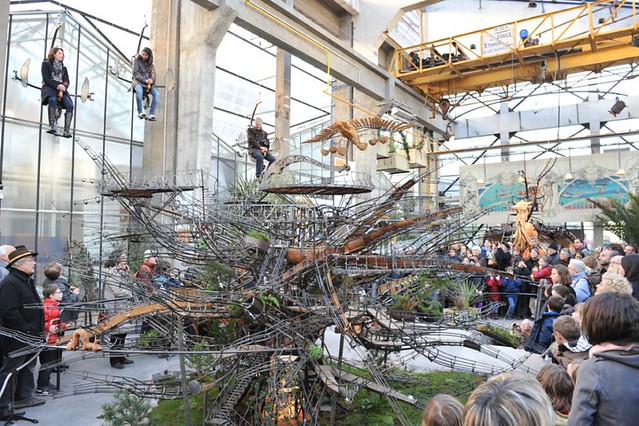
Maquette de l'Arbre aux Hérons.. Photo: Jean-Dominique Billaud
The inspiring real life version of Jules Verne's Twenty Thousand Leagues Under The Sea has captured the imagination of travelers and locals alike, but it's the city's commitment to a healthy living environment and social equity that has turned heads among policy makers across Europe. While the creative instinct that informs the Urban Community of Nantes' (Nantes Métropole) thinking no doubt has served as the foundation for the city's development, it is Nantes' strong commitment to sustainability - from strong citizen engagement to a focus on public transit and bicycles to its climate action plan - that put it on the urban renaissance map when it was awarded the 2013 European Green Capital title.
This September 25-27 Nantes will be hosting the 10th edition of the Ecocity World Summit, the preeminent conference on rebuilding our human habitat in balance with living systems. Ecocity 2013 will bring together speakers ranging from IPCC Vice-President Jean Jouzel to Transition Network co-founder Rob Hopkins, as well as over 500 contributors from 50 countries who will be collaborating with researchers, elected officials and citizens on everything from funding mechanisms for the ecological transition to making the sustainable city spectacular. On the latter, I've been invited to talk about how my hometown San Francisco has used its residents' creativity to turn car-dominated streets into vibrant cultural corridors.
More on that in a minute, but first, let me explain why cities play such a pivotal role in the long-term well being of our beautiful planet.
The largest things that humans build
The numbers tell the story: A hundred years ago, two out of every ten people lived in an urban area. Today, it's more than half the world's population, and by 2050, 70% of all people on the planet are expected to live in cities. According to UN-Habitat, cities are responsible for emitting 70% of the world's greenhouse gases while occupying only 2% of the planet's land cover. With atmospheric levels of carbon dioxide surpassing 400 parts per million this year for the first time since the Pliocene epoch three million years ago - causing climate chaos that is already wreaking havoc from the Arctic to Thailand to New York City - it's obvious these extremely concentrated human settlements are a huge part of the problem.
The good news is that cities are also big pieces of the puzzle in the search for solutions. If 70% of global emissions come from urban areas, it's clear that lowering the carbon footprint of cities presents the most consequential chance at global emissions reductions. Joan Clos, executive director of UN-Habitat and a keynote speaker at Ecocity 2013, says that local governments can play a vital role in the global effort to curb emissions, even when their national governments do not accept or acknowledge the challenges.
For Richard Register, the visionary artist who first coined the term "ecocity" in the 1970s and launched the conference series in 1990, ecological city design offers one of the few silver bullets in addressing climate change. After all, an urban organism that enables easy access by foot or bike, utilizes passive solar design in buildings, and integrates local organic agriculture not only reduces the demand for energy in the first place but builds the resilient communities needed to adapt to the environmental changes already set in motion by rising CO2 levels. "Cities are the largest systems that humans build," Register reminds us. "We can build them to contribute to humanity's creative and compassionate evolution on a healthy planet, in exciting and rewarding built communities from the village scale to the city scale."
This begs the question: If the solution is right in front of us and a redesign of our urban spaces would significantly reduce global greenhouse gas emissions, why haven't we been able to do it on a large enough scale? Why, for example, is the number of cars in the world projected to triple to 2.5 billion by 2050 - a carbon emissions increase of 250 percent - when we could use all the materials and resources it takes to manufacture and fuel these cars to build cities where people don't need them in the first place?
The answers, of course, are complex and vary from place to place. In western countries, where most people have become accustomed to an ecological footprint that would require several planets to sustain, change is often associated with giving up comfort, even if that comfort means being stuck in traffic every day or eating unhealthy, mass-produced food. In emerging economies like China and India, where most of the growth in consumer goods and energy use is projected to take place over the next few decades, the allure of the fossil-fueled lifestyle and its perceived comfort is driving unsustainable development. "Who wants to ride a bike when you can drive a car?" may be the sentiment that best encapsulates both existing and aspiring convenience cultures.
Thus, one of the pivotal challenges in fundamentally redesigning urban infrastructure in alignment with the earth's carrying capacity is to inspire a widespread "Who wants to drive a car when you can ride a bike?"
Opening minds and building ecocity culture
There are a lot of smart people who have presented compelling cases for why we need to take action. Scientists have shown us the irrefutable evidence. Economists tell us the bubble is going to burst. The United Nations is wholeheartedly committed to sustainable development. No doubt, most people around the world are aware that we are collectively on the wrong path. And yet, too often the way our environmental predicament is presented to us is like that of a child who has done something wrong, so when asked to make changes in our lifestyles or built environments we get resentful because we perceive it as a sacrifice. We have locked ourselves into a mental zero sum position, where a gain for the planet is tallied as a personal loss. "I have to give up my two-car garage because it's killing the polar bears!" The best we can hope for in this paradigm is for those concerned about "The Environment" to make things a little less bad for our grandchildren.
But what if doing the right thing for the planet were also the right thing for us personally? What if redesigning our cities on a human scale were an uplifting activity instead of a nagging obligation? What if ecocity living were simply part of our cultural DNA?
This is where creativity comes into play. In Nantes, urban planners realized that desirable physical conditions like clean air or water don't happen in a vacuum but are connected to healthy human interactions. Having a melange of supernatural sea creatures populating your streets isn't just a gimmick to attract tourists but a great reason for people to slow down, become aware of their surroundings, and engage with fellow citizens. It's a reminder that life isn't just about getting from Point A to Point B as quickly as possible but about being present for the magical moments in between. A citizenry that derives meaning from soulful experience is not only more likely to forgo the fossil-fueled materialism that pollutes air and water but to experiment with changes to their physical environment.
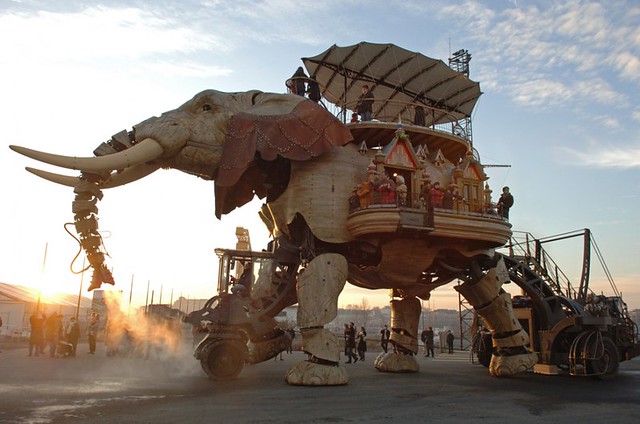
Le Grand Éléphant. Photo: Jean-Dominique Billaud
If you're going to San Francisco
This power of creative experimentation in shifting common perception has been on full display In San Francisco. Like any other major American city, the default position among most stakeholders used to be that streets could not be "successful" without cars. Merchants used to scoff at the idea of giving up a parking space as "bad for business," and residents could not imagine how to take care of their daily needs without driving door-to-door to their various destinations. It all changed in 2005, when a group of local artists converted a single metered parking space into a temporary public park in downtown San Francisco, until the parking meter expired after two hours. Once people saw how much more you could do with a parking space than fill it up with 4000 pounds of plastic and steel, the idea quickly caught fire.
In cities across the world, the movement evolved into an annual PARK(ing) Day, where individuals and groups transform their drab pavement into beautiful imaginative "parklets" for people to hang out and play. In San Francisco, people liked the parklets so much that they started wondering why they couldn't have them all the time. Merchants realized how much better it was for their business to have dozens of people "parked" in front of their businesses than just a single vehicle. So the city responded with a Parklet Program that allows merchants, community organizations and individuals to convert car spaces into beautiful people spaces of their own design.
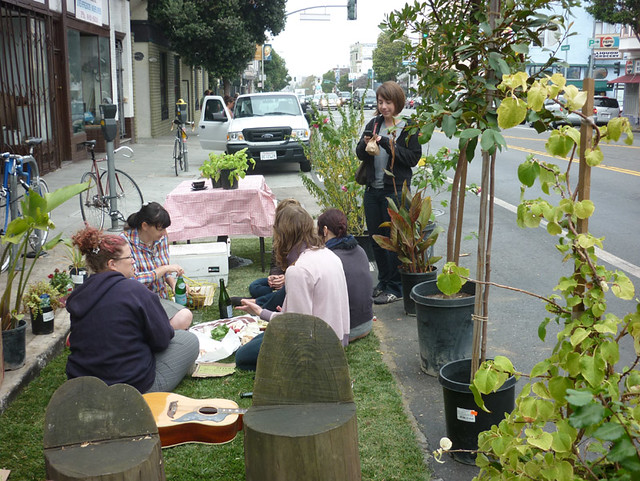
A temporary (park)ing space in San Francisco. Photo: Sven Eberlein
Parklets are just one small part of San Francisco's growing street theater. Whether it's a game of street Jenga, a ballet flash mob, or a bicycle rickshaw band at the hugely popular car-free Sunday Streets events, or off-the-ground dances and window meditations in unexpected places, the power of creative expression has fostered a culture that cherishes human connection and embraces new ideas. It's a culture that chooses to take the long way home because of the things you might see and the people you might meet along the way. A culture that likes to share things because of what we might learn from each other. A culture whose idea of expansion is generosity. An ecocity culture.
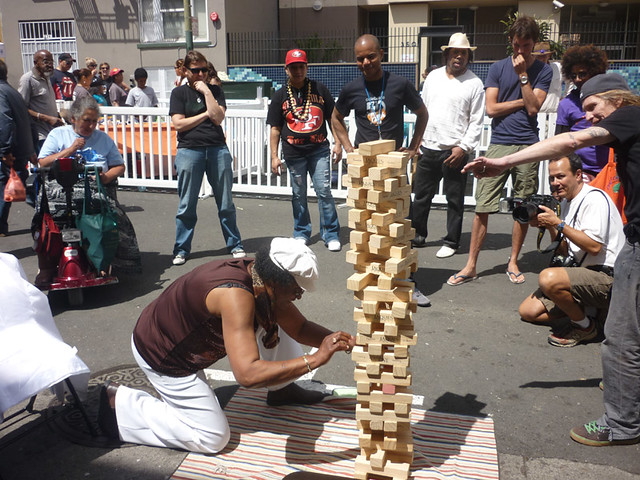
Playing "Street Jenga" at Sunday Streets. Photo: Sven Eberlein
This September at Ecocity 2013, some of the greatest minds in the world will gather to come up with solutions to the most complex problems humanity has ever faced. European Commissioners will announce a number of policy priorities for sustainable cities. The United Nations Environment Programme (UNEP) will present a new global environmental governance. The World Mayors Summit will formulate the sustainable city road map in preparation for the next UNFCCC climate negotiation (COP 19) in Warsaw, Poland.
Through it all, it is my hope that whenever these thinkers get weighed down by heavy bureaucracy and thick policy talk, they will remember the nearby island where wondrous creatures make the impossible possible. As Richard Register, the man who has been envisioning ecocities for nearly 40 years, told me recently, "If you try to figure out what it means to evolve into a more fulfilling human future, individually, as a society, and as a species, the best I know how to do that is through compassion and creativity."
o~O~o~O~o~O~o~O~o~O~o~O~o~O~o~O~o~O~o
Originally posted at Matador Network.
|
ECOCITY WORLD SUMMIT SIDE EVENTS

Feeding the 5000
Tristram Stuart and Disco Soupe
The Giant Meal will be held on 25 September 2013, from 18.00 to 22.00.
http://www.ecocity-2013.com/en/feeding-5000
_______________________________________________________________________
LEGO - "BUILD THE CHANGE"
A sponsor of ECOCITY, LEGO will bring 1 million Lego blocks for children to build their sustainable city during 5 days. From schools and high schools to leisure centres and families, 3,500 to 4,000 children will take part in this gigantic construction work. Location: The Nefs - "Galerie des Machines" www.ecocity-2013.com/en/lego-build-change
 ________________________________________________________________ ADEME French-US workshop of exchanges on sustainable cities25 SEPTEMBER 2 - 5PM - Cité des Congrès http://www.ecocity-2013.com/en/workshops-ademe ________________________________________________________________ Ecocity-Ecocitizen: Citizens as Catalysts for SustainabilityDate: 27 SEPTEMBER 11 - 12:30 http://www.ecocity-2013.com/en/ecocity-builders-1 Location: Le Lieu Unique, 2, rue de la biscuiterie
http://www.lelieuunique.com/ Presented by: Ecocity Builders and Partners
Lead Sponsor: British Columbia Institute of Technology, School of Construction and the Environment Format: Interactive workshop combined with short presentations Featuring: Dasho (Dr.) Sonam Tenzin, Secretary for the Ministry of Works & Human Settlement - Bhutan Dasho Secretary Dr Sonam Tenzin is administrative head of highways, dams, power plants, airports and cities in Bhutan and is in an unequaled position to promote ecocity development in his country. he is also a medical doctor, champion of traditional building, as well as the country's Gross National Happiness Initiative.
Richard Register, Founder of the International Ecocity Conference Series/Ecocity World Summit, President, Ecocity Builders, author of "Ecocities", "Ecocity Berkeley", "World Rescue, An Economics Built on What We Build" Ecocity theoretician, author, hands-on and policy project instigator, international lecturer and consultant, Richard Register is considered to be the pioneer of the ecocity movement. His book, "Ecocities - Rebuilding Cities in Balance with Nature," is course material in design, planning and architecture schools. 
Dr. Jennie Moore, Director of Sustainable Development and Environmental Stewardship, British Columbia Institute of Technology, Vancouver, Canada Dr. Moore develops and implements sustainability as a core value at the Institute. She identified and developed initiatives to position the School of Construction and the Environment as a leader in sustainability education, including new curricula and revision to existing curricula. She is a Core Advisor to the development of the International Ecocity Framework and Standards, an index currently in development to help cities assess and make progress toward ever higher ecocity achievement. Shannon McElvaney, Global Industry Manger, Community Development, ESRI As Global Industry Manger for Community Development at ESRI, Shannon is responsible for the development and marketing of tools, processes, and techniques that will enable people to design and build livable, sustainable, healthy communities. He has over 20 years of experience in applying a broad range of geospatial technologies including remote sensing, GIS data collection, spatial analysis, and systems integration to support wise decision making with particular emphasis on conservation and sustainable development. Shannon is former Project Manager of the Site Control & GIS section on the $22B MASDAR City Development Program, the first carbon neutral, zero waste city for the Abu Dhabi Future Energy Company (2008-2009)  Anthony Flint, Fellow and Director of Public Affairs, Lincoln Institute of Land Policy Anthony Flint, Fellow and Director of Public Affairs, Lincoln Institute of Land Policy
Anthony Flint is a Fellow and Director of Public Affairs at the Lincoln Institute of Land Policy, a think-tank based in Cambridge, Mass., where he is engaged in writing and research about urbanism and development patterns. He is author of Wrestling with Moses: How Jane Jacobs Took On New York's Master Builder and Transformed the American City (Random House, 2009). He was a visiting scholar at Harvard Design School while writing This Land: The Battle Over Sprawl and the Future of America (Johns Hopkins University Press, 2006) and co-editor of Smart Growth Policies: An Evaluation of Programs and Outcomes (Lincoln Institute, 2009). He has been a journalist for twenty years, primarily at The Boston Globe, where he covered urban planning, development, architecture and transportation, had a weekly column on urban design and public space, was a policy advisor on smart growth for Massachusetts state government, and was a visiting scholar and Loeb Fellow at Harvard University's Graduate School of Design. Facilitator/Moderator:  Kirstin Miller, Executive Director, Ecocity Builders
Kirstin leads NPO Ecocity Builders' program development, global initiatives and activities. She works internationally to establish access to ecocity knowledge, integrating experiences from a diverse range of perspectives. She helps link separate knowledge pools through joint research, consulting services, and partnerships, develops mutual understanding of ecocity goals, and helps implement knowledge in new settings, including coordinating joint partnerships, projects and work plans. Kirstin is an international speaker and presenter on ecocity design, technology, development and citizen participation.
|
|
Ecocity Updates
News, events and announcements
________________________________________
September 11-12 2013
International Green Island Forum, Jeju, Korea
 Ecocity Builders' President Richard Register will provide the keynote address to the International Green Island Forum (IGIF), September 11 ~12, 2013 in Jeju, Korea. Strategies that will be explored at the forum include renewable island energy, energy efficiency, smartgrids, resource recycling, and the combined use of ecocity design and elevated fill for security from storms, tsunamis and rising seas. Ecocity Builders' President Richard Register will provide the keynote address to the International Green Island Forum (IGIF), September 11 ~12, 2013 in Jeju, Korea. Strategies that will be explored at the forum include renewable island energy, energy efficiency, smartgrids, resource recycling, and the combined use of ecocity design and elevated fill for security from storms, tsunamis and rising seas.
________________________________________
September 25-27 2013
Ecocity World Summit, also known as the International Ecocity Conference, was the first and the now longest running conference for ecological city design, development and functioning.
For over twenty years we have been the vanguard conference on urban problems and solutions in relation to climate change, renewable energy, bicycle and transit infrastructure, environmentally healthy architecture and city design. We are also leaders in issues of democratic participation in the decision making that plans and develops cities, changes them for the better, and confronts the difficult issues of our time in terms of how we live in our built communities.
Past International Ecocity Conferences
________________________________________
October 4-5, 2013
Building a Sustainable Logistics System for El Salvador
San Salvador, El Salvador
Ecocity Builders' Executive Director Kirstin Miller will join a meeting to launch the design of a Sustainable Logistics System for El Salvador organized by the Technical Secretariat of the Presidency and the Ministry of Environment and Natural Resources of El Salvador and the Basel Convention Regional Center for Central America and Mexico.
________________________________________
November 17, 2013
Ecocity Builders teams up with Absinthe Films
Berkeley, California :: California Theater
http://www.absinthe-films.com/film-tour/usa

Absinthe Films Full Spectrum Snowboarding brings its 2013 North American Premier Tour to Berkeley's California Theater. Absinthe will donate part of their proceeds to Ecocity Builders in appreciation for our work to raise awareness about the causes of and solutions to global climate change.
________________________________________
|
|
EARTH OVERSHOOT DAY
By Jeff Stein, Board Member, Ecocity Builders; President, Cosanti Foundation

August 20 marked "Earth Overshoot Day" 2013. This day has occurred each year since the 1970's, a day on the calendar when "our resource consumption for the year exceeds Earth's ability to replenish those resources." We have computers; we can calculate this.
Around Arcosanti when we talk about consumption and the existing culture that was designed to induce it, we point to a lean model for remedying it that we are trying to create with this project. The argument is about creating a global equity and how we can design it by shrinking our urban - and thus our ecological - footprint, as in: "Look, here in the US 5% of the world's population consumes 20% of Earth's resources. If we expect the whole world to live equitably at that same frenetic level of consumption, we will need 4 earths to support us." It's a useful image that utilizes third grade math to make a point about the future.
There are difficulties. First, we won't be gifted with four Earth's to support us anytime soon. And beyond that, how many Americans want to alter our high-consumption lifestyles? At Arcosanti we are actively working toward a lean alternative, and we are very much the exception.
And so we see wars for scarce resources, read about global economic collapse, the 1% vs 99%, and of 47 million Americans on food stamps, more than a billion people worldwide living in urban squatters' settlements, more than two billion lacking access to the resources required to meet their basic needs.
The four Earths image is about the future, which as Paolo Soleri liked to point out, never really does exist. You can plan for a future, work toward it, but it cannot be predicted, and besides, whatever happens, the future will be some other generation's present, not ours. So far that's the response globally.
This brings us to our present and the annual Earth Overshoot. For a few years now the Global Footprint Network along with the New EconomicsFoundation, has been marking Earth Overshoot Day. As of August 20, "humanity has exhausted nature's budget for the year and is now operating in overdraft," say spokespersons for these organizations. Global Footprint Network tracks humanity's demand on the planet's ecological resources (such as food provisions, raw materials and carbon dioxide absorption) - its Ecological Footprint - against nature's ability to replenish those resources and absorb waste. Global Footprint Network's data show that, in less than eight months, we have used as much nature as our planet can regenerate this entire year.
The rest of the year corresponds to "overshoot." Through this fall and winter we will keep-up an ecological deficit by continuing to deplete stocks of fish, trees and other resources, and accumulate waste such as carbon dioxide in the atmosphere and oceans. As the Global Footprint Network puts it, "As our level of consumption, or resource budget, grows, the interest we are paying on this mounting ecological debt - shrinking forests, biodiversity loss, fisheries collapse, food shortages, degraded land productivity and the build-up of carbon dioxide in our atmosphere and oceans - not only burdens the environment but also undermines our economies. Climate change - a result of greenhouse gases being emitted faster than they can be absorbed by forests and oceans - is the most widespread impact of ecological overspending."
We cannot pretend to produce "qualitative easing" to replicate the resources of the Earth. Resources - life support - provided by the Earth are neither expendable nor made of paper. This deficit cannot be "written off" or hidden.
So here we are. We are not looking toward some future Earth overshoot; we are in the midst of it; not looking ahead to the largest species die-off in earth's history; we are in the midst of it. By not preparing for global warming and the changes it brings to land and water and patterns of inhabitation, we are adrift and in the midst of them.
We might be able to design our way out of some of this. Paolo Soleri's message on a hand-lettered sign at his Corcoran Museum ARCOLOGY exhibition in 1970 still holds true: "If you are truly concerned about the problems of pollution, waste, energy depletion, land, water, air and biological conservation, poverty, segregation, intolerance, population containment, fear and disillusionment," the poster began, "Join us." Please do join us by building at Arcosanti, thinking clearly about the issues in your own community, helping your neighbors alter an American Dream that no longer quite works for the world.
Arcosanti is an experimental town in the desert of Arizona, built to embody Paolo Soleri's concept of arcology - the fusion of architecture with ecology. www.arcosanti.org
 Jeff Stein is former Dean of Architecture at the Boston Architecture College and before that a professor at Wentworth Institute of Technology. He also taught at Technicum Winterthur, Zurich, and Ecole d'Architecture Languedoc-Rousillon, Montpellier, France. Mr. Stein is currently President of the Cosanti Foundation, building Arcosanti, Arizona, and keeper of Paolo Soleri's architectural and philosophical legacy. Jeff lives and works at Arcosanti. Jeff Stein is former Dean of Architecture at the Boston Architecture College and before that a professor at Wentworth Institute of Technology. He also taught at Technicum Winterthur, Zurich, and Ecole d'Architecture Languedoc-Rousillon, Montpellier, France. Mr. Stein is currently President of the Cosanti Foundation, building Arcosanti, Arizona, and keeper of Paolo Soleri's architectural and philosophical legacy. Jeff lives and works at Arcosanti.
|


Founded in 1992, Ecocity Builders is a nonprofit organization dedicated to reshaping cities for the long-term health of human and natural systems.
www.ecocitybuilders.org
|
|
|
|
|
PRINCIPAL SPONSOR OF THE INTERNATIONAL ECOCITY FRAMEWORK AND STANDARDS
|
|
|
|
|



