|
Ecocities Emerging
To support humanity's transition into the Ecozoic Era
|
Ecocity Builders
May 2013
| |
|
Greetings,We are recently back from a Board retreat at Arcosanti, Arizona - architect/philosopher Paolo Soleri's experimental town that began construction in 1970 in central Arizona, 70 miles north of Phoenix in the high desert. Soleri passed away last month at the age of 93 and a memorial is being planned for later in the fall to commemorate his extraordinary life. We had the opportunity while there to visit the Soleri archives, a treasure trove of drawings and sketches going all the way back to Soleri's early childhood. We also got to watch a director's rough cut of a new documentary on Soleri's life, and some of us rose at dawn one morning for a trek into the desert to hunt for petroglyphs amidst the canyon wall cactuses before our morning meetings: a great team building experience! Our sincere thanks to Board member Jeff Stein, also Board President of the Cosanti Foundation, and to Arcosanti, for hosting us.
In addition to routine Board topics and duties, we spent time evaluating the organization's short and long term goals and strategies for leveraging impact in a time of rising awareness and concern around issues of cities and the environment. We reviewed our early history of local activism and demonstration projects and the trend over past five years of moving towards greater involvement in international urban campaigns and initiatives as the demand for our services and expertise spreads. As the ecocity movement goes mainstream, we considered how Ecocity Builders can become ever more effective and inspire positive actions by cities and citizens moving towards ecocities.
Our goal is to move towards a business model that helps sustain both the "think tank" side of the organization as well as the program and services side through the development of the Ecocity Standards initiative and related planning and assessment tools and services, the Ecocity World Summit/International Ecocity Conference Series, and our consulting, speaking, writing and workshops. We will be launching a new program, Ecocity CoLab, to help advance our educational mission and build awareness through professional collaboration and project development. Our founding partners will include British Columbia Institute of Technology/School of Construction and the Environment, CONSENSUS Institute and Walter Hood/UC Berkeley. Under the CoLab project, we hope to expand our current office space into an adjoining suite in downtown Oakland to create more opportunities for co-working and collaboration, training, mentoring and support for ecocity related projects and initiatives, locally, nationally and internationally.
And last but not least! Ecocity World Summit 2013 is now open for early bird registration. We will be convening in beautiful Nantes, France, September 25-27th with an expected 2,000 delegates from around the world. Please see more information and links in this edition of Ecocities Emerging. And don't forget to renew your membership to Ecocity Builders -- among other benefits, you receive a substantial nonprofit discount to the conference.
With warm regards,

Kirstin Miller
Executive, Director

Keeper of the International Ecocity Conference Series
Ecocity Builders is a non-profit organization dedicated to reshaping cities, towns and villages for long-term health of human and natural systems. Ecocity Builders 339 15th Street, Suite 208 Oakland CA 94612 USA www.ecocitybuilders.org www.ecocitystandards.org
 Thank you to our major supporters: British Columbia Institute of Technology - School of Construction and the Environment; Helen and William Mazer Foundation; Novatek; The California Endowment and our patron members and long time supports. Your on-going support is crucial for helping to build the healthy city of the future.
|
|
|
Ecocity Updates
News, events and announcements
 | | Thimphu, Bhutan |
Mid May to Early June
Richard Register will be in Bhutan advising the government on strategy for developing a new ecocity that ties to Bhutan's cultural identity and priorities for placing people and their happiness over profit and consumerism.
Bhutan is a small landlocked country located in South Asia and shares borders with India to the south, east and west and China to the north. Bhutan is the only Vajrayana Buddhist nation in the world, its principles exerting a strong influence on all aspects of life. Considering the primary environment and harmonious society, the little kingdom of Bhutan has been called the "Last Shangrila".
July 7-9, 2013
INTERSOLAR NORTH AMERICA - San Fracisco
Ecocity Builders is teaming up with Intersolar to design the "Green City" session at this year's Intersolar North America Conference. Executive Director Kirstin Miller will present on "Ecocity Standards and Green Cities".
September 25-27 2013
Ecocity World Summit, also known as the International Ecocity Conference, was the first and the now longest running conference for ecological city design, development and functioning.
For over twenty years we have been the vanguard conference on urban problems and solutions in relation to climate change, renewable energy, bicycle and transit infrastructure, environmentally healthy architecture and city design. We are also leaders in issues of democratic participation in the decision making that plans and develops cities, changes them for the better, and confronts the difficult issues of our time in terms of how we live in our built communities.
Past International Ecocity Conferences
|
 ECOCITY INSIGHTS
by Jennie Moore, Director, Sustainable Development and Environmental Stewardship, British Columbia Institute of Technology
Community Capacity Building
The International Ecocity Framework and Standards ( IEFS) identifies "community capacity building" as an important socio-cultural feature and one of 15 ecocity conditions. Specifically, the IEFS notes that a city that builds community capacity is one that "supports full and equitable community participation in decision making processes and provides the legal, physical and organizational support for neighborhoods, community organizations, institutions and agencies to enhance their capacities." Capacity in this context refers to the actual or potential ability to act. Action in an ecocity is informed by ethics, not only an environmental ethic, but an ethic of care as well. A society's caring capacity is arguably the cornerstone of sustainability. Morality expressed as an ethic of care towards each other in the form of social justice and toward the planet in the form of environmental stewardship is the hallmarks of a sustainable society. In a study contrasting the effectiveness of regional governments in northern and southern Italy, Robert Putnam et al. (1993) found that societies that care for each other also achieve fuller participation in decision-making processes. He qualifies caring societies as having a high degree of social capital. This is a fancy term for good social relations, predicated on familiarity, trust and reciprocity, integrity and accountability. Mark Roseland (2012) sees social capital as an important feature of "community capital," and he is developing tools to help cities measure it. Mike Carr (2004) sees social capital as contributing to both bioregionalism and civil society. Building community capacity, therefore, can be seen as an important starting point not only for building ecocities, but also for transitioning to the Ecozoic era. References: Carr, Mike. 2004. Bioregionalism and Civil Society: Democratic Challenges to Corporate Globalism. Vancouver BC: University of British Columbia Press. Putnam, Robert, Robert Leonardi, Raeffaell Nanetti. 1993. Making Democracy Work: Civic Traditions in Modern Italy. Princeton NJ: Princeton University Press. Roseland, Mark, ed. 2012. Towards Sustainable Communities: Resources for Citizens and their Governments. Gabriola Island BC: New Society Publishers. British Columbia Institute of Technology School of Construction and the Environment is Lead Sponsor of the International Ecocity Framework and Standards Initiative 
|
ECOCITY BUILDERS' BOARD RETREAT
April 27-29th
 | |
Jeff Stein, Kirstin Miller and Tong Yen Ho visiting the Soleri archives.
|
 | Gray water treatment pond.
|
 | | Walking through the Vaults - from left - Tong Yen Ho, Steven Bercu, Jeff Stein and Kirstin Miller. |
 | Board members Rick Pruetz, Richard Register, Steven Bercu, Jeff Stein and Tong Yen Ho (not pictured - Carla Ricchetti and Silvia McLaughlin)
|
|

World Rescue - An Economics Built on What We Build
World Rescue - An Economics Built on What We Build by Richard Register is about the role of ecocities in economics. The author's quest in this book has been to clarify the connection between nature's economy and society's.
Highlights:
How to get the Editor's Cut copy:
- Order online via Paypal and major credit cards
- Choose PDF email attachment or CD, 425 pages, 17 inspiring pictures for $20.
- CD has 28 higher resolution images and will be sent to your postal address, so $20 +shipping.
- If you pay by check here's our address: 339 15th Street, Suite 208, Oakland, California 94612, USA. Make sure to include your email address of the address of the recipient, if someone other than yourself.
|
|
Car Free Journey
By Steve Atlas

As summer approaches, we look for getaways outside of major cities that are easy to enjoy without driving. One of the most popular vacation spots in New England is Martha's Vineyard, located near Cape Cod in Massachusetts.
Our next two columns, spotlighting Martha's Vineyard will spotlight a guest author: David Waight from Cambridge, Massachusetts. Dave, who has become a personal friend, is a retired travel agent and creator of the website http://www.pubtrantravel.com. (By the way, you can view past issues of Car Free Journey, and other of my car-free articles and e-books on the top right side of the homepage on this website.) If you are serious about vacationing without a car, this website is a place you should visit frequently.
Dave visits Martha's Vineyard frequently. I want to thank Dave, on behalf of myself and all of you, for taking the time to show us how we can enjoy a visit here without needing to drive. Part 1 is in this issue. Part 2 will be in the June issue of Ecocities Emerging.
Martha's Vineyard Island: Part 1 -by David Waight
Had enough of Winter? - Ready for a getaway?
Martha's Vineyard Island may just be the perfect end of the winter getaway. A popular summer resort, famous for its many beaches, it is also a good choice in the Spring and Fall before the crowds arrive or after they leave.Most importantly, visiting Martha's Vineyard doesn't require driving.
The Martha's Vineyard Transit Authority (VTA) offers bus service to most of the island. A comprehensive network of bike trails and numerous bike rental shops offer another car-free way to enjoy your visit.
READ ON
 | | Martha's Vineyard |
|


Founded in 1992, Ecocity Builders is a nonprofit organization dedicated to reshaping cities for the long-term health of human and natural systems.
www.ecocitybuilders.org
|
|
 | |
Ecocity World Summit 2013
September 25-27
|
Ecocity World Summit
is the international forum... - for innovators and pioneers, designers and planners, policy makers and administrators, professionals and business people, environmentalists and developers, teachers and students;
- of sustainable cities, towns and villages of the future;
- from theory to the application of all things related to the ecological city
More exciting developments on the 2013 Ecocity Summit! After culling from over 500 proposals from 48 different countries, the Summit organizers have unveiled their final program selections. September 25-27 will be packed with 100 diverse, thought provoking and enlightening lectures, workshops and presentations. A bit about the Ecocity Summit Program: The program organizers have used a novel grouping system to select the presenters and organize the program information. Firstly, each presentation or workshop at the summit addresses one or more of the five main themes: - Reducing the environmental footprint - Addressing energy challenges of the city - Organizing and systems - Strengthening solidarity and participation - Mobilizing enabling factors Presentations are further grouped under approach categories, including thinking, shaping, financing and governing. A matrix of all the planned programs enables you to searching for theme or approach so you can easily find the programs and themes you are most interested in. You can also view a tentative scheduling of the programs here: Pre-program schedule.Early registration is now underway for the Summit Conference and there are numerous benefits to signing up early. Visit the Ecocity Summit website to register now!
Members of Ecocity Builders receive the special nonprofit rate - you will need to get a proof of up-to-date membership to present when you arrive at the conference.
Update your membership: |
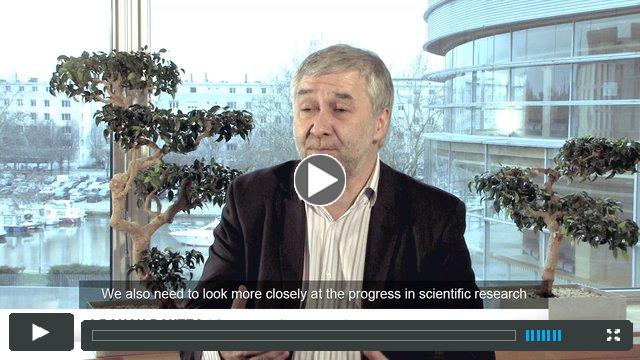 | |
SENATOR RONAN DANTEC, CHAIR, ECOCITY WORLD SUMMIT 2013 STRATEGIC COMMITTEE
|
|
|
Is your city interested in hosting the next Ecocity World Summit?
We now invite expressions of interest from cities and organizations wishing to bid for hosting the next International Ecocity Conference after the event planned for Nantes, France, September 25 through 27, 2013.
We seek conference hosts who agree that we need both bottom up and top down approaches to solving our urban and environmental problems and that the same applies to approaches for the content of the conferences, that the particulars down to the personal and local level effect the global, climate and biosphere level and vice versa, good policy working its way down to the benefit of everyone at the "grass roots" as well. We have been, from the first conference on to the present, a conference series with a very international, multi-cultural and social justice oriented set of events. We have held conferences on all continents except Antarctica. To receive an information packet on how to apply to host the next Ecocity World Summit, please email Conference Correspondent Richard Register, ecocity@igc.org and cc Ecocity Builders' Executive Director Kirstin Miller, kirstin@ecocitybuilders.org  | | Ecocity World Summit Montreal 2011 Exhibition Hall |
 | | Finale, 8th Ecocity World Summit, Istanbul, Turkey, 2009 |
 | Richard Register presents Jaimie Lerner with special recognition, Ecocity World Summit 2008, San Francisco, California
|
|
Co-evolution of our Bodies, Brains and both natural and constructed Environments
Deeper meaning to "As we build, so shall we live"
 By Richard Register, President, Ecocity Builders By Richard Register, President, Ecocity Builders We are all in it together: we, our fellow travelers on this circling planet, the plants and animals, the very minerals and laws of nature in a constant dance of emergence and entropy, sometimes called evolution. "As we build so shall we live" has been something of a mantra, slogan, directive, even philosophy for me over many long years. I've taken it to mean something rather simple, obvious, but, I've thought, profoundly important and worth thinking about quite seriously.
The notion is that we shape our constructed environment, and once we do, it locks us by influence and sometimes by force into actions and whole lifestyles that may produce results from wonderfully friendly to awesomely destructive. In our circles many of us see ecologically healthy cities as pretty wonderful, should we ever decide to build them, and the present city designed around cars and cheap energy to be more than a little damaging. We should build the ecocity choice for helping make us as full of life and appreciation of it as possible.
A little more subtly, beyond being either liberated to enjoy nature close in to our happily functioning life sciences-aware cities, towns and villages and beyond benefiting from a healthy environment and a creative, compassionate culture, our cities can deliver the awareness of a very friendly message: Those who designed, built and maintain the cities we live in did their work with love of us the beneficiaries as well as for their own money and hoped-for security. Or not! In serious commitment to the future such as in building our long-lasting urban infrastructure, we have the opportunity to do it very rightly or wrongly. Or we might mush along somewhere in the middle. Imagine a city designed for cars - do we love them, that is the cars, more than each other? Imagine a city of brazen neon lights flashing, "buy, buy, buy" with no view to hills, water or even stars above in the nighttime haze and glare - do we love the things we can buy more than the gift of life itself and the glory of the heavens? Imagine the city to screw up our climate system and drive species around the globe into extinction while burning up the complex organic chemicals - fossil "fuels" - stored in Earth's crust instead of carefully marshalling such gifts of past life for the highest uses we can sit down and think of - do we love ever faster, always "more" and impulsive "freedom" more than security and beauty for our children and the offspring of our fellow different species on our home planet, more than at least trying our hand at wisdom rather than whim? I enjoy studying evolution, trying to learn where we all come from, maybe the better to understand how to get better into the future at whatever seems to make us, as a Yogi I once met called it, healthy, happy, holy. In my usage the "holy" means things done in "reverence for life," as Christian theologian and humanitarian Albert Schweitzer might also interpret. In my study, among the most insightful books were two: Animal Architects - building and the evolution of intelligence by James L. Gould and Carol Grant Gould and A Brain for all Seasons - human evolution & abrupt climate change by William H. Calvin.
Brain and building
Gould and Gould trace the growing and ever more complexifying awareness of living entities from the single celled critters all the way through to us. That's we who dream, plan and build, consider ourselves to be aware with ever so deep memories, emotions and profound layers of logic and theory, able to experience and appreciate the agony and the ecstasy, the longing for love and desire for life everlasting that we think characterizes our kind of... whatever sort of electro/chemical percolating seems to be pulsing through us, most concentrated in nerve fibers and brains. Is that "us" in there, in the mind, the soul, the total wholeness (from the same Greek root holos, for "holy") of the matter and energy we seem to be physically in the product of our parents' DNA, in the processes of growing and changing, of fully living, of being and doing in awareness, at least partial, whatever awareness really is?
 | | Masked Weaver |
Their conclusion is that the very act of building - tools as well as habitations like nests, hives and buildings - has a powerful effect on our own total evolution. So does simply exploring natural surroundings, though much of those surroundings are themselves changing over time while being effected by lots of whoever we are and whoever the other living actors on Earth's stage are. In the case of you and I that's us humans in our stunningly large numbers, affecting everything else in our environment much more than, say, detritus nibbling millipedes or sauntering African lions. They, the Goulds, follow a sequence that I think is very helpful in developing some real understanding.
They start out with the single celled organism. There is something neurologists and practitioners of neuroscience - people who study nerves and the signals that move through them - call Stimulus-Response or S-R reactions. Some string of molecules inside the organism or connecting to the cell wall, by the slow development of genetics producing variations in DNA, happen to be such that a slight electric and chemical change indicates some sort of change in the cell for good or ill, meaning for health or harm of the living cell. This becomes the earliest form of something like nerve tissue. As it actually does evolve into nerve tissue and retains some changes caused by the passage of the "signal," something like the ghosts of early memory start to form. Of course the string of molecules or nerve tissue also connects with something that helps the cell in some way too, such as connecting with a contracting tissue - think muscle - such that a beneficial squeeze happens and, for example, the cell moves in an advantageous direction, toward food, say, or away from danger. All this is so painfully tiny in action, one would think such evolutionary progress would be next to meaningless. But the meaning, sure enough, does come when the staggering number of years involved sifts for changes to enrich the external and internal environments with ever growing complexity.
READ ON |
What's the matter with "The Google Bus?"by Sven Eberlein
Yesterday I went to a panel discussion entitled A Story of Shuttles at SPUR, the San Francisco Planning and Urban Research Association. For those of you not living in SF (and the Bay Area), what's come to be known as " The Google Bus" is a whole fleet of privately run corporate limousine buses that are shuttling employees in the tech industry from hundreds of pick-up places near their homes in SF to their workplaces in Silicon Valley. The premise, according to company representatives at the panel, is that their predominantly young, under 35 workforce is "nauseated by the suburbs" and would rather commute up to 80 miles round trip to San Francisco every day than live near their workplace, and so the companies' job is to make that trip as comfortable as possible, to attract and retain their workforce. According to the SFMTA, there are now almost 40 companies running these shuttles with over two hundred stops across the city. Google alone runs over 100 buses and 380 trips daily across the Bay Area, which has earned them the honor of being the poster child for the luxury liner phenomenon. However, the trend was first started about 7 years ago by some of the more established biotech companies in South San Francisco like Genentech. It wasn't really a big deal when there were just a handful, but the last two years has seen such a rapid explosion of these behemoths into our neighborhood streets that it feels a bit like an invasive species. 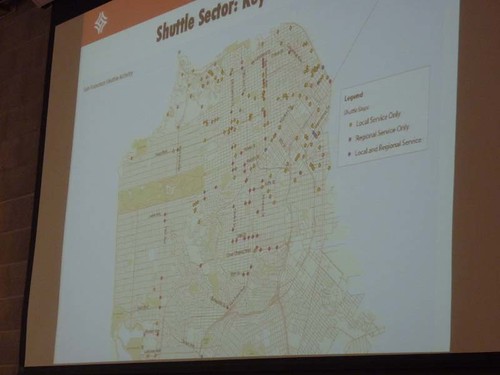
Most of these buses are anonymous entities that often make everything and everyone else dwarf in comparison and clog up the streets. They load and unload in the public transit (MUNI) bus stops, and quite frequently just double-park right in an intersection.
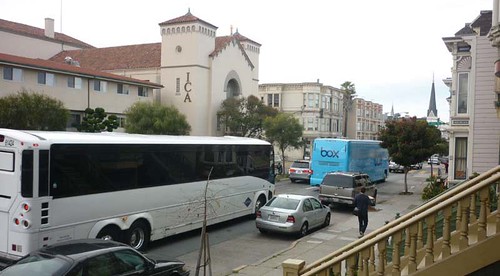 | | Two deep, about to unload "customers," cars honking and pulling dangerous maneuvers to get past. |
They are pretty much everywhere now, even on Valencia St, which has been transformed into a bicycle highway and people friendly walking corridor in recent years, but as a cyclist during rush hour you now have to contend with these guys turning on and off at random intersections. I guess this is one way to get big corporate billboards into a neighborhood that prides itself on protecting its small local merchants from chain store invasions.
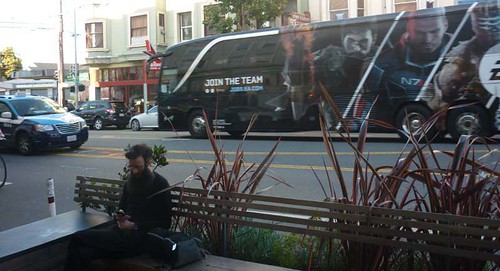 There are some much touted benefits of reducing automobile trips on Bay Area roads, and I definitely appreciate and applaud the good intentions behind these buses, but as someone who has written quite a bit about sustainable urban design, these buses, while addressing one small transportation sliver of the whole livable city ecosystem, raise a whole range of other social, cultural, economic, and environmental issues that are basically being treated as externalities by the people who are enabling the flooding of these private "yachts on wheels" deep into city neighborhoods, without much public discussion. SPUR's description of the panel had me excited because I thought it would delve into some of the broader ramifications of this transformation: Those big buses are tough to miss. As employer shuttles sprout up across the Bay Area, what do they tell us about our region, its workers and its employers? What are the benefits and challenges that accompany their increasing presence? This forum will take a closer look at how and why some employers manage worker transportation.
Alas, it did not live up to its billing, and my hope is that this letter will spark further discussion and perhaps another panel where this issue can be addressed on a more meaningful level, perhaps inspiring more integrative solutions to the unsustainable way of life we've created for ourselves.
READ ON
|
|
|
|
|
PRINCIPAL SPONSOR OF THE INTERNATIONAL ECOCITY FRAMEWORK AND STANDARDS
|
|
|
|
|



