|
Ecocities Emerging
To support humanity's transition into the Ecozoic Era
|
Ecocity Builders
April 2013
| |
|

Greetings,
This issue of Ecocities Emerging is dedicated to the memory of architect philosopher Paolo Soleri who died on April 9th. Soleri influenced a generation of designers and architects, primarily through his concept of arcology (architecture + ecology). His unwavering determination and resolve to express himself is most evidenced by his experimental city project and urban laboratory, Arcosanti. Please see the article by Richard Register in this edition of the newsletter about Soleri's influence and legacy.
We've recently returned from Paris and the second meeting of the Ecocity World Summit 2013 Program Committee. Chaired by French Senator Ronan Dantec, the conference is positioning to provide an international forum and stepping stone towards the 19th Session of the UN Framework Convention on Climate Change (COP 19) upcoming in Warsaw, Poland in November of this year. Dantec is creating momentum around a strategy to bring the voice of local government into the center of the discussions on climate change issues and solutions. With major city networks like ICLEI, Local Governments for Sustainability and the UCLG (United Cities and Local Governments) attending, along with the United Nations, business and industry, academia, institutions and financiers, Ecocity World Summit 2013 could be a turning point for how the climate change conversation unfolds globally in 2013. Nantes will shortly announce the pre-program and open registration on the conference website. The Call for Contributions was met by over 550 submissions from all over the world. As Green Capital of Europe for 2013, Nantes is going all out to make Ecocity 10 a meaningful experience for everyone who attends. Prepare to be impressed, and make sure to plan for a few extra days to explore the beautiful Brittany coast. As we build, so shall we live,
Kirstin Miller Executive Director, Ecocity Builders

Keeper of the International Ecocity Conference Series
Ecocity Builders is a non-profit organization dedicated to reshaping cities, towns and villages for long-term health of human and natural systems. Ecocity Builders 339 15th Street, Suite 208 Oakland CA 94612 USA www.ecocitybuilders.org www.ecocitystandards.org
 Thank you to our major supporters: British Columbia Institute of Technology - School of Construction and the Environment; Helen and William Mazer Foundation; Columbia Foundation; The California Endowment and our patron members and long time supports. Your on-going support is crucial for helping to build the healthy city of the future.
|
 "10th International Ecocity Conference"
|
|
|
Ecocity Updates
News, events and announcements
April 2013
Ecocity Builders' Board Meeting, Arcosanti, Arizona


Ecocity World Summit, also known as the International Ecocity Conference, was the first and the now longest running conference for ecological city design, development and functioning.
For over twenty years we have been the vanguard conference on urban problems and solutions in relation to climate change, renewable energy, bicycle and transit infrastructure, environmentally healthy architecture and city design. We are also leaders in issues of democratic participation in the decision making that plans and develops cities, changes them for the better, and confronts the difficult issues of our time in terms of how we live in our built communities.
Past International Ecocity Conferences
|
 IS SUSTAINABILITY STILL POSSIBLE?
by Jennie Moore, Director, Sustainable Development and Environmental Stewardship, British Columbia Institute of Technology
That is the title of this year's State of the World report published by Worldwatch Institute ( www.worldwatch.org). Worldwatch was founded in the 1970s by Lester Brown and has become recognized as a leading source of research on sustainability with particular emphasis given to renewable energy, access to nutritious food, a conservation rather than consumer culture, and planned parenthood to address population growth. Several of these themes map to the work of the International Ecocity Framework and Standards (IEFS), particularly with regard to energy, food, and a culture that conserves rather than squanders its resources.  Ecocities can support high quality of life with low energy and materials consumption. They are an important key in the transition to a sustainable future. However, there is evidence today that some initiatives branded as ecocities are merely co-opting the brand without delivering a sustainable built environment. In State of the World 2013, the first chapter addresses the phenomenon of "sustainababble." This term is used to describe the plethora of products and initiatives that claim to be sustainable, but in fact are only mildly greener than others. Without an accurate way to measure the merits of these products and initiatives, the term "sustainable" risks losing integrity. Therefore, it is important to pursue development of sustainability assessment tools and metrics such as the IEFS ( www.ecocitystandards.org). The IEFS will serve as an open source assessment tool to help people identify the characteristics of an ecocity and measure their own (or any other) citie's progress towards sustainability. An important ecocity condition in the IEFS is to live within ecological carrying capacity, specifically that "the city keeps its demand on ecosystems within the limits of the Earth's bio-capacity, converting resources restoratively and supporting regional ecological integrity" ( www.ecocitystandards.org). An important metric to help measure whether we are living within ecological carrying capacity is the ecological footprint ( www.footprintnetwork.org). The term "one-planet living" refers to a society who, on average, lives within Earth's carrying capacity ( www.oneplanetliving.org). It uses the ecological footprint to assess whether an individual or a society is living within average per-capita globally available biocapacity. In other words, if the world's ecologically productive ecosystems were distributed across the global human population, such that each individual was attributed an equal share, and with approximately 12% of total biocapacity set aside for nature, then each person would need to live within the ecologically productive capabilities of just 1.7 hectares of land and water area. While most of the world's population achieves this goal, high consuming societies located mostly in Europe, North America use much more. In State of the World 2013, William E. Rees and I explore "Getting to One Planet Living." We compare consumption patterns across high and low consuming countries and reflect on the prospects for closing the sustainability gap. Through this analysis, it becomes apparent that in an urban world, we need ecocities to help us live sustainably. To learn more, join me at the State of the World 2013 book launch via the free webinar. To register go to: http://www.worldwatch.org/SOW13Launch and to participate in the discussion over the year visit: http://blogs.worldwatch.org/sustainabilitypossible/. British Columbia Institute of Technology School of Construction and the Environment is Lead Sponsor of the International Ecocity Framework and Standards Initiative
|

World Rescue - An Economics Built on What We Build
World Rescue - An Economics Built on What We Build by Richard Register is about the role of ecocities in economics. The author's quest in this book has been to clarify the connection between nature's economy and society's.
Highlights:
How to get the Editor's Cut copy:
- Order online via Paypal and major credit cards
- Choose PDF email attachment or CD, 425 pages, 17 inspiring pictures for $20.
- CD has 28 higher resolution images and will be sent to your postal address, so $20 +shipping.
- If you pay by check here's our address: 339 15th Street, Suite 208, Oakland, California 94612, USA. Make sure to include your email address of the address of the recipient, if someone other than yourself.
|
|
Car Free Journey
By Steve Atlas

Dallas, Texas - Part 2
Before continuing our visit to Dallas, I want to include an update about our January Car Free Journey destination: Orlando. Megabus offers affordable bus service from Orlando to Atlanta (GA), and the Florida communities of Gainesville (home of the University of Florida) and Jacksonville. If you live in one of these communities, the one-way fare can be as little as $9 (to Jacksonville), making it possible to visit Orlando for a day or a weekend. Megabus stops at the Lynx Central bus terminal in downtown Orlando. For schedules and fares, visit http://us.megabus.com/
 | | Dallas, Texas |
This month, let's continue our car free visit to Dallas, Texas.
Unlike other Texas cities, Dallas has a light rail system that can take you to many interesting neighborhoods and attractions. Downtown Dallas also has many attractions. Dallas Area Regional Transit (DART) operates light rail and local buses. Trinity Railway Express (TRE) is a commuter rail service, operating Monday-Saturday that connects Dallas and Fort Worth.Our guides are Johnny Elbow and Karen Ptacek from DART's Marketing and Communications Department. Time's a-wasting. This is the 2nd part of a two-part series. (Part 1 was in the March 2013 issue.) In this month's column, we will repeat information about getting here and other essentials. Then, we will visit neighborhoods that were NOT included in last month's column.
READ ON
|

|
|
HOLY SPOKES!!!!! London commits £1 BILLION to new bicycle infrastructure
By Sven Eberlein, Communications and IEFS Advisor at Ecocity Builders
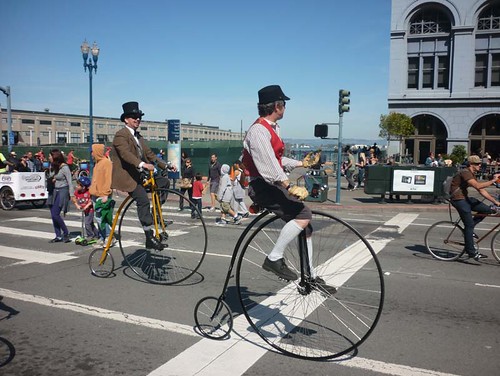
This occasional taste of what it would be like if streets were for people and not cars is, of course, all fine and well, and as one of the most bicycle friendly cities in the U.S., SF even has a solid bike plan to more permanently improve safe streets for cycling. However, there is only so much tinkering around the edges you can do before you run up against the limitations of a fundamentally car-centric infrastructure and the realization that bigger, more systemic changes that require bigger and bolder investments are needed. So ultimately, the resources allocated to making these big infrastructural changes a reality is where the intertube meets the bike lane, and London has just made a huge statement that it is serious about doing so. Here's a sampling of what you can do with £1 billion ($1.4 billion):
- A new 'Central London Grid' of bike routes in the City and West End, using segregation, quiet streets, and two-way cycling on one-way traffic streets, to join all the other routes together
- A new network of 'Quietways' - direct, continuous, fully-signposted routes on peaceful side streets, running far into the suburbs, and aimed at people put off by cycling in traffic
- Substantial improvements to both existing and proposed Superhighways, including some reroutings
- Major improvements to the worst junctions, making them safer and less threatening for cyclicsts
It's pretty simple: If you have a comprehensive network of separated bike lanes, people will use them and turn drivers into cyclists. Here's what it will look like: direct link: http://www.youtube.com/watch?v=vJSvdpoVHBk This is literally off the scale, not just the American scale (where pedestrian and bicycle projects received less than 2 percent of federal transportation dollars in 2012), but anywhere in the world.
This is like a Marshall Plan for the bicycle, and by extension for ecologically healthy city design, and thus ultimately a commitment to making the fundamental infrastructure changes needed for dealing with climate change and resource depletion instead of slapping green veneers on poorly designed structures. It's really not all that complicated. It's mostly a matter of what our values are and how are they reflected in our political and economic choices. And yes, whether we'd like to go on as a functioning human species into the foreseeable future. It's a choice between this... 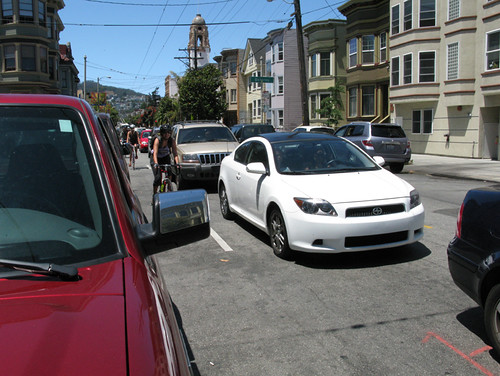 and this... 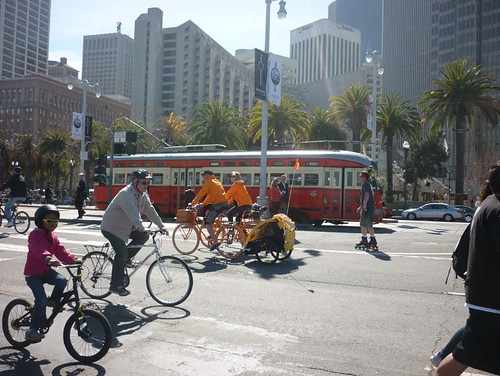 between streets like this... 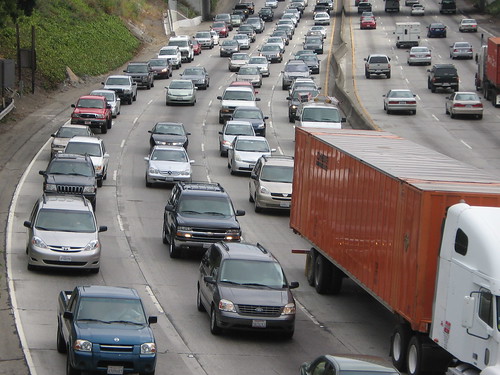 or like this... 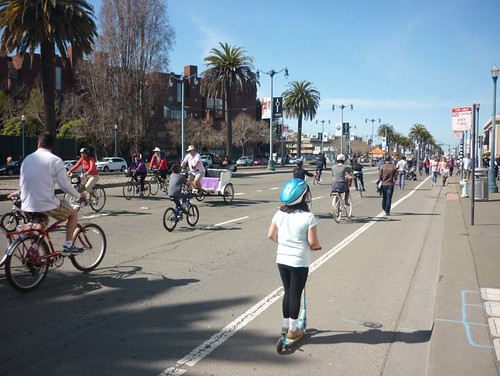 You'd think that something as significant as this would at least get an honorable mention in any American mainstream media outlets, but I guess to the serious keepers of the gate bikes are just kids' toys.
But largely, Americans aren't taking notice, and neither is the American media rushing to task. Take the words "Boris, Cycling" for a spin on the New York Times internal search engine and you'll come up with a big goose egg: '0 results,' says the Times.
Come to think of it, they really are great kids' toys, but those kids will be really psyched if there'll still be an inhabitable planet to live on, once their own kids pedal their first baby steps... 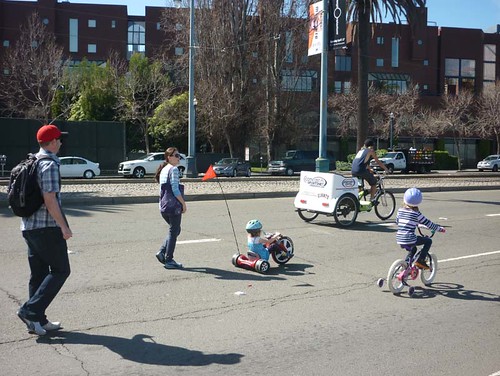
|
Takeaways for Ecocity 10 - Solutions for the 21st Century
 By Richard Register, President, Ecocity Builders By Richard Register, President, Ecocity Builders I'm just back from France and helping with some planning for the 10th International Ecocity Conference/Ecocity World Summit in Nantes coming up September 25 through 27. Thinking back over the last nine International Ecocity Conferences to the First International Ecocity Conference in 1990, not to speak of all the conferences in our series hosted by others I've participated in, a thought occurred to me. Clarification of what seems to work you might call it. And the notion of "takeaways" came up. (Pronounced "take aways" - the word looks a little peculiar...) There always seems to be a small number of highlights people remember that effect them into the future, often in important ways, a small number of things that lead to some sort of positive change in the real world we all share. For Ecocity 10 in Nantes? These three immediately came to mind: - The role of elevated fill/artificial hill + ecocity design = best adaptation to climate change and rising waters AND prevention of the problems in the first place.
- A scheme for "natural carbon sequestration through holistic management" and how ecocities help with that.
- Linking - finally! - ecocities to the climate change debate and in particular to the next UN Climate Conference: COP 19 in Warsaw, November 11 to 22.
The elevated fill/artificial hill connection What appears to be a rather small discrete item sometimes turns out to be a powerful point of leverage and the launch of major new alternatives. Here's one good take away that fits our times and could be a major objective of Ecocity 10: that the key to both solving problems of flooding from climate change, rising seas and more ferocious storms and the problem of transforming cities from dysfunctional to strikingly healthy might be in something as simple as building ecocity designs on simple mounds of earth. Make these high enough to rise above the floods. Simple. Readers of this newsletter and audiences at my talks have heard this at least a couple times from me in the last few years, but it works. That the Sumerian Civilization 4,500 years ago solved the problem of flooding in the Tigris Euphrates Valley by simply rising a few feet over the swollen waters shouldn't be viewed as a - ho-hum - old, way out of style idea, but as something that actually works to save lives and preserve hard earned property, and given the expected disasters of climate change, massive improvement relative to knowledgeable predictions into the future. What's new at this time in history is that tying ecocity design to elevated fill/artificial hill solves numerous problems all at once. Far from being old style, ecocities are the space age solutions brought down to Earth, a very new integration into something different and leading. Following too is that the transition from the car city to the city for people is already underway as more people in traffic jam-weary, money wasting countries are beginning to head for the lively centers. The only problem there is that such wonderful new living close to jobs, culture, friends, good food, etc. is driving the housing prices up. That problem could be solved but people haven't yet figured out how to build more development of an ecocity variety in those centers, how to make those places truly delightful. We can show it can be done. But first... First, no more flooding. You've simply risen above the waters. This is no small thing. Approximately a third of all humanity lives close to shorelines on their way up, in zones of hurricanes and in or along inland river flood zones. All can employ elevated community design in a simple strategy to be safe.  | |
Fred R. Conrad/The New York Times
Officials in Highlands, N.J., a shore community of 5,000 residents that Hurricane Sandy devastated, want to raise the town by 8 to 10 feet to prevent damage from future storms. |
Second, ecocity design, in conserving energy in many ways, vastly reduces carbon waste going into the atmosphere and helps solve the problem of climate change and flooding at the level of causes. Get the energy demand down far enough, power your streetcars, metros and between-city rail with solar and wind electricity and why produce hardly any CO2 at all? Lester Brown in this month's report to his internet list from his Earth Policy Institute points out that with automobile ownership and driving shrinking impressively since 2007 in the United States, again the US is in the lead in the world transportation trend, this time in the right direction. Actually, that's a point I want to make. His point and that of his research staff was that as solar, wind and biofuels that do not compete with food production rapidly increase their energy production, we can imagine phasing out fossil fuels for both transportation and electricity generation much sooner than earlier realized. Check out "Falling Gasoline Use Means United States Can Just Say No to New Pipelines and Food-to-Fuel" by his policy and technical analyst Janet Larsen at www.earth-policy.org/data_highlights/2013/highlights38. Janet, by the way, has spoken for the Earth Policy Institute at two or our previous International Ecocity Conferences, #7 in San Francisco and #8 in Istanbul. READ ON |
Remembering Paolo Soleri
Soleri, Einstein and Gandhi
by Richard Register, President, Ecocity Builders
for Soleri's 90th birthday celebration, June 2009
 | |
Paolo Soleri two or three years before Richard met him, that is, around 1962 or 1963. He is working on his early structures at Cosanti in Paradise Valley, then some distance from Phoenix, now surrounded by urban sprawl. Photo credit: Cosanti Foundation/Arcosanti Archives
|
Paolo Soleri is one of the three most important people of the 20th century, and leading into the 21st century now. Time Magazine got it backward deliberating on their two nominees when its editors and publishers chose Einstein over Gandhi as Man of the 20th Century. Of course they missed Paolo entirely, for reasons I'll contemplate below.
In "outward looking," mechanistic Western tradition they chose Einstein over Gandhi because Einstein told us a great deal about the universe we are part of, the universe outside of ourselves, and how it works in terms of physics and mathematics. Very important for sure, even beautiful in its way. Gandhi, however told us about ourselves and how to survive deep into the future by way of non-violence and self-discipline, by the love and spiritual/psychological path that many equate with the "inward looking" Eastern tradition. Of course! Time Magazine is a western publication.
Gandhi, like Einstein, worked in the physical world but in a very different field of action, destroying the most far-flung empire the world ever saw and replacing it with the still-largest democracy on the planet - all with non-violence and appeal to the compassionate and spiritual. It is amazing, and to our discredit and gathering danger, that he is talked about so infrequently these days. On behalf of us Westerners avoiding self-confrontation, Time Magazine correctly represented the strong tendency of economics and science to embrace Adam Smith's "invisible hand" of economics and supposed objectivity of science leading the way, with little guidance from whatever it is humanity really is. We float into the future following what is physically possible. We blindly follow the pathetically under-examined and under-evaluated trends of economy. (Should we really follow something that's invisible?!)
Soleri figures in as providing the General Field Theory that Einstein sought unsuccessfully, because he, Einstein, didn't identify one of those key items in the evolutionary process, namely us people with our ability to shape evolution itself, to provide another dimension of creativity to the full swath of evolution's course through the universe - and destructivity. What we add to evolution are love and hate, passion and robotic numbness, greed and generosity, good and evil and other elements of a wide range of "drivers" way off the radar screen of physics and math. Soleri, though developing the theory in a language that most people couldn't read - or didn't want to think about - said it most succinctly in the title of one of his books: "The Bridge Between Matter and Spirit is Matter Becoming Spirit." This sounds puzzling to most people but simply means that evolution delivers changes in a particular pattern in which people now play a crucial role giving rise to higher levels of integration, physically and thereby spiritually, if spirit means higher levels of consciousness and conscience in us humans and heading toward whatever may come in moving in that direction into the unknown reaches of future evolution.
READ ON |


Founded in 1992, Ecocity Builders is a nonprofit organization dedicated to reshaping cities for the long-term health of human and natural systems.
www.ecocitybuilders.org
|
|
|
Principal Features of an Ecocity

|
|
PRINCIPAL SPONSOR OF THE INTERNATIONAL ECOCITY FRAMEWORK AND STANDARDS

|
|
|
|
|